Taking a break – and jumbling the chronology of things, I wanted to add a postscript to the postscript. At the end of the 2009 cruise log, I mentioned how unobservant I was with the rivers.
Recently, I was reminded about this, whilst sailing the Yare. It was an Autumnal Day, and rarely – I had the opportunity to put 3 reefs in, set a storm jib and enjoy some proper heavy weather sailing.
I’m not being fool-hardy, it’s worth sailing in heavy weather, you should understand how your boat performs when fully rigged. I know that I’ve sailed ‘Corsair’ with 3 reefs on 3 occasions in 12 years. This was the first time with the new rig.
It was comfortable, and more importantly balanced – you should always match a jib to each reef you take in. ‘Corsair’ has 3 jibs of varying sizes, and as such, the rig always gives you the right power that’s manageable. And, keep it simple and straightforward – be able to manage the rig even on a breezy day.
This video below gives you an idea of the day;
Co-incidently, ‘Corsair’ is sailing left to right, and heading toward the site of Jalil’s grounding; https://broadssailing.blog/2019/11/05/2009-cruise-day-5/
Also, the remains of a fascinating, hidden Broadland feature are nearby.
I’m sailing past the ghost of a railway. Between 1922 & 1937 – Claxton Manor was occupied by John Samuel Pyke, and in 1926 he built a railway here.
Built on the cheap, it utilised ex WD ‘jubilee’ track, which was effectively a 2ft gauge Hornby train-set. Rolling stock was some tipper wagons, and the cargo… Norfolk Beet!
Each year – local farms produce a tremendous volume of sugar beet, and in the 1920’s, the roads between Claxton & the sugar factory at Cantley were poor, unmetalled – and to travel to Cantley factory you were dependent on Reedham ferry. 7ton limit. A 1920’s lorry would need to make several trips, and you’d pay each way on the ferry.
Not to mention – Beet season is through the winter, so the roads could be relied upon to be muddy (!) making for a slow journey.
Or you can use a wherry – upto 30ton at a time, and can moor directly outside the factory to load & unload.
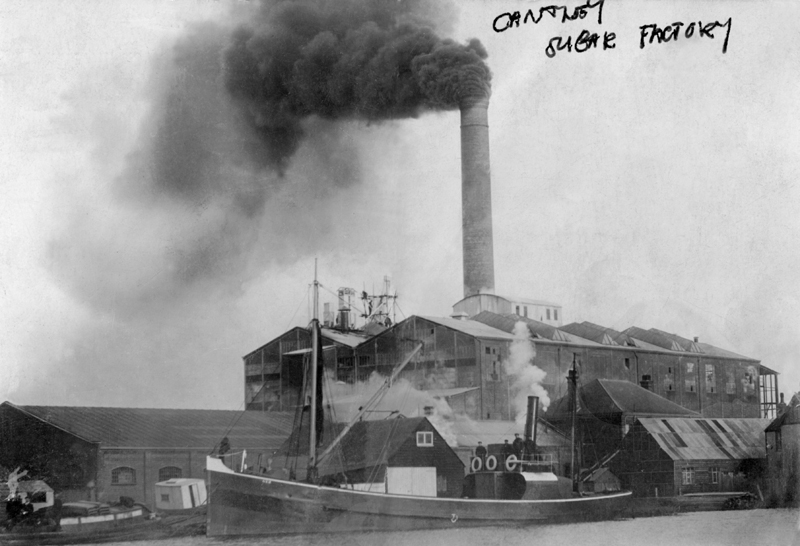
In fact, all of this serves as a useful reminder that the Broads were an industrial landscape. Don’t be fooled by the picturesque windpumps, the Dutch came and drained the marshes – the rivers were the transport network.
Anyway – Farmer Pyke’s railway was also used to help construct some reservoirs at Cantley in 1926 – such was its portability, 16ft pre-fab sections can be lifted at will and rerouted.
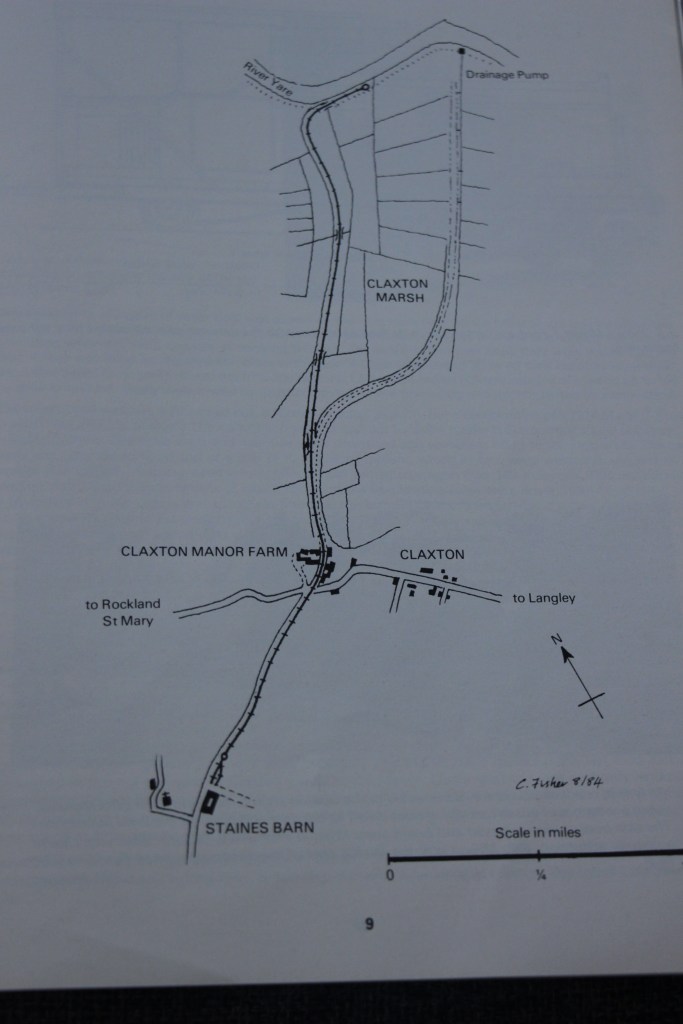
The route can be seen below, running from Staines Barn through Claxton manor farm to the river Yare.
Each train consisted of about 10 tipper wagons, each holding 1/2 ton (or so) of beet. This charming railway was the spirit of Heath Robinson himself!!
Although charming, the railway worked hard. Wherries initially carried 30tons of beet at a time, and by the late 1920’s steel lighters carrying upto 100 tons of beet at a time were used, being towed downstream by steam tug.
Loading certainly was done by hand, on the bankside of the Yare, during winter.
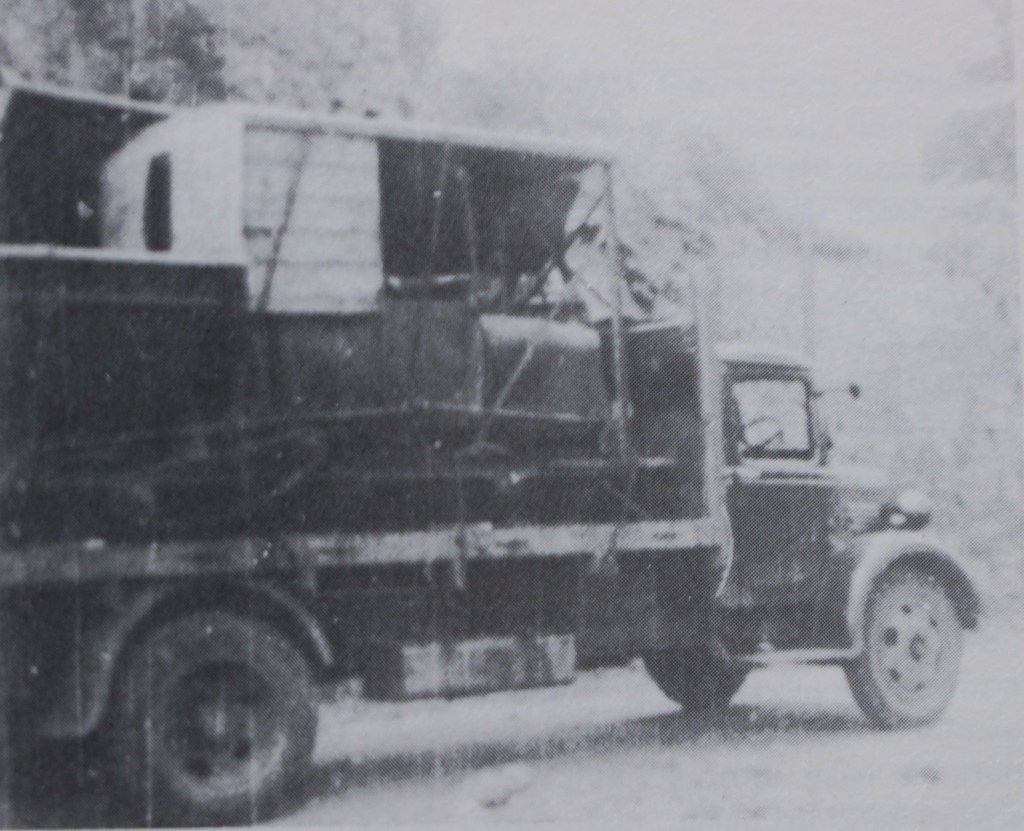
The locomotive was the star of the show. Locally made, it featured a recycled Model T Ford car (yes, really!)
The conversion was undertaken by John Keeler & Sons – agricultural engineers from nearby Thurton. To make a locomotive, you need only take one Model T, the frame of two skip wagon chassis’ & avoila!
For good measure, some sprockets and chains were robbed off a threshing machine and added to the mix.
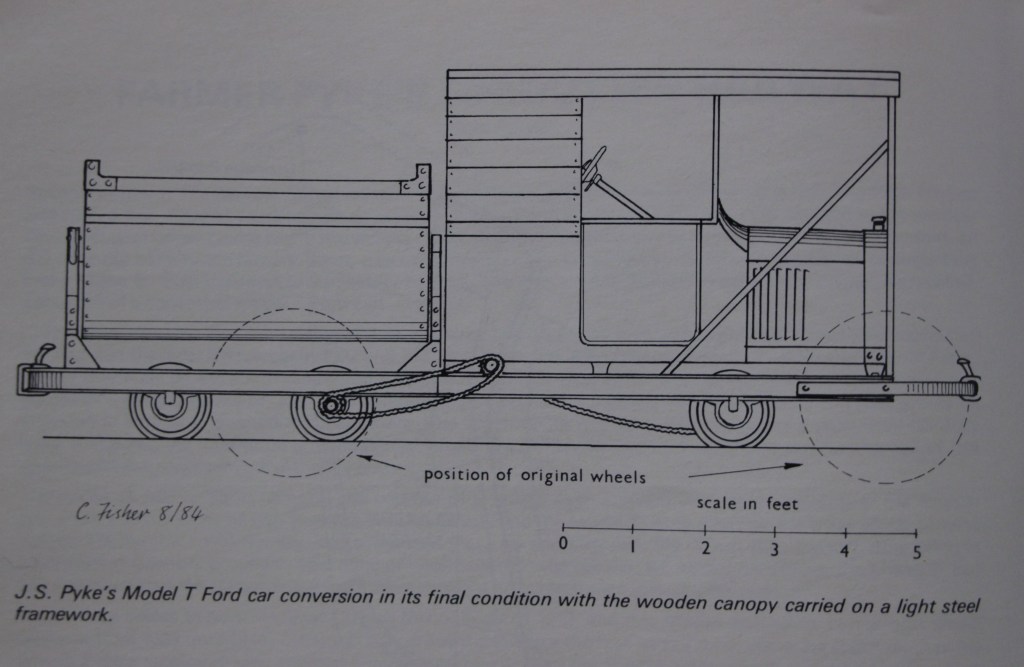
Now – I won’t lie. I LOVE this. The ingenuity of it, the exposed chain drive to both axles, its all… well it’s excellent! Just imagine the noise!!
The loco is described as being ‘black and sort of rusty’ – with a spare engine being kept in reserve at the farm and readily swapped when overhaul was required.
Sadly – by 1936, despite an extension right upto Staines Barns, it was clear that the improved road network was causing both the wherries and the railway to sweat. Initially to cross the road, a simple solution was to bolt in the track piece across the roadway ‘as & when’…
As the local authority surfaced the road through Claxton – this makeshift crossing was frowned upon. Not to be deterred – the rails were brought VERY close to the edge of the road, and splayed slightly either side.
The entire train, loco & 10 loaded wagons then ‘lumped’ off the track, and drove across the road surface itself before re-railing itself on the opposite side!!
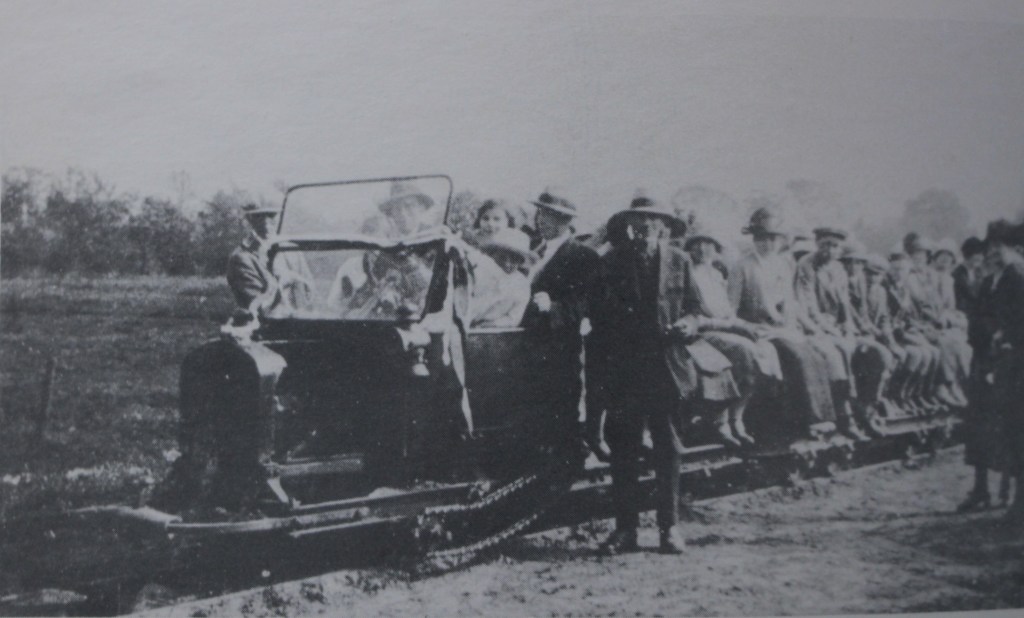
I have only one photograph of the loco working – on a Whit Monday holiday, circa 1928;
But yes – by 1936, the writing was on the wall. Sadly the railway was no longer needed. Farmer Pyke’s cunning wasn’t done yet. He managed to sell the entire railway to the Ouse Catchment Board, for use in Cambridgeshire.
Quite what they’d do with a ‘sort of black & rusty’ loco I don’t know… (cherish it I hope!)
In 2005 – I witnessed the conversion of Staines Barns into housing, and saw several lengths of rail removed from the concrete, the last fragments of the line. Today nothing really remains, hence – the forgotten railway.
Anyway – yes. I wanted to write this, as demonstration of my statement about looking and understanding the subtleties of the Broads landscape. What’s hidden away is usually interesting.
I’m lucky enough to love where I live.
Next time, I promise I’ll write more about the boat… (!)
 A Broadsman
One thought on “Farmer Pyke’s Forgotten Railway”