Phew. Well after a particularly long evening, the skipper can report his safe return to ‘Corsair’. Miss Jalil & I also managed to spend a pleasant night on relatively dry bunks!
I’m not sure of the details now, writing this 11 years later, but I can see that I’ve changed the crew names for today to “Binky, my faithful Binky, Wiggles & Pol-Pot” – no doubt they were testing my otherwise charming nature.
As it’s the last morning (or meal) – we dined on an ENORMOUS breakfast which for the others was on top of their own feast at the pub last night. But yes, last meal – usually ‘lob in’. Despite the sheltered nature of the staithe – we could tell it was bloody windy, another 3 reefs & storm jib job.
We quanted out, raised sail & blasted across Barton just once to feel the breeze. That dealt with we started on a passage which highlighted just how crap a sailing river the Ant can be! Initially we struggled with the tricks & schemes of the trees at Irstead.
Only then, we got clear of that bloody lot & found ourselves in a long tacking sessions whilst dodging a myriad of hire boats, and getting somewhat (ahem) frustrated in the process. Honestly I’ve never met so many retards.
Tacking the Ant…
Just downstream of How Hill, there followed 10 minutes of the most vicious, horrible sailing. We caught a ‘roger’ from the marshes, which ripped the mainsheet out of my hands. It took both hands & all my strength of the tiller to keep ‘Corsair’ from rounding up into the bank.
We spent then 10 long, scary minutes surfing down the Ant, huddled in the cockpit (it wasn’t safe to go forrad with the way the mast was bending) before luffing into a sheltered spot behind some trees.
n.b; trees are your friend on a day like this, I never say a bad word about them!
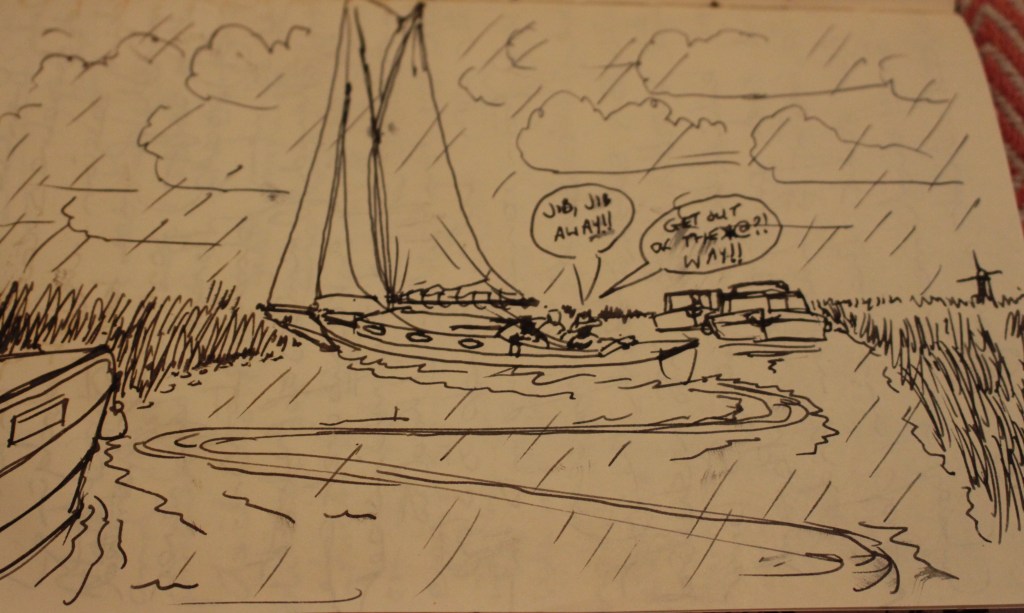
Sails lowered in record time, we put the outboard on & motored to Ludham Bridge. At which point… WHOOSH. Biblical rain! Everyone hid in the cabin, except me…
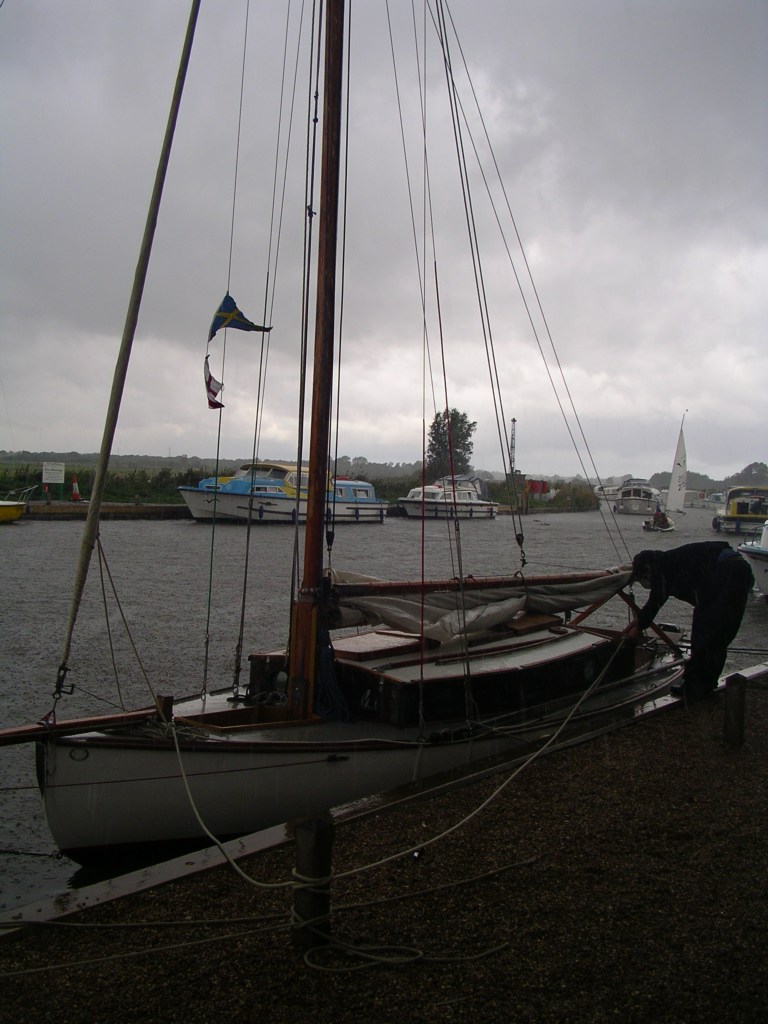
Ludham in the rain.
At this point, cold, fed up & being given the gift of feedback from Wiggles & Pol-Pot, we accepted the inevitable and motored back to Oby Dyke. To all our disbelief, the Land Rover started – so we drew our holiday to a close!
Falling gently asleep to multiple sirens from the emergency services was abit bizarre – seems a motorcyclist decided to leave the Stalham bypass at over 100mph last night…
Truth was, we soon found ourselves in a frenzy of activity ‘HB’ was being returned to her owners – both Jalil & Jacob were returning (reluctantly) to ‘Corsair’ & we needed more provisions…
So a high-speed motor to Stalham saw us victualled at Tesco, before we motored straight back to the Punt Club on Barton Broad, to sign in for 2 races.
That done, there was a little matter of a reunion to attend to, & I honestly can’t say absolutely the last time that 3 Chumley & Hawke clippers were rafted up – but it wasn’t an opportunity to be missed! Chronologically, we managed to get Clipper’s 4, 5 & 6 posed – sadly though no time for a photo!
We flurried back to Barton Turf, picked up Clover (another Jalil) – deposited Jacob & headed for the start line…
It’s clear we’re not going to trouble the ‘big boys’ anytime soon! Highlights included not loosing the rig (topping lift on a Nav post) & cutting inside a competitor at the buoy. We came a definitive last, but we also had fun – I mean you can’t get too competitive can you?
Post – race – we deposited crew at Barton Turf (again) – and headed to Gay’s staithe for some lunch. We carried 1st reef & out big jib – so enjoyed another cracking sail across the Broad. We even managed some screams from the feminine contingent (both Jalils).
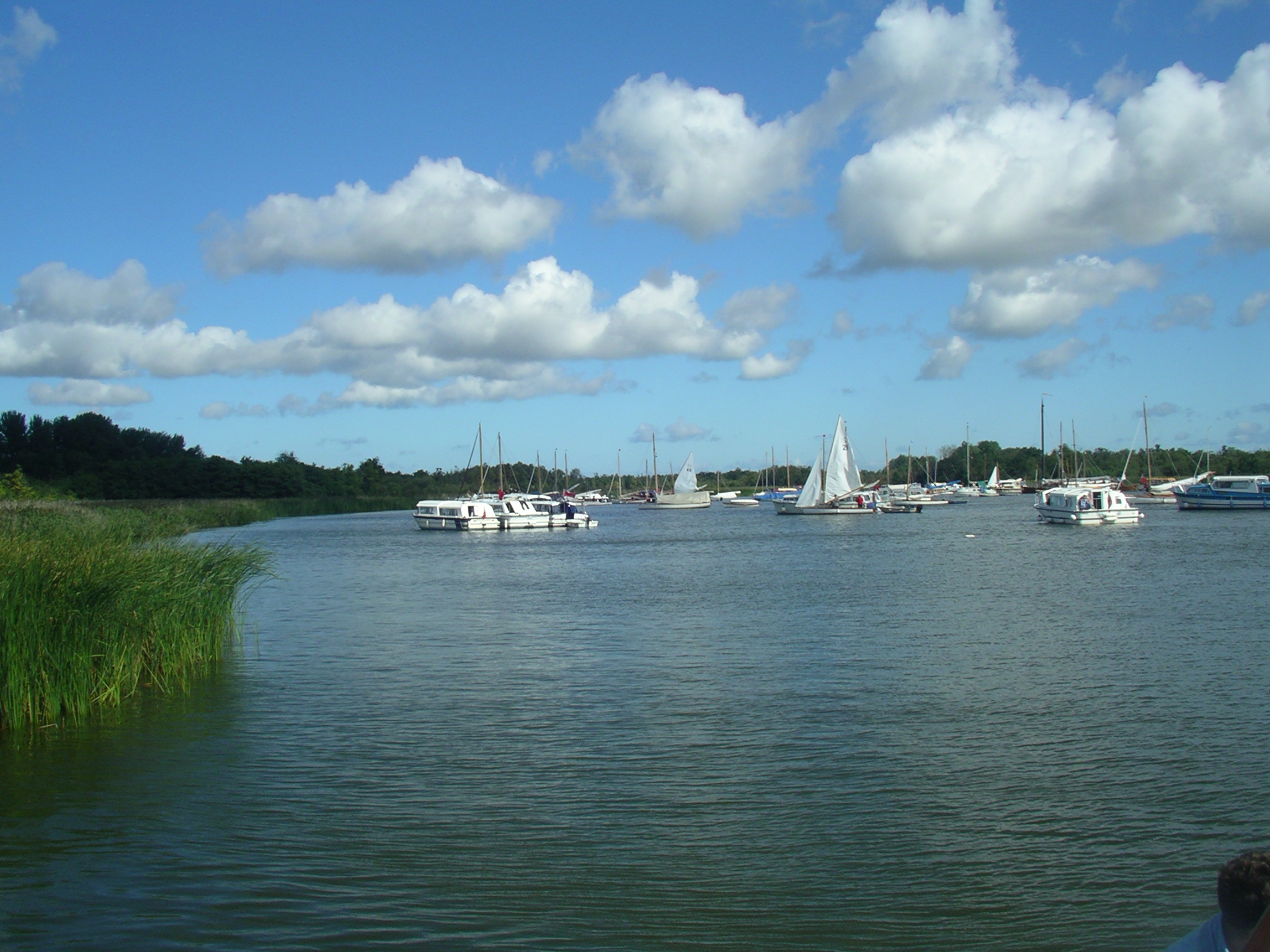
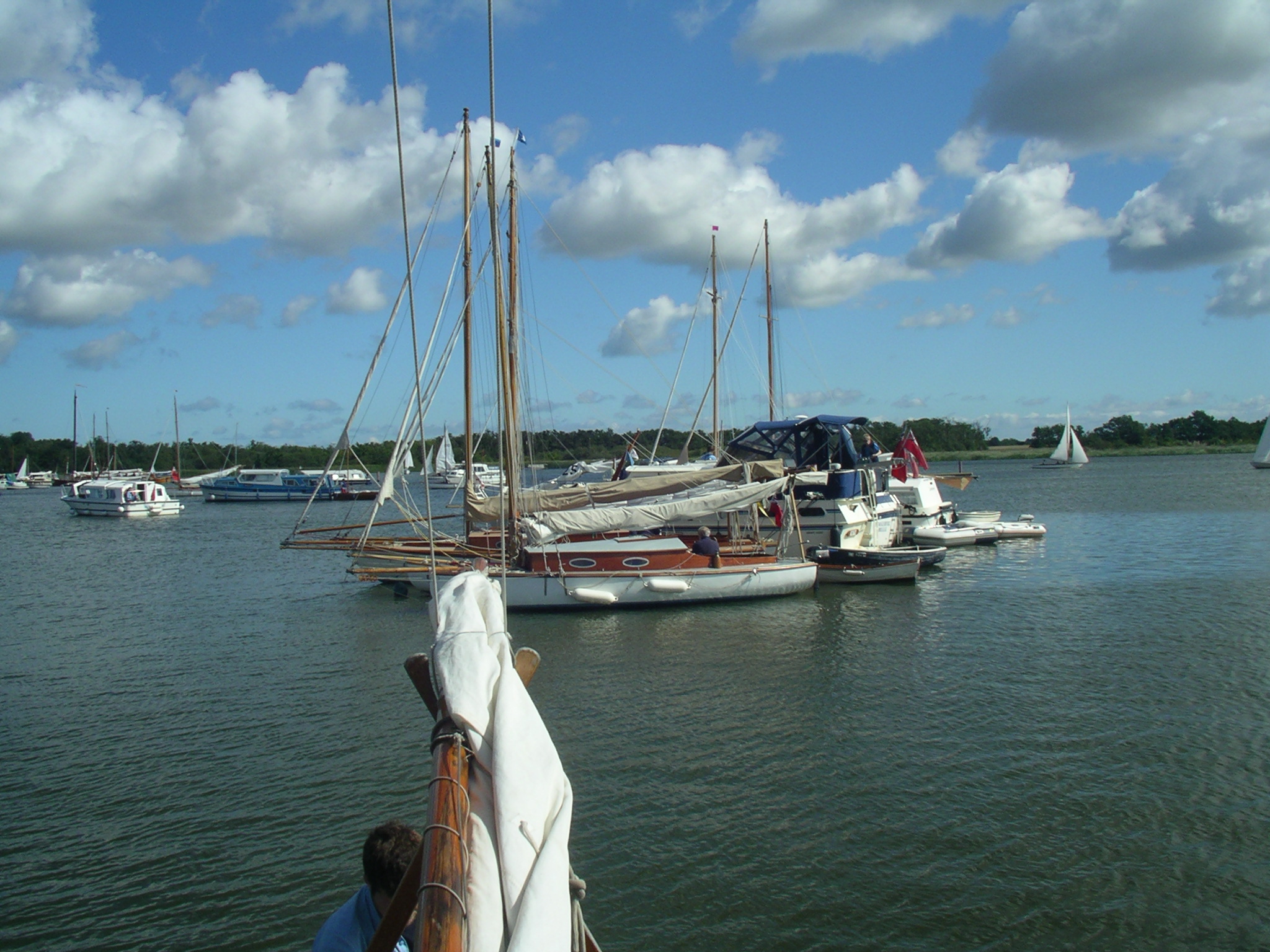
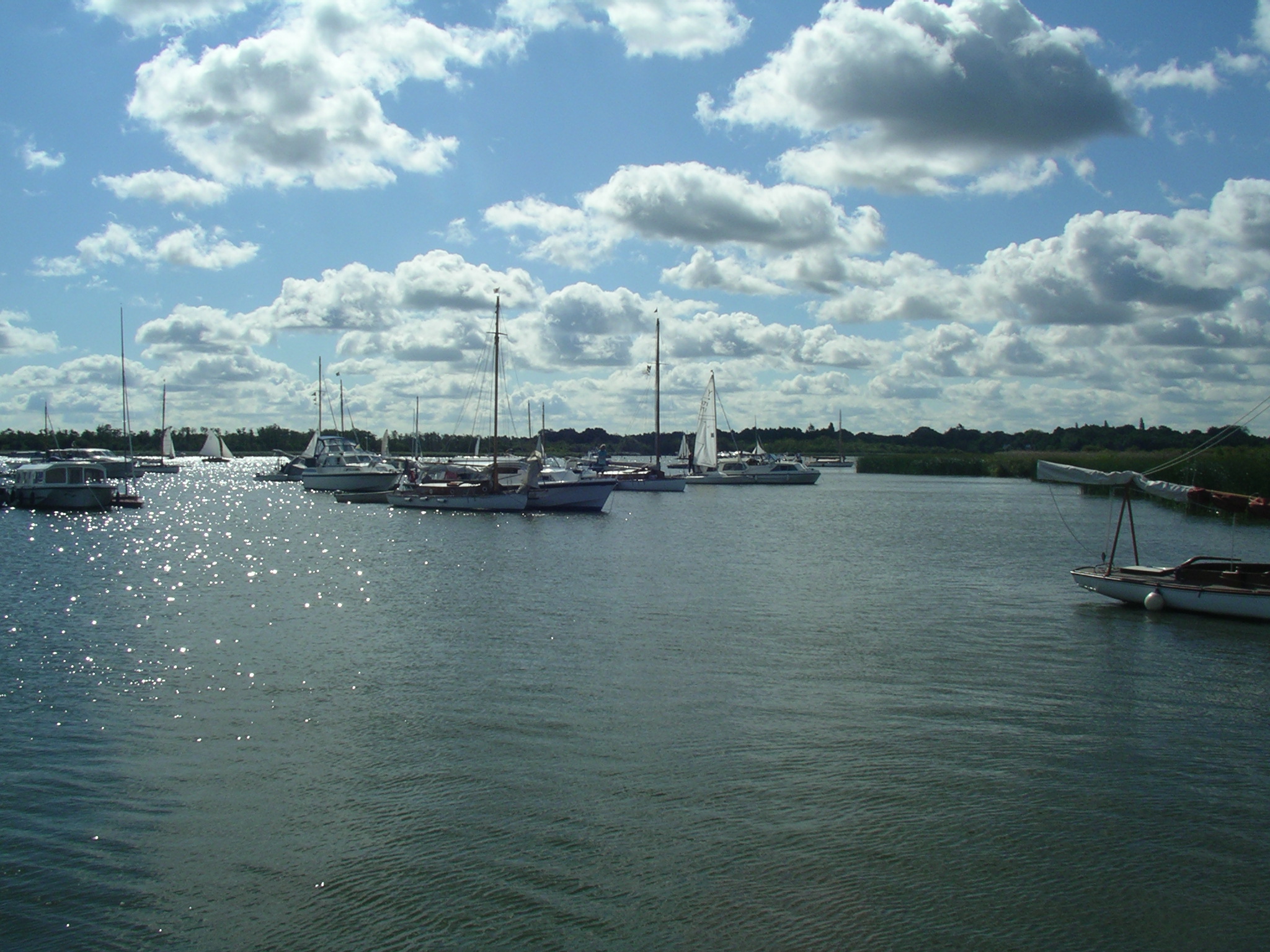
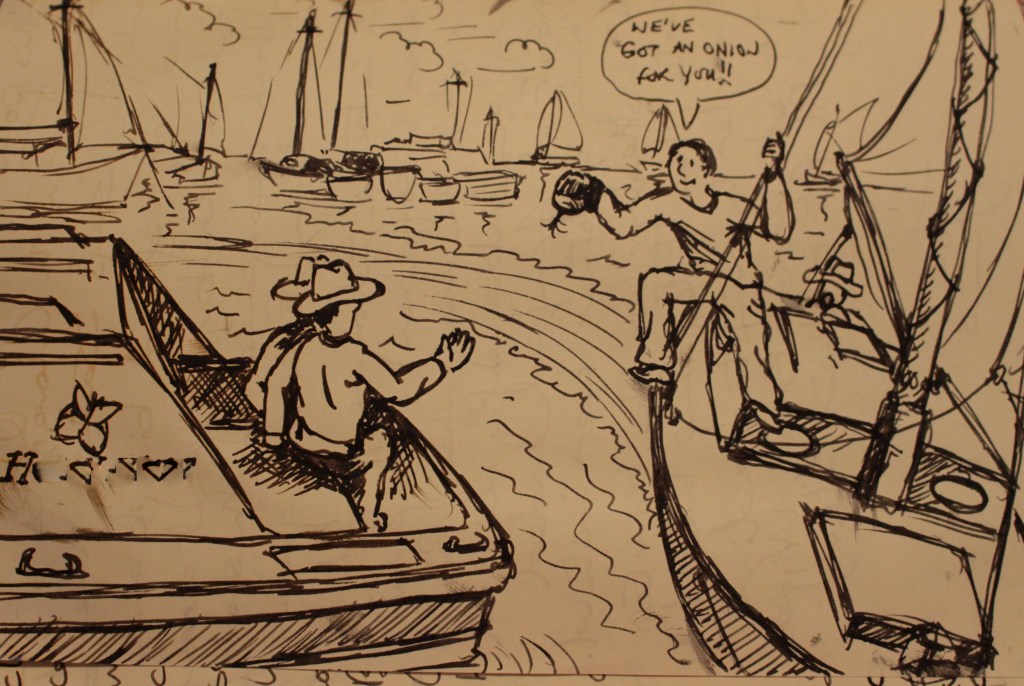
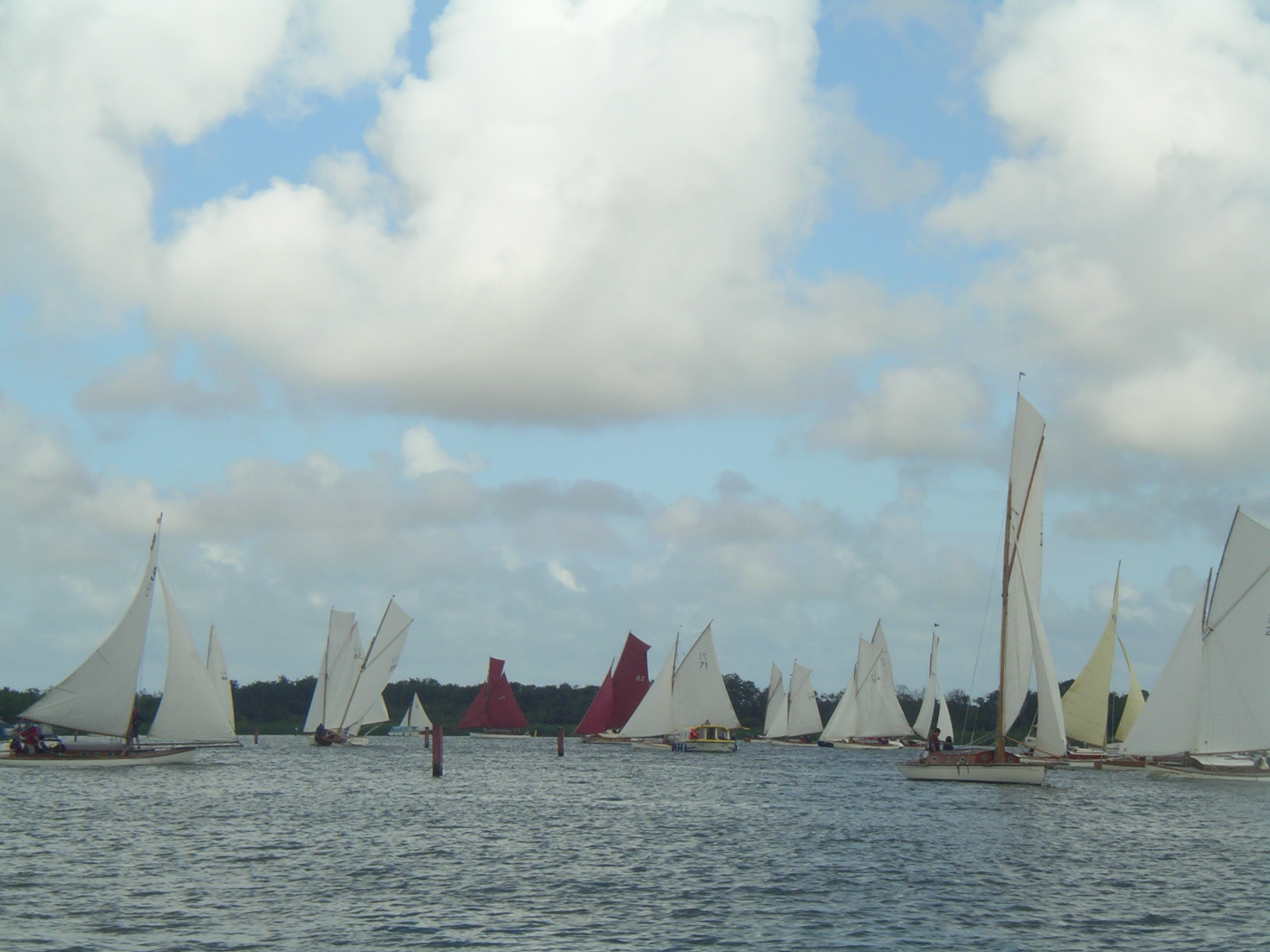
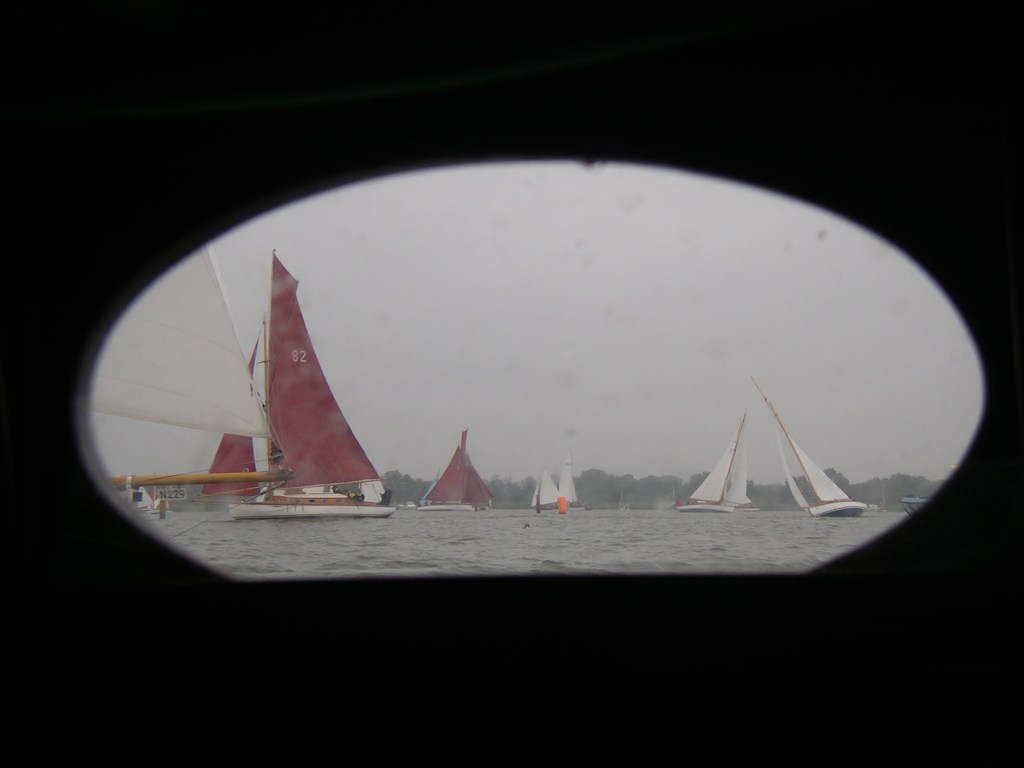
On-route, we managed to bowl a fresh onion to ‘HB’ to save their dinner plans (this is no mean feat at 6 knots & a good angle of heel!) Also – pictured above are some typical scenes from Barton regatta – it forms a water-borne city for the weekend, through which we threaded (at speed) searching for a motor boat to deliver an onion. Madness.
I’m proud (pissed?) to say that in time-honoured fashion, we then found ourselves in a pub, and is often the way with Broads sailing we subsequently missed out start at 4pm & ended up staggering back to the boat quite ‘merry’…
After a whistlestop lesson in how to operate the Tilley lamp, I left to maintain a dinner engagement leaving them all ‘to it’. Christ knows what I’ll come back to…
A reasonably dry night surprised us all at Coltishall, 4 drips overall we reckon can be considered reasonably dry!
We motored in the rain (surprise!) downstream to Wroxham, taking the shortcut through Bridge Broad. This is a stretch of the navigation which can be overlooked – did you know there’s an Alpine landscape next to the river?
At Wroxham, some replacement waterproof trousers were needed (don’t ask) – an unfortunately due to a stocking issue, the entire crew of ‘Corsair’ can now wear these poxy trousers at the same time!!
Given the now torrential rain, we all clambered aboard ‘HB’ & found ourselves moved quite briskly downriver to Horning, ready to make sail again (after all, this is a sailing boat – Skipper’s grumble).
Maybe it was an omen, but we found ourselves in the sunshine (for the 2nd time that week, AND with a favourable breeze it felt like maybe it could be an actual holiday! This was Jacob’s 1st venture into yachting, so typically we launched ourselves straight into the path of an oncoming wherry (Albion)!
At the mouth of the Ant, we cut short our yachting & joined the procession of jolly sailor types heading from Barton Open Regatta. En-route we passed the film crew of ‘Jam Today’ again – and by How Hill we’d set 1st reef & middle jib for some more yachting.
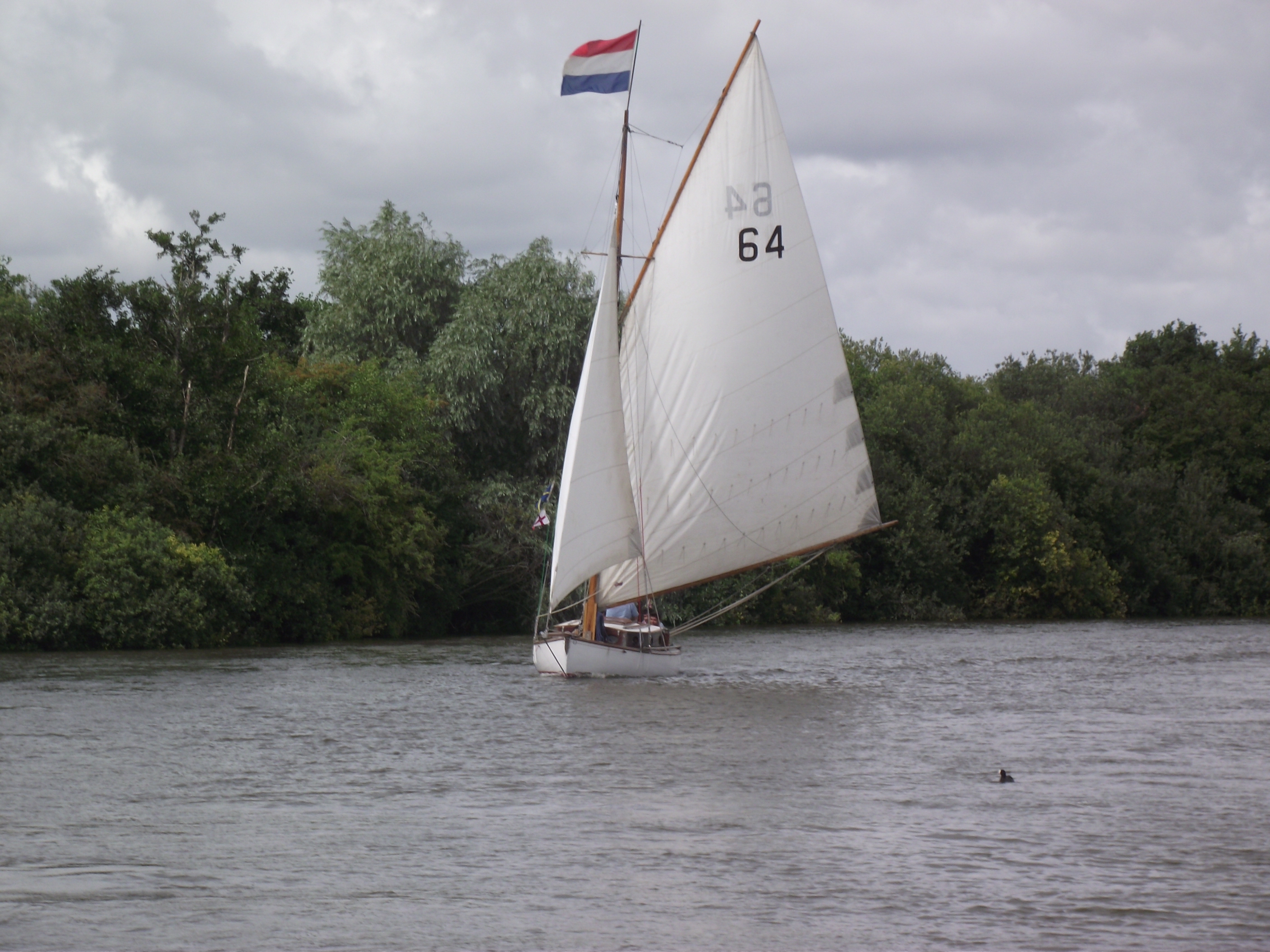
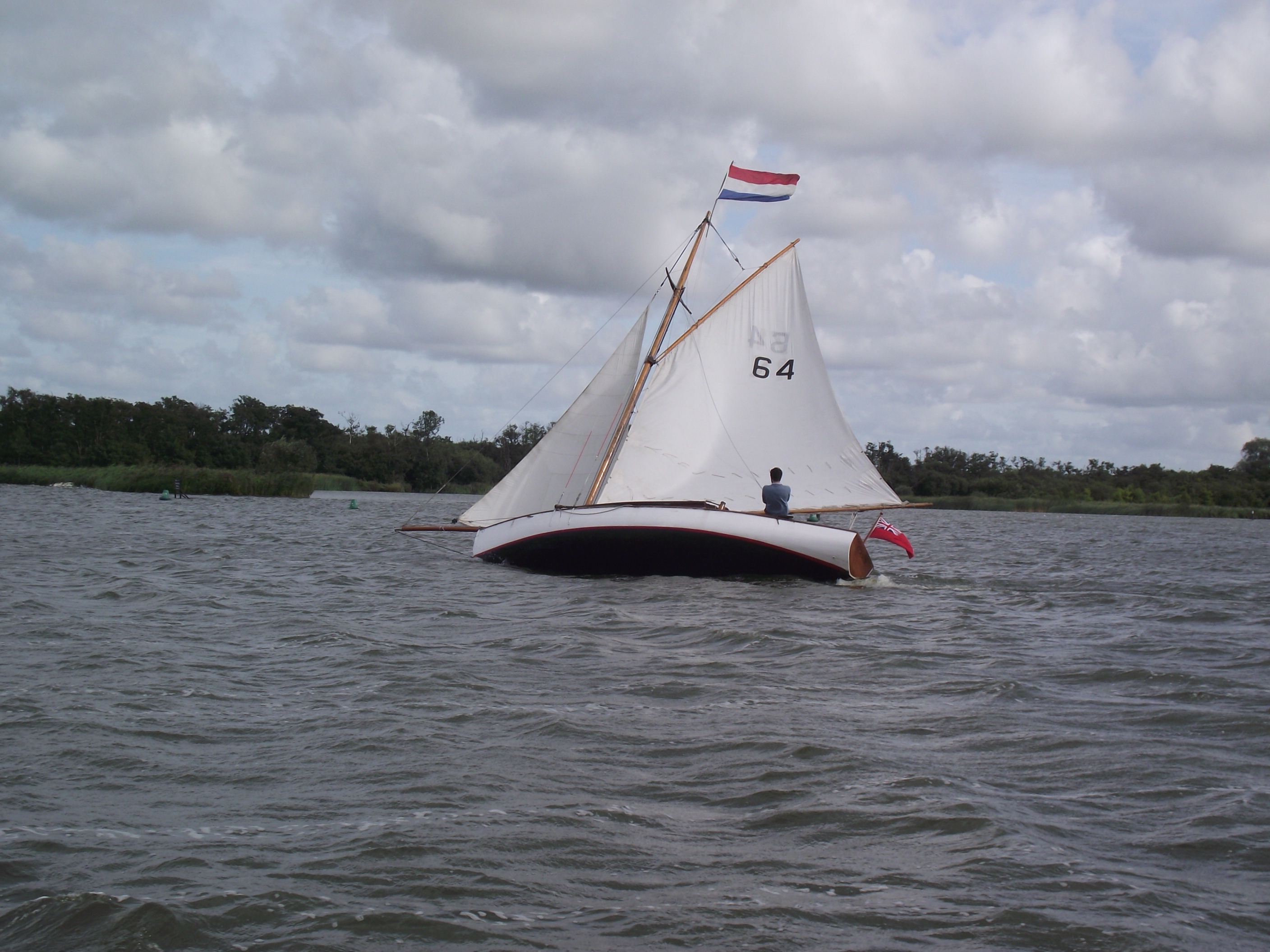
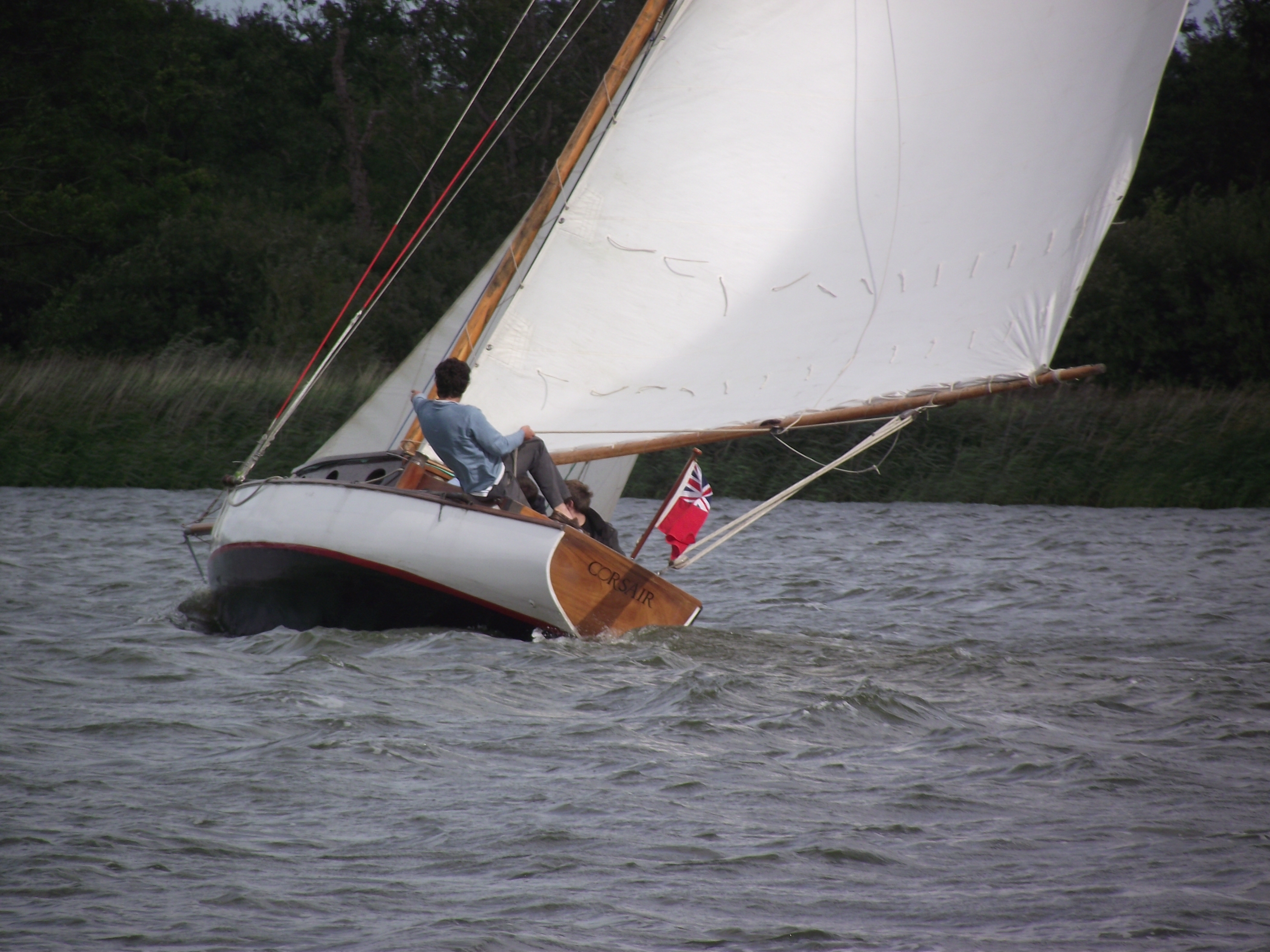
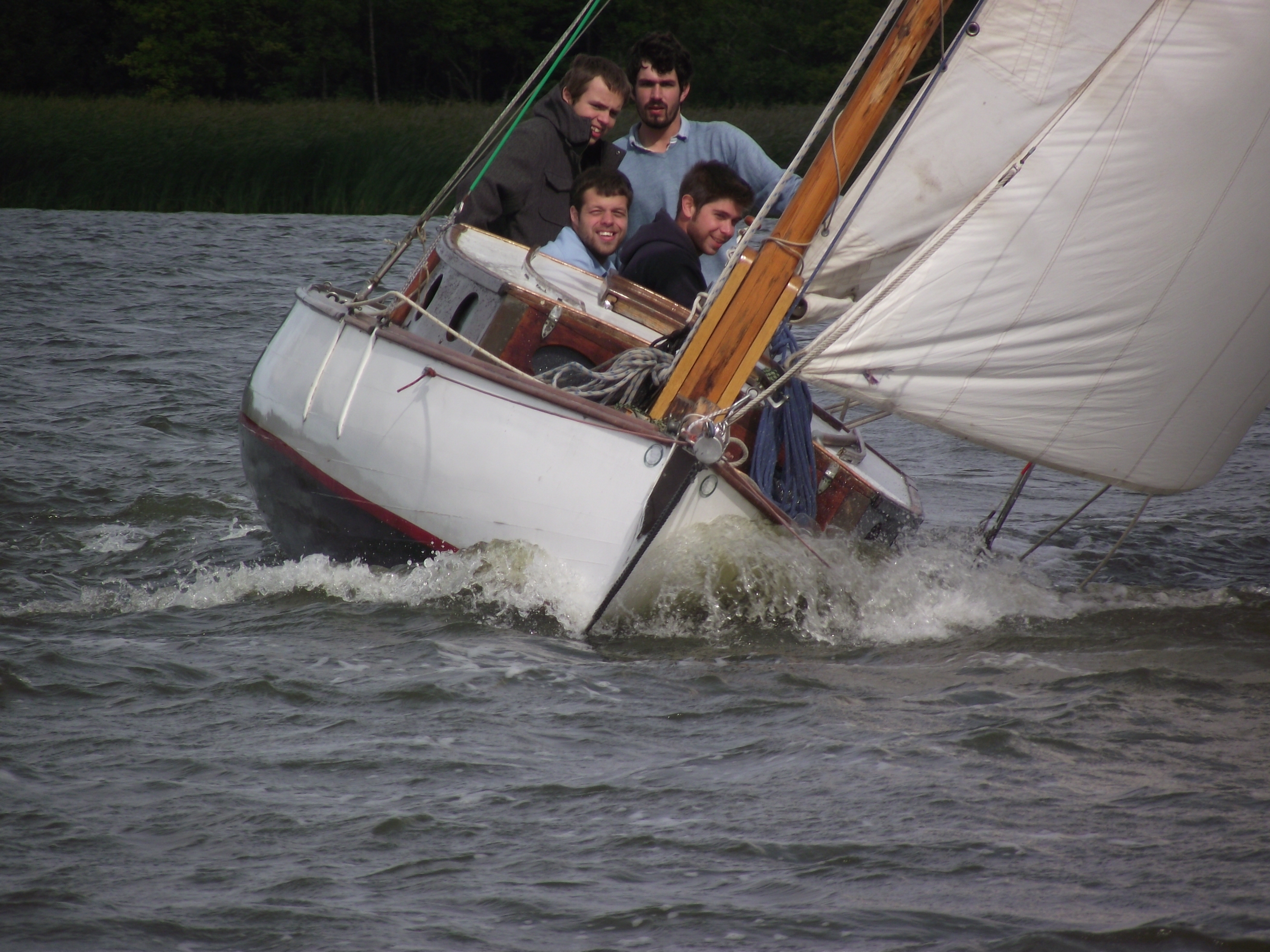
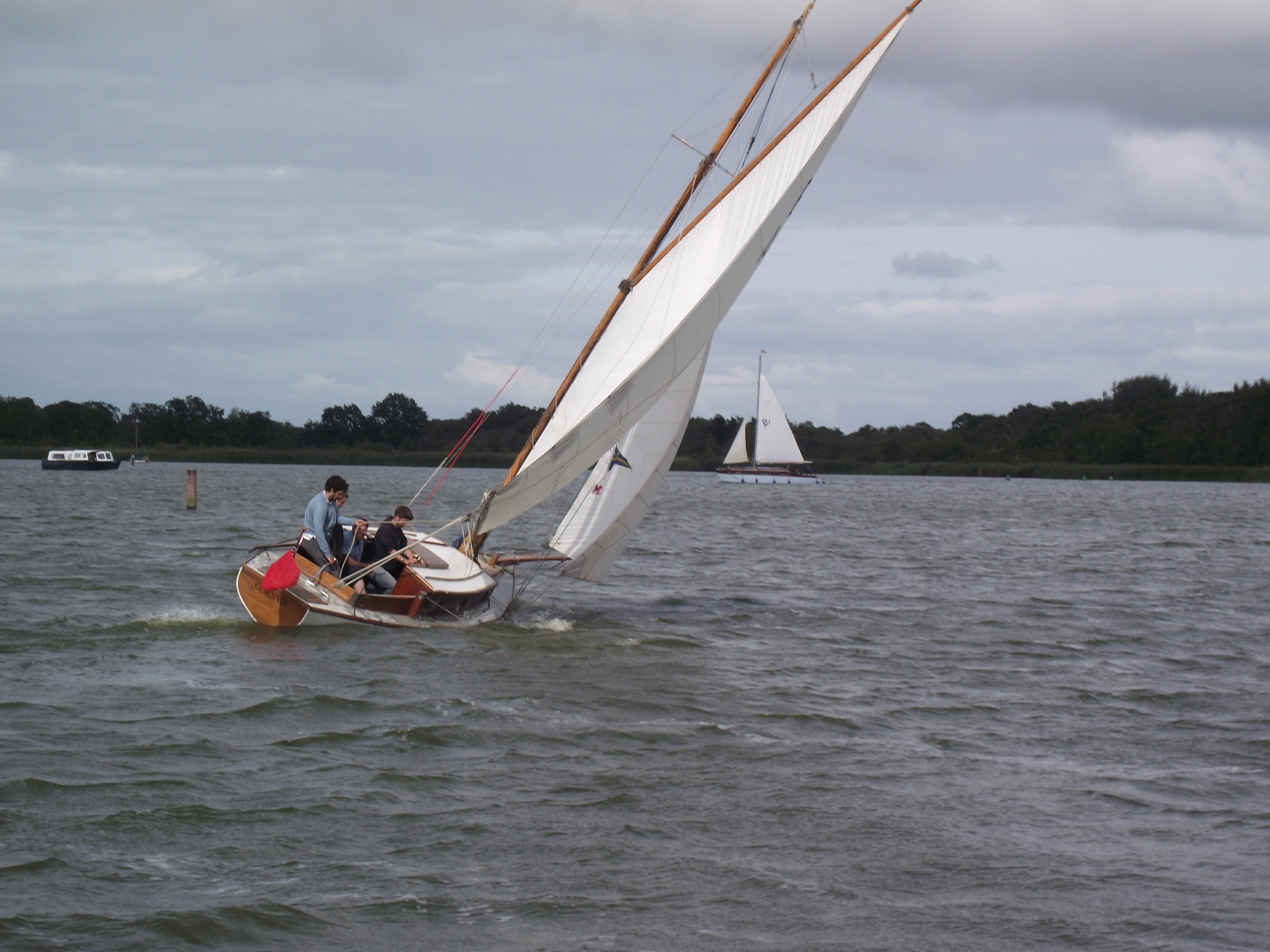
Out on Barton we were glad of the reef – storming about adjacent to ‘HB’ – causing chaos in the cabin,
Energetic sailing doesn’t pay!
although we did get some spectacular photo’s of the old girl. Our antics were carefully watched by ‘Jenny’ – a fully reefed hire boat from Martham who disapproved.
Eventually, ‘HB’ towed us to Sutton Staithe, where we moored in the rain (how familiar) & spent the evening BBQ’ing… after all we are on holiday!
Sorry – I haven’t written for a few days. Not least that I have made a break-through in my research. Think ‘source of the Nile’ moment… I am going to break my rule of writing chronologically – and give you an update. Then I will write fully about what I’ve found later.
But. Back to Chumley & Hawke. Their fleet differed from most hire-fleets, in so much that they were mostly designed properly. This sounds harsh, but its unrelenting honest I’m afraid. Most broads yachts were build ‘by eye’, from half models… And, AND! They were badly built!! It’s easy to look at a river cruiser today, and get misty eyed, but in the ‘heyday’ – these boats were built to do a job, and to be disposable.
Look at ‘Corsair’ – she lasted 10 years in hire, then was sold off as redundant. Now, admittedly her first private ownership was a lavish environment, with all the right elements for a wooden boat. Money, dedication, money, enthusiasm and money. Oh, and Rolls Royce chrome.
Chumley & Hawke was run pre-war by Roland Hawke, and Alfred Lloyd Braithwaite (A.I.N.A.). Braithwaite had bought into the yard in 1930, moving to Horning. His first few designs but the emphasis on sailing qualities, with accommodation coming second. Proof of this, washis ‘Clipper’ class which won the challenge cup for small yachts, Horning 1935.
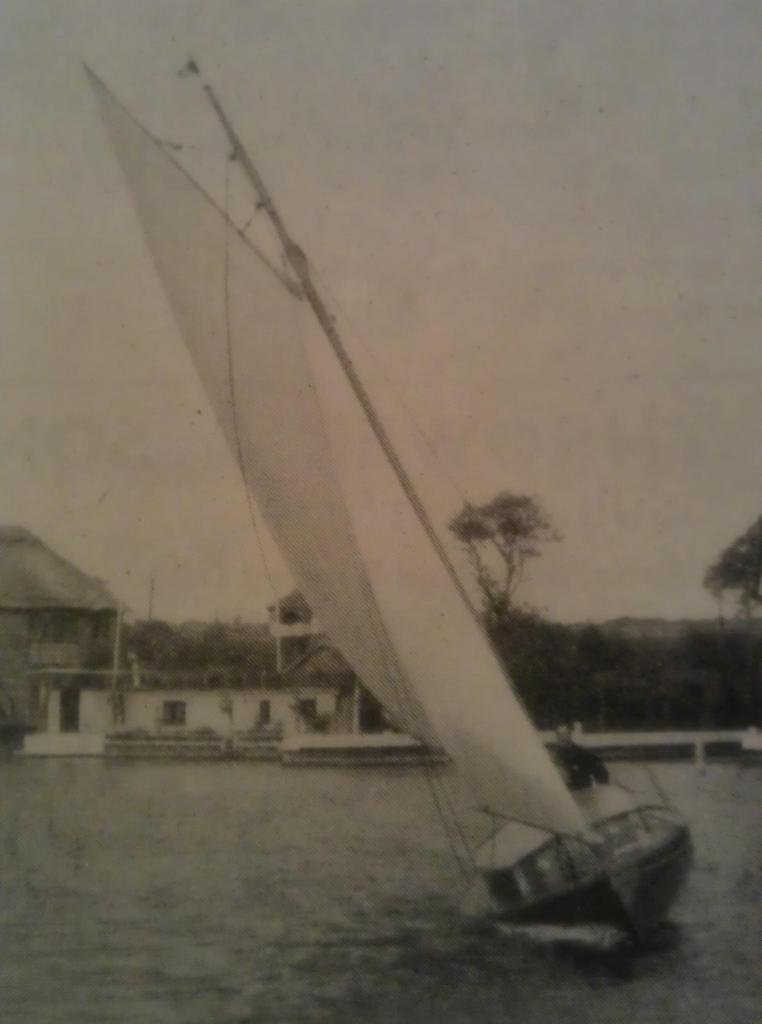
Clipper – 1939, showing the fine sailing they were capable of.
Aside from ‘Khala Nag’ – the best example I can think of this is ‘Viking’, built circa 1937. She is now a beautifully restored member of the River Cruiser class, however originally built as a 26ft halfdecker, and described as;
“Dayboat, mahogany built and designed for those who appreciate a really fine sailing boat, which compares favourably with a half-decker and has the advantage of a low cabin shelter…”
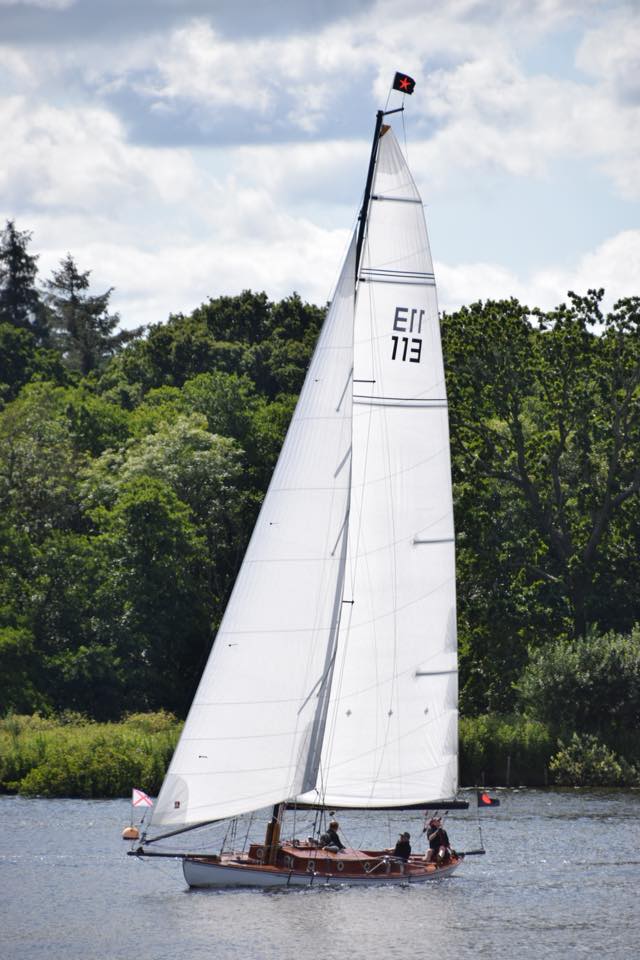
Nowadays, ‘Viking’ is a stunning vessel, having been modified to a canoe stern. Perhaps this is the biggest compliment to a devotee of metacentric hull theory – Viking was ably transformed to a canoe-stern yacht without major disfiguration. Here’s a picture of that indecently pretty hull;
RCC 113 – ‘Viking’, post rebuild at Broadland Boatbuilders.
Now, I can hear you ask ‘what’s metacentric hull theory’? No? Well I’ll tell you anyway. It was popular in the 1930’s. Mind you, so were airships and facism. So we’ll tread carefully.
A.L. Braithwaite was a supporter of the ‘metacentric shelf formula’, which aims to achieve good balance and handling under sail. Other notable followers include Harrison Butler.
The theory is based on the principle that as a yacht heels over under sail, the balance of the rig forces and the hydro-dynamics will be influenced by the changes in the immersed form of the hull.
Succinctly, a different shape underwater is presented as she heels and sails. The shape of the hull is defined at each ‘section’, and those different sections exert difference amounts of buoyancy. Aft sections may possibly being more buoyant than forward sections, interestingly the faster boats sit ‘bows down’ without the crew in the cockpit so are level fore/aft when sailing…
Metacentric shelf analysis plots the shifts in the varying buoyancies at each cross section of a boat, and defines a net value to windward or leeward and serves as a guide to achieving equal buoyancy in the dissimilar ends of a design. For a designer, the key is to draw and build a boat which has its greatest cross section area, within a close tolerance of the mid-point in the waterline.
The challenge then is to couple that principle with a hull drawing that decreases its cross sectional surface area in a union manner – both fore & aft of the mid-section. Further refinements can be made by accommodating the weight within a yacht into these calculations during design & build to ensure that the forces of hull buoyancy, rig power & centre of gravity all complement each other.
A.L Braithwaite designed boats which corresponded to this metacentric theory, both ‘Viking’ & ‘Privateer’ being good examples. Theoretically, their hulls change uniformly both fore & aft of the mid-section (usually within a small tolerance +/- 7-10%).
The ultimate test of course, being that a truly 100% metacentric hull should look almost identify from either direction. This has been demonstrated with ‘Viking’
Typically, the application of metacentric formula gives a sweet handling boat that is aesthetically pleasing, and has a good sailing performance without arm-breaking cases of ‘weather helm-shoulder syndrome’(™).
It should also be noted that nowadays, these calculations are done at the click of a mouse button, for Braithwaite to have applied this theory whilst it was relatively uncommon, in limited numbers whilst working in a Horning boatshed for a fleet of hire craft is quite extraordinary.
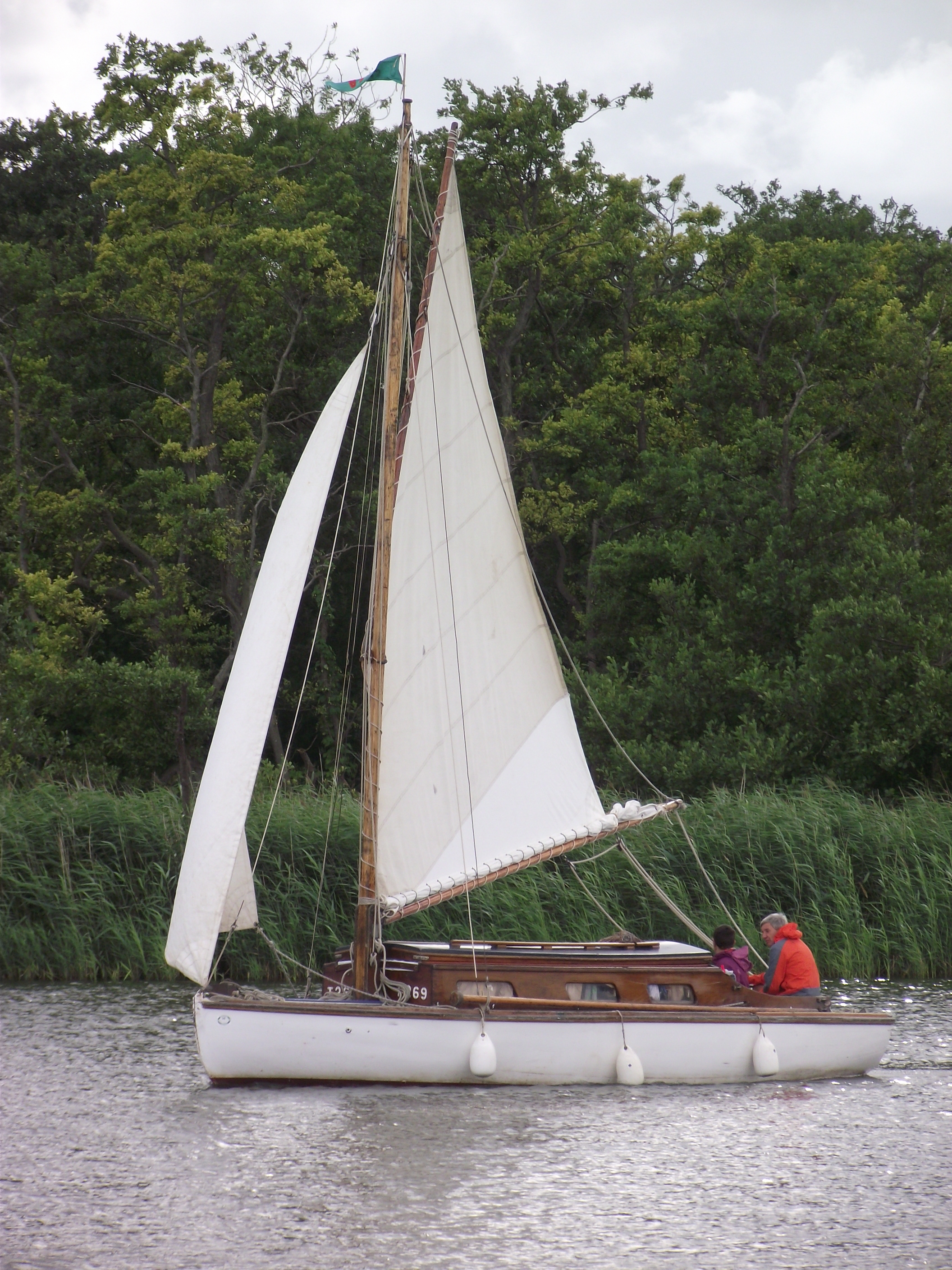
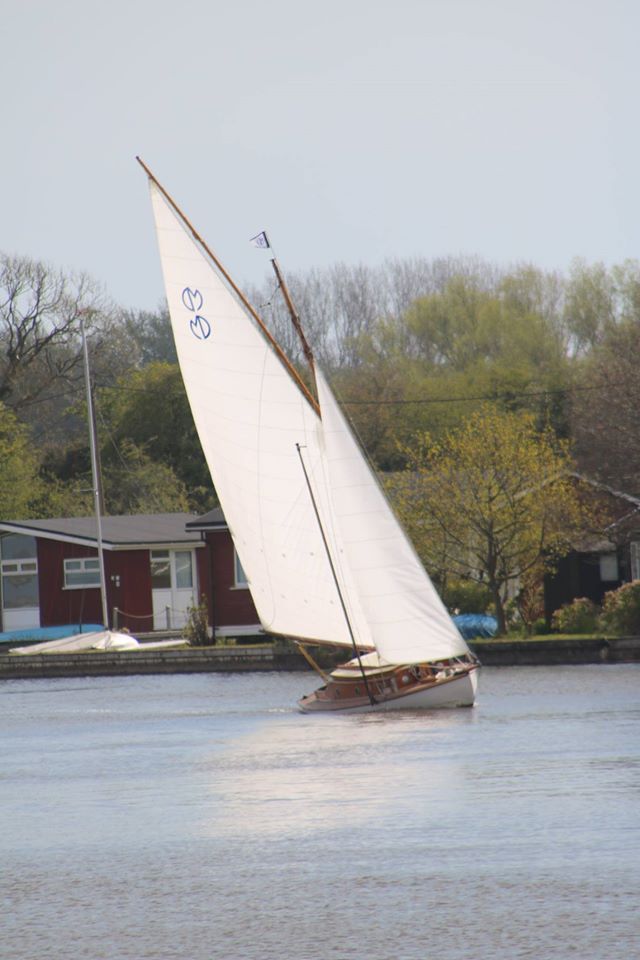
All Chumley & Hawke yachts have a distinct ‘look’ about them, with low slung cabins and sweet sheerlines. Don’t believe me? Here’s a family album;
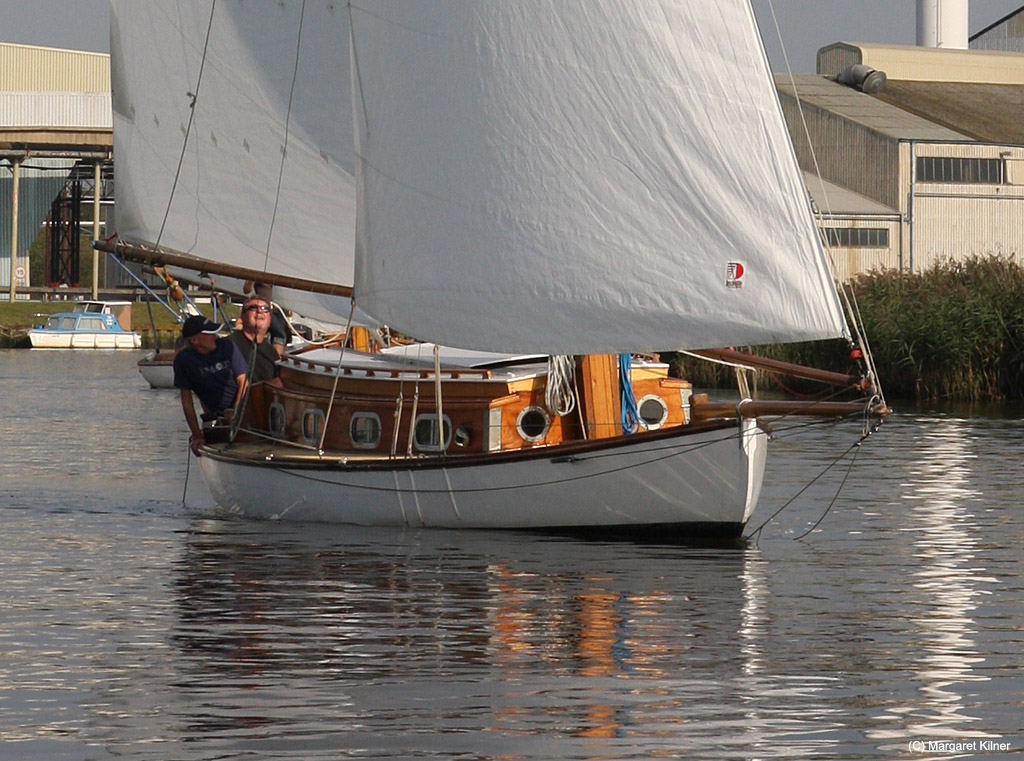
RCC Privateer – photo Margaret Kilner
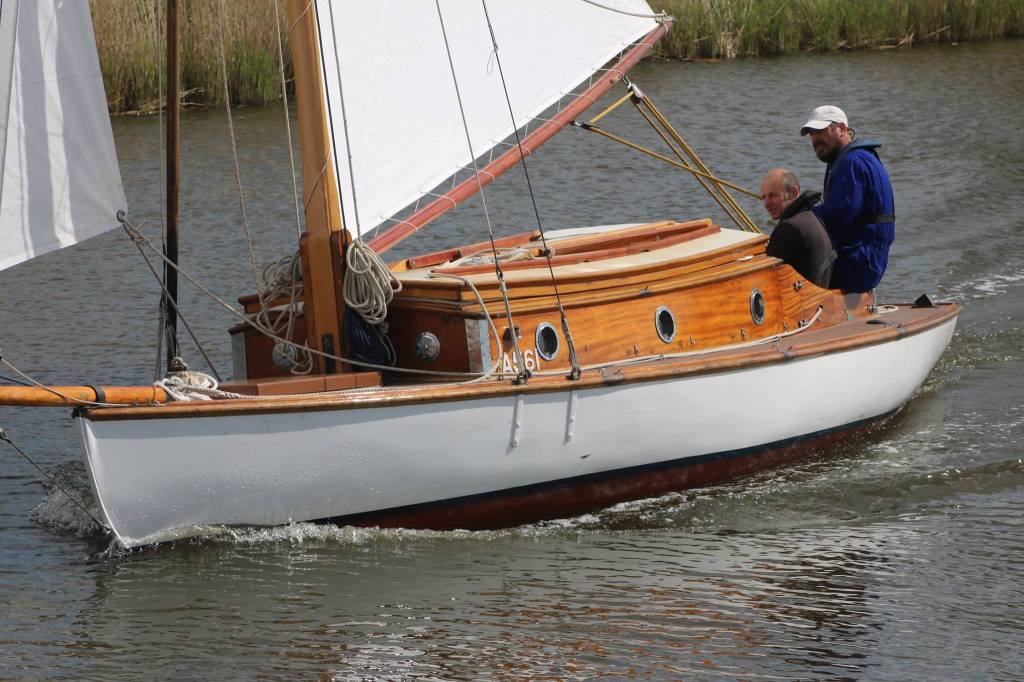
Clipper I
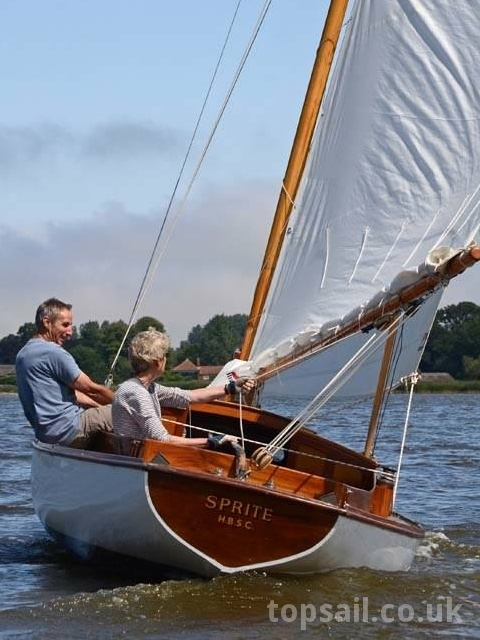
RCC Viking – photo Trish Barnes
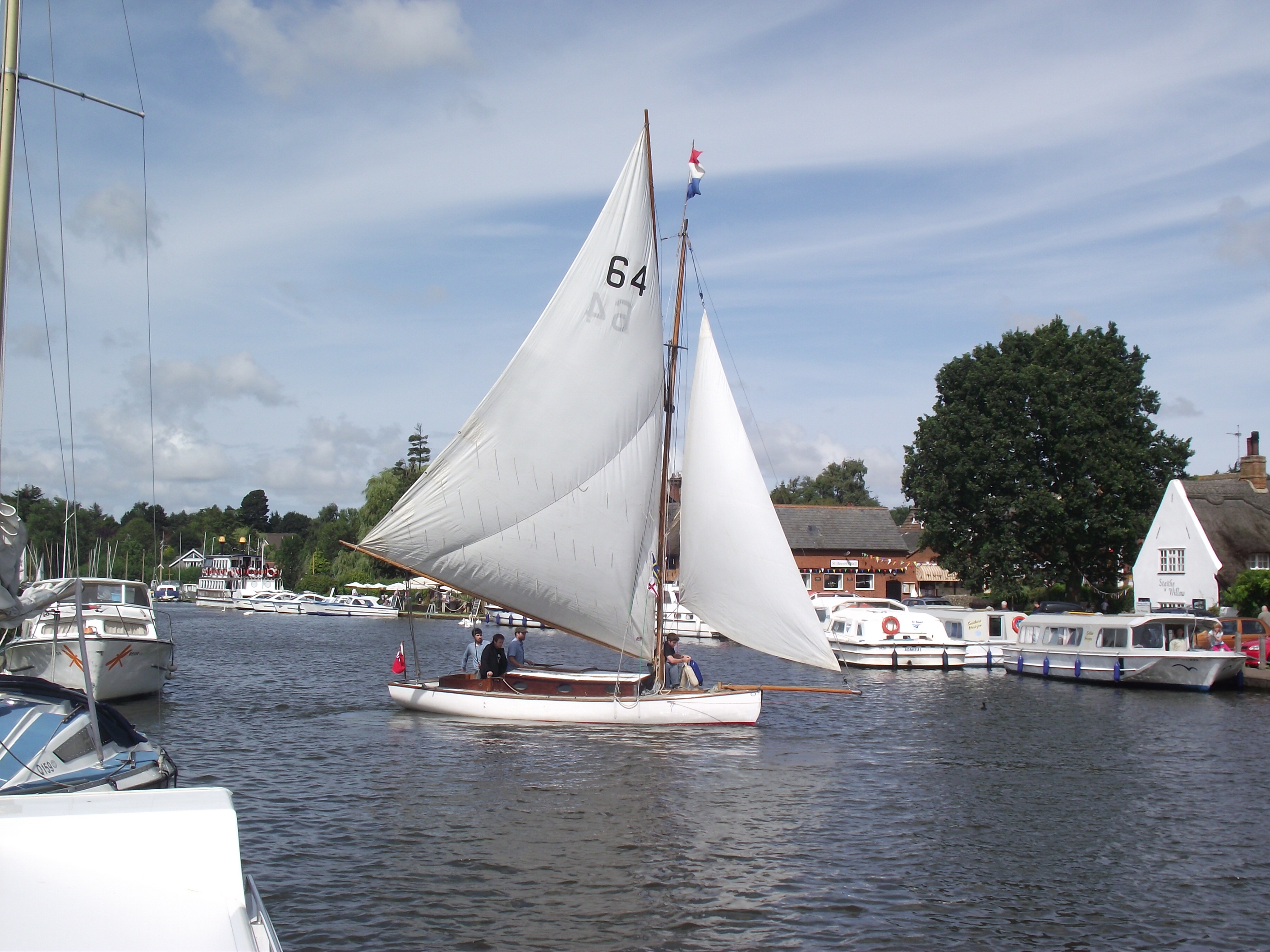
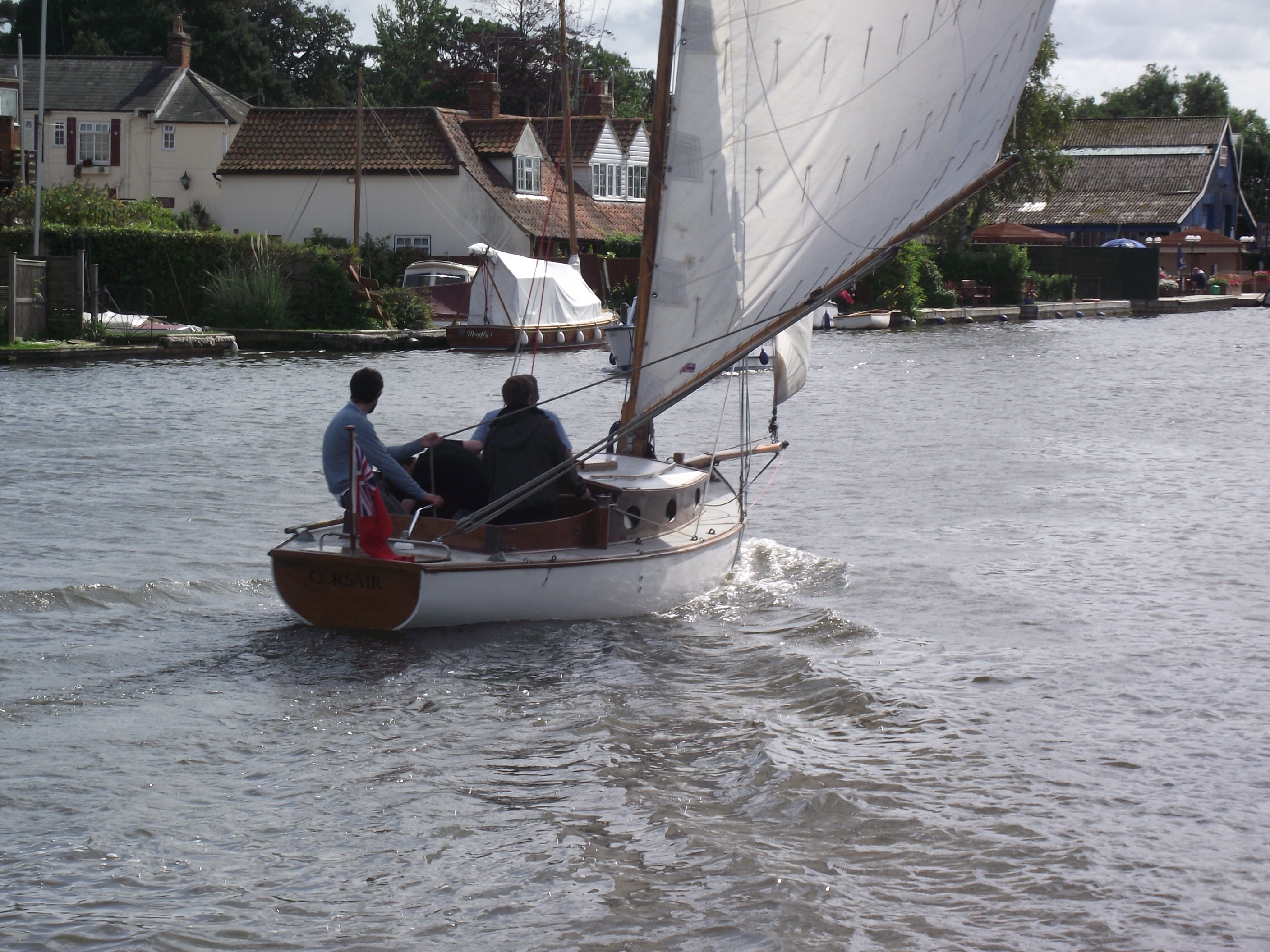
RCC ‘Corsair’ – photo Sue Hines
Finally – the stem repair I made during that first winter.
Having rough-planed the bows quite blunt, I made sure everything was square (ish) before cutting and laminating a series of oak laminates in place. These were screwed and glued, and clamped into place with large baulks of timber helping me bend them right down the hull.
I had no way of knowing if it’d work. I remember cutting the excess off each side, to preserve the ‘scallops’ where the stem is faired into the planking. Judicous use of primer and sandpaper faired it all in nicely.
12 years later, it’s still there, and it’s been not de-laminated or ‘sprung’, so I think I got it right. Evidently my nervous approach was paying off, I hadn’t done anything massively stupid (yet).
During that winter, I also donated the original 1951 short bowsprit to S/N 242 ‘Freedom, who also gained a Clipper mainsail from another. Seemingly I was surrounded by people with old wooden boats, and a perchant to recycling! Or else we were all broke. I know I was.
That winter I often had to choose to walk/cycle to work during the week. I couldn’t afford the diesel to commute AND get to the boatyard at weekends.
Next time I write, I’ll give you an update on why I’ve been so quiet. I promise it’s exciting (to me at least).
As you’ve read – that first season I relished all that’s good about wooden boat ownership. It was halcyon days, but my ignorance would soon come galloping to catch me up.
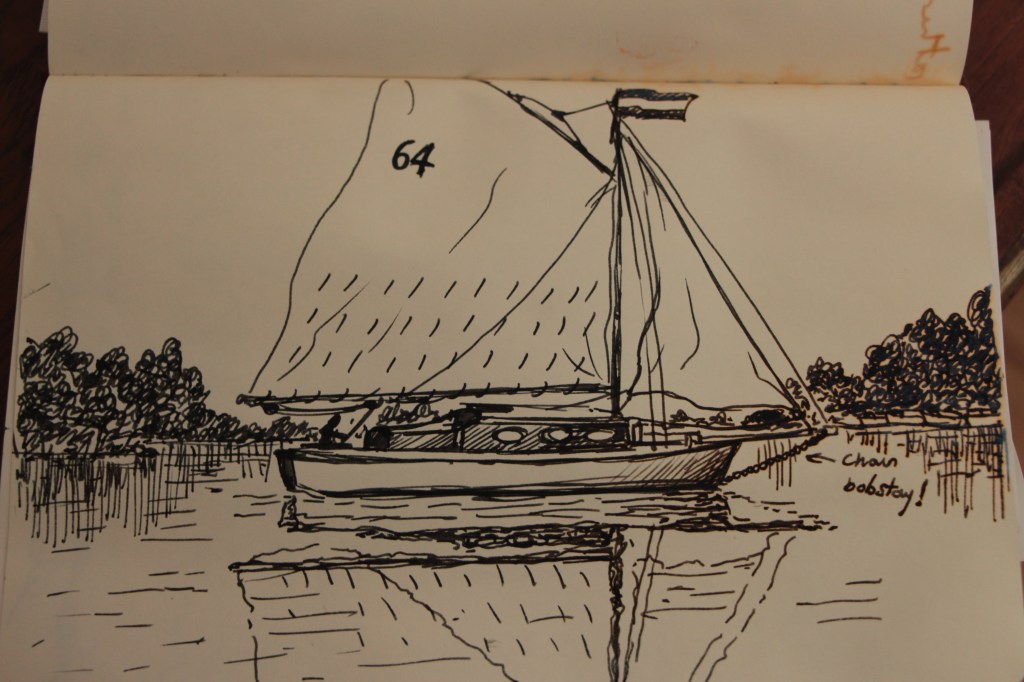
Artist’s impression of that 1st season.
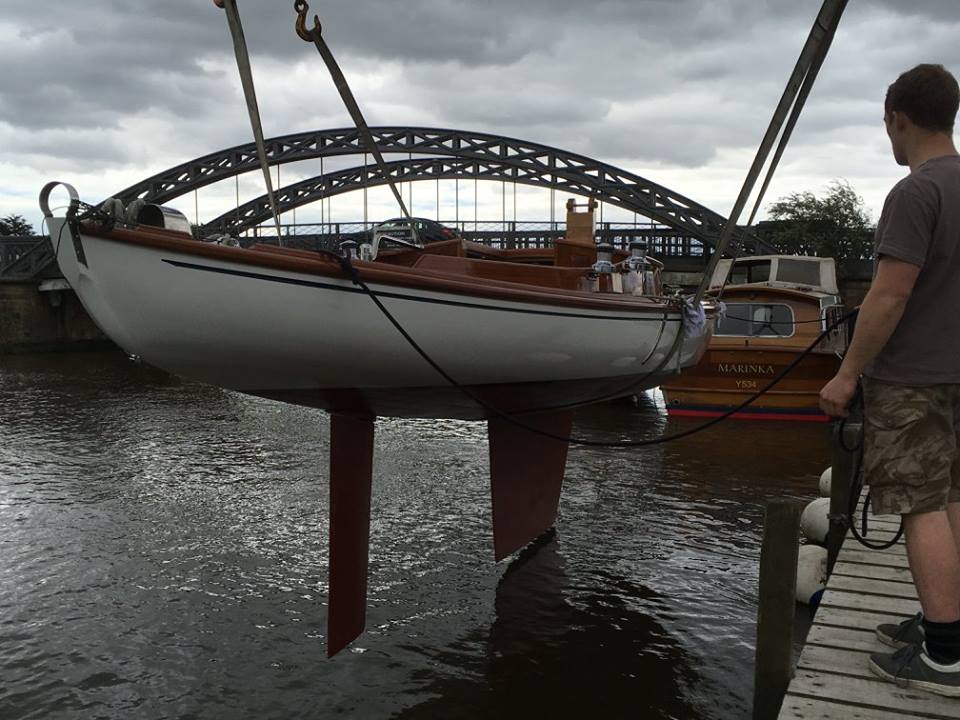
First off – I know that this first winter I needed to address the rudder. It was extremely worrying, how little control I had under certain conditions. From talking with the previous owner – I learnt that it had already been modified/enlarged once!
Okay. So I studied boat design at University, this won’t be too tricky (oh ho ho ho!). Most Broads yachts have freestanding, rather than keel-hung rudders. But there are two main types. Teardrop shaped, and ‘spades’. ‘Corsair’ had a spade, with one corner lobbed off. The tricky bit, is to ensure that the blade and the shaft never part company.
n.b. in a scene worthy of Green’s ‘The Art of Coarse Sailing’, I have once attacked a Bungalow due to a rudder disintegrating… (different boat)
‘Corsair’ was lifted out at Coxes boatyard, at Barton Turf. I knew nothing about them at the time, just that their storage was cheap, their cranage cheap, and it was as close as Thurne had been.
Oh. Yes derigging. My halfdecker was simple. Sails could be folded, and most items placed in the boot of my ancient Volvo. Not so with a River Cruiser! The matresses, the cookers, the Tilley Lamp, the standing rigging, the cordage, the blocks, the sails (X3 jibs), the awning it was all… BIG! Plus it all needed storing.
These days, I’m quite good at folding everything, emptying the boat and storing it all. Not so in the early days.
My housemate at the time was quite shell-shocked. Our garden shed, attic and conservatory soon disappeared, the visual aesthetic was not dissimilar to an olde-world chandlery. The awning being natural canvas smelt lovely, if a little damp for the first few days.
Anyway, the rudder. This was drawn, in a scene reminiscent of the Somme. A rudder tube is about 31/2ft through the hull, and then there’s another 3ft through the blade. That’s a sodding great hole, which was dug with a pick and spade by me. UNDERNEATH the boat, by myself. I also learnt that boatyards are often made up of discarded rubble, which creates fine hard-standing. (oh my arms!).
The new rudder was based on the ‘barn-door’ principles of hydrodynamics. It’s about 40% bigger than the old rudder. It’s balanced, and achieved my desire. I can push it across in a tack, let go – tend the jib sheets/backstays and the tiller stays where I left it.
However, it wasn’t a piece of fine woodworking! I used whatever ply, softwood and cheap epoxy-esque glue I could get my hands on. 11 years later it has survived. Possibly I got lucky. I know that it cost less than £40 in materials, and has some ferrous screws hidden within it. (!)
The old rudder had been designed by a glider pilot. It worked beautifully at hull-speed. That’s about all I can say nicely. My ever-patient housemate watched with on aghast, as I built the new rudder in the conservatory after work, over a week. The use of an electric plane indoors created some excitement.
I was so bloody naïve, I even told people at the time ‘oh no, there’s nothing major this year. Just paint and varnish. Oh and this little job’. Yup. You’ve guessed it.
Rot.
The stem was rotten!!! There had been a deck leak, which had tracked down the stem, and now needed my attention. I was volubly upset. This wasn’t in the plan! How could I afford it. How could I repair it!
I am not a confident woodworker. Certainly not back then. I remember cutting off the offending rotten stem, having first removed the gammon iron, and the bobstay fitting. It was horrible! I cut back as far as I dared, and almost certainly into the apron. I was VERY close to some hood-ends, and had made the front of ‘Corsair’ very, very blunt.
Overall – I was quite dejected. I walked away from the boat with my head spinning. This has happened many times throughout my ownership. At the time, I didn’t realise it, but if you love old boats, owning them gets into your head and your heart much more than you’d believe.
At this time though, I had started the research project which I hope to write about from now on, (whilst re-counting other pitfalls and sailing holidays).
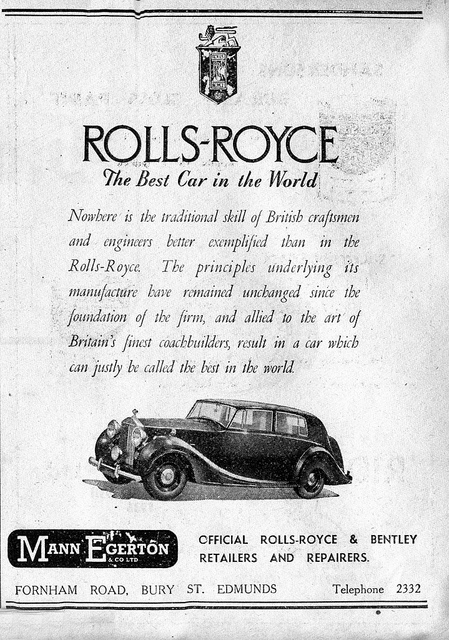
It all started with me being told that ‘Corsair’ had at one time, been the smartest little boat on the broads. She’d been owned by a Mr Campbell. The MD of Mann Egerton* – A large motor engineers in Norwich. Long-closed there are still some signs of its presence. Such as the ‘ghost sign’ still on Constitution Hill.
I had written to his son, Jamie Campbell, who replied. It was the first of many ‘wow’ moments. His first communication confirmed that ‘Corsair’ had been owned by his family, and that they’d bought her out of hire in 1961.
Just think – in the early 1950’s, you could buy a lovely Broads Yacht, or you could go to Mann Egerton’s…
Jamie kindly proceeded to give me several photographs, and some personal memories of ‘Corsair’, which I’ll write about next time. Along with how I fixed the stem!!
Well, having spent an enjoyable night in the White Horse, today we were forced to make a particularly early run from Upton to Ludham Bridge. I helmed, whilst cowering behind the awning as it pelted with rain. The engineer & first mate were quite sensible, they stayed in bed!! (Swines).
We had big plans for the lunchtime, as after motoring to Irstead we were due to start our illustrious racing career. Alas, it was definitely memorable (!), but for all the wrong reasons!!
First race, we rigged and got onto the Broad in perfect conditions. We ‘jockeyed’ around in the fleet, until we spied the red flag. No life-jackets onboard meant we were forced to abandon, before we’d even started! Heyho…
At this juncture, CD & JW appears on ‘MH’, and things did become slightly ‘hazy’…
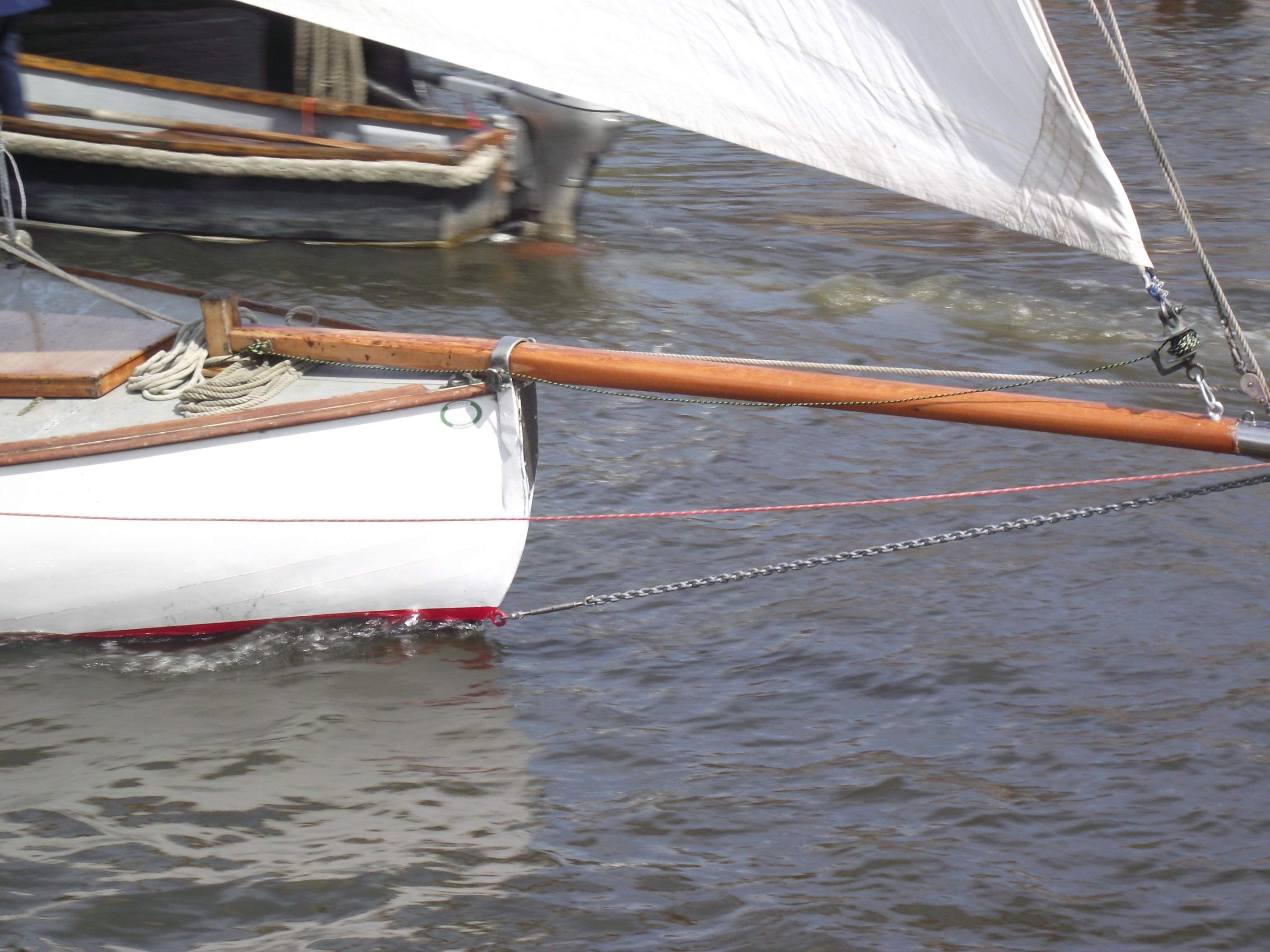
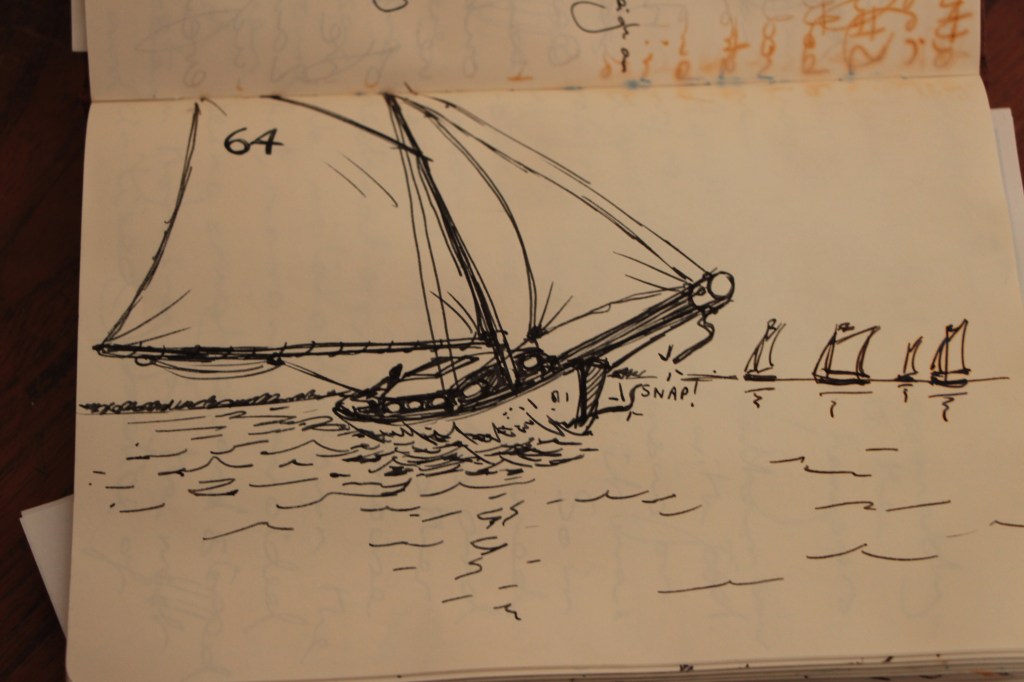
There was an equally abortive evening race, which saw ‘Corsair’ start (quite well), and round some of the course when our bowsprit suffered a mischief. The bobstay (stainless steel wire) snapped cleanly at one end (and it was a flat calm, look at the photos!!). Although a temporary stay was rigged, we returned to Gay’s Staithe.
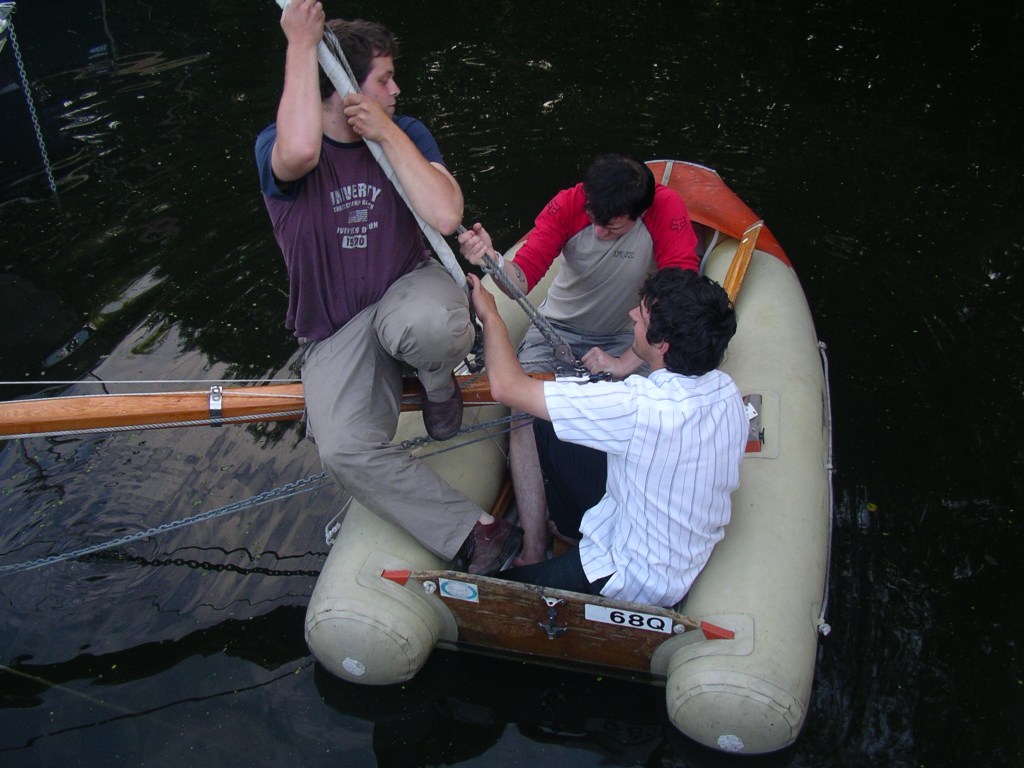
Rigging a new bowsprit was ‘interesting’ – we went for chain. It was rigged using a variety of the crew in various positions, all trying to bend the bowsprit into the right place, and get the chain to stretch! Eventually we used a nearby Tinker Tramp inflatable dinghy. After an hour and a half, it was fitted.
The evening race…
‘Engineering’
It fits!
One BBQ, one bottle of Jägermeister (!), one of vodka, one of gin, eight strongbow and twelve kronenburg later, we’d made friends with most people we saw, several trees and at least one puppy.
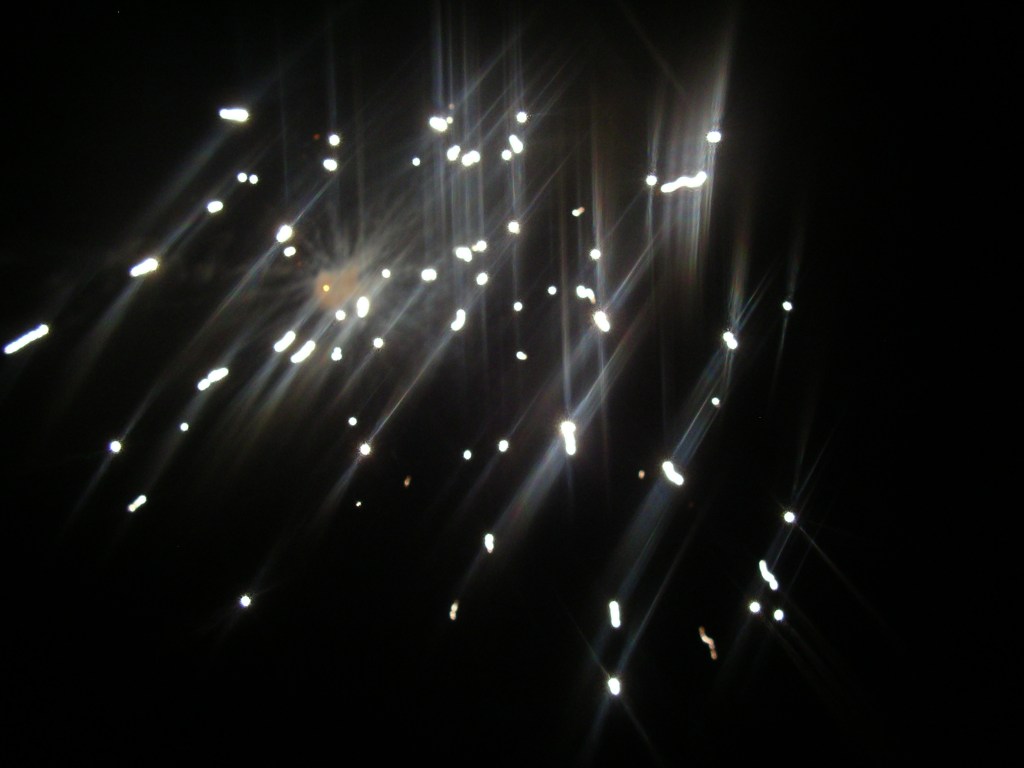
Finally, at the midnight hour, whilst roaring drunk, we motored out into Barton Broad, where we set-off the remains of our fireworks. These fitted nicely into the ensign staff of ‘Corsair’, whooshing up into the sky, only inches above the outboard and petrol tank. (!!!)
The effects were quite spectacular. At Barton regatta, all competitors mudweight on the broad, staying on their boats for 72 hours, in a series of large rafted up enclaves. Imagine. It’s midnight. Most are asleep, many of the boats have their families aboard.
BOOOOM! WHIZZZZZZZ! BOOM! BANG! KABOOM!
Pyrotechnics!
Judging by the plethora of lights that started coming on in boats, and the shouting that followed, our fellow sailors were just as impressed as us with the fireworks. Navigation lights doused, we fled.
(n.b; We were young, stupid, drunk and stupid. I would not EVER repeat this)
Eventually we retired at 2am, it had been a loud and enjoyable evening.
Goodnight.
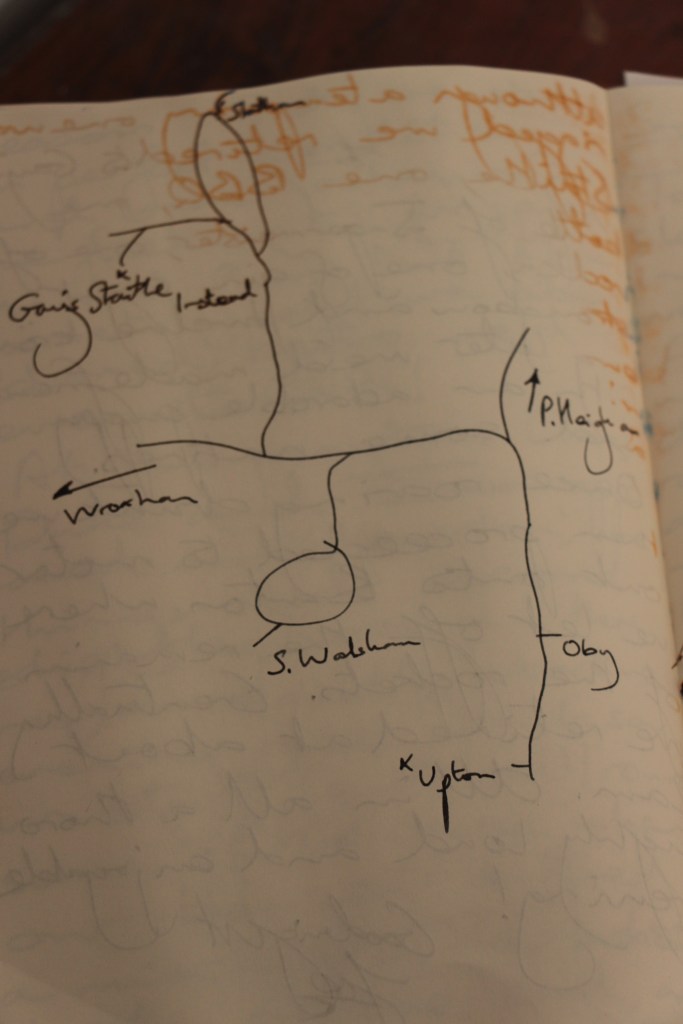
Our route.
The bobstay breaks!
Day 7.
Today started reasonably slowly… mostly due to the industrial sized hangovers we suffered from.
A quick motor to Stalham however saw us re-stocked with food, and a general consensus was reached that racing was a very bad idea. Plus it was raining and ‘orrible.
Racing in the rain – no thanks!
So instead, we ate restorative bacon sandwiches and decided that we would head to Salhouse Broad. Motoring down the Ant, we avoided the melee, and stopped in Horning for the most civilised practice (after last nights behaviour!) for an ice cream.
Horning to Salhouse was covered by sail, as by then most of us had recovered from the night before. Most enjoyable it was too! We gently tacked up the Bure, and drifted onto Salhouse Broad for a quiet sail on the last of the zepher like breeze available to us.
All of us went to bed early. (I didn’t even have the energy to draw a map)









 A Broadsman