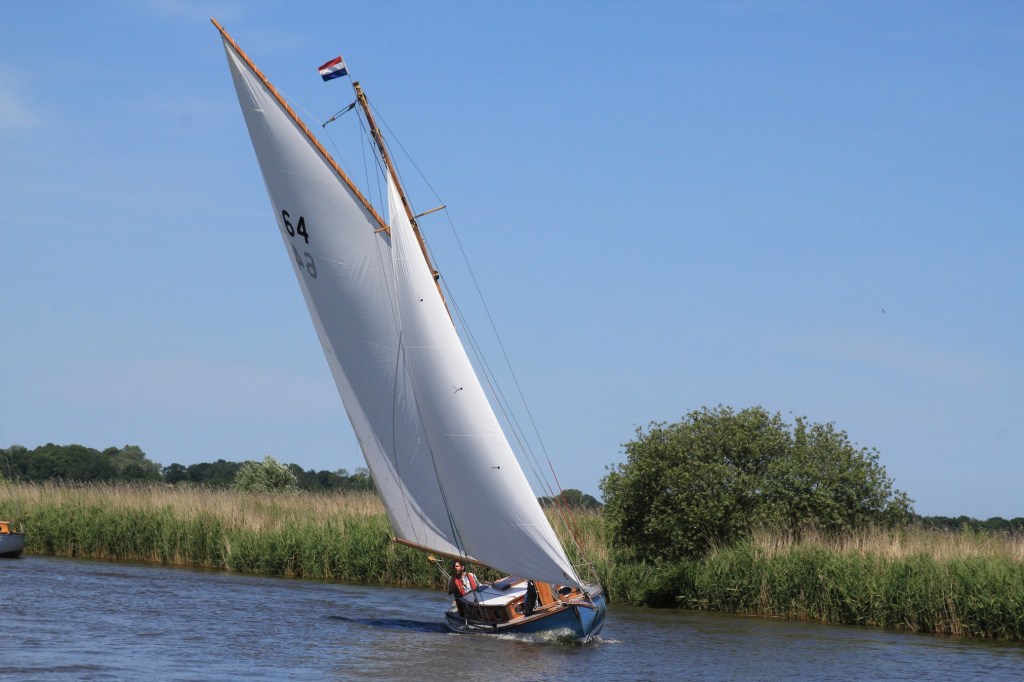
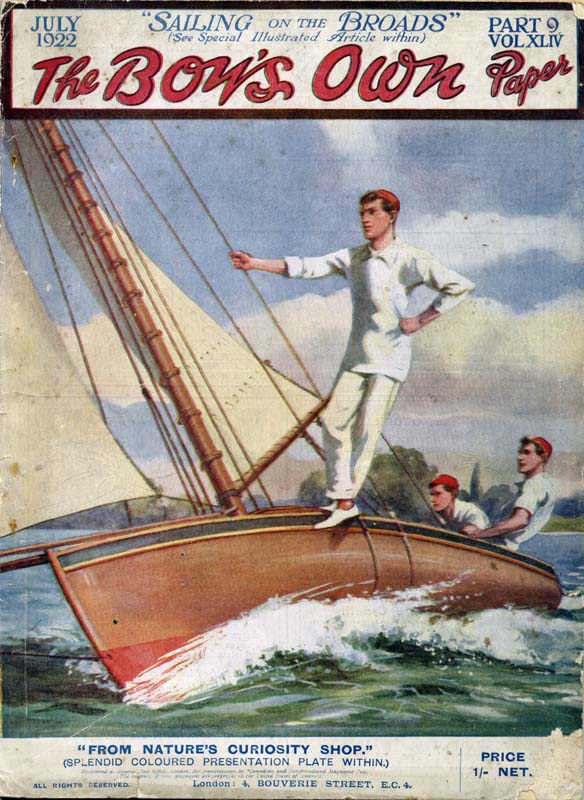
2009 – relaunch & my first YSC race.

Sorry – the delay in writing has been for the best reasons. I have been out sailing, a very enjoyable 4 day cruise to the head of navigation at Dilham.
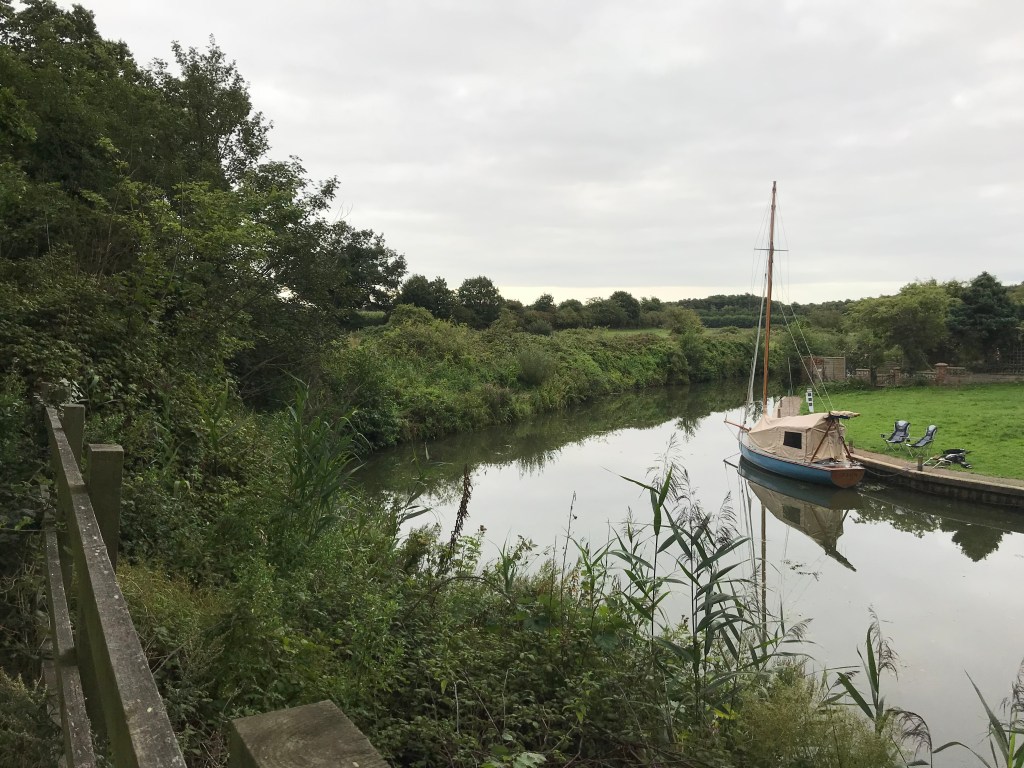
‘Corsair’ at Dilham.

I’m always struck by how different the landscape is on the Broads when I go to Dilham, you are in gently undulating North Norfolk country-side, in a genuine canal setting. Very different from the rest of the rivers.

If you are lucky enough to sail on the Broads, do take yourself to the extremities in the navigation. You’ll see tremendous scenery. Moor at Horsey, and you look on at the Dunes of the North Sea, the next day you can be in a canal basin, and the day after on a huge tidal lagoon (as was) faced with a Roman Fort looking down on you.

One day I hope the North Walsham & Dilham canal trust https://www.facebook.com/NWDCT/ achieve their goal of connecting the canal back to the system.

The canal itself, was authorised by parliament in 1812. Unfortunately it was finally abandoned in 1934. Don’t think the canal wasn’t useful though. In 1898 – 6,386 tons was received at wharves on the canal and shipped away. The wherries on the canal carried about 15-20 tons… So that’s nearly 319 wherry loads in a year!!

The last wherry to navigate it was the ‘Ella’. And in tribute, the canal trust have recently launched Ella II – a launch which will take you on the re-watered sections of the canal.
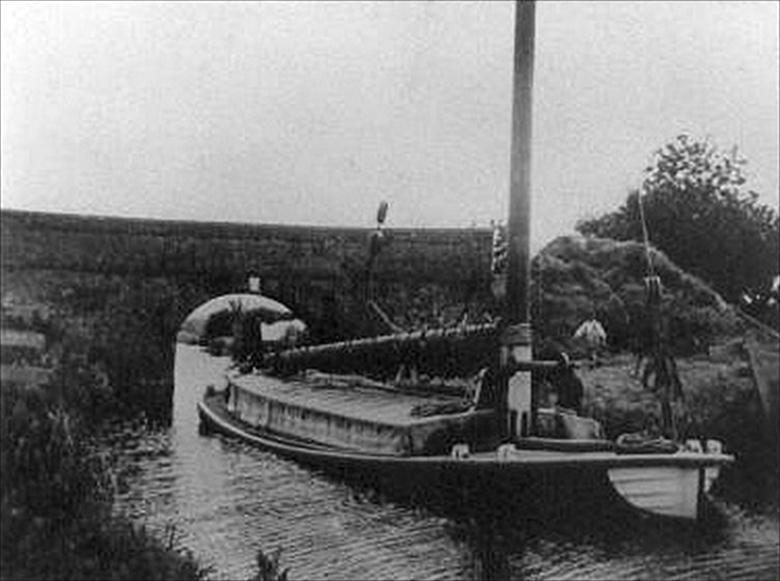
Wherry at Swaffield Bridge – NW & D canal

In its heyday, the canal boasted a small fleet of these very pretty, small wherries. About 2/3 the size of a typical trading wherry, sadly none have survived. If you visit the canal these days, well it’s very eery – dereliction has left pieces of it beautifully stagnant, like the lock chamber at Honing, just waiting.
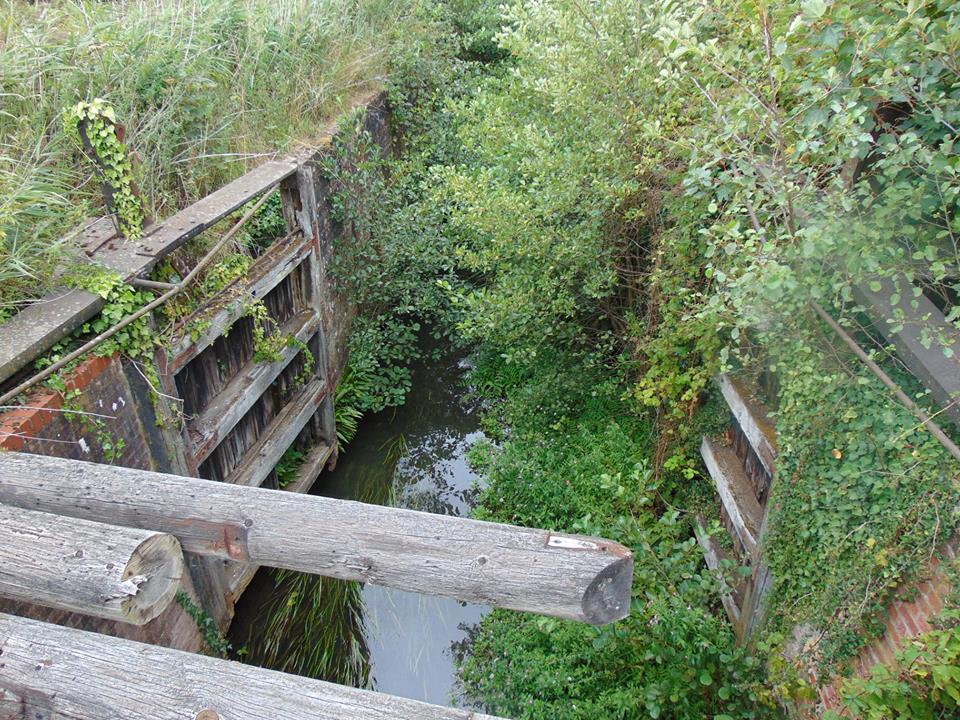
Honing Lock

Anyway. I digress. But it’s worth going to look at the canal, if you ever get the chance. Running alongside it is the trackbed of the Midland & Great Northern Railway, the Stalham – North Walsham section of their network.

Such direct competition no doubt proved to be the undoing of the canal. But again, the old railway has been left in splendid isolation, and is full of hidden relics as you walk the trackbed.

Back in 2009, I was in the final throes of preparing ‘Corsair’ for launching. This would be my first run at it ‘solo’, I was nervous. Throughout the winter I’d done what I thought was best. I’d applied a liberal amount of Dulux gloss on the hull, and one whole tin of Screwfix ‘no nonsense’ yacht varnish on the toerails (! – horrible stuff). I was set!
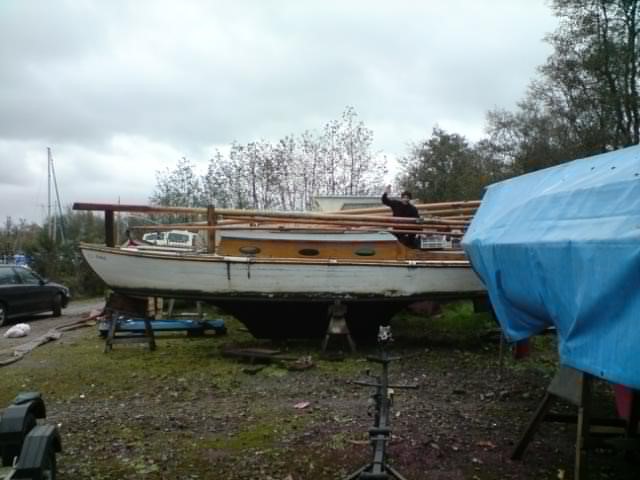
Barton Turf – January 2009 – ‘Corsair’ is hidden behind S/N242 ‘Freedom’. Luxurious conditions!!

Or so I thought. ‘Corsair’ was launched on the allotted day, and surprisingly the ancient and defunct car battery worked adequately to keep the bilge pump humming and she floated (mostly) after a few hours. Eager to sail this year, I had aimed for an Easter weekend launch.

After work, there I was… Heave-ho, hauling away on the heel rope there was the usual strain as the mast rises the first few feet. Then a shroud snagged (cabin roof corner, the usual spot). I made fast, and then walked aft to un-snag.

CRUNCH.

Bollocks. As I had walked down the sidedeck, the mast had swayed about, not being fully in the tabernacle, it was free to pivot. The snagged shroud was snatching, arresting this oscillation. The crosstrees fell victim to this, and neatly folded themselves either side of the mast, snapped cleanly in half

Bollocks, bollocks, bollocks! I was filled with despair, then anger. I’d worked, I’d slaved! I’d gone hungry, through sodding winter. I’d dug a trench! All for this bloody boat, and now this!! Feeling very dejected, I lowered the mast, removed the detritus and left.

I’d planned a weekend away on the boat, what would I do? After a couple of hours, I realised that I wasn’t going to be bloody beaten by this bloody boat.

I eyed up an unsuspecting refectory-style Oak table…

Once again the conservatory was functioning as a workshop quite late into the night, and my housemate quietly despaired. It could have been noisy desperation in all honesty. I couldn’t hear above the noise of my jig-saw.

By midnight I had crosstrees again. They were rough – but they’d do! I was able to re-rig ‘Corsair’ the following day, and returned to Oby Dyke. Bizarrely, S/N 242 ‘Freedom’ who had acquired my old bowsprit, also picked up the second hand rig off ‘Clipper I’ – which suited her nicely. Whatever echelon of yachting I was in, it definitely was the ‘grass roots’ end of things!! We all loved wooden boats, just necessarily didn’t have the finance to keep them.
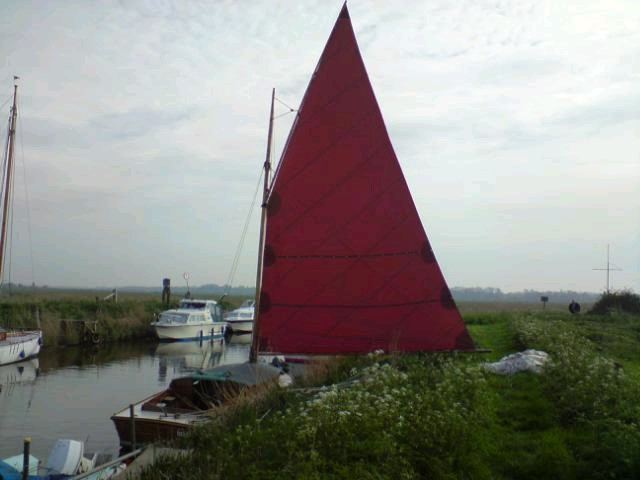
S/N242 – ‘Freedom’ at Oby, with Corsair’s bowsprit, and Clipper’s mainsail.

Remnants of the French-Polish stayed on those cross-trees for YEARS afterwards. They survive to this day, and somewhere the remains of that table lurk in the workshop.

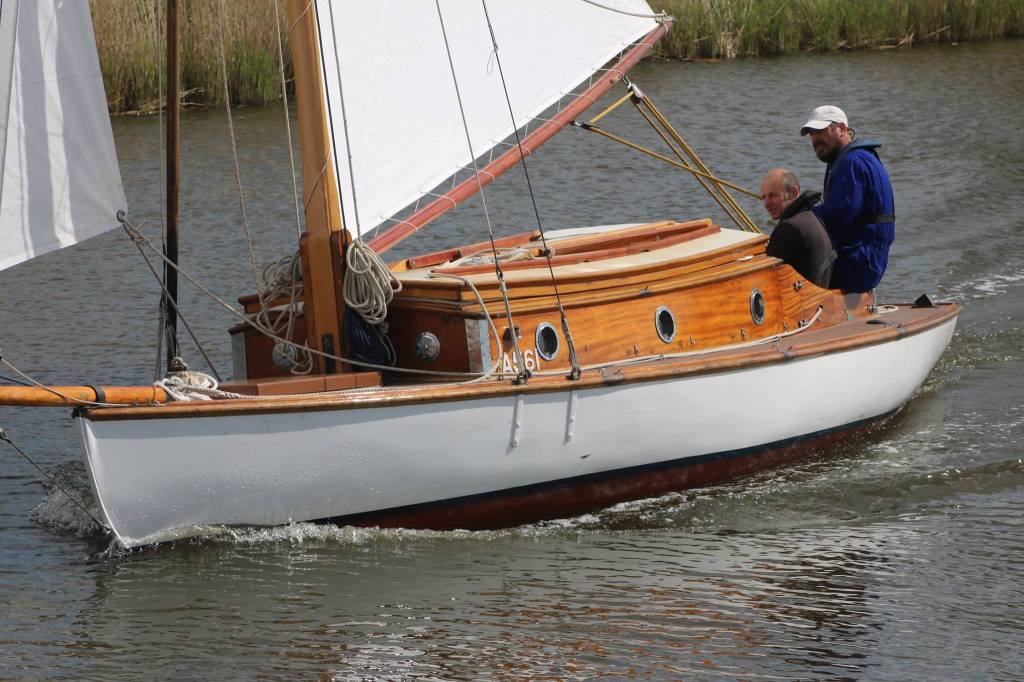
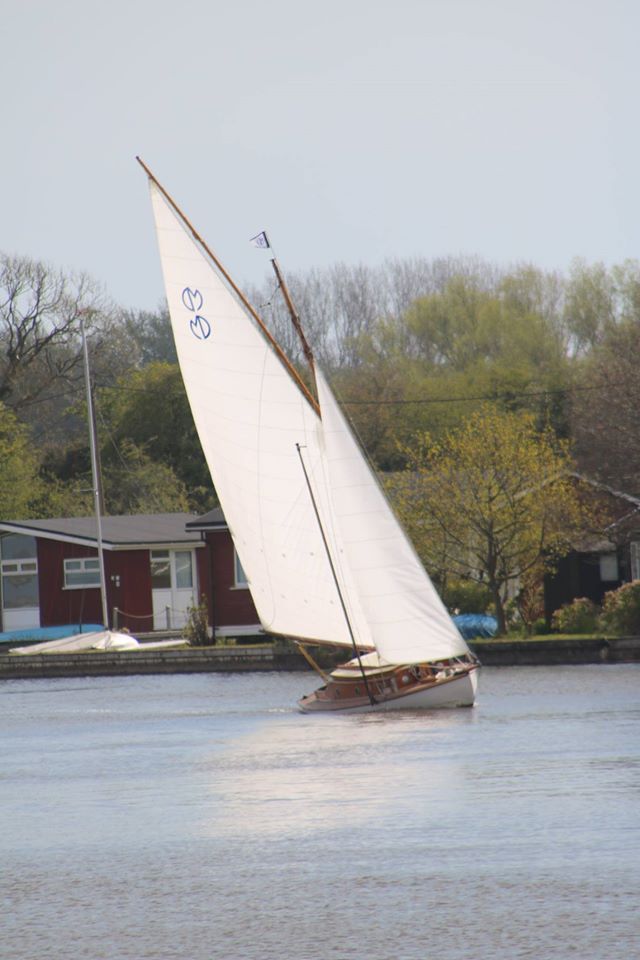
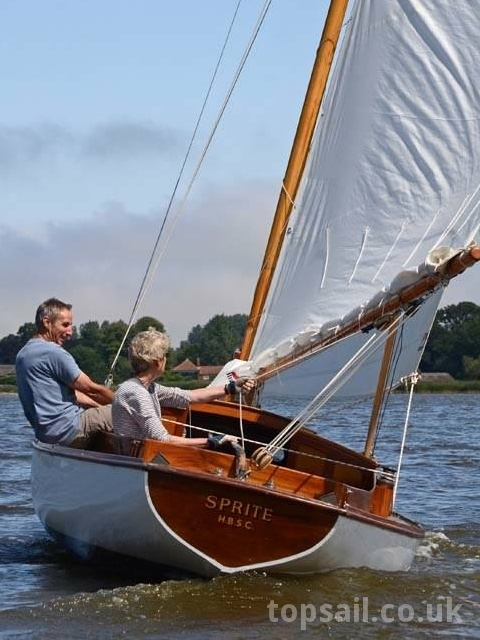
Having overcome this difficulty, and starting to realise that wooden boats are tricky things I decided to venture south onto the Waveney in May 2009 – for my first Yare Sailing Club race, the Ray Perryman memorial passage race. This runs from Somerleyton to Beccles each year. It also would be my first navigation through Yarmouth with ‘Corsair’.

I survived Great Yarmouth, which is always tricky to get the tidal gate correct, and even arrived at Somerleyton in time for a few drinks at the Dukes Head before last orders.

The trouble with rushing to the pub of course is that when you come back to the boat, you’re too drunk to raise the cabin roof, or put the awning on. Something which you need to remember at 4am when you get up to pee… That cabin roof is solid, and low!!

The course of the Perryman race takes you upstream from Somerleyton, starting adjacent to the railway bridge. Smart thinking is to get course-side of the bridge before the thing shuts and traps you the wrong side!! Every year the fleet gets split pre-start, to the great amusement of those who are the correct side…
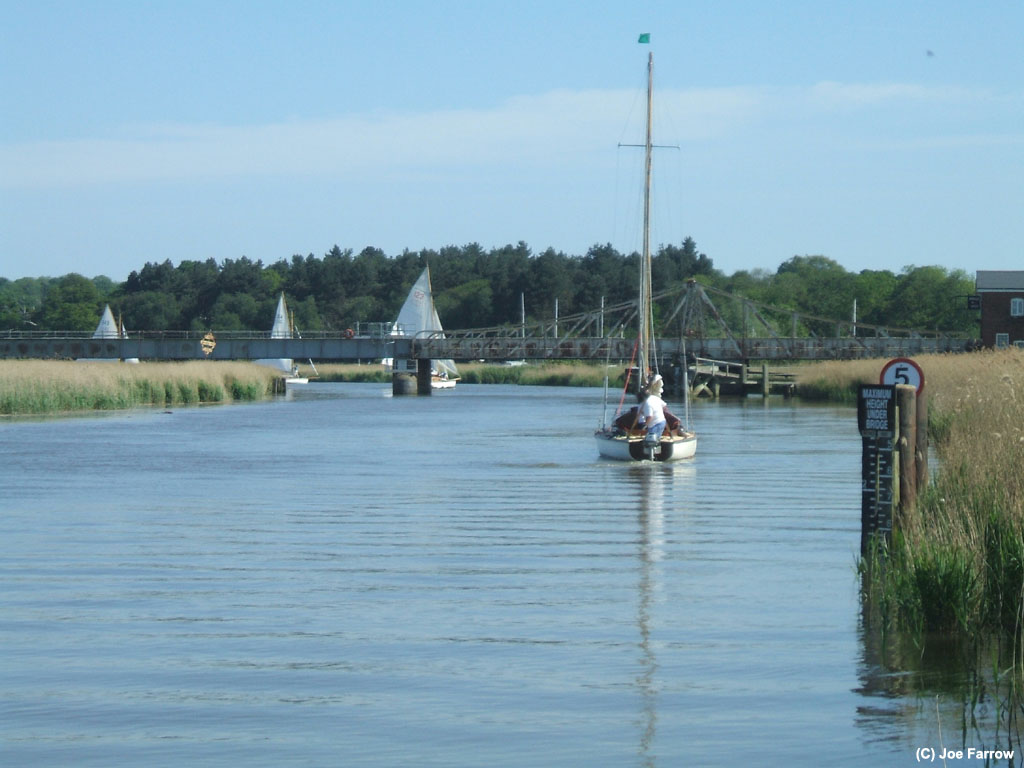
The fleet, divided!!

I did provide some amusement pre-start, as my flag of choice is, somewhat oversize!
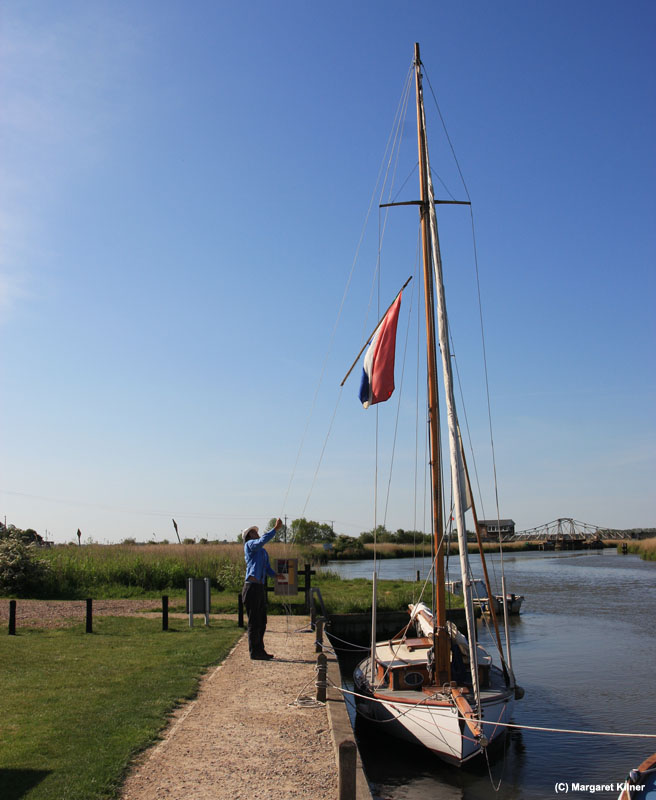
Big flags. ‘That’ bridge in the background…

The race itself suits me, its a passage race, and presents as a mixed bag. You start in the open marshes with clear air, and a wide river. Soon after Burgh St. Peter and its unique church, you find yourself in a very pretty albeit tree-lined river. That’s when you use the tide, and every last puff of air to your advantage. The last section (2 miles ish) from Aldeby to Boaters Hill is very tricky, you need every bit of momentum to keep going!

‘Corsair’ didn’t set a world record, I believe she placed 7th out of 9th entries. We did start a mere 19 seconds after the gun, which I thought wasn’t too bad. These days if I’m much over 5 seconds off, I chastise myself!

However, we completed the course and nothing was broken. Success! We tussled throughout with a much larger, and heavier yacht S/N 149 ‘Stella Genesta’. I think we finished only 24 seconds apart after an 8 mile race. She is a beauty, and is credited with being sailed to Holland sometime in the pre-war years. A fine craft, but I’m not sure I’d take her across to Flushing!

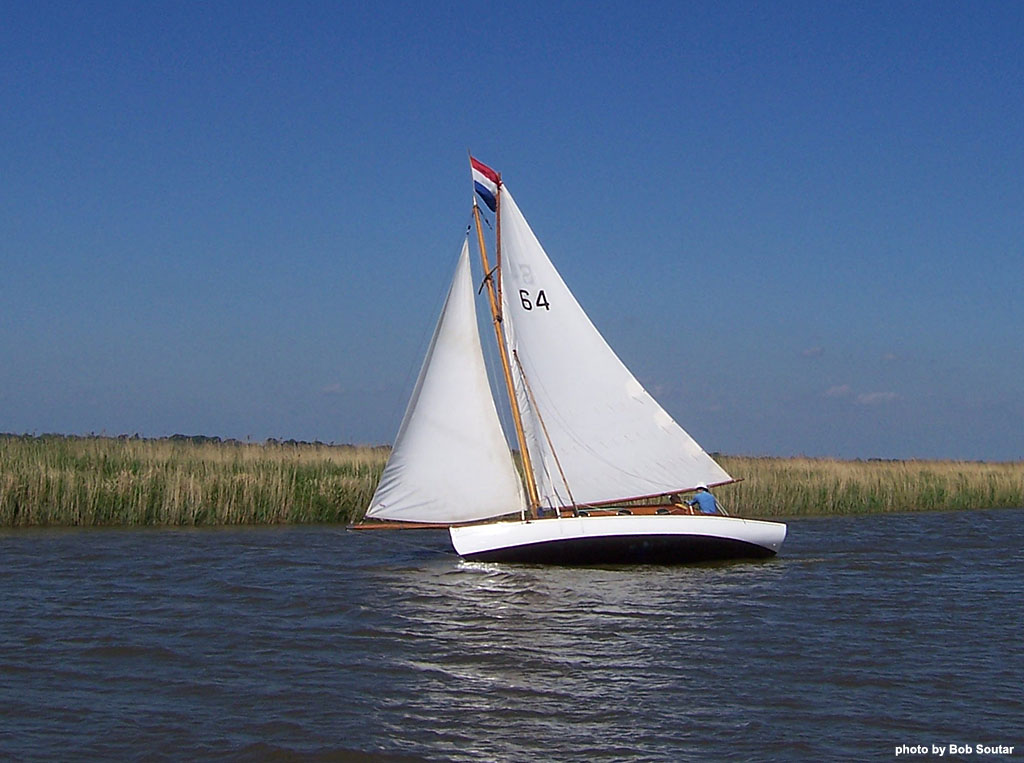
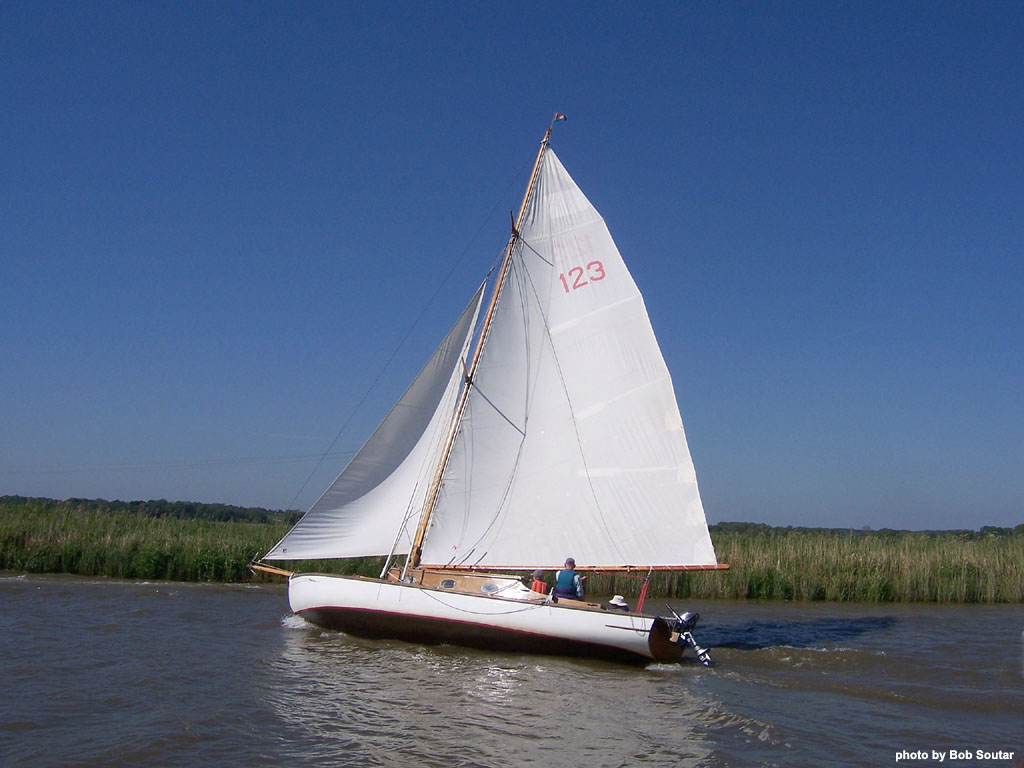
Line honours that year went to S/N 123 ‘Puck’, an ex Fine Lady from Herbert Woods. Albeit with a much more adventurous rig than her days in hire!

We celebrated the next day by sailing in company to Geldeston – another part of the rivers where you are faced with derelict lock chambers…. I wonder if it’s a condition??

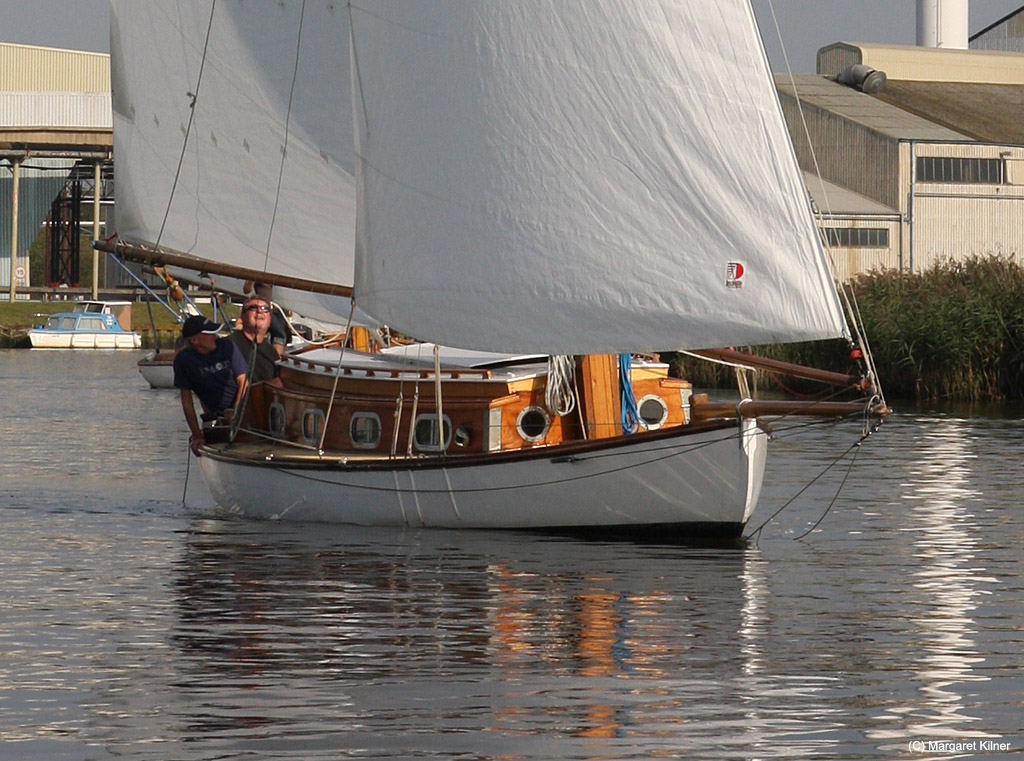
Anyway – I’ll finish with some photographs of that weekend. Halcyon days again, after a somewhat frustrating winter.
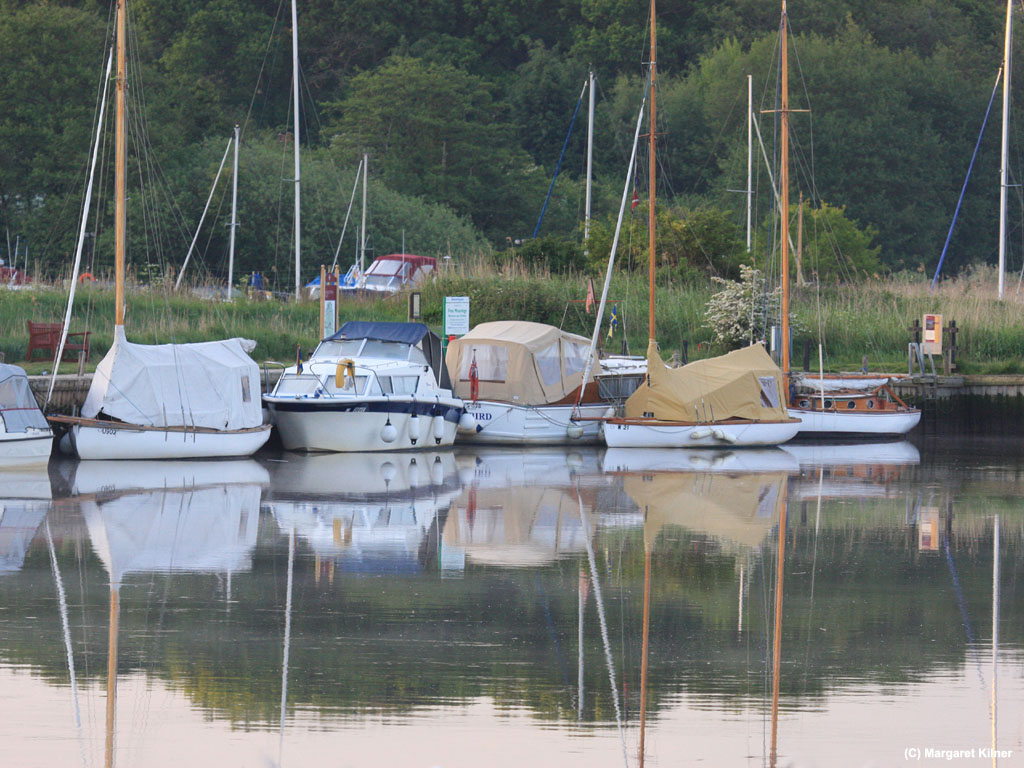
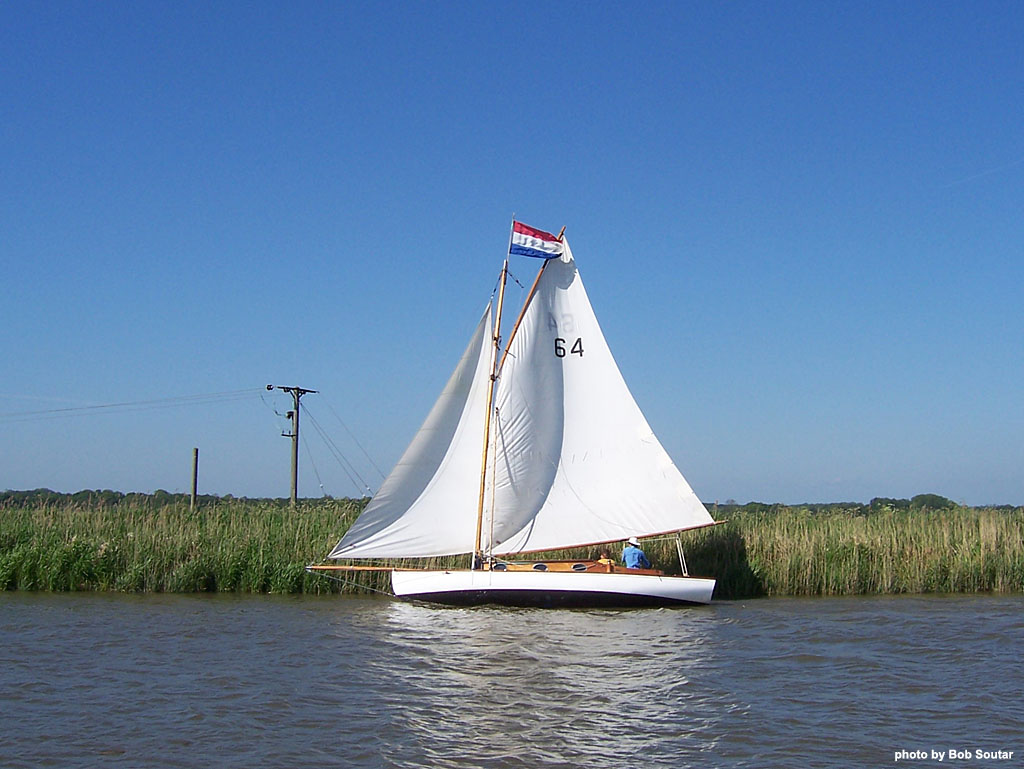
The next prominent sailing event of 2009 of course, would be our annual sailing holiday! We’d already done it once on ‘Corsair’, what could go wrong!?
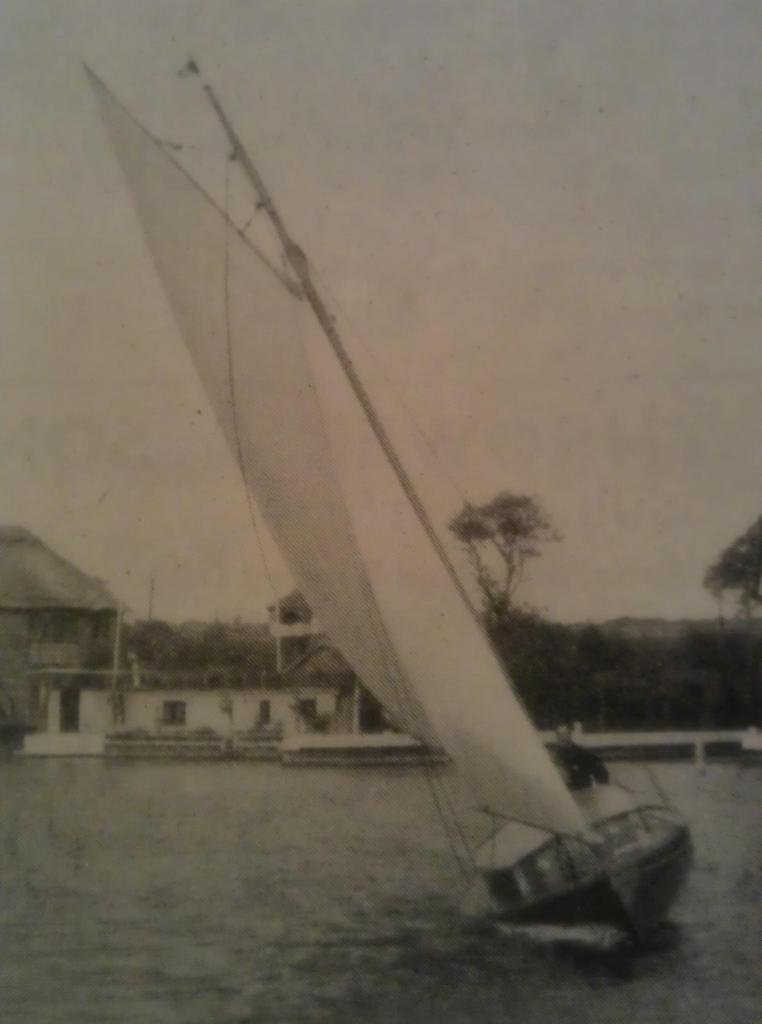
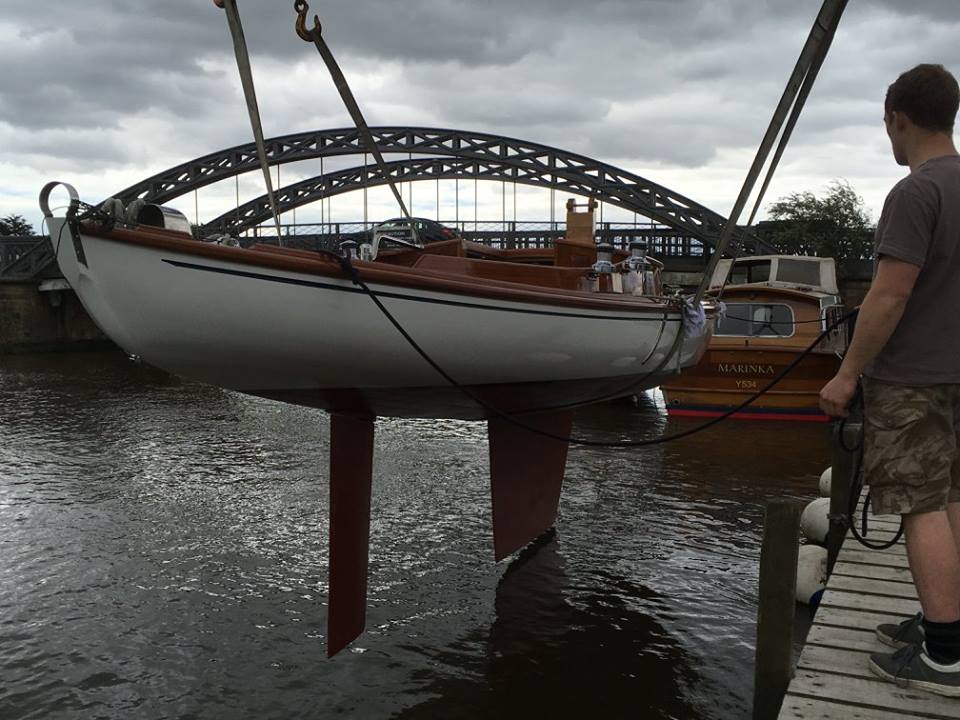
Chumley & Hawke… the designs

Sorry – I haven’t written for a few days. Not least that I have made a break-through in my research. Think ‘source of the Nile’ moment… I am going to break my rule of writing chronologically – and give you an update. Then I will write fully about what I’ve found later.

But. Back to Chumley & Hawke. Their fleet differed from most hire-fleets, in so much that they were mostly designed properly. This sounds harsh, but its unrelenting honest I’m afraid. Most broads yachts were build ‘by eye’, from half models… And, AND! They were badly built!! It’s easy to look at a river cruiser today, and get misty eyed, but in the ‘heyday’ – these boats were built to do a job, and to be disposable.

Look at ‘Corsair’ – she lasted 10 years in hire, then was sold off as redundant. Now, admittedly her first private ownership was a lavish environment, with all the right elements for a wooden boat. Money, dedication, money, enthusiasm and money. Oh, and Rolls Royce chrome.

Chumley & Hawke was run pre-war by Roland Hawke, and Alfred Lloyd Braithwaite (A.I.N.A.). Braithwaite had bought into the yard in 1930, moving to Horning. His first few designs but the emphasis on sailing qualities, with accommodation coming second. Proof of this, washis ‘Clipper’ class which won the challenge cup for small yachts, Horning 1935.

Clipper – 1939, showing the fine sailing they were capable of.

Aside from ‘Khala Nag’ – the best example I can think of this is ‘Viking’, built circa 1937. She is now a beautifully restored member of the River Cruiser class, however originally built as a 26ft halfdecker, and described as;

“Dayboat, mahogany built and designed for those who appreciate a really fine sailing boat, which compares favourably with a half-decker and has the advantage of a low cabin shelter…”

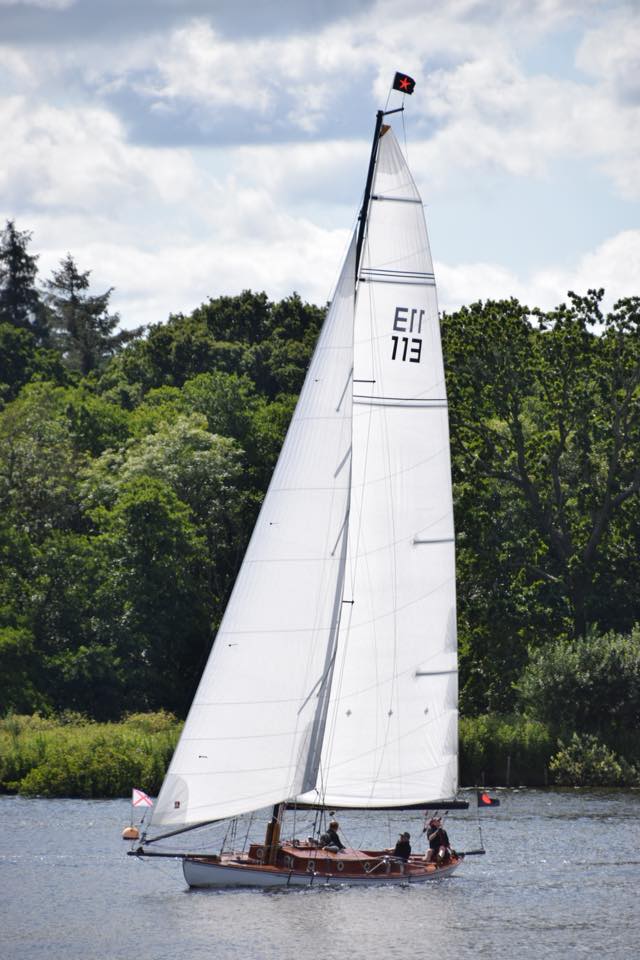
Nowadays, ‘Viking’ is a stunning vessel, having been modified to a canoe stern. Perhaps this is the biggest compliment to a devotee of metacentric hull theory – Viking was ably transformed to a canoe-stern yacht without major disfiguration. Here’s a picture of that indecently pretty hull;

RCC 113 – ‘Viking’, post rebuild at Broadland Boatbuilders.

Now, I can hear you ask ‘what’s metacentric hull theory’? No? Well I’ll tell you anyway. It was popular in the 1930’s. Mind you, so were airships and facism. So we’ll tread carefully.

A.L. Braithwaite was a supporter of the ‘metacentric shelf formula’, which aims to achieve good balance and handling under sail.   Other notable followers include Harrison Butler.

The theory is based on the principle that as a yacht heels over under sail, the balance of the rig forces and the hydro-dynamics will be influenced by the changes in the immersed form of the hull.  

Succinctly, a different shape underwater is presented as she heels and sails. The shape of the hull is defined at each ‘section’, and those different sections exert difference amounts of buoyancy.  Aft sections may possibly being more buoyant than forward sections, interestingly the faster boats sit ‘bows down’ without the crew in the cockpit so are level fore/aft when sailing… 

Metacentric shelf analysis plots the shifts in the varying buoyancies at each cross section of a boat, and defines a net value to windward or leeward and serves as a guide to achieving equal buoyancy in the dissimilar ends of a design.  For a designer, the key is to draw and build a boat which has its greatest cross section area, within a close tolerance of the mid-point in the waterline.

The challenge then is to couple that principle with a hull drawing that decreases its cross sectional surface area in a union manner – both fore & aft of the mid-section.  Further refinements can be made by accommodating the weight within a yacht into these calculations during design & build to ensure that the forces of hull buoyancy, rig power & centre of gravity all complement each other. 

A.L Braithwaite designed boats which corresponded to this metacentric theory, both ‘Viking’ & ‘Privateer’ being good examples.  Theoretically, their hulls change uniformly both fore & aft of the mid-section (usually within a small tolerance +/- 7-10%).

The ultimate test of course, being that a truly 100% metacentric hull should look almost identify from either direction.  This has been demonstrated with ‘Viking’

Typically, the application of metacentric formula gives a sweet handling boat that is aesthetically pleasing, and has a good sailing performance without arm-breaking cases of ‘weather helm-shoulder syndrome’(™).

It should also be noted that nowadays, these calculations are done at the click of a mouse button, for Braithwaite to have applied this theory whilst it was relatively uncommon, in limited numbers whilst working in a Horning boatshed for a fleet of hire craft is quite extraordinary.

All Chumley & Hawke yachts have a distinct ‘look’ about them, with low slung cabins and sweet sheerlines. Don’t believe me? Here’s a family album;

Finally – the stem repair I made during that first winter.

Having rough-planed the bows quite blunt, I made sure everything was square (ish) before cutting and laminating a series of oak laminates in place. These were screwed and glued, and clamped into place with large baulks of timber helping me bend them right down the hull.

I had no way of knowing if it’d work. I remember cutting the excess off each side, to preserve the ‘scallops’ where the stem is faired into the planking. Judicous use of primer and sandpaper faired it all in nicely.

12 years later, it’s still there, and it’s been not de-laminated or ‘sprung’, so I think I got it right. Evidently my nervous approach was paying off, I hadn’t done anything massively stupid (yet).

During that winter, I also donated the original 1951 short bowsprit to S/N 242 ‘Freedom, who also gained a Clipper mainsail from another. Seemingly I was surrounded by people with old wooden boats, and a perchant to recycling! Or else we were all broke. I know I was.

That winter I often had to choose to walk/cycle to work during the week. I couldn’t afford the diesel to commute AND get to the boatyard at weekends.

Next time I write, I’ll give you an update on why I’ve been so quiet. I promise it’s exciting (to me at least).

Early history & winter maintenance.

As you’ve read – that first season I relished all that’s good about wooden boat ownership. It was halcyon days, but my ignorance would soon come galloping to catch me up.

Artist’s impression of that 1st season.

First off – I know that this first winter I needed to address the rudder. It was extremely worrying, how little control I had under certain conditions. From talking with the previous owner – I learnt that it had already been modified/enlarged once!

Okay. So I studied boat design at University, this won’t be too tricky (oh ho ho ho!). Most Broads yachts have freestanding, rather than keel-hung rudders. But there are two main types. Teardrop shaped, and ‘spades’. ‘Corsair’ had a spade, with one corner lobbed off. The tricky bit, is to ensure that the blade and the shaft never part company.

n.b. in a scene worthy of Green’s ‘The Art of Coarse Sailing’, I have once attacked a Bungalow due to a rudder disintegrating… (different boat)

‘Corsair’ was lifted out at Coxes boatyard, at Barton Turf. I knew nothing about them at the time, just that their storage was cheap, their cranage cheap, and it was as close as Thurne had been.

Oh. Yes derigging. My halfdecker was simple. Sails could be folded, and most items placed in the boot of my ancient Volvo. Not so with a River Cruiser! The matresses, the cookers, the Tilley Lamp, the standing rigging, the cordage, the blocks, the sails (X3 jibs), the awning it was all… BIG! Plus it all needed storing.

These days, I’m quite good at folding everything, emptying the boat and storing it all. Not so in the early days.

My housemate at the time was quite shell-shocked. Our garden shed, attic and conservatory soon disappeared, the visual aesthetic was not dissimilar to an olde-world chandlery. The awning being natural canvas smelt lovely, if a little damp for the first few days.

Anyway, the rudder. This was drawn, in a scene reminiscent of the Somme. A rudder tube is about 31/2ft through the hull, and then there’s another 3ft through the blade. That’s a sodding great hole, which was dug with a pick and spade by me. UNDERNEATH the boat, by myself. I also learnt that boatyards are often made up of discarded rubble, which creates fine hard-standing. (oh my arms!).

The new rudder was based on the ‘barn-door’ principles of hydrodynamics. It’s about 40% bigger than the old rudder. It’s balanced, and achieved my desire. I can push it across in a tack, let go – tend the jib sheets/backstays and the tiller stays where I left it.

However, it wasn’t a piece of fine woodworking! I used whatever ply, softwood and cheap epoxy-esque glue I could get my hands on. 11 years later it has survived. Possibly I got lucky. I know that it cost less than £40 in materials, and has some ferrous screws hidden within it. (!)

The old rudder had been designed by a glider pilot. It worked beautifully at hull-speed. That’s about all I can say nicely. My ever-patient housemate watched with on aghast, as I built the new rudder in the conservatory after work, over a week. The use of an electric plane indoors created some excitement.

I was so bloody naïve, I even told people at the time ‘oh no, there’s nothing major this year. Just paint and varnish. Oh and this little job’. Yup. You’ve guessed it.

Rot.

The stem was rotten!!! There had been a deck leak, which had tracked down the stem, and now needed my attention. I was volubly upset. This wasn’t in the plan! How could I afford it. How could I repair it!

I am not a confident woodworker. Certainly not back then. I remember cutting off the offending rotten stem, having first removed the gammon iron, and the bobstay fitting. It was horrible! I cut back as far as I dared, and almost certainly into the apron. I was VERY close to some hood-ends, and had made the front of ‘Corsair’ very, very blunt.

Overall – I was quite dejected. I walked away from the boat with my head spinning. This has happened many times throughout my ownership. At the time, I didn’t realise it, but if you love old boats, owning them gets into your head and your heart much more than you’d believe.

At this time though, I had started the research project which I hope to write about from now on, (whilst re-counting other pitfalls and sailing holidays).

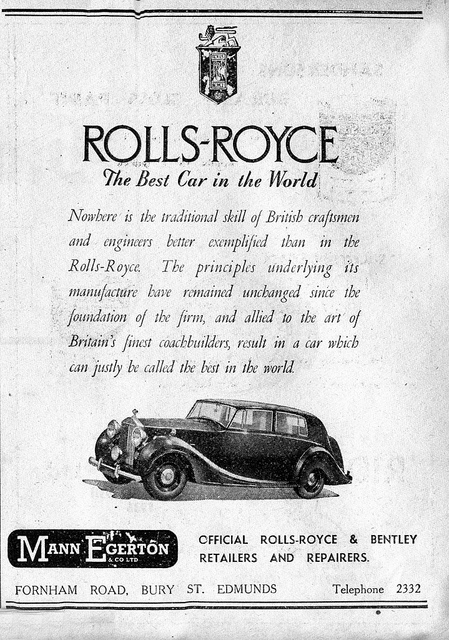
It all started with me being told that ‘Corsair’ had at one time, been the smartest little boat on the broads. She’d been owned by a Mr Campbell. The MD of Mann Egerton* – A large motor engineers in Norwich. Long-closed there are still some signs of its presence. Such as the ‘ghost sign’ still on Constitution Hill.

*there is a lot of interesting history on Mann Egerton – here; https://myntransportblog.com/tag/mann-egerton/

follow the tram lines!

I had written to his son, Jamie Campbell, who replied. It was the first of many ‘wow’ moments. His first communication confirmed that ‘Corsair’ had been owned by his family, and that they’d bought her out of hire in 1961.

Just think – in the early 1950’s, you could buy a lovely Broads Yacht, or you could go to Mann Egerton’s…

Jamie kindly proceeded to give me several photographs, and some personal memories of ‘Corsair’, which I’ll write about next time. Along with how I fixed the stem!!