Dear readers… this morning we managed to wake slowly, with no hysterics from Jalil… our temporary waterproofing HAS WORKED!
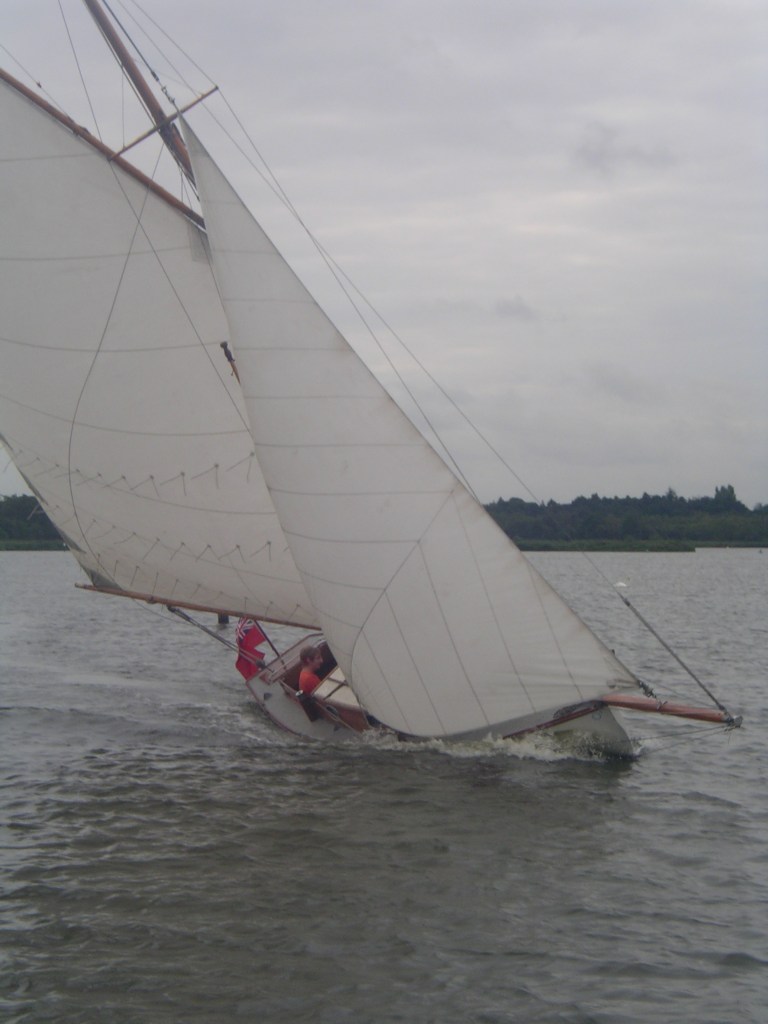
Despite the sheltered nature of the staithe – it was apparent that it was bloomin’ windy, something we discovered when we ventured onto Barton Broad. We set the ever familiar 2 reefs & middle jib, before storming across the Broad enjoying ourselves, and ignoring the chaos in the cabin (!)
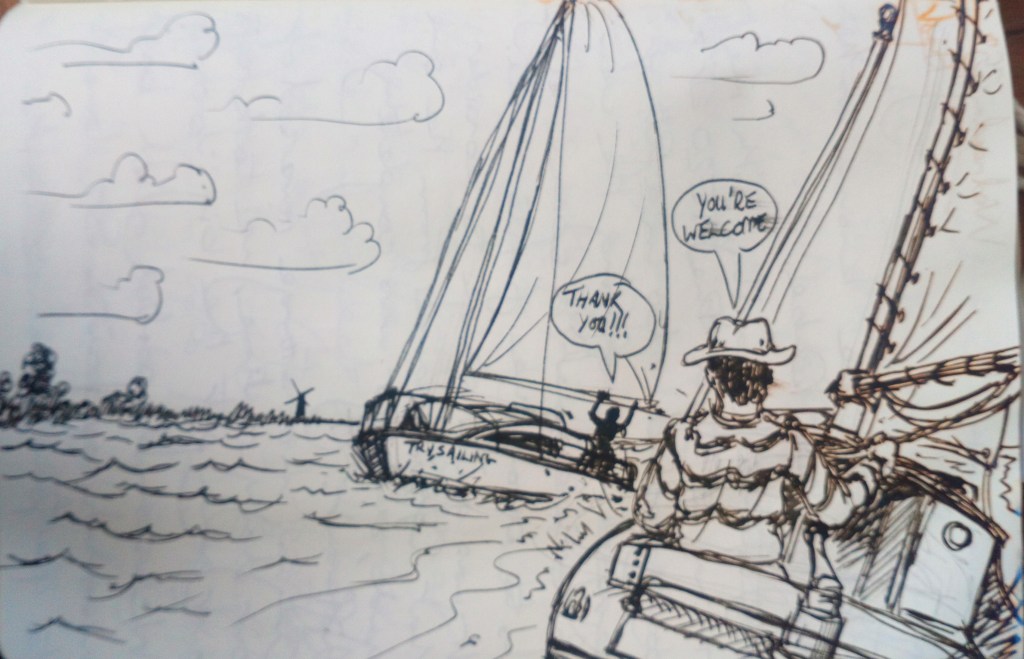
Whilst thundering around the Broad, we allowed ourselves a giggle at a hire-yacht branded with ‘TRY SAILING’ -which at times seemed a good suggestion for the helmsman to follow. (!)
This was said through gritted teeth!
Fun over, we decided that a tack down the Ant would be impossible – so we became tourist-esque. We motored to Stalham to wander around. It was at this point I bought a Tilley lamp, which turned out to be a complete lemon! (I think we were desperately trying to find ways of drying out the boat)
Sadly even the charms of Stalham weren’t enough to keep us there, despite a ‘en masse’ decision for hot showers at Richardson’s boatyard (behave! Not like that) So freshly laundered, we gave into the inevitable and motored downriver to Ludham Bridge, where we moored in half a bloody gale… holiday’s afloat eh?
The crew at this point abandoned me – choosing to sit in the cabin rather than endure another cold & wet slog into the rain. Can’t blame them! (but I will)
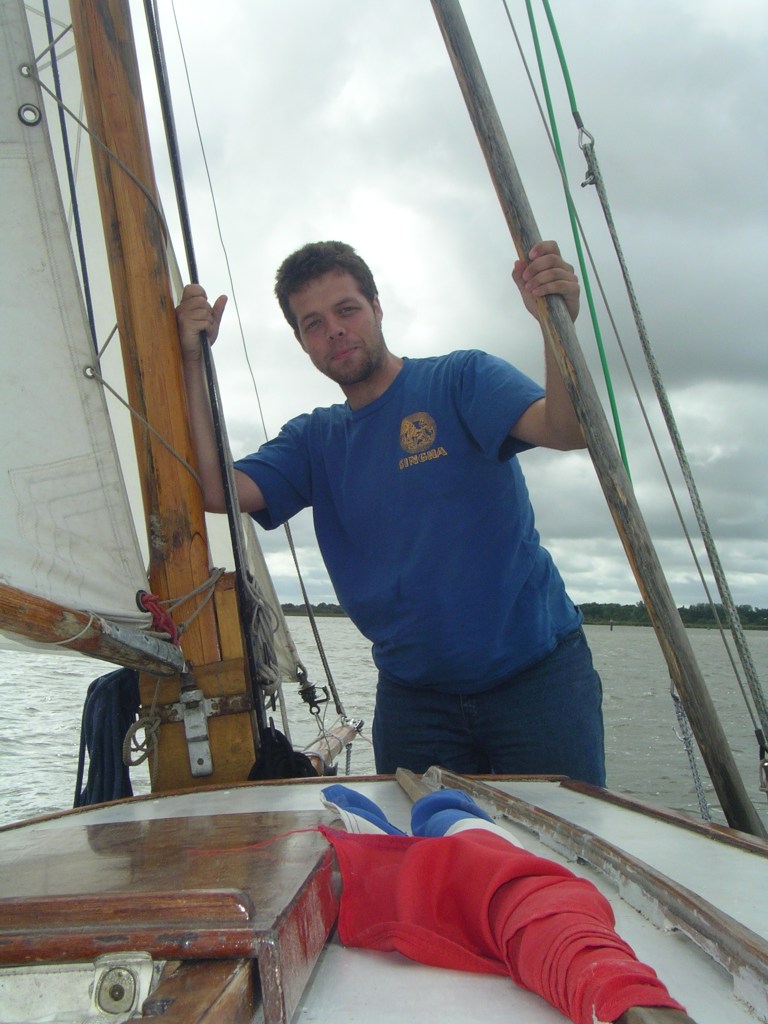
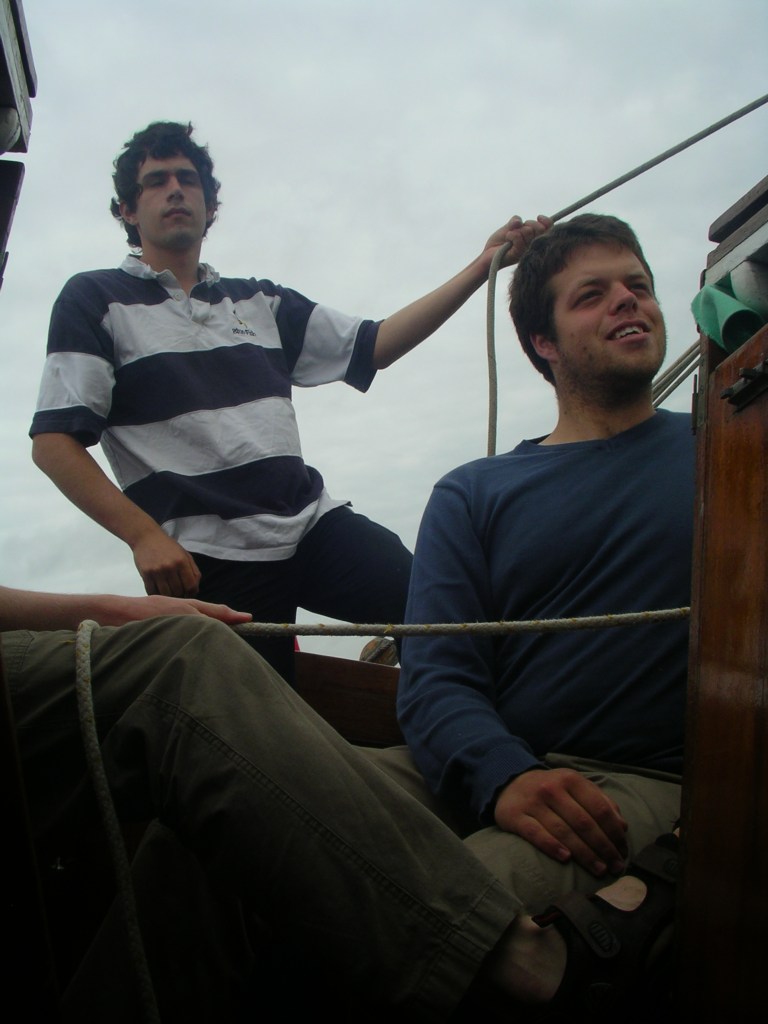
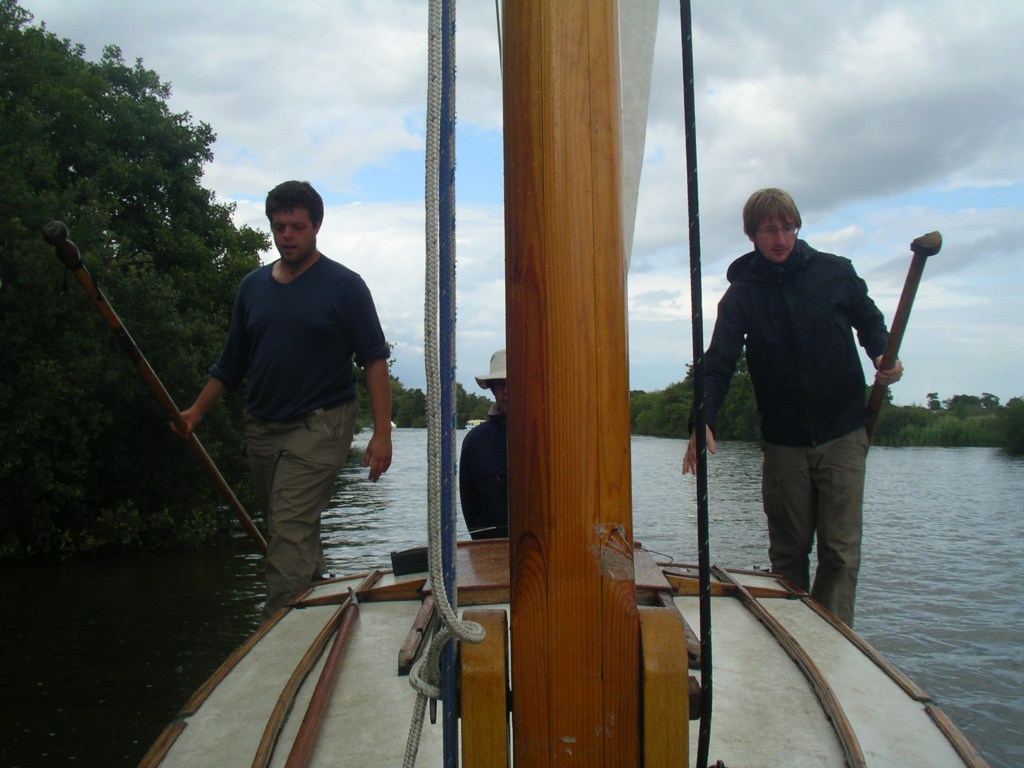
‘Enjoying’ ourselves in the summer weather.
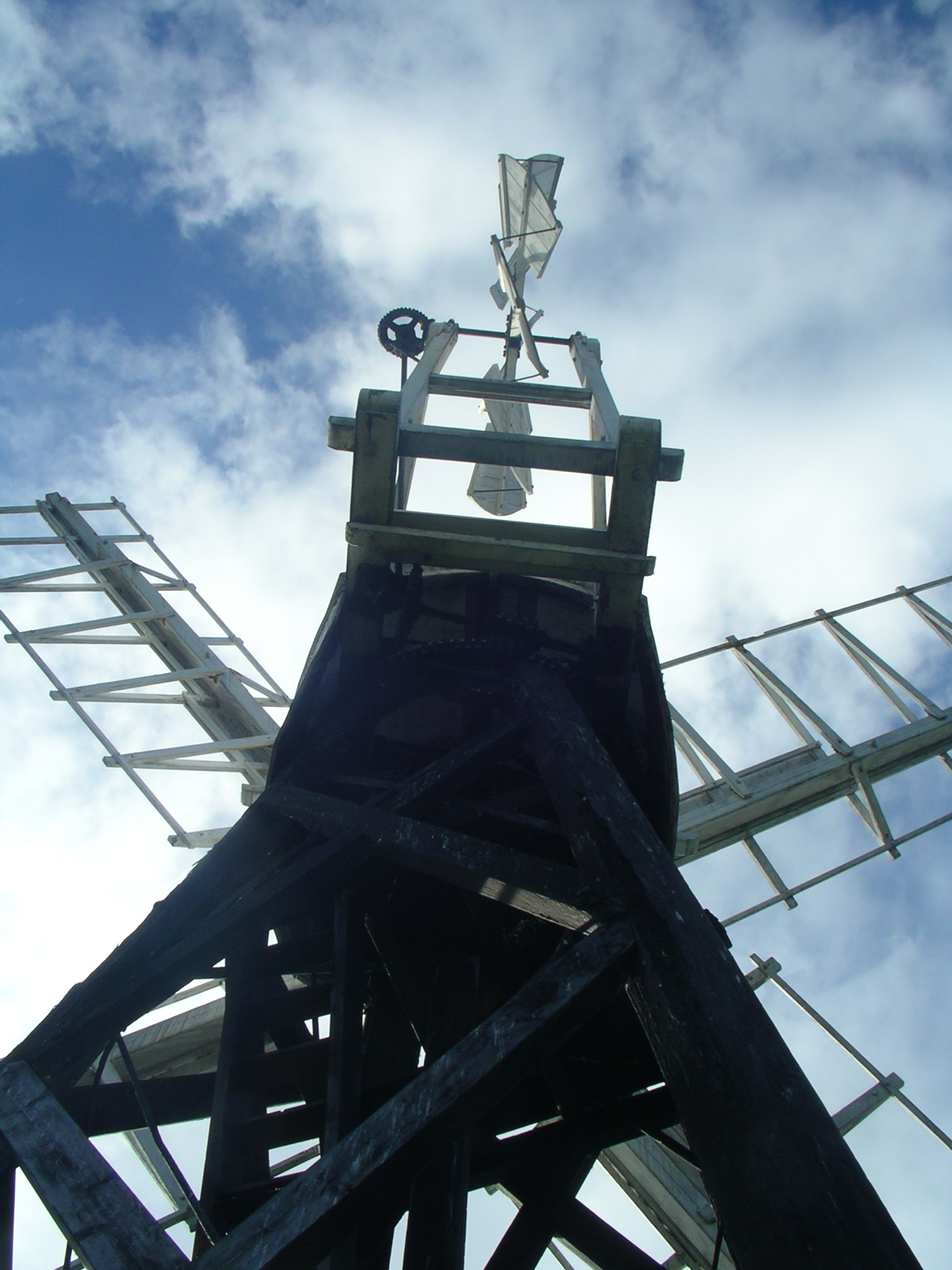
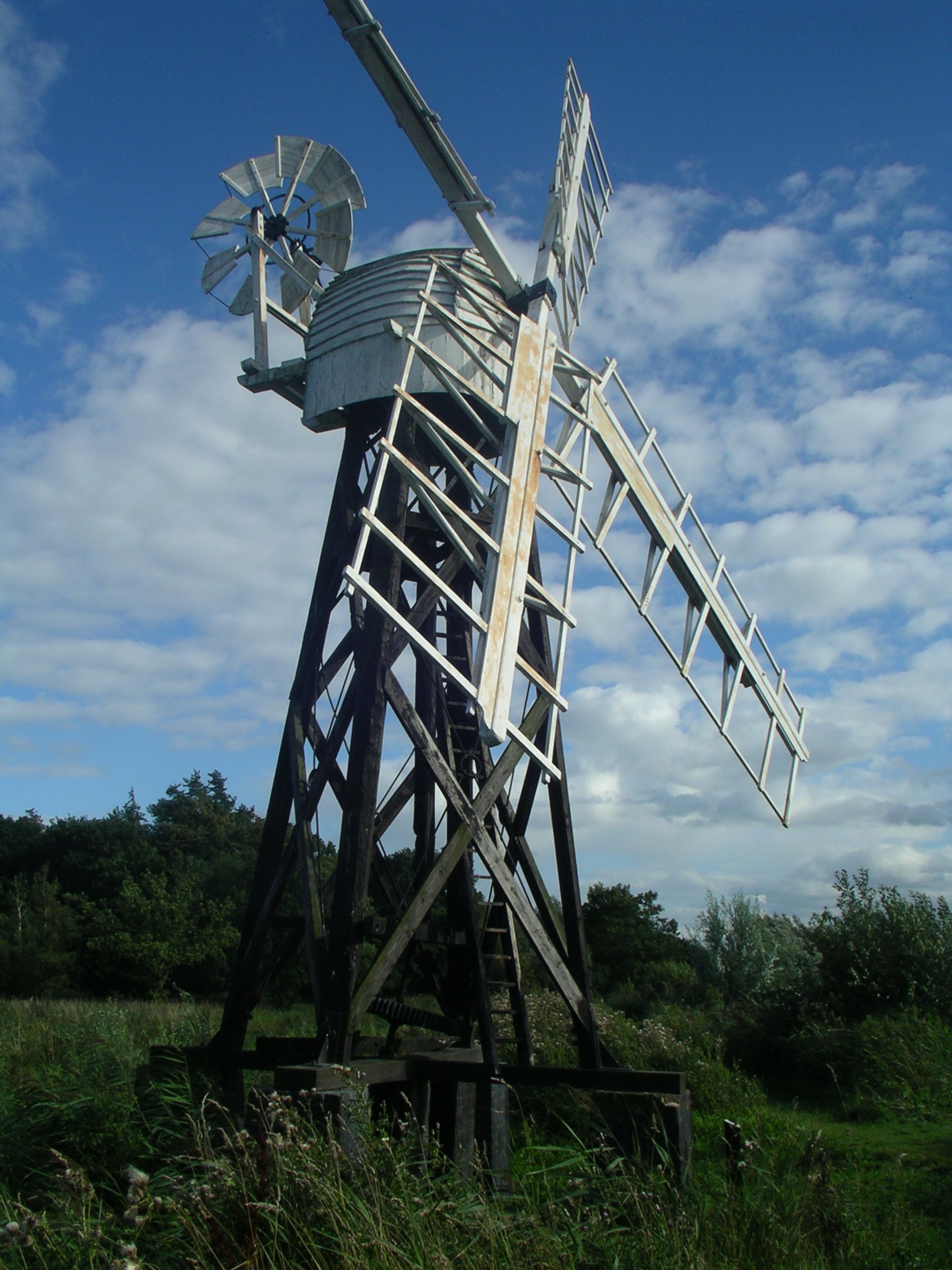
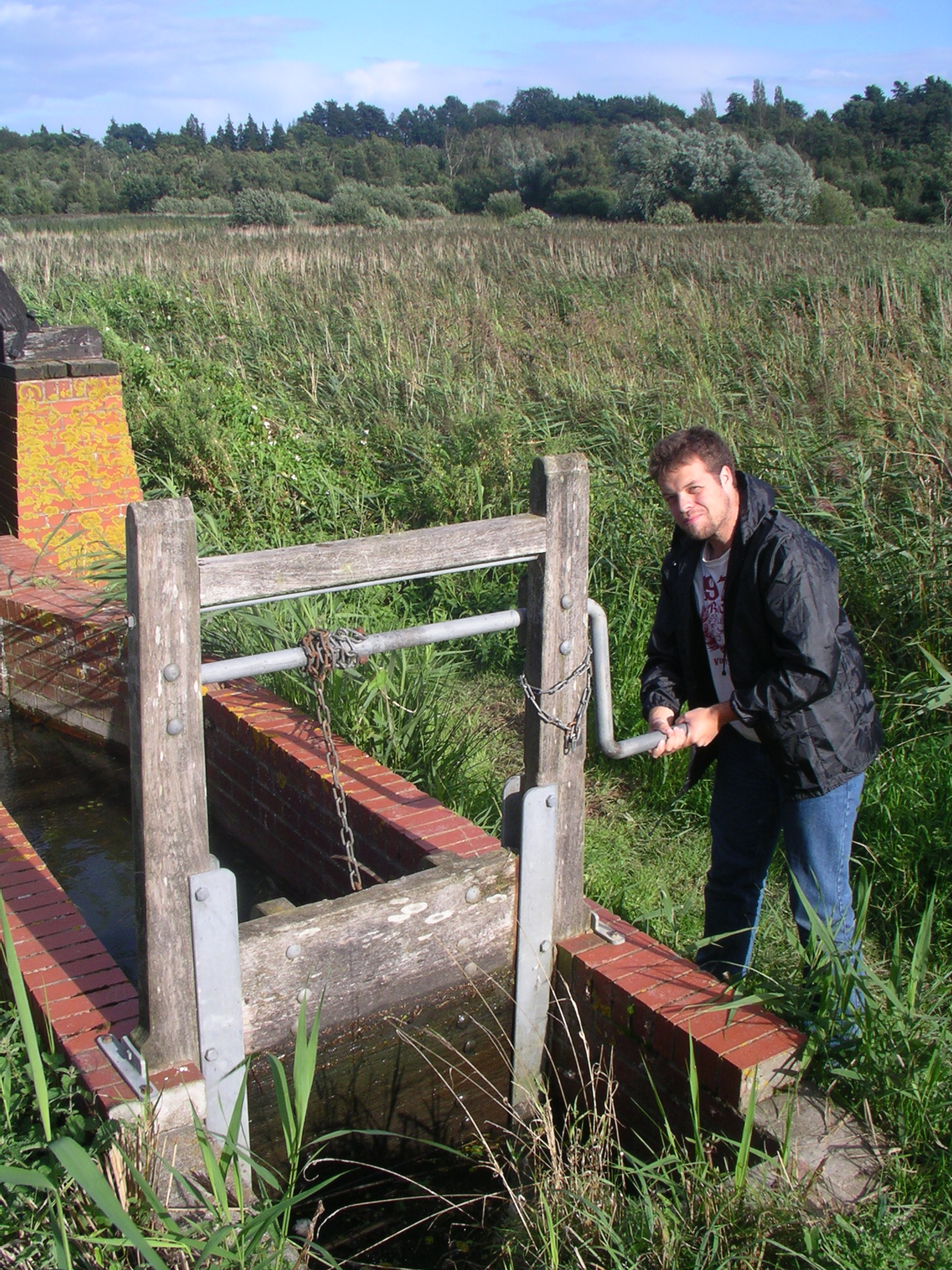
The weather did moderate a little, which enabled us to stop at ‘How Hill’ (more tourism) – walking around & inspecting both Toad Hole cottage & Boardman’s pump. Boardman’s pump is a trestle open frame mill, complete with its turbine pump (dating from 1897) – it’s amazing what you’ll read on an information board when you’re soaked through & fed up!
Sensibly at this point, we sought refuge in the ‘Dog Inn’ for the evening. Highlights (or not) was how we ended up in conversation with a film crew who were filming a short film called ‘Jam Today’ – for the UK independent film council. The weather meant these lads were stuck on a boat with beautiful young women. Bastards.
Today started with a sense of deja vu… Although without such a vibrant soundtrack, Mr Jalil was nontheless forced to vacate his bunk in search of drier sanctuary in the cockpit…
(At the time, we ended up duct-taping bin bans to the cabin side & routing them behind the bunk-shelf – diverting water mostly away from the mattress and sleeping crewmate)
This was to prove a persistant issue – and it wasn’t until 2016 I was in a position to attempt a permanent repair.
After such inclemency, the weather did improve somewhat. However before I divule such metrological bumphf I should mention the nice lay who sold us eggs… It’s all in aid of ex-battery hens & extensive testing of the said eggs (with bacon & fried bread) revealed that they are DELICIOUS!
Tacking out of Hickling – note the small rig (Day 3 of double reef / No. 2 jib!)
Despite this usual ‘slog’ – we bravely carried on! (I suspect heads may have been sore after the Greyhound P.H) and began a long tack into Potter. There’s little which can be said about tacking against the tie, however if you add a narrow river, moored boats, bungalows and trees… suddenly it becomes a more ‘entertaining’ scene. One small piece of Willow was our only trophy for our endeavours!
Mooring at Potter Heigham proved to be quite eventful… The Hunter’s yacht ‘Luna’ who after several abortive attempts made a down-tide mooring which saw our harassed bowsprit bending most alarmingly. Full credit to the skipper who performed a leap worthy of a gymnast which Theo was dragged along the bank trying to tether same yacht with its bow-line. Still… it’s only varnish!
Such excitement behind us, we motored slowly out down the Thurne, before tacking up the Bure toward St. Benets, this 2nd bout of tacking proved to be the only sunny interlude of the day – something which we remembered fondly later on…
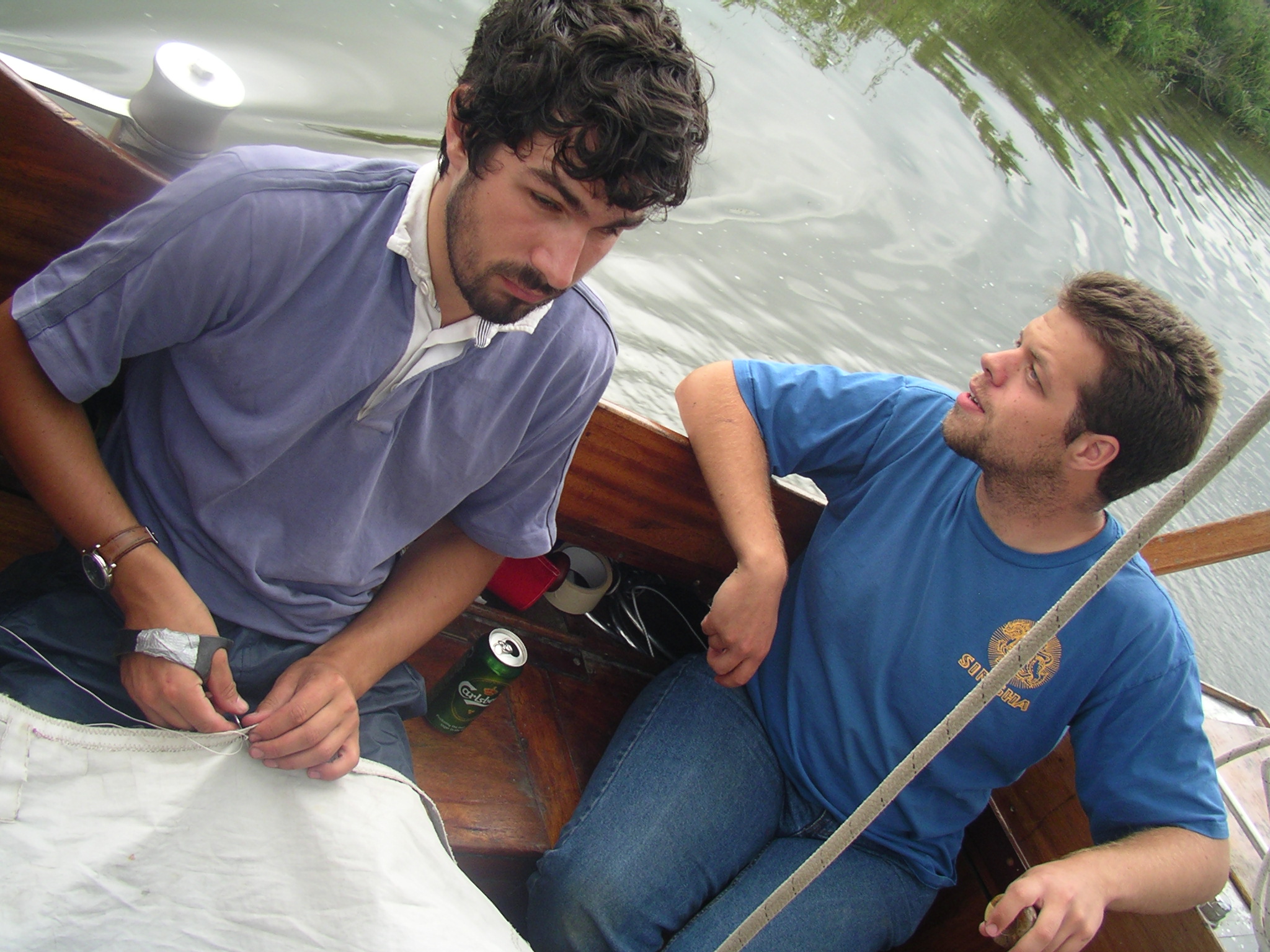
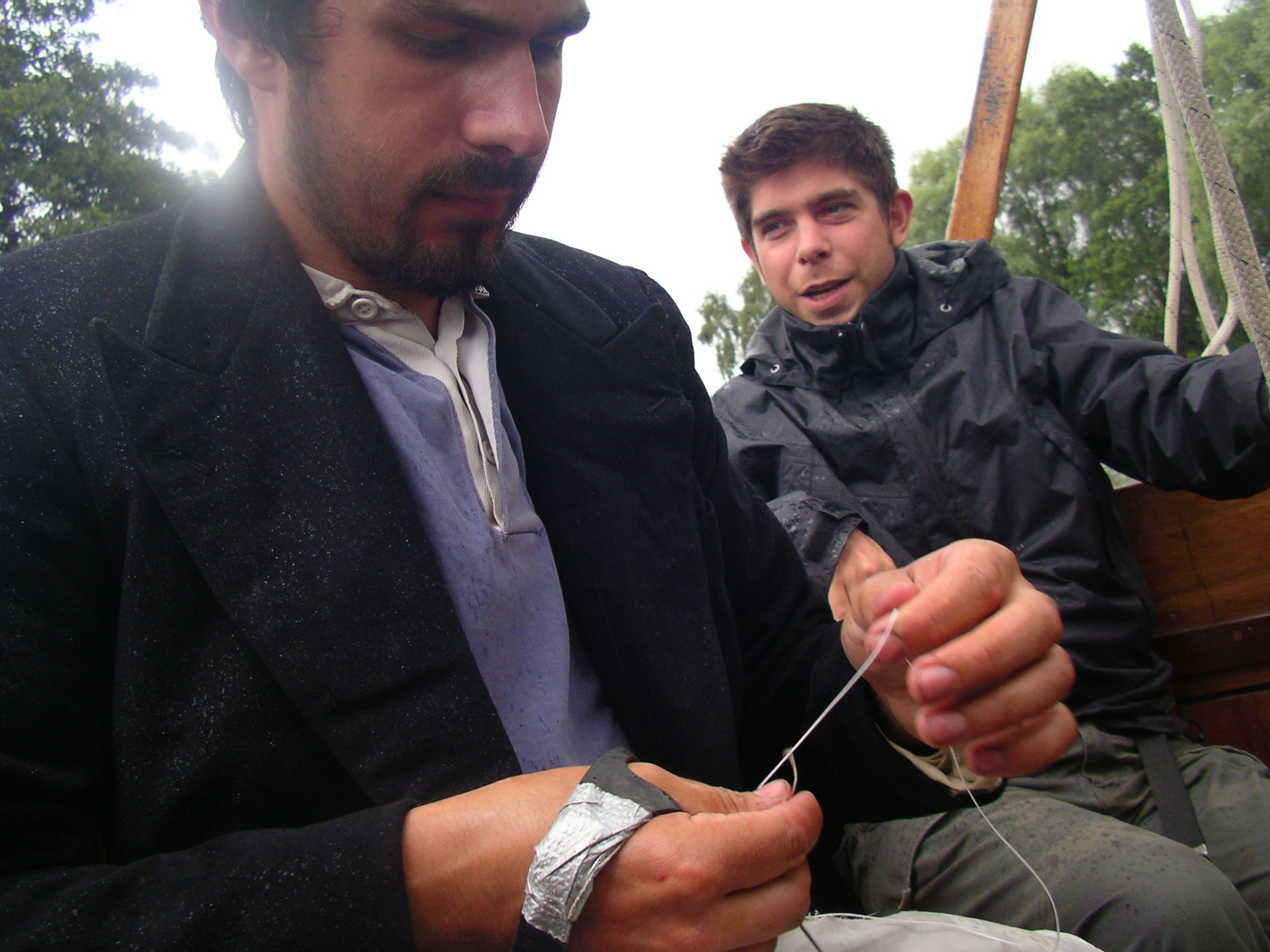
I can’t speak much for our trip up the Ant, except that I was busy repairing No. 1 jib (three repairs) and en-route we selected Neatishead as our destination for the evening.
Mooring & navigating to Neatishead requires care at the best of times, you dodge trees, motor-boats & other obstacles all the way up the dyke. So we went slowly…
… our unusual caution meant us getting caught in a viscous downpour which soaked us all to the skin. In such circumstances, we moored & ‘awned’ in record time. With both burners going on in the galley – we recreated a sauna whilst re-waterproofing Theo’s bunk with more bin bags.
Last night there was rain, not your average ‘oh dear it’ll do the garden good’ rain… but biblical, bouncing off the cabin roof deluge.
Still – could be worse!
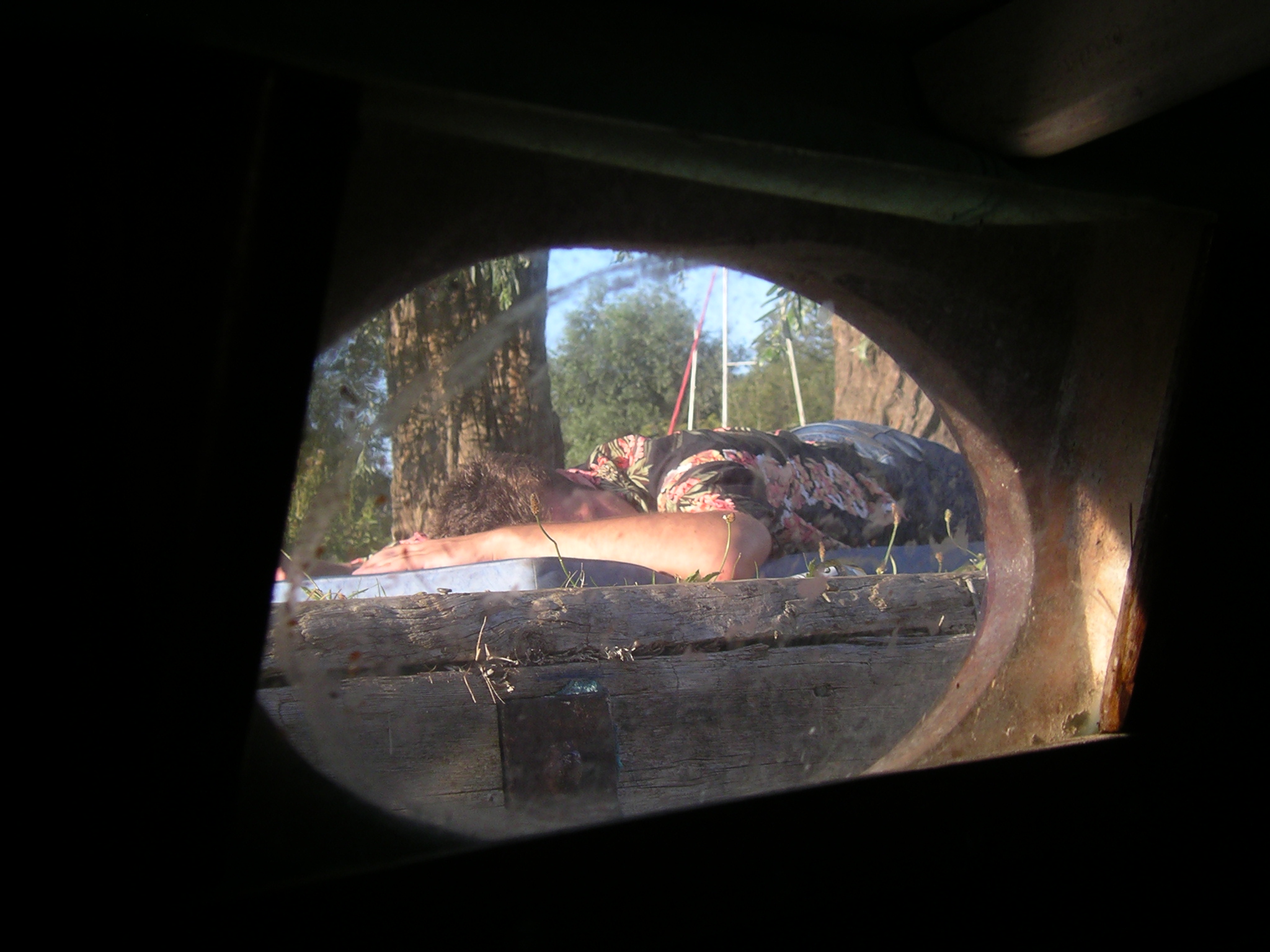
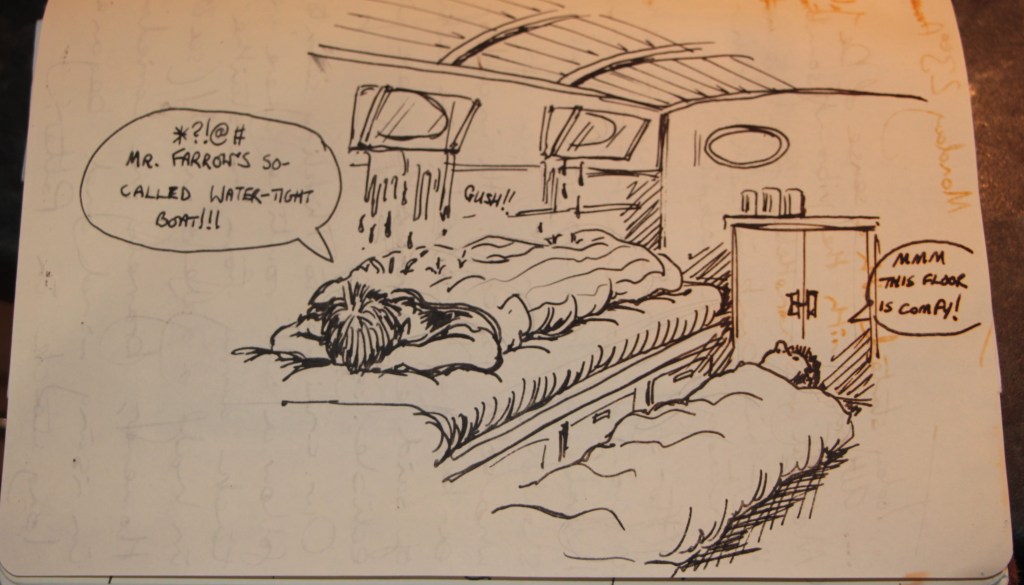
Truthfully my first conscious memory of the day was to see Mr Jalil storming indignantly out of the cabin (whilst still in his sleeping bag) muttering something about “Mr Farrow & his so called waterproof boat” (!)
Needless to say, he slept the rest of the evening in the cockpit – a miserable experience. ‘Corsair’s’ benches are just under 6ft long, and work ideally as seats – but not beds!
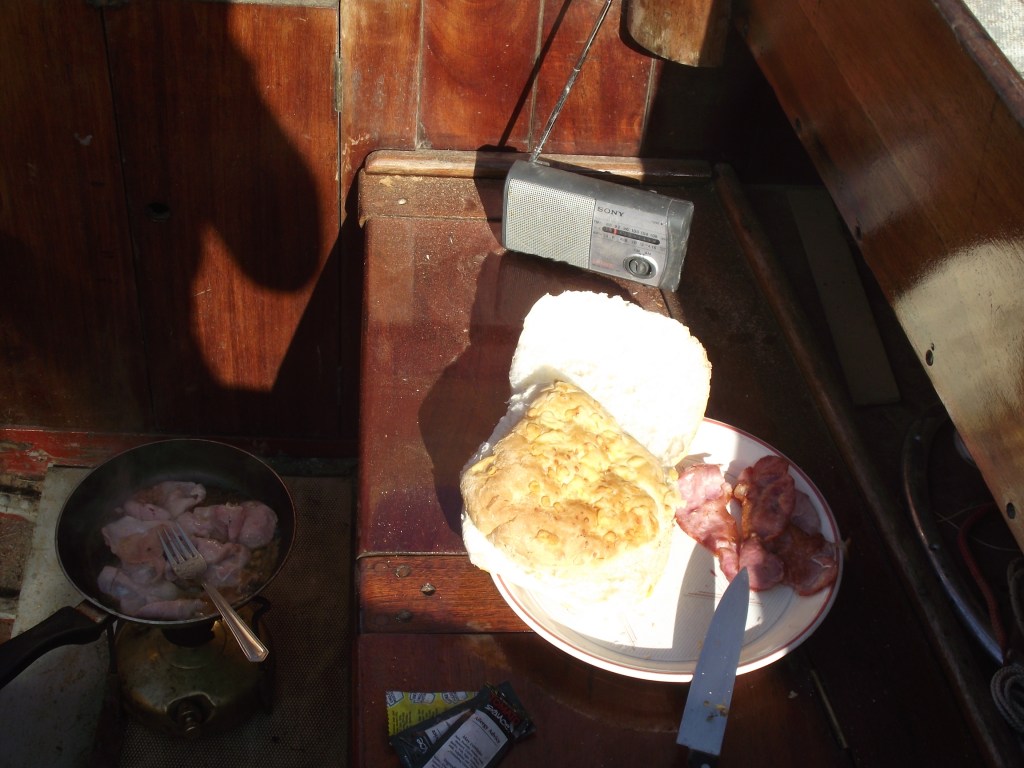
Sated with a cooked breakfast (these engineers are so very tempremental) we decided to keep our cut-down rig and sedately proceeded upriver to Potter Heigham, where with ice cream & burgers we lunched with CD & co.
The calming breakfast…
Having quanted through both bridges – we were treated at this juncture to the sight of several Hunter’s yachts scattering themselves across the river.
Evidently trying to ‘shoot’ the bridges, some had masts down, some halfway up, some just were a tangle of legs, string & quants… We noted all of them were ‘uptide’ of the new bridge (how brave!)
The Hunter fleet at Potter – with an interesting yacht below the bridge
Eventually, we set sail upriver toward Hickling, sliding along as we tacked through the bungalows to Kendal Dyke.
Here we were treated to a bit of champagne sailing, the wind had filled in to a steady sea breeze and ‘Corsair’ stormed across Hickling, narrowly beating local YBOD ‘Monarch’
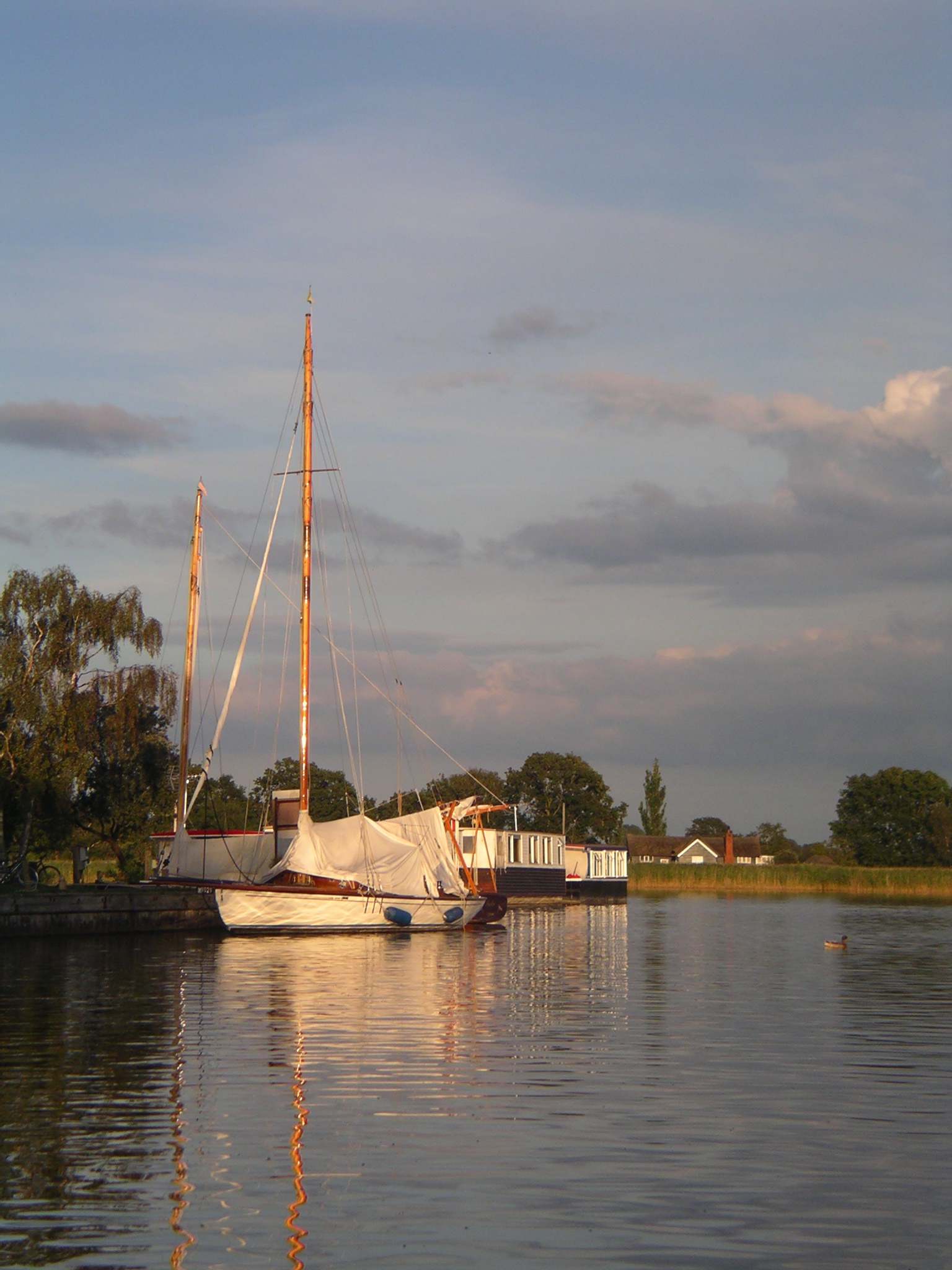
By now we felt truly ‘on holiday’ – Jalil managed to dry his bunk mattress in the evening sunshine, and as we were moored in the aforementioned sun, we sipped at Cab. Sauv. whilst writing this.
Afterwards in the wake of a spectacular sun-set we ventured ‘up the road’ to the Grayhound P.H. The skies were fantastic, purple even!
For those of you who’re familiar, each year the reality of having an old wooden boat meant I also holidayed… aboard my old wooden boat. 2010 was no different!
Day 1
Today, as ever was quite hectic (this stands true now – no matter how prepared I think I am – I still end up pulling a superhuman effort to leave the house on time with all the gear I need for a sailing trip)
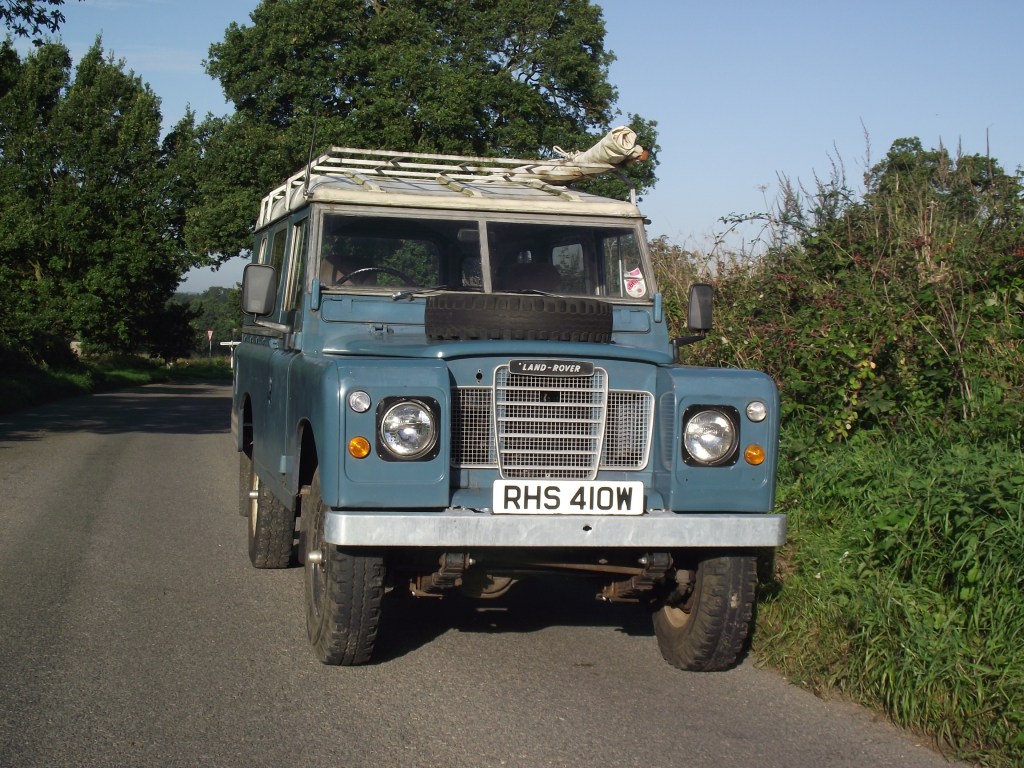
The precious/vital items you’ve forgotten, the last minute jobs etc. This year it was further compounded by ‘Boris’ a truculent 30yr old Land Rover;
The L/R
You get 2 choices at Oby – make several time-consuming trips, OR make one lung bursting, eyeball popping legs-bowed trudge – thinking stoic thoughts about pack mules. The path itself was also uneven, often muddy & with livestock to contend with…. Character building!
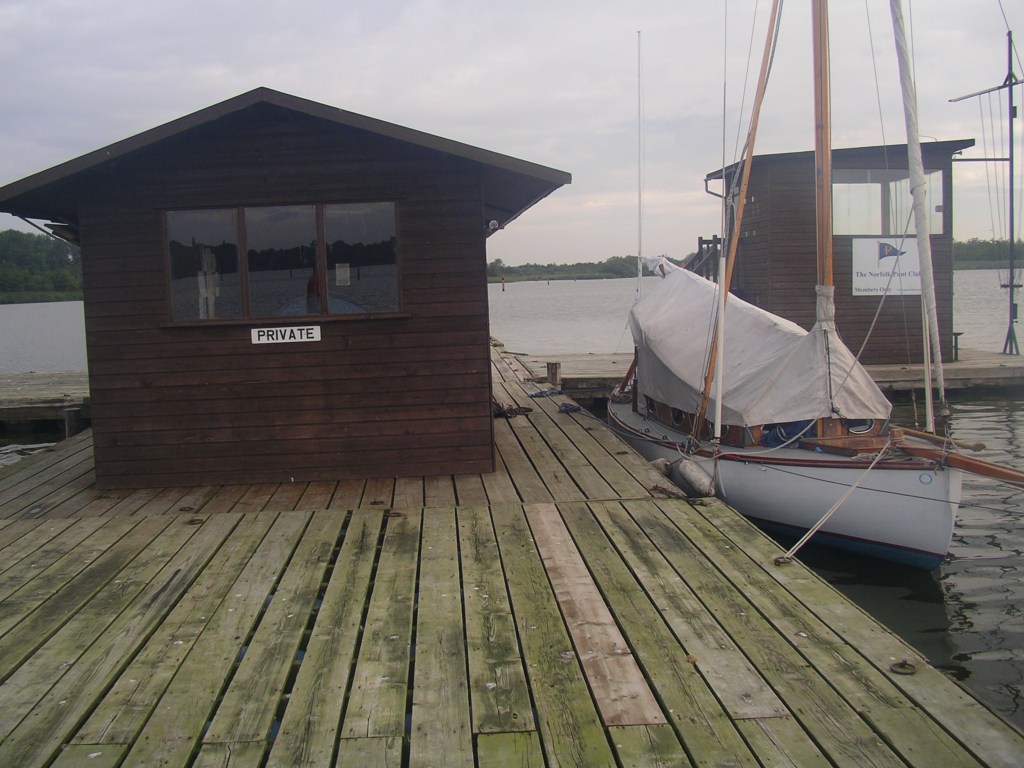
With ‘Corsair’ loaded – we then entered our usual underwater ploughing competition to leave the mooring. 3ft 8″ draft. Sigh.
(having just bought a L/R with a 2.6L straight six – I was resigned to sailing without the engine as I couldn’t afford petrol for both. Improves your sailing skills, but watching both quants bend like bananas as we forced ‘Corsair’ through the mud always was unnerving!)
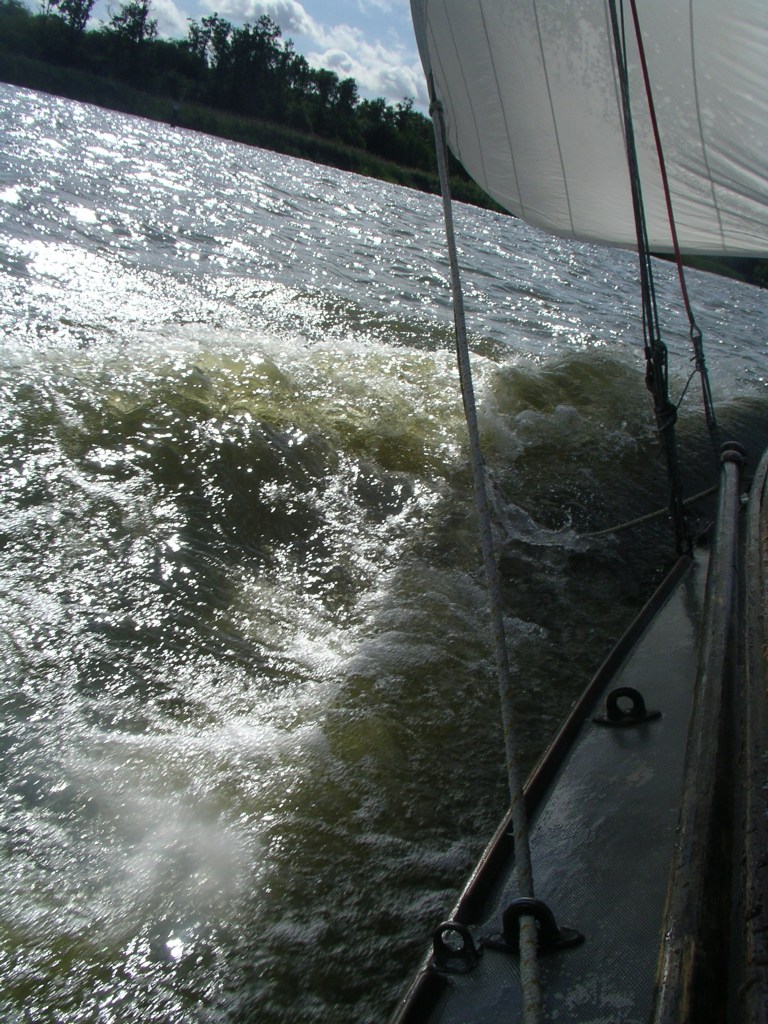
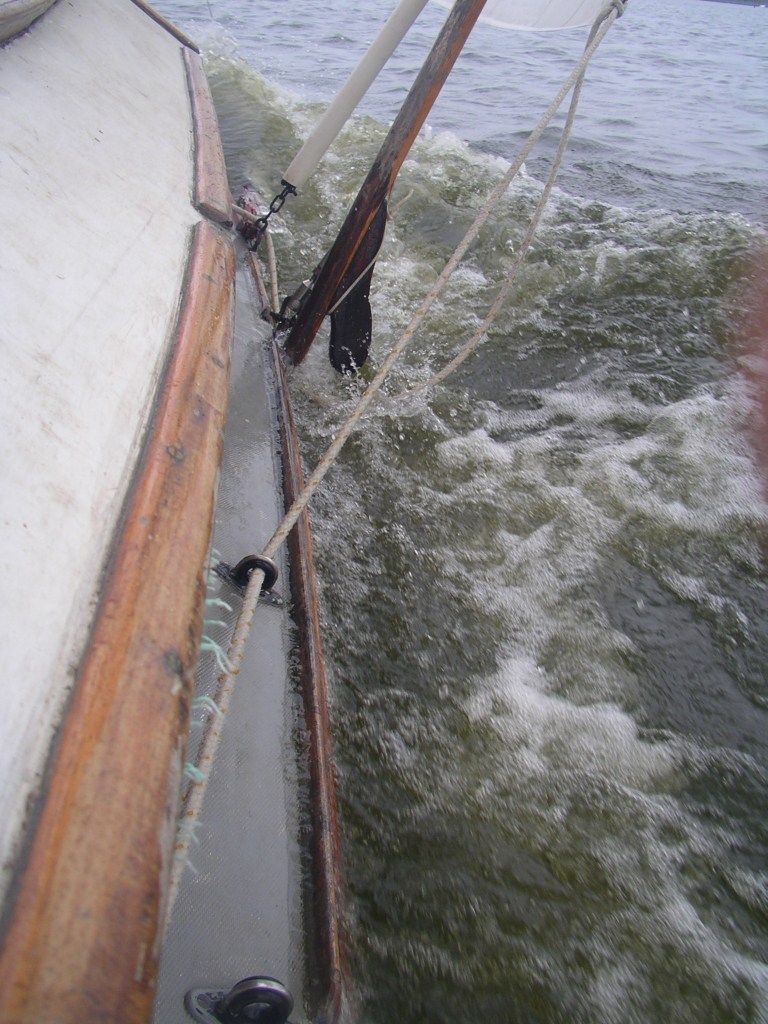
Freed, we set two reefs & middle jib saw us storming up the Bure toward Thurne junction. Despite our efforts at reefing, control soon became marginal (!)
Situation ‘not ideal’
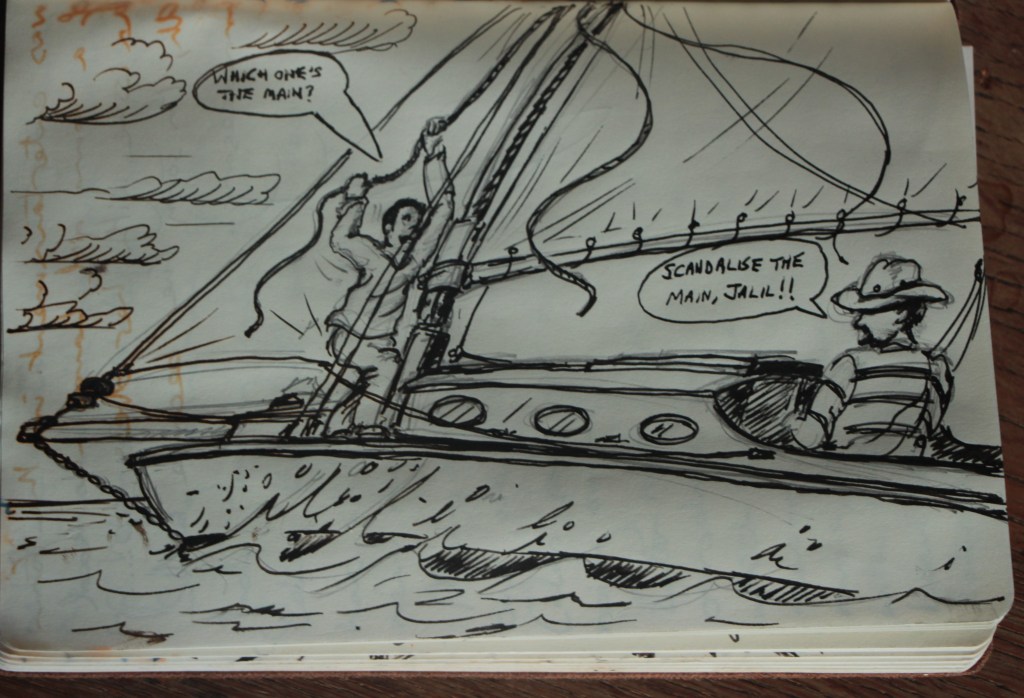
…and it was only the sterling work of Mr Jalil (who I note has been promoted for 2010?) that brought relative calm by scandalising the mainsail.
We ventured up Womack water for the evening, and sliding upriver we spotted ‘Pickin Jack’ looking quite forlorn outside Colin Buttifant’s yard. Evidently he has still yet to complete ‘Seabird’s’ new mast…
(nb ‘Seabird’ had sustained an injury whilst acting as start-boat for Reedham regatta. Colin B. being tasked with a new mast. ‘Seabird’s’ owners been reported as muttering “I wanted a new bloody windscreen not a new bloody mast” to much hilarity.)
Mooring at the staithe proved tricky but we slid into a little spot!! We adopted our usual trick of aiming at the gap – pushing in until the fenders sqweak, keep pushing then adjust the other boats mooring lines to make the space fit ‘Corsair’… works every time – especially with unsuspecting tourists.
In fact, my top-tip for mooring next to holiday-makers. First come alongside, then step aboard… Get a line on the nearest cleat. Then, and only then ask if its okay to moor alongside them. Got it?
(alas boat next door turned out to be noisy swines)
Later that night, we found ourselves in the King’s Arms, which for some inexplicable reason had a DJ and the music… more bloody noise!
Well peeling your eyelids with rusty nails would have been less painful. However later in the evening there was entertainment in the form of Laura (also a pub-goer) who had an issue with her dress zip(!)
(The logbook notes the skipper became all unnecessary at this point & ends abruptly)
Very opposite sailing at the moment. From sailing fully reefed in a near gale to a flat calm, on a beautiful, crisp day.
Personally – I think it’s worth keeping the boat in until December, Autumn does give some beautiful days, so I resolved to make the topsail work, with a proper spar.
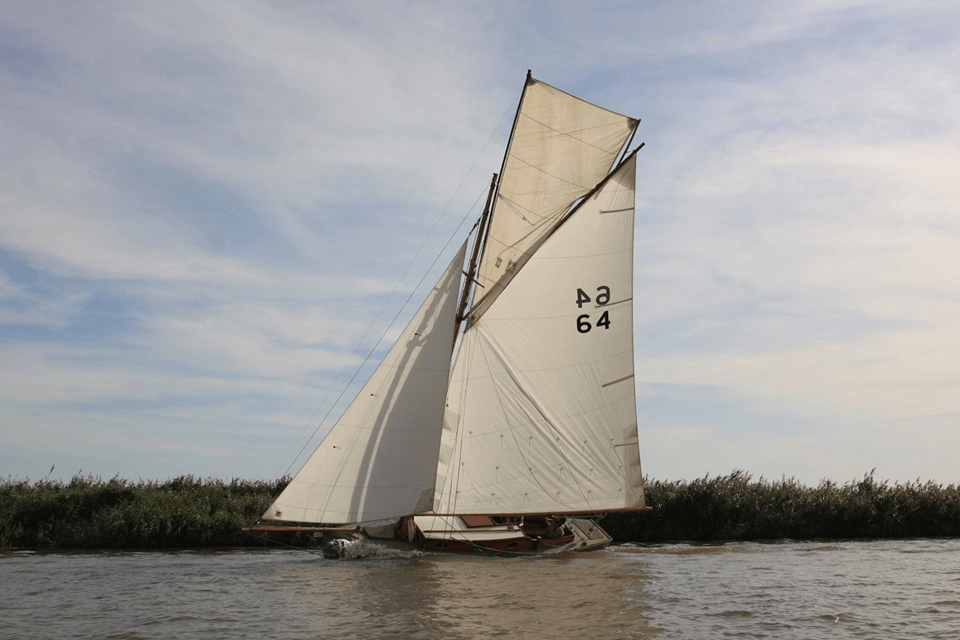
I sailed ‘Corsair’ for the 1st time with her topsail this year, at Cantley Autumn Regatta with the Yare Sailing Club. Here’s a gratuitous photo;
Corsair with topsail.
I’m not going to pretend that’s set well. In face, given that it’s hanging off my quant pole, which is at least a metre too short, the yard is tangled the wrong side of the gaff, and the peak isn’t high enough I’m reasonably surprised we came 3rd in that race!!
Sticking to my principles, the rig should work, and it should look right. So I resolved to make the topsail set properly. I’ve previous experience of jackyard topsails, having spent a lot of my teenage years sailing a topsail rigged halfdecker;
Grace – my halfdecker. Topsail contrived from upside down BOD jib.
Unlike his counterparts though, I am unable to send a man or two afloat to stow the topsail – neither do I have a clue when he advises us to be mindful of “passing the weather earing”.
So – first hoist of the topsail, and it was apparent that the sheeting angle was wrong – with the sheet being too low on the yard. Even worse – on port tack the yard pulled away from the mast, allowing everything to ‘twist’;
I appreciate that topsails & mainsails are two separate sails. However, for the purposes of my simple brain – one is an extension of the other. And a ruddy great gap in the middle of it doesn’t help.
So down it all came again!
Rig adjustments are subtle. The sheet was moved by 3 inches, and an addition line was added, which held the topsail spar close to the mast, and ensured it would be parallel at all points of sail. This is tied loosely to the spar – so it just pulls ‘in’ to the mast, I don’t want it to impact on the downhaul, which you can see is caught up in the topping lift.
So next attempt revealed the sheet was wrong (by 1 inch) and the second halyard (for want of a better name) was also ‘out’ by about 4 inches.
Lowered again… Avoila!
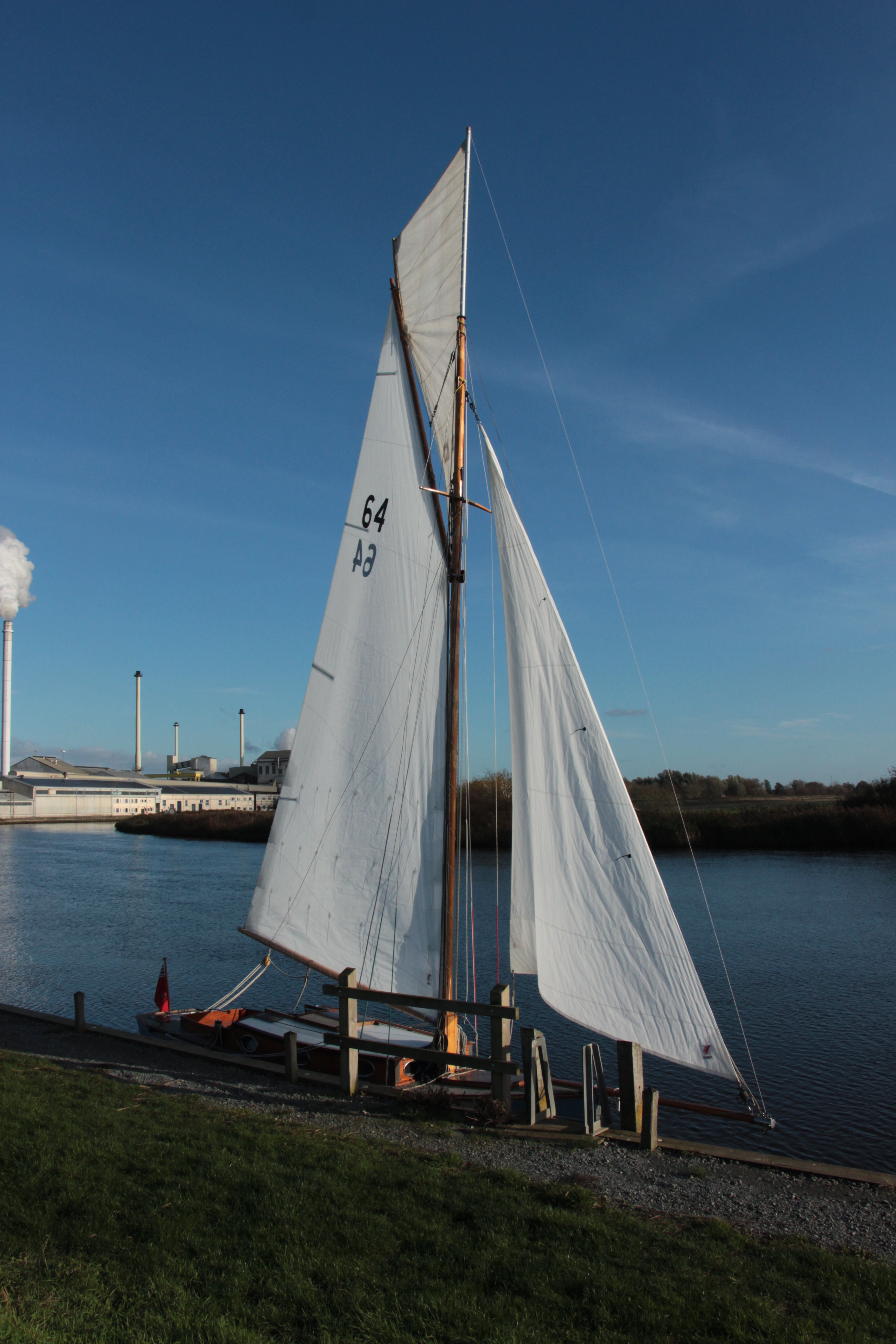
Nicely set.
So, in my book, that’s not bad. Crease diagonally up and down the main from peak to tack. Topsail yard nicely vertical. Load on the jib & the topsail forestay.
Crucially – I’ve marked everything on the spars, and given that I was knee-deep in rope on the forepeak I’ve had some thoughts about extra cleats, and some rope bags to tidy everything.
I’m pleased with this. Just got to test it all over the next few Autumnal Days.
Bliss.
My ambition to have a rig that works well on ‘Corsair’ have been a constant process if I’m honest. During 2009, I made some alterations to the jib, effectively cutting it parallel to the luff, removing approximately 12 inches of sail up its length.
At that time, I had hoped to resolve some issues with occasional lee-helm, and soon reduced the length of the bowsprit to match. From this photo in 2009, you can see that the jib doesn’t quite ‘fit’ the foretriangle;
Small jib – big gap!
To be honest, this set-up worked beautifully for me, at that time. Sailing single-handed I wanted really positive weather-helm. If it all went wrong, I needed to know the boat would luff, and come to a halt.
This was the thinking behind the original hire-boat rig, keep a small jib, so that the boat will automatically luff and stop. Also, for hire-boats any bowsprit would only be a unnecessary damage making implement!
‘Corsair’ has had 4 rigs now throughout her 68 years. She started off a stem-head sloop. First with a self-tacking jib, then a loose footed jib. In 1961 she gained a small bowsprit with the Campbell family, with a larger, high peaked mainsail. In 1989 she gained the ‘large’ topsail rig whilst in the ownership of Joe & Julia(originally cut 1978 for ‘Sabrina’ s/n 71). Joe & Julia actually kept the old sails, and the original bowsprit – enabling them to have either a ‘big’ or a ‘little’ rig.
Finally in 2019 she got her current rig – the 2nd time in her 58 career as a private yacht that she’s received brand new sails, specifically for her!
So, will I keep the rig in its current form? If history repeats itself, she will probably end up carrying this suit of sails for 40 years or so – so who can say?!
I know that for now, the extra string, extra effort and space needed for a topsail is manageable – but I can’t say how I’ll feel about it in 5, 10 years with any accuracy really.
I am glad though, the rig now can be set properly, or as near to as I can get!
So, back to the 1960’s – Peter Olorenshaw had disposed of ‘Corsair’ quite soon after acquiring her, and she was on the bank at Brundall. In truth, she was having an ignominious time of it.
Peter Olorenshaw is credited however with reducing the sail gear by lowering the peak slightly, and fitting an inboard engine. A Vire 6hp, with a hotch-potch arrangement of different height cockpit seats to accommodate this.
Whilst the engine itself is long gone, there is a remaining legacy, namely the ‘slot’ for the gear change lever in one of the cockpit lids.
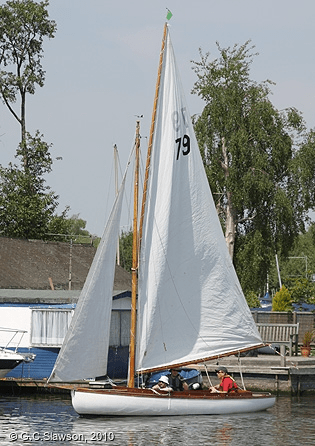
The Campbells had swapped her for a fairly new White Boat (No. 79 – The Old Lady), seen here in 2010;
Photo – G.C. Slawson.
In 1964 – brothers John & Peter Olorenshaw registered as a owners of Norfolk dinghy, essentially each time ‘Corsair’ found herself moved on, for a smaller boat!
The Norfolk Dinghy was originally conceived by Herbert Woods, legendary Broadsman and boatbuilder from Potter Heigham. The prototype is actually No. 2, that’s another story!! The first Norfolk dinghies were built in 1931, costing approximately £65. It’s rumoured they were an alternative to the International 14, which at that time cost 150 guineas. The Norfolks were mostly built pre-war.
For the Olorenshaws, their dinghy was built in a period where that class was slowing down. In fact from 1951 to 1968, only 9 new boats were built. In the pre-war days, averages of 6 or 7 new dinghies a year wasn’t uncommon! The Olorenshaw brothers only kept their Norfolk from 1964 until 1977.
Prior to the Olorenshaw’s passing ‘Corsair’ on to her next owner, (she was sold in 1969). Her next owner was in fact, across the Atlantic!
As a young man, Stephen Hinde had taken 6 months’ work in a department store in Detroit, Michigan, which lead to him being in a position to purchase ‘Corsair’. Although he first covered approximately 12,000 miles on Greyhound buses, travelling around America.
Once back in the UK, Stephen was mulling over which river cruiser to purchase – prospective craft being either ‘Corsair’ or ‘White Wings’ (S/N 1)
So yes. ‘Corsair’ was purchased at Brundall (Brooms Boats) there being a family connection between the Brooms, and the Olorenshaws. Her new owner Stephen Hinde. His family interestingly, also were business owners in Norwich. His great grandfather founded ‘Bonds’ department store, now part of the John Lewis chain.
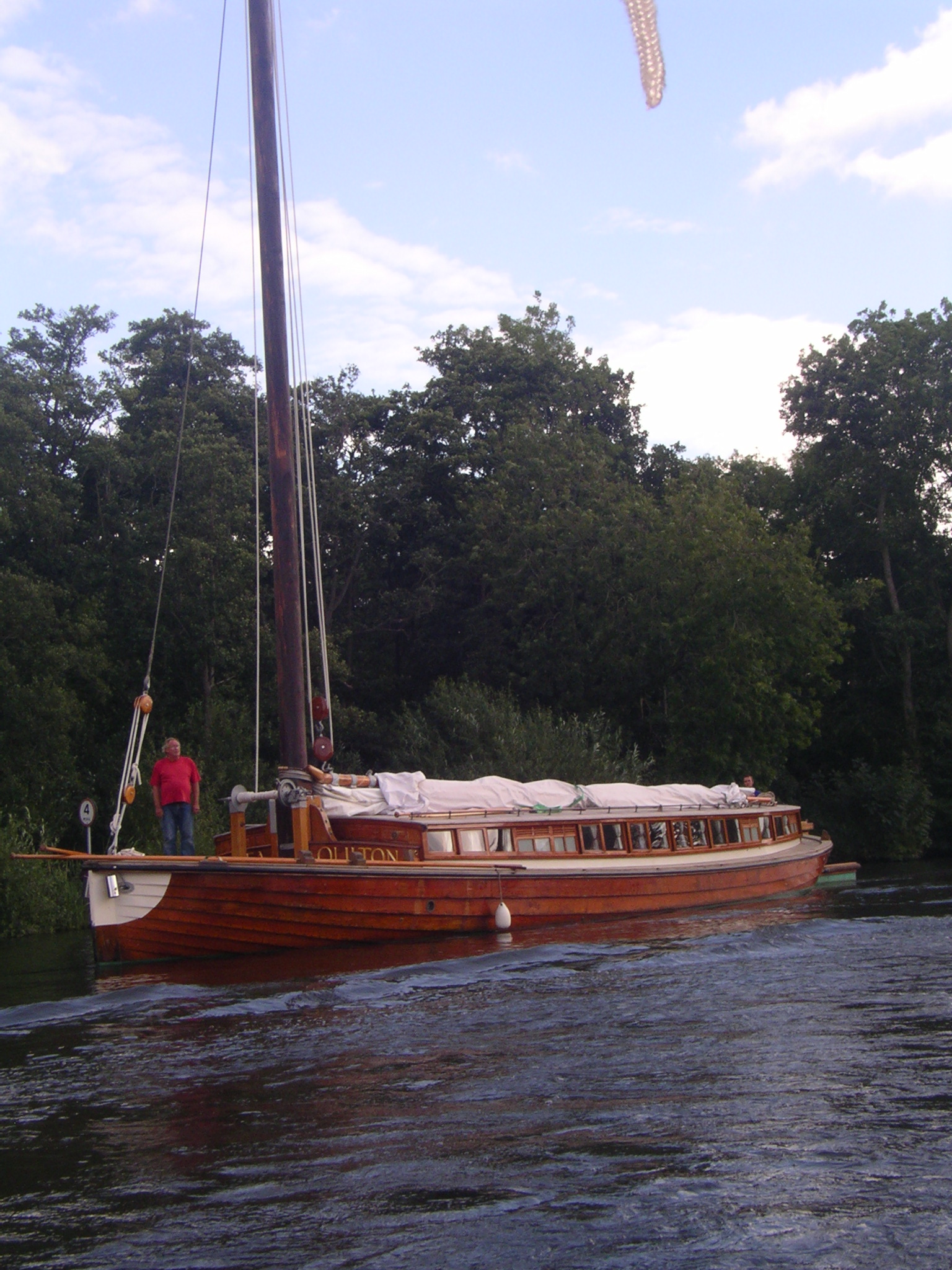
His grandfather Ernest Bond also owned the wherry ‘Lorna Doon’;
Wherry Lorna Doon – presumed onboard, Robert Bond & possibly his sons Ernest & William.
Again – ‘Corsair’ had secured the attentions of a devoted owner, thankfully with the means to keep her well. Stephen’s first impression was that a lovely boat, but in the wrong place!!
I have been lucky enough to correspond with Stephen, and having met both he and his wife Janice at their home – and as such I was able to piece together more of ‘Corsair’s’ history.
At this time, Stephen was a member of the river cruiser class committee, so it made sense for ‘Corsair’ to be kept at Wroxham broad, with her own buoy near the public beach. Hence on the 29th June, 1969 he undertook his maiden cruise, sailing ‘Corsair’ from Brundall to the northern rivers.
I am fortunate enough to have in my possession several photographs of Stephen’s ownership. He not only sailed ‘Corsair’ actively within the river cruiser class, but also achieved some success, winning the ‘Rogue Tankard’ one Barton regatta. He also competed in the 1970 3 rivers race, with the Bakelite plaque now kept in my desk drawer.
L-R; Rogue, Corsair (in the lead) Swallow & Barracuda – Wroxham c.1965
During this time, ‘Corsair’ was over-wintered at John Clabburn’s yard; ‘Dawncraft, where it was necessary to replace some of the original sapele planking, even at this comparatively early stage in her life.
Also in 1970, he took ‘Corsair’ down Yarmouth harbour, just so she could sniff at the salt water – something to my knowledge which wasn’t repeated for her until 2012, where she was berthed at the Royal Norfolk & Suffolk Yacht Club for their regatta on Lake Lothing.
Stephen had fitted an accessory which I understand is entirely bespoke to ‘Corsair’, and I’m not aware this has not been repeated by another Broads yacht before or since!
On the cabin roof, in the aftermost port corner, there is a shaped wooden holder, which receives a chromed spotlight. This was to enable night-time sailing! It too, is retained and lives in the forward cabin drawer under the starboard bunk.
Given the context of Stephen’s work (he was part of the family business, Bonds department store) it is evident that the search light was actively used, particularly as Saturday was a working day for him. He specifically recounted its’ use on a midnight navigation of Meadow Dyke, one summers’ evening – eventually mooring under the familiar silhouette of Horsey Mill.
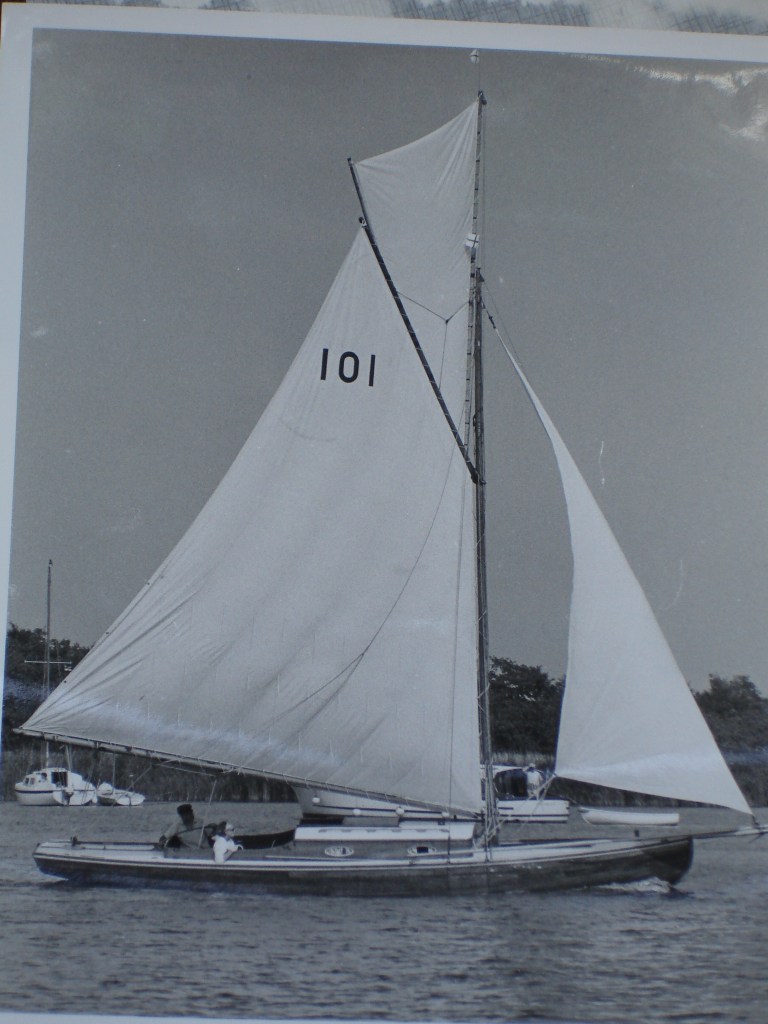
During 1974, after Stephen had married – another Broads yacht caught his eye – s/n 101 ‘Loyalist’, a larger fully varnished Broads yacht that had been built for estuary/coastal work in addition to Broads sailing. He’d bought ‘Loyalist’ whilst still owning ‘Corsair’, and no doubt needed to focus his energies on the new…
RCC S/N101 – Loyalist. Built by Ernest Woods, as an estuary / inland cruiser. A beautiful and powerful boat.
As such, after a busy 6 years of racing and cruising, which included taking ‘Corsair’ to every single head of navigation on the Broads, Stephen put her into a boat auction at Potter Heigham. He recounted to me that the price achieved was somewhat lower than he’d hoped, and as such he removed certain equipment from her itinerary. Much later (42 years in fact) I was able to reunite ‘Corsair’ with certain items, including a fitted winter cover, still bearing the legend “Jeckells Sailmakers, Wroxham).
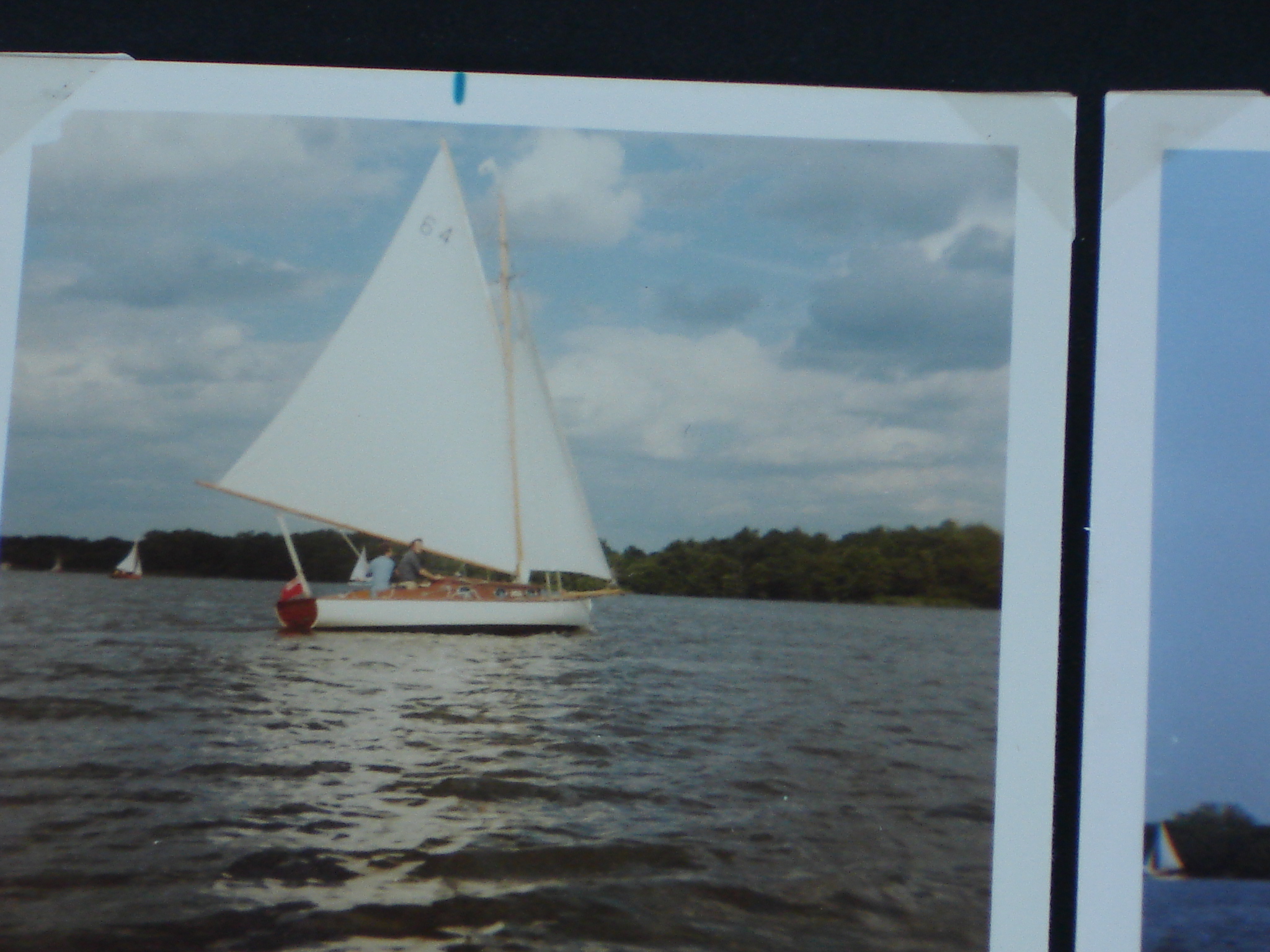
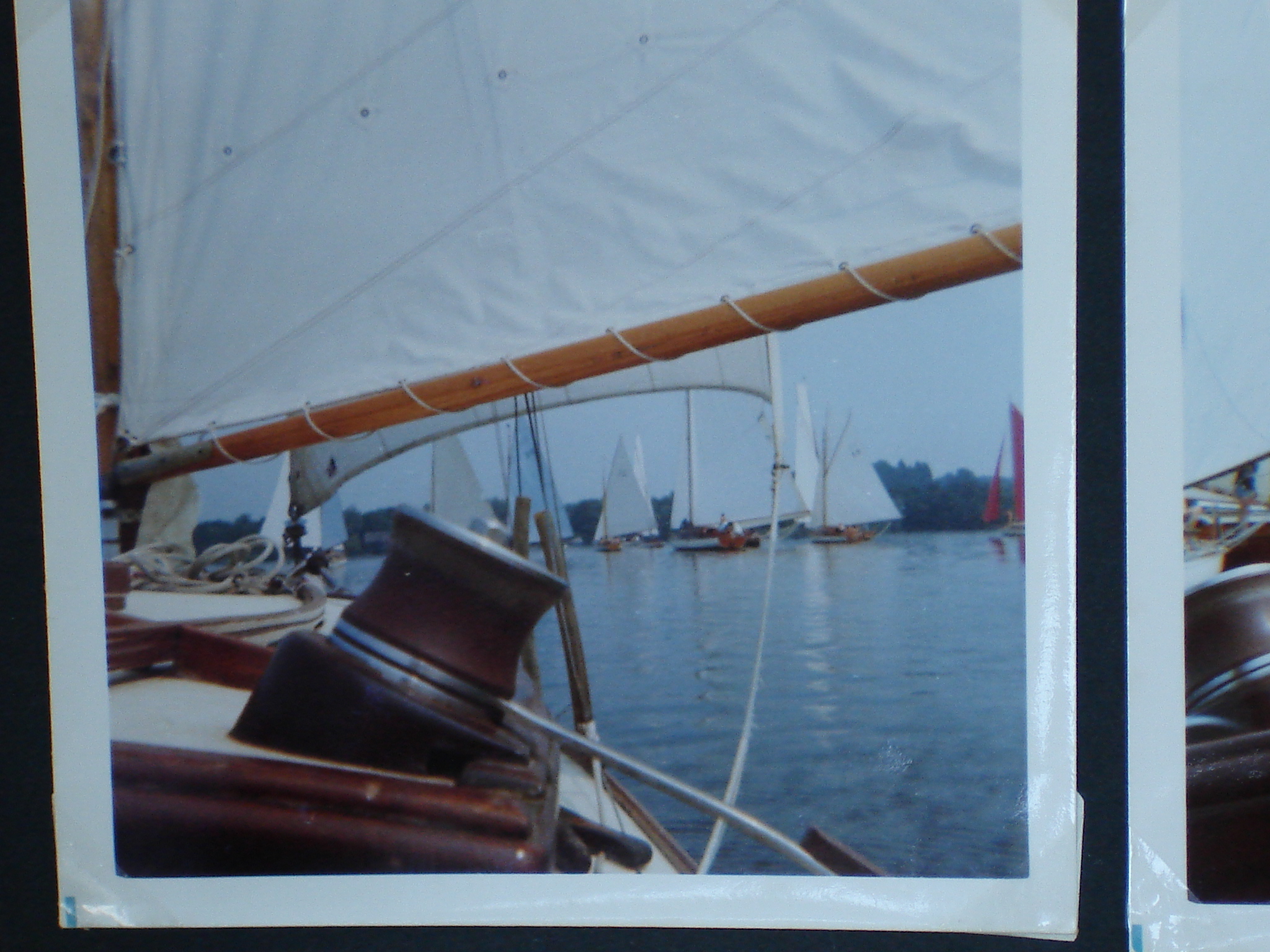
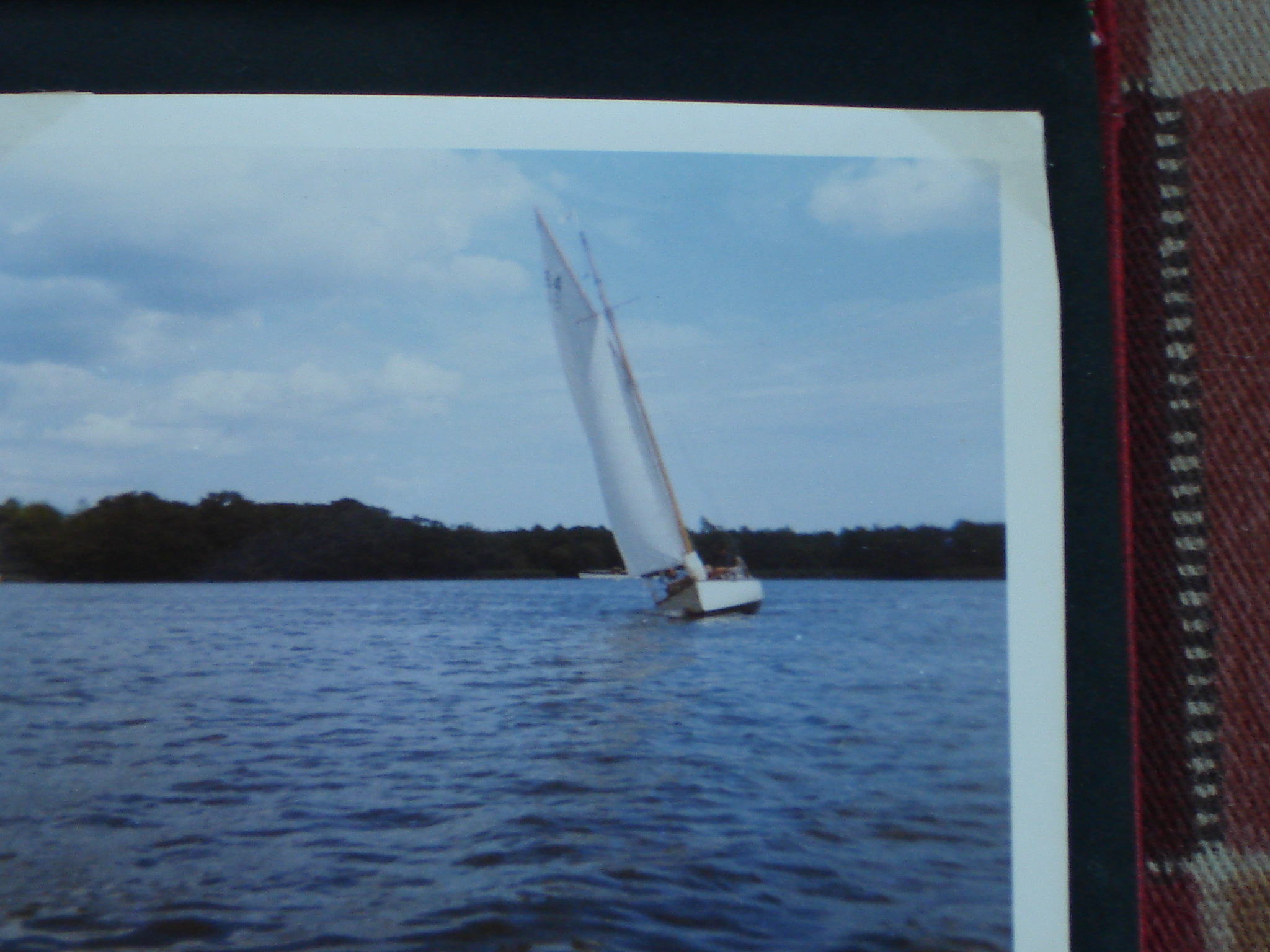
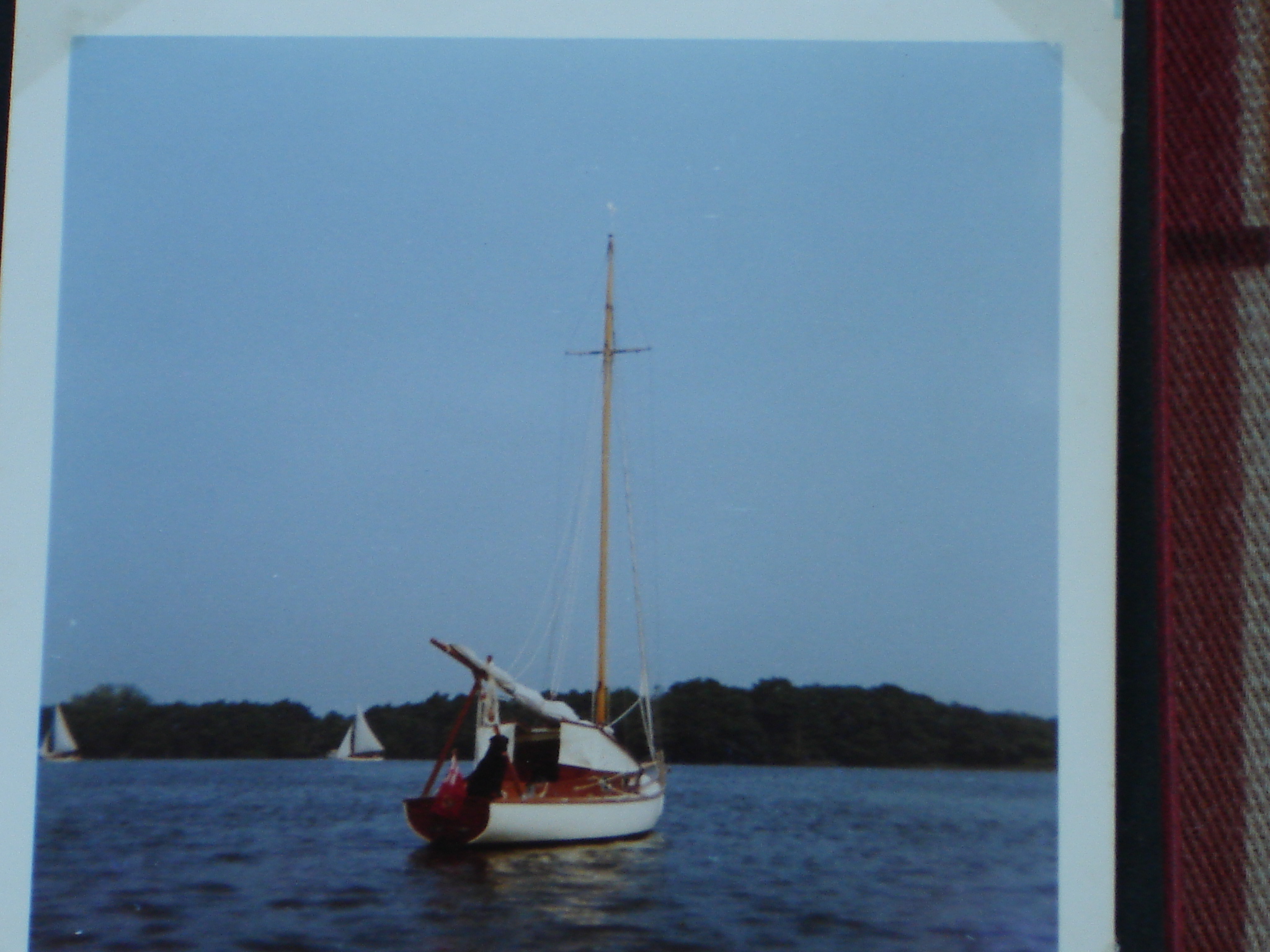
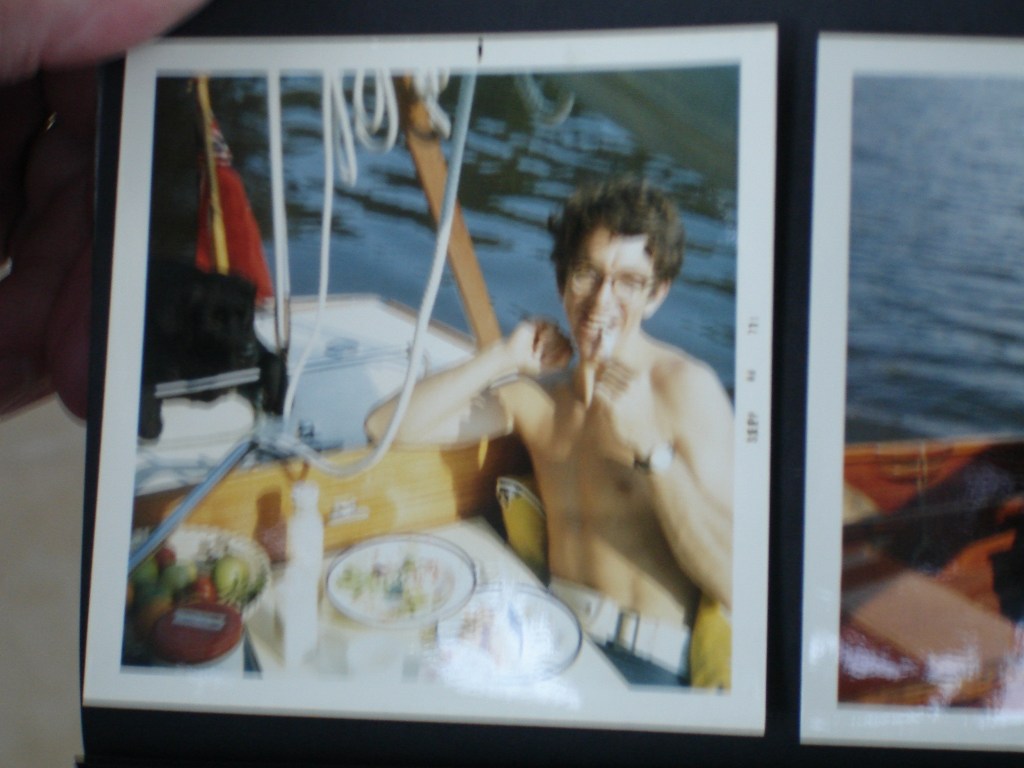
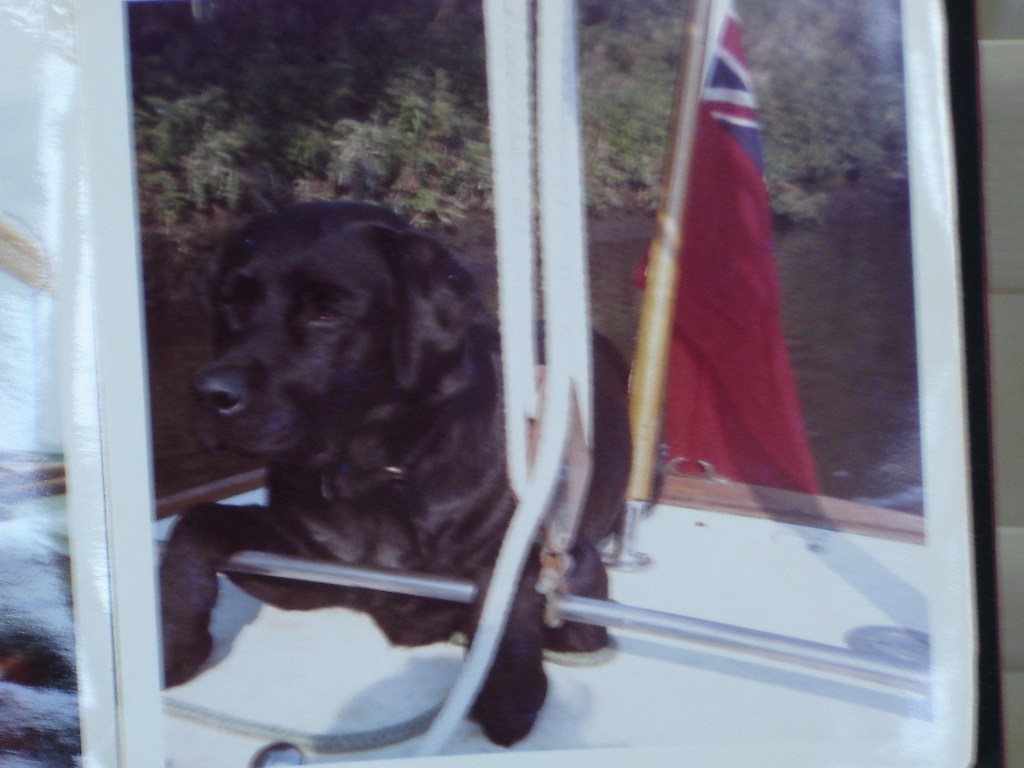
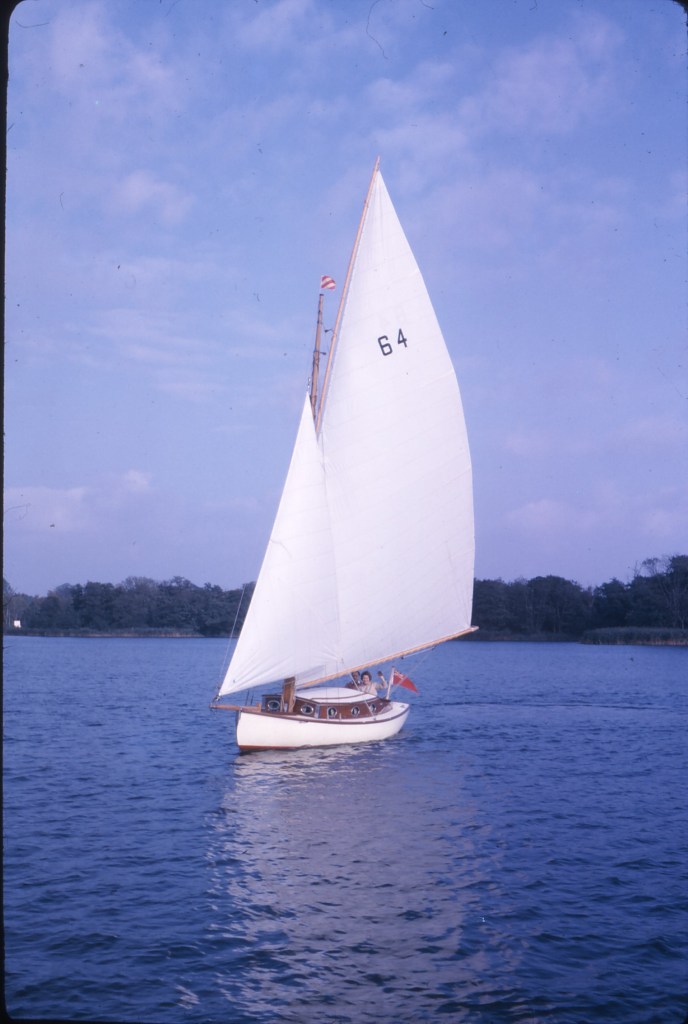
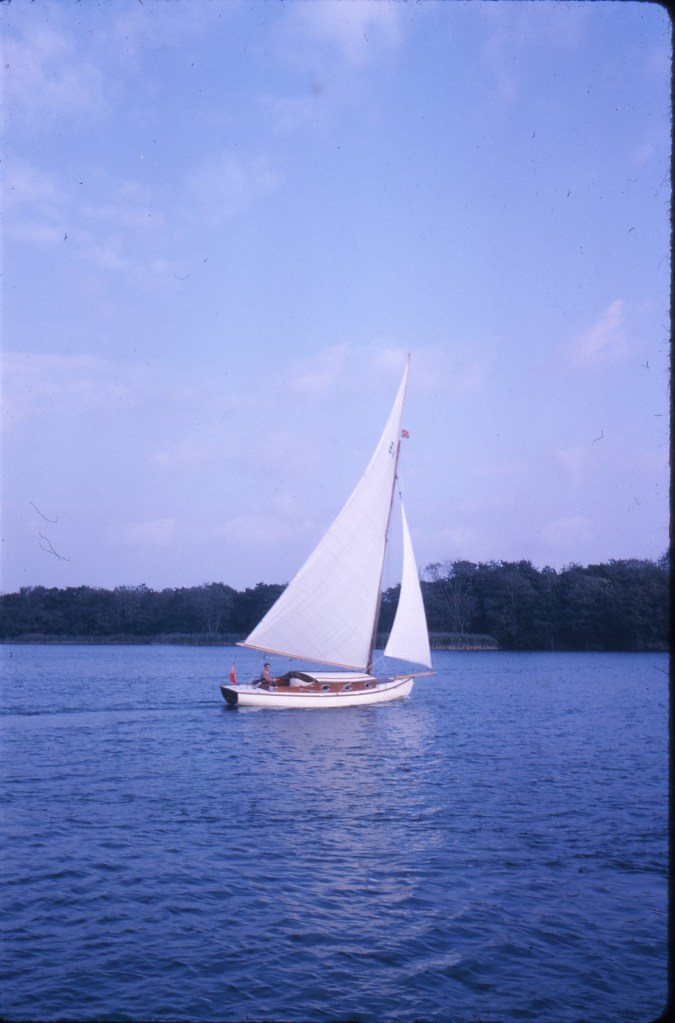
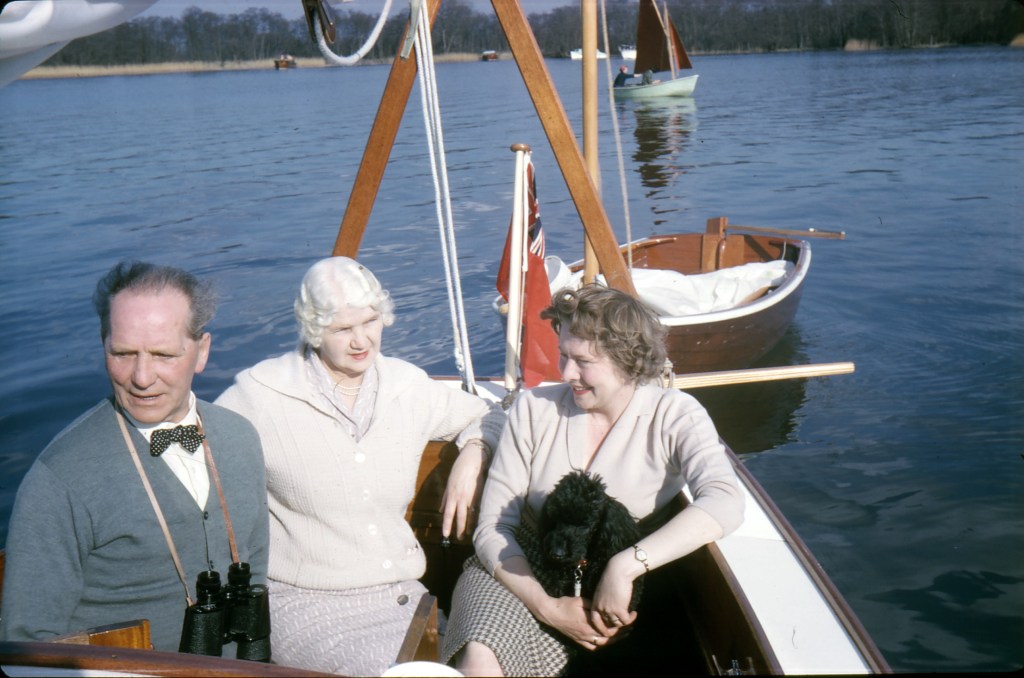
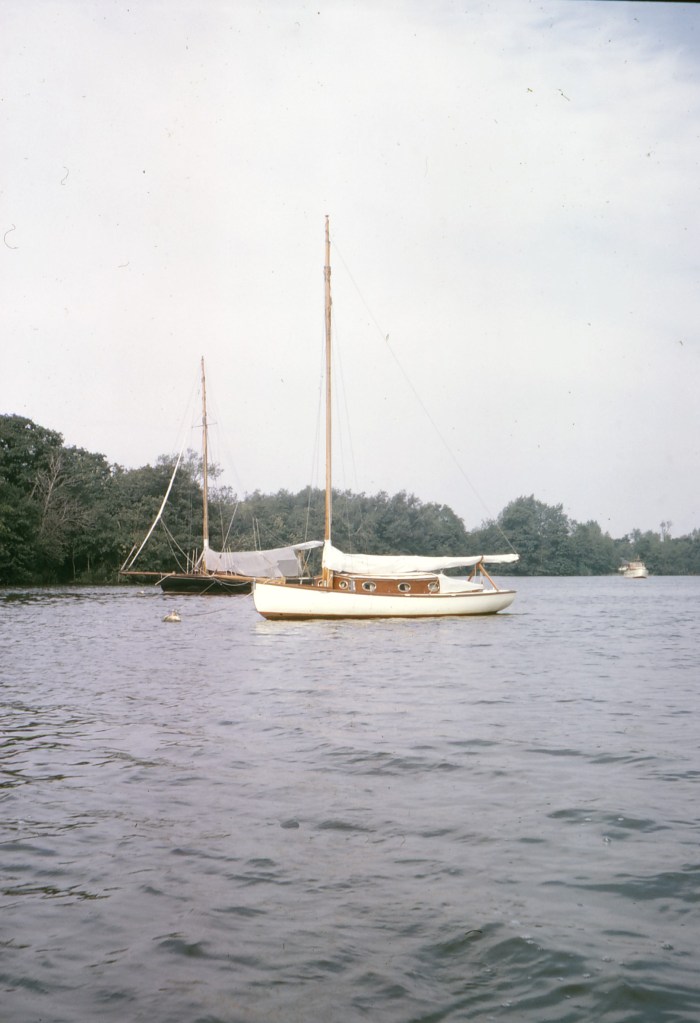
I’m going to finish now, with two my my favourite photographs of Stephen’s ownership. They show a young man, with his dog – enjoying the boat.
Which is exactly what me and the dogs are now going to do now.
Sorry – I haven’t written for a few days. Not least that I have made a break-through in my research. Think ‘source of the Nile’ moment… I am going to break my rule of writing chronologically – and give you an update. Then I will write fully about what I’ve found later.
But. Back to Chumley & Hawke. Their fleet differed from most hire-fleets, in so much that they were mostly designed properly. This sounds harsh, but its unrelenting honest I’m afraid. Most broads yachts were build ‘by eye’, from half models… And, AND! They were badly built!! It’s easy to look at a river cruiser today, and get misty eyed, but in the ‘heyday’ – these boats were built to do a job, and to be disposable.
Look at ‘Corsair’ – she lasted 10 years in hire, then was sold off as redundant. Now, admittedly her first private ownership was a lavish environment, with all the right elements for a wooden boat. Money, dedication, money, enthusiasm and money. Oh, and Rolls Royce chrome.
Chumley & Hawke was run pre-war by Roland Hawke, and Alfred Lloyd Braithwaite (A.I.N.A.). Braithwaite had bought into the yard in 1930, moving to Horning. His first few designs but the emphasis on sailing qualities, with accommodation coming second. Proof of this, washis ‘Clipper’ class which won the challenge cup for small yachts, Horning 1935.
Clipper – 1939, showing the fine sailing they were capable of.
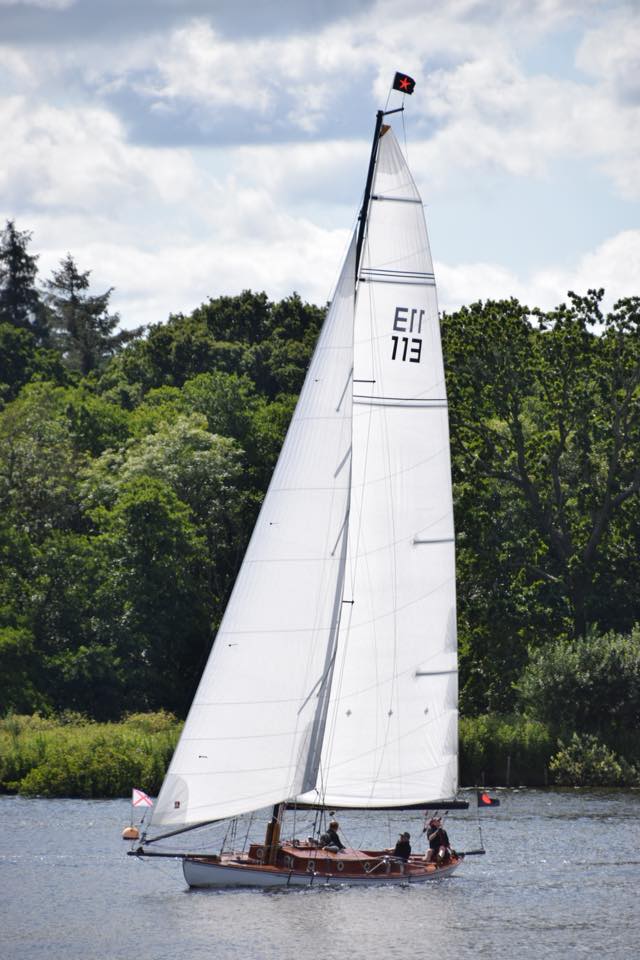
Aside from ‘Khala Nag’ – the best example I can think of this is ‘Viking’, built circa 1937. She is now a beautifully restored member of the River Cruiser class, however originally built as a 26ft halfdecker, and described as;
“Dayboat, mahogany built and designed for those who appreciate a really fine sailing boat, which compares favourably with a half-decker and has the advantage of a low cabin shelter…”
Nowadays, ‘Viking’ is a stunning vessel, having been modified to a canoe stern. Perhaps this is the biggest compliment to a devotee of metacentric hull theory – Viking was ably transformed to a canoe-stern yacht without major disfiguration. Here’s a picture of that indecently pretty hull;
RCC 113 – ‘Viking’, post rebuild at Broadland Boatbuilders.
Now, I can hear you ask ‘what’s metacentric hull theory’? No? Well I’ll tell you anyway. It was popular in the 1930’s. Mind you, so were airships and facism. So we’ll tread carefully.
A.L. Braithwaite was a supporter of the ‘metacentric shelf formula’, which aims to achieve good balance and handling under sail. Other notable followers include Harrison Butler.
The theory is based on the principle that as a yacht heels over under sail, the balance of the rig forces and the hydro-dynamics will be influenced by the changes in the immersed form of the hull.
Succinctly, a different shape underwater is presented as she heels and sails. The shape of the hull is defined at each ‘section’, and those different sections exert difference amounts of buoyancy. Aft sections may possibly being more buoyant than forward sections, interestingly the faster boats sit ‘bows down’ without the crew in the cockpit so are level fore/aft when sailing…
Metacentric shelf analysis plots the shifts in the varying buoyancies at each cross section of a boat, and defines a net value to windward or leeward and serves as a guide to achieving equal buoyancy in the dissimilar ends of a design. For a designer, the key is to draw and build a boat which has its greatest cross section area, within a close tolerance of the mid-point in the waterline.
The challenge then is to couple that principle with a hull drawing that decreases its cross sectional surface area in a union manner – both fore & aft of the mid-section. Further refinements can be made by accommodating the weight within a yacht into these calculations during design & build to ensure that the forces of hull buoyancy, rig power & centre of gravity all complement each other.
A.L Braithwaite designed boats which corresponded to this metacentric theory, both ‘Viking’ & ‘Privateer’ being good examples. Theoretically, their hulls change uniformly both fore & aft of the mid-section (usually within a small tolerance +/- 7-10%).
The ultimate test of course, being that a truly 100% metacentric hull should look almost identify from either direction. This has been demonstrated with ‘Viking’
Typically, the application of metacentric formula gives a sweet handling boat that is aesthetically pleasing, and has a good sailing performance without arm-breaking cases of ‘weather helm-shoulder syndrome’(™).
It should also be noted that nowadays, these calculations are done at the click of a mouse button, for Braithwaite to have applied this theory whilst it was relatively uncommon, in limited numbers whilst working in a Horning boatshed for a fleet of hire craft is quite extraordinary.
All Chumley & Hawke yachts have a distinct ‘look’ about them, with low slung cabins and sweet sheerlines. Don’t believe me? Here’s a family album;
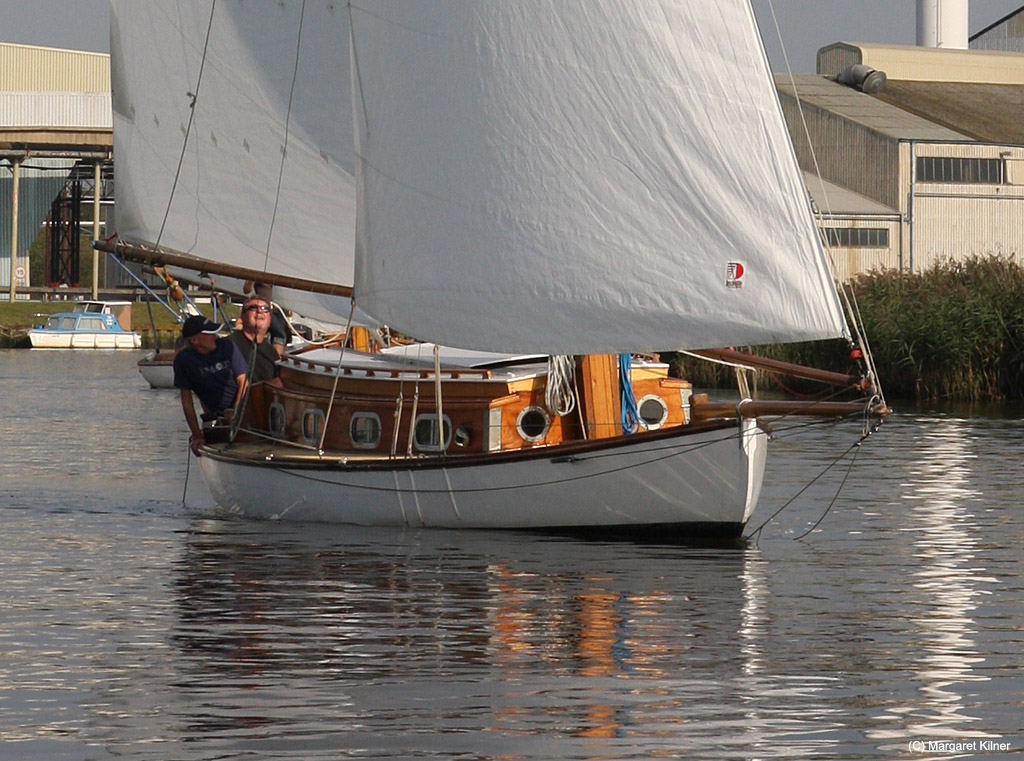
RCC Privateer – photo Margaret Kilner
Clipper I
RCC Viking – photo Trish Barnes
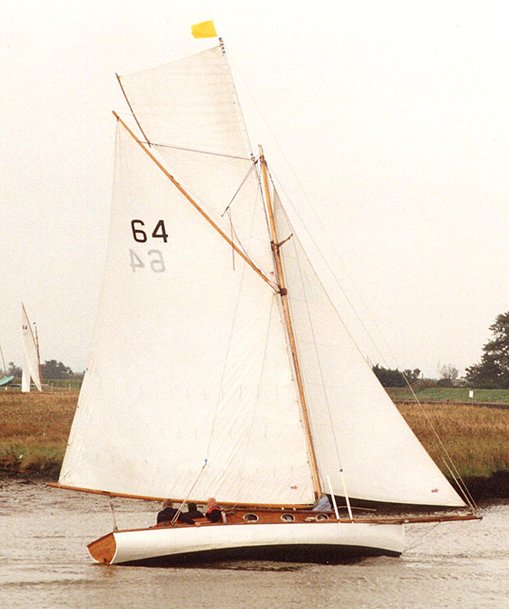
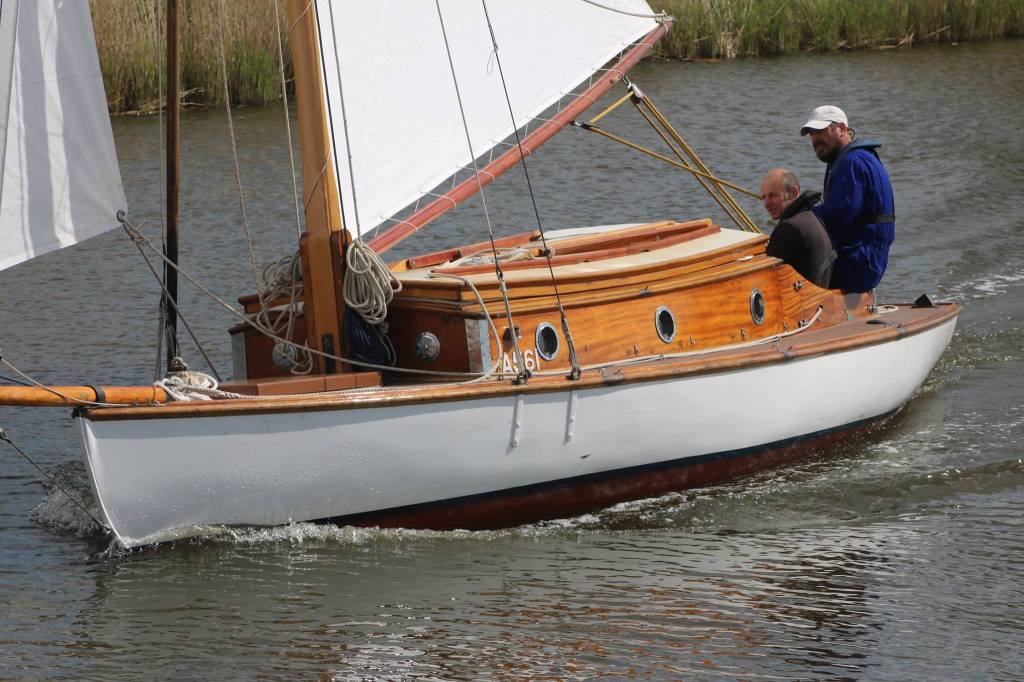
RCC ‘Corsair’ – photo Sue Hines
Finally – the stem repair I made during that first winter.
Having rough-planed the bows quite blunt, I made sure everything was square (ish) before cutting and laminating a series of oak laminates in place. These were screwed and glued, and clamped into place with large baulks of timber helping me bend them right down the hull.
I had no way of knowing if it’d work. I remember cutting the excess off each side, to preserve the ‘scallops’ where the stem is faired into the planking. Judicous use of primer and sandpaper faired it all in nicely.
12 years later, it’s still there, and it’s been not de-laminated or ‘sprung’, so I think I got it right. Evidently my nervous approach was paying off, I hadn’t done anything massively stupid (yet).
During that winter, I also donated the original 1951 short bowsprit to S/N 242 ‘Freedom, who also gained a Clipper mainsail from another. Seemingly I was surrounded by people with old wooden boats, and a perchant to recycling! Or else we were all broke. I know I was.
That winter I often had to choose to walk/cycle to work during the week. I couldn’t afford the diesel to commute AND get to the boatyard at weekends.
Next time I write, I’ll give you an update on why I’ve been so quiet. I promise it’s exciting (to me at least).
In 1961, there was a lot of upheaval at Chumley & Hawke. For reasons I didn’t know at the time I was in correspondence with Jamie Campbell and learning when ‘Clipper VI’ was sold off.
However I know now – and will write about in the future. I’m trying to explain my ownership, and how I learnt what I did.
C&H – Horning
Wenonah & possibly Viking
Chumley and Hawke were selling off their hire fleet of yachts. Rangers, Clippers, Privateer, Wenonah I & II, The Elfs, and Viking all up for grabs. To be fair, by the 1960’s the fleet would have been predominantly pre-war. The only yacht built post-war was ‘Corsair’, although she was built as ‘Clipper VI’;
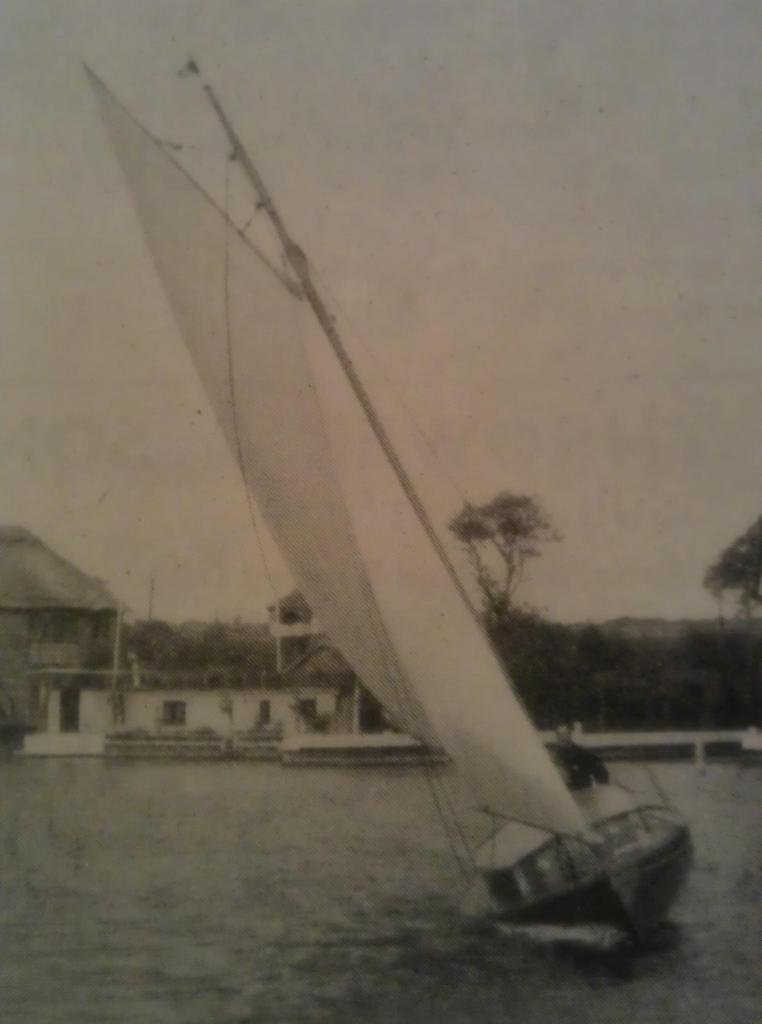
Clipper VI – the hire boat.
Several local boatyards moved decisively – Martham Boats snatched up the Rangers, the Clippers and the Wenonahs. Tim Whelpton (her builder) bought the Elfs and the Imps from Chumley & Hawke, to start his own hire fleet at Upton.
The clippers certainly had enjoyed a fine history of being an exhilarating yacht to hire – featuring as the ‘cover’ boat in the yachts section of Blakes catalogues for several years. Although to be fair – all of Chumley & Hawkes fleet had been described as boats where ‘good sailing was the principle concern’. Even in 1960, Clippers were described as;
“a distinguished class of craft giving first class performance with a high degree of comfort”
‘Corsair’ is actually built slightly differently to her sisters, with an extra plank in the hull. Certainly when she was in hire, this would have given her a ‘dumpy’ appearance when compared to her sister ships.
Anyway. Yes, in 1961 both ‘Clipper VI’ and ‘Privateer were sold privately. I can write about ‘Privateer’ another time, and will do I promise!
The Campbell family purchased ‘Clipper VI’, as they were warned off ‘Privateer’, which I understand was something they regretted, in terms of size. Meanwhile, ‘Corsair’ was whisked to Wroxham, where Leslie Landamore and Raymond Jeckells were tasked with making her ‘suitable for racing in private ownership’.
The budget was £500, which I understand those two nearly doubled! But, here she is, newly ‘yachted’ at Landamore’s shed in Wroxham;
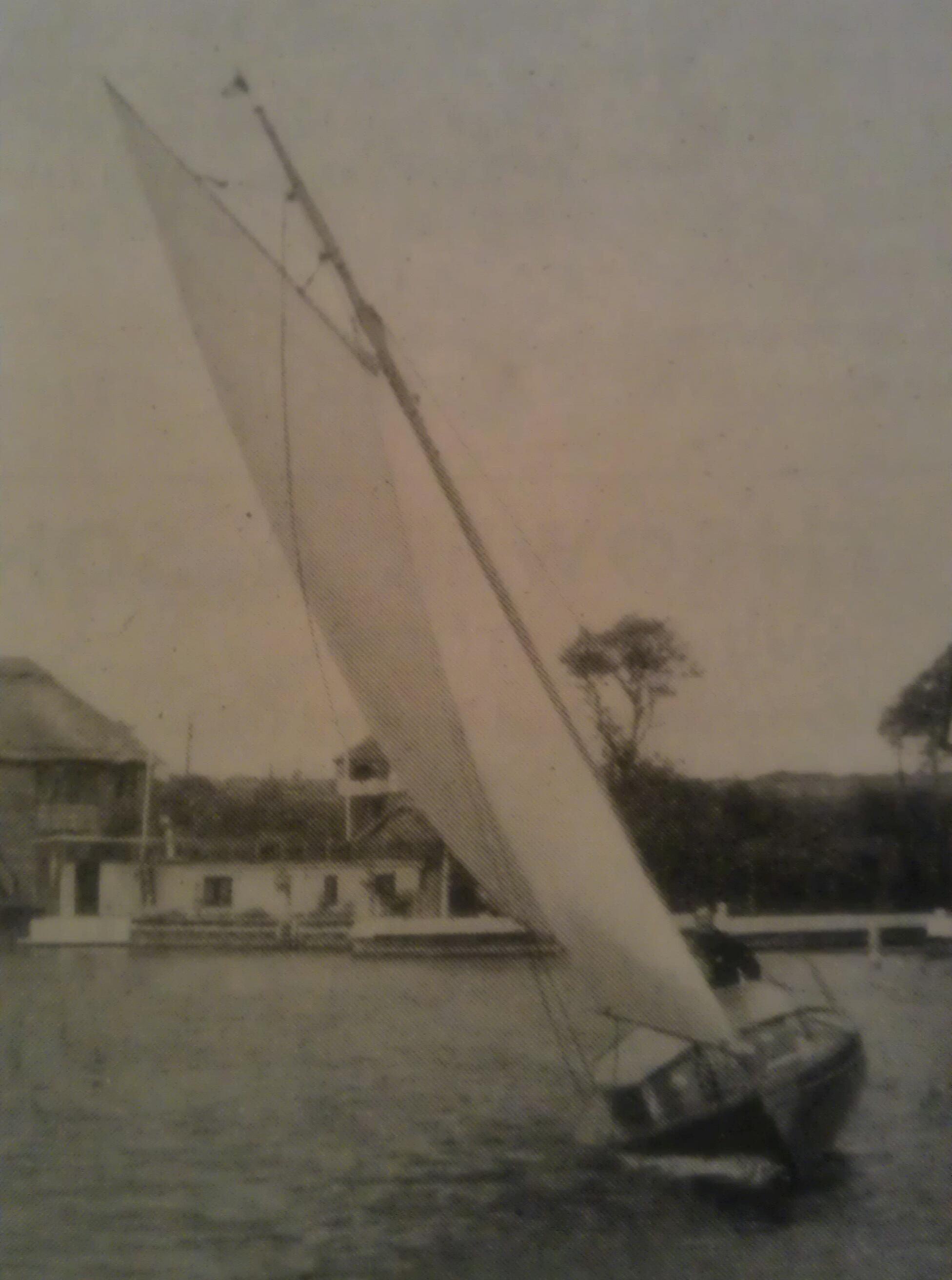
‘Corsair’ the yacht.
At that time, her condition was mixed. Her original planking is Sapele, a poor substitute for Mahogany, and apparently even in the 1960’s there were problems with rot. Broken timbers also featured. Being in hire clearly came with lots of bumps and bashes! Chumley and Hawke had actually fitted some galvanised steel frames as sisters… (!) These hung around until 2018, where they were cut out by my irate boatbuilder – during the rebuild. (I’ll write about that later).
Her original round cabin ports had been cut and changed to ovals with hopper windows. This echos the arrangement on ‘Evening Flight’, a much larger river cruiser – which incidentally is now owned by Jamie Campbell.
The porthole surrounds were fabricated and chromed courtesy of a local Rolls Royce dealership!
67 years on, all the chrome still looks fantastic.
The conversion was obviously looked on favourably, as the Campbells were asked if she was glassfibre as they took her downriver for the first time. I have some photographs of their first sail, and some others.
First sail ‘a yacht’
Black Horse Broad
BH broad II
The Campbell family
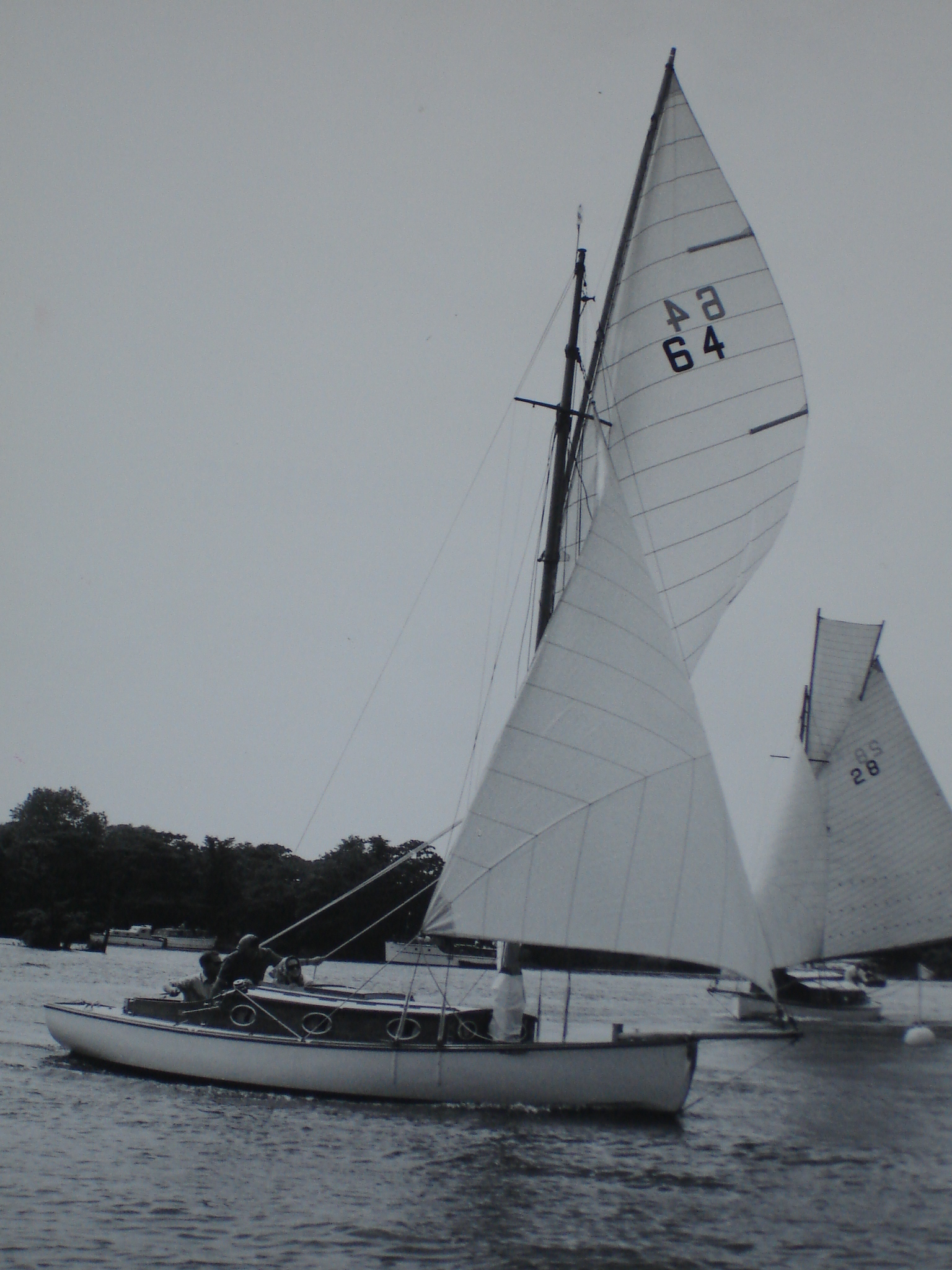
‘Corsair’ & ‘Rogue’ – Wroxham Broad 1960’s
Tea with RCC ‘Bryony’ & ‘Goldfish’
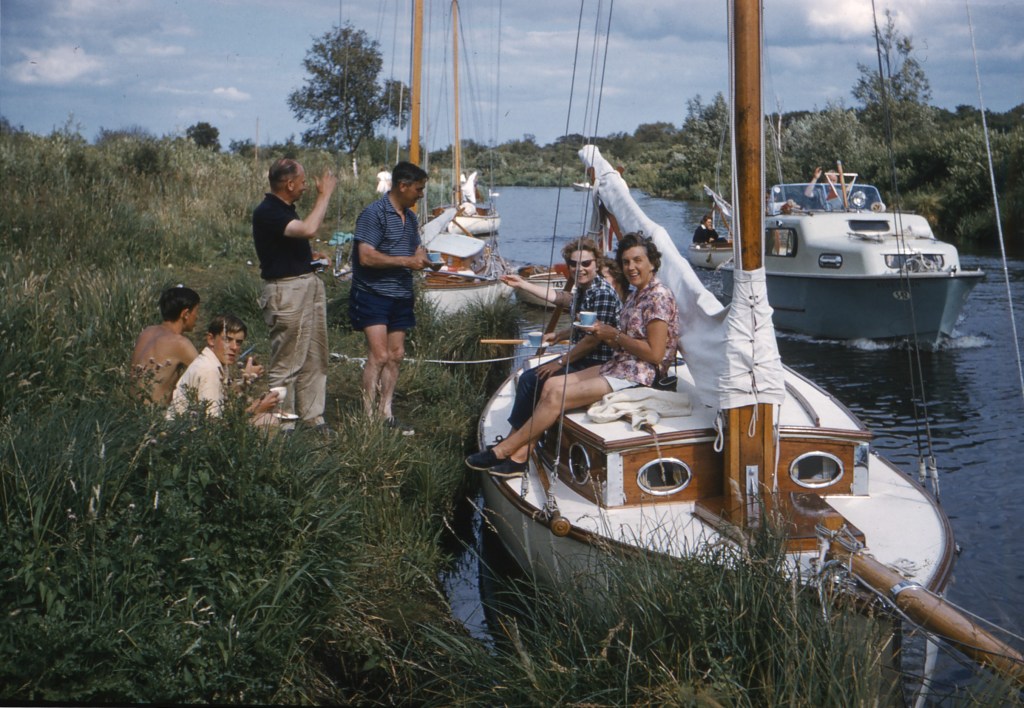
‘Corsair’ then moved to the Norfolk Broads Yacht Club – where she lived for some years during the 1960’s. It’s clear that during this time, she was a family boat. Just look at her condition from the photo with the riverside picnic!
Although, I have heard a rumour that the bodywork apprentices at Mann Egerton (a large coachbuilders) where often tasked with the painting and varnishing of ‘Corsair’, so no surprises that she looked gleaming.
Jamie Campbell actually won the first cruiser race he ever sailed in ‘Corsair’ in 1962. Although he does claim that as a 12 year old he had ‘no clue what I was doing’ – and was instructed to steer a straight course!!
You’ll also see a nice Lapstrake dinghy astern of ‘Corsair’ in the family portrait, this is still Jamie’s today.
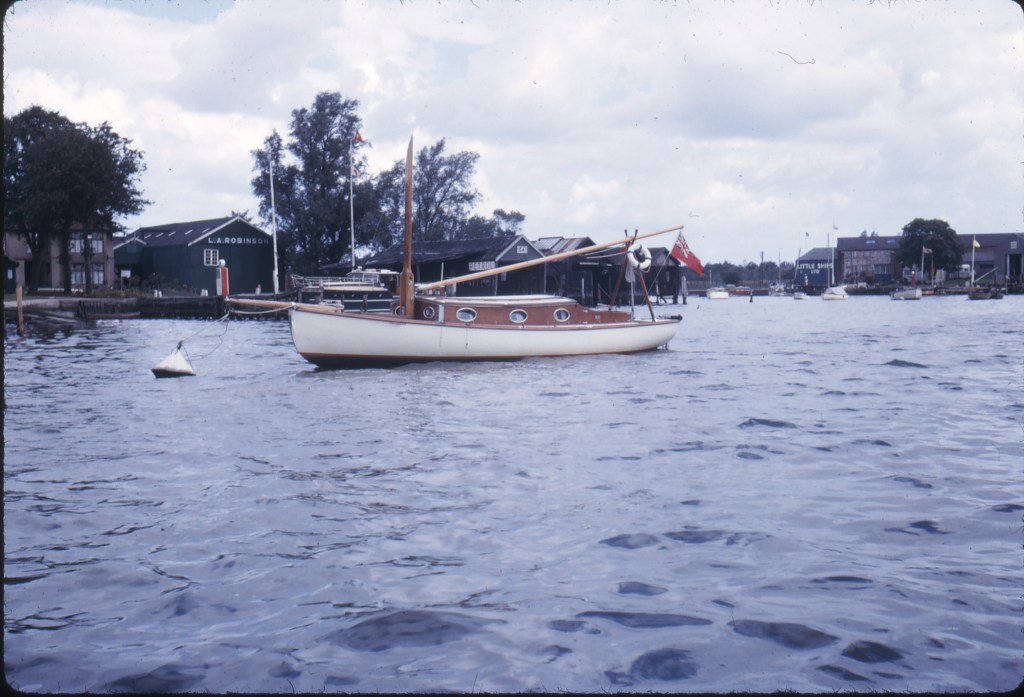
Her racing career with the Campbells was… chequered! In 1964, at Oulton week regatta they over-cooked it slightly, as Jamie recounted; “We moored at Leo Robinson’s yard for Oulton weeks, and I can remember seeing the mast ‘snowdropping’ – it was inevitable it was going to break for at least 100yards. Lowering the stump wasn’t easy against the lead counterweight!!”
In the end, the stump was cut short, and ‘Corsair’ was motored back to Wroxham with a venerable Seagull outboard. She got a new mast and a set of runners.
‘Corsair’ – 1964 with broken mast & Seagull outboard – Leo Robinson’s boatyard, Oulton Broad.
The Campbell family kept her for a comparatively short duration, compared to later owners. They swapped ‘Corsair’ for a nearly new ‘White Boat’ (Yare & Bure One Design) halfdecker with Peter Olorenshaw. Peter and his brother John were directors of the Norwich Motor Company, based on Prince of Wales road, so doubtless competitors of Mr Campbell at Mann Egerton (albeit friendly).
Sadly – Peter Olorenshaw died in 1990, and a conversation with his widow Elizabeth just elicited the information that they didn’t own the boat for very long at all. ‘Corsair’ was ignominiously placed on the bank at Brundall – in a boat auction.
So still a yacht – but as yet her future was uncertain.
I’ve written quite alot, so I’ll leave the stem repair for next time, when I’m able to introduce her next owner.
Ouch. Today was a painful start. An inadvisable quantity of beer at the ‘Fur & Feathers’ and the existing head injury made me jaded. I was not alone – the crew made similar noises… but we couldn’t remember the Morris Dancers, so win some, lose some!
As a priority, we quanted out of our mooring spot, to escape what was possibly the most noisy inboard engine in the world! (Curse those hire-boats, which run engines incessantly for hot showers in the morning).
We motored ‘briskly’ to Wroxham, and resorted to ‘hair of the dog’ on the way, as a restorative. (It was 9:30am!)
Evidently we’d not learnt our lesson, at Wroxham we victualled 24 Strongbow, 1 bottle of red & a bottle of Vodka. We had however nabbed a nifty mooring outside a little coffee shop, and basked in the sun a while…
After some Latte & Teacakes (also restorative) we did set sail in the direction of Ranworth.
This proved the most enjoyable sail of the week thus far. We soared across Wroxham Broad where we saw ‘Chatterbox’ – a gorgeous lugsail dinghy built in 1900, and reputed to be the prototype of the Norfolk ‘Dumpling’ class. We also saw wherries ‘Ardea’ & ‘Solace’. It was starting to feel like a holiday!
The record must also state that at this point, Petty Officer Jalil (and he is Petty!) suffered life-threatening injuries. It was ‘touch and go’ for abit until emergency ice cream was administered. (!)
A whistle-stop tour of Salhouse saw us admiring a Brooke motor launch, ‘Viking’. Very rakish.
As the afternoon progress, the wind dropped, even to the extent that a reef was shaken out, although when sailing through Horning Street the passing showers did force several crew members to retire to the cabin.
Approximately 5 1/2 hours after we left Wroxham, we quanted across Ranworth Broad and moored in pole position (for the Maltsters P.H.) Tomorrow I understand that an expedition to the top of the campanile is planned.
Goodnight.
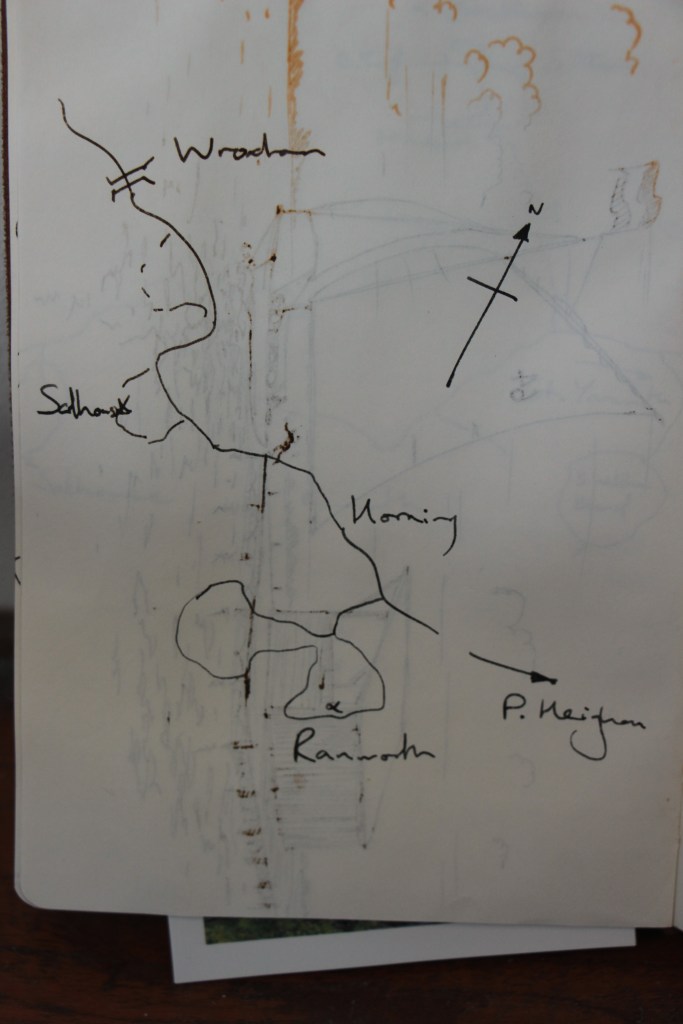
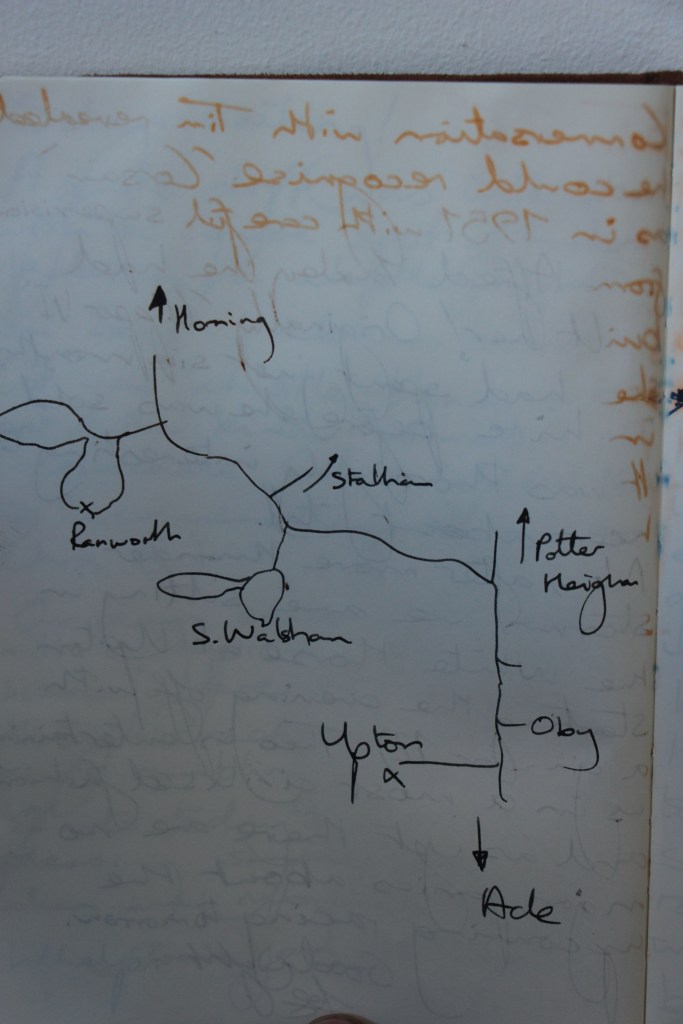
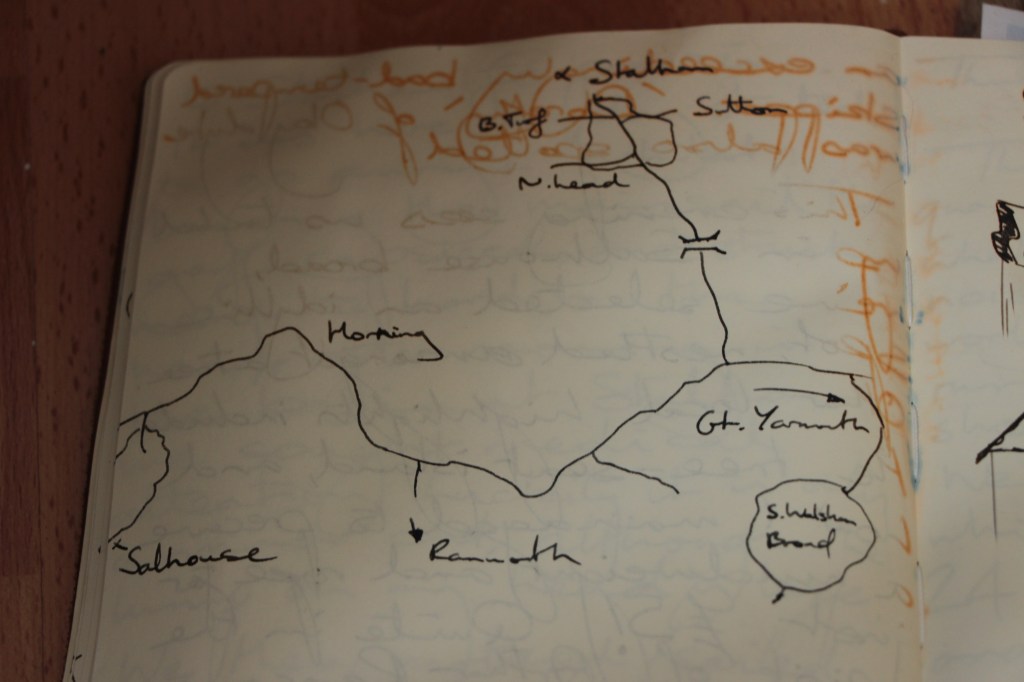
Our route
Quanting – again!
Day 5.
Ah. Rain. Good, we’d only have 3 days of that so far. We sheltered under the awning waiting for the rain to ease. Presently it did, and we enjoyed a climb to the top of the church tower (St. Helens), admiring both the view and the mobile signal!
Upon our descent, the skipper exercised his judgement and delayed everyone until 11:02am, thus avoiding the deafening from the bells! (clever chap that Skipper).
St Helens
Up and up!
The bells
Spot ‘Corsair’
Spot the skipper
Tat from the gift shop duly purchased, we had a furry spider and a Fox finger puppet aboard, as we set-sail with full rig for the first time 5 days sailing! A gentle drift was interspersed with a quick spot of lumber-jacking with the gaff on unsuspecting trees, and a whistling competition on South Walsham Broad – to rustle up a breeze.
(It was whistle blowing, but that soon turned very nasty amongst the crew!)
Our day’s sailing finished with a Wagnarian scene, where we sailed through crackling lightening and rumbling thunder.
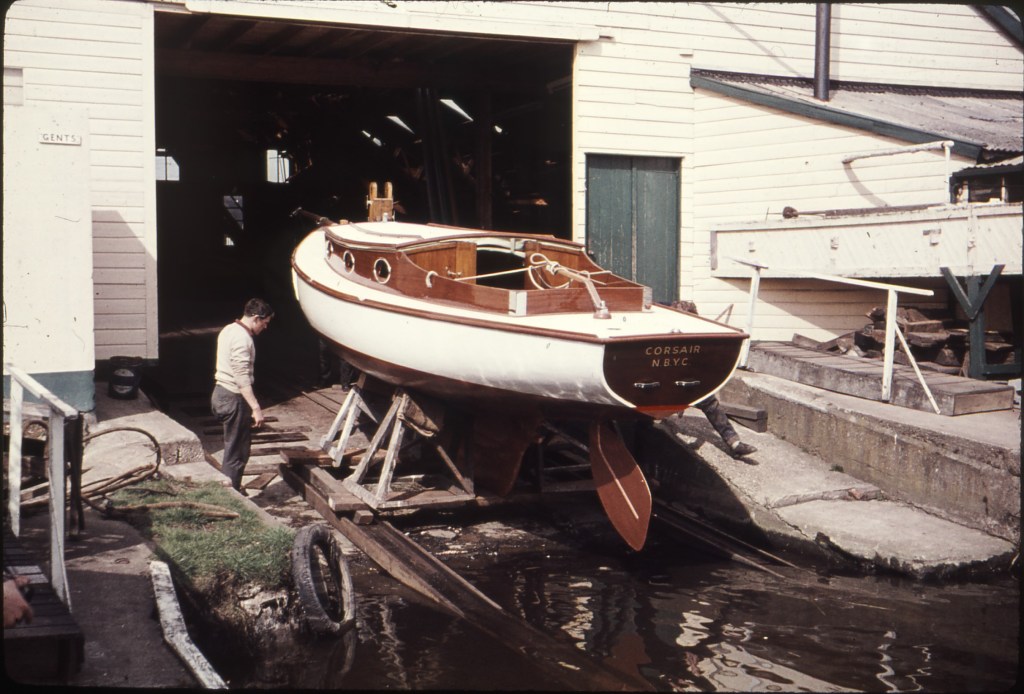
The highlight of the day was without question the surprise we had when we moored opposite Whelpton’s yard at Upton. Conversation with Tim Whelpton revealed that he could recognise ‘Corsair’, as in 1951 with careful supervision from Alfred Yaxley (Chumley & Hawke foreman) – Tim had BUILT HER. I was stood next to the man who’d built my boat.
He even asked me to retrieve a bunk drawer, before upturning it and showing his signature on it, from 1951!!!! It was a humbling experience, and I was stunned at our fortune. We hadn’t planned it, I didn’t know Tim had worked for C&H. Sometimes these things just happen. Wow.
Tim W – her builder
Clipper Vi
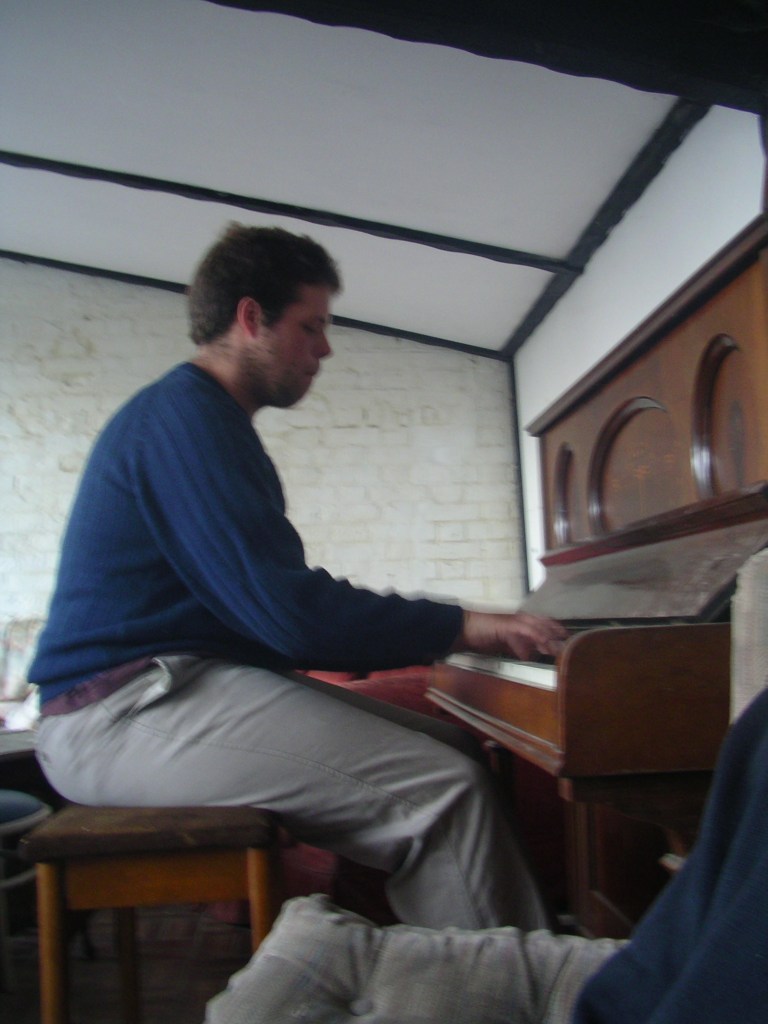
Now, after more Thunder and Lightening – we are sitting in the White Horse at Upton, having started the evening off with a Vodka (or 12) back at the boat (!). Theo has managed to rouse the Pub Piano into life, and is playing Scott Joplin. It lived in a lean-to, had not been tuned in a lifetime and a dozen mute keys. He’s good though.
Theo plays.
As yet, there are no major panics about our planned racing tomorrow at a local regatta.
Well, isn’t it odd how often you find yourself in a pub to reminisce about the days’ sailing. The only huge disadvantageat present is that this particular pub has bloody Morris Dancers in it!!
Anyway, I disgress. Today has been eventful to say the least. We had a moonlit evening on our personal island, and awoke to a surprise – sunshine!
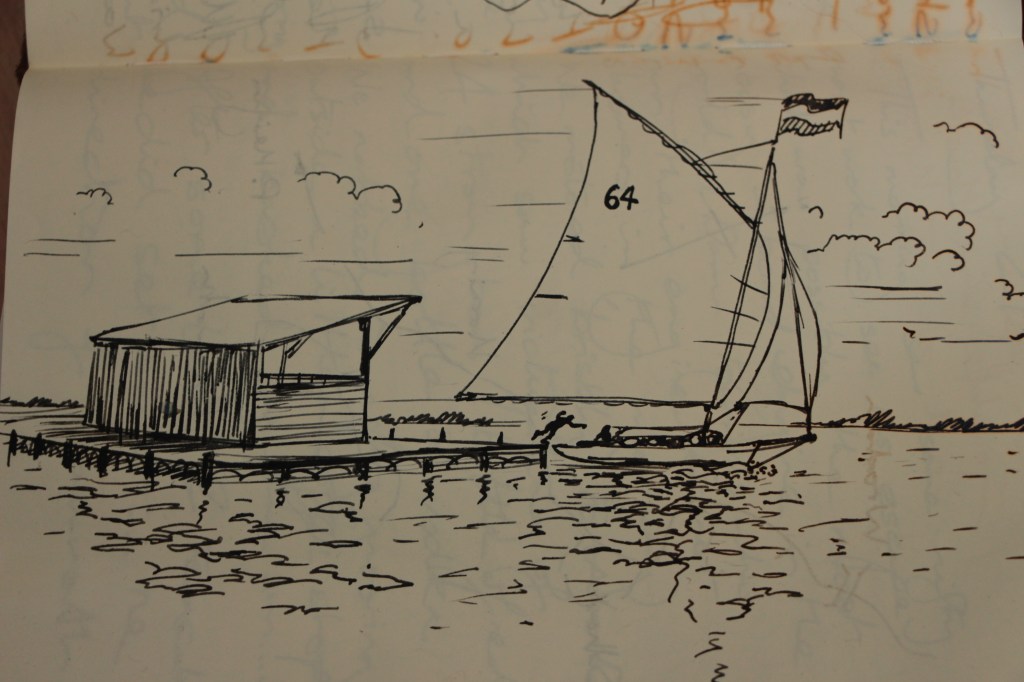
We played about on Barton with full sail for a while before heading to Stalham for provision. In the end, we sailed around the Punt Club pontoons, with a camera man snapping away. Some fantastic photos of ‘Corsair’ were got, with an exciting moment getting Chris the photographer back onboard!! (he survived, see illustration)
Our personal island
Going for it!!
It was here the day started to go awry… Whilst lowering the mainsail, the gaff capsized – striking me VERY hard on the head. After mooring in the basin at Stalham, with blood now flowing freely down my face, we sought medical attention.
Never have the volunteers at the Museum of the Broads been so startled, at the dishevelled, bloody faced lunatic who shuffled in. Thankfully Stalham Doctor’s surgery super-glued the cut closed, although I do have a large lump on my head.
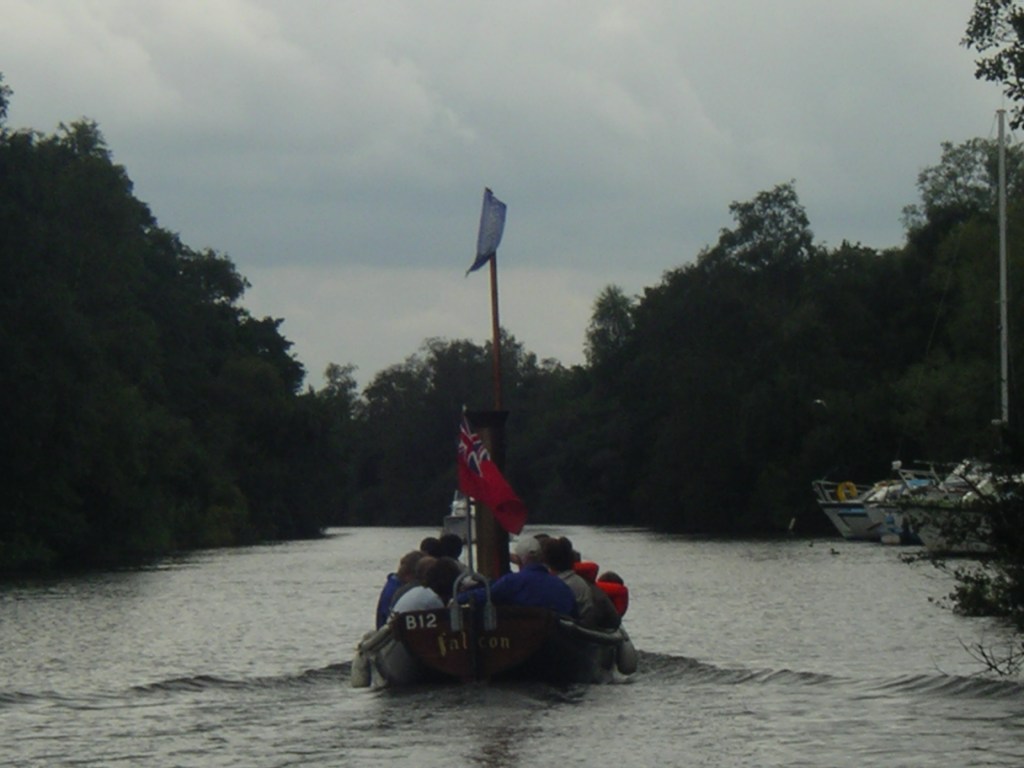
Leaving Stalham in the company of steam launch ‘Falcon’ we motored/sailed and double quanted down the Ant. Using 2 quants to propel a vessel is a fantastic way of covering ground easily in the calm.
Double-quanting.
Eventually we motored through Ludham Bridge, and turned upstream toward Horning on the Bure.
It was here that ‘Zoe’ (hire yacht) collided with a moored motor boat who unfortunately had a VERY bad-tempered skipper (enjoy your holiday!). ‘Dorothy’ (S/N331), one of our neighbours from Oby Dyke was also seen.
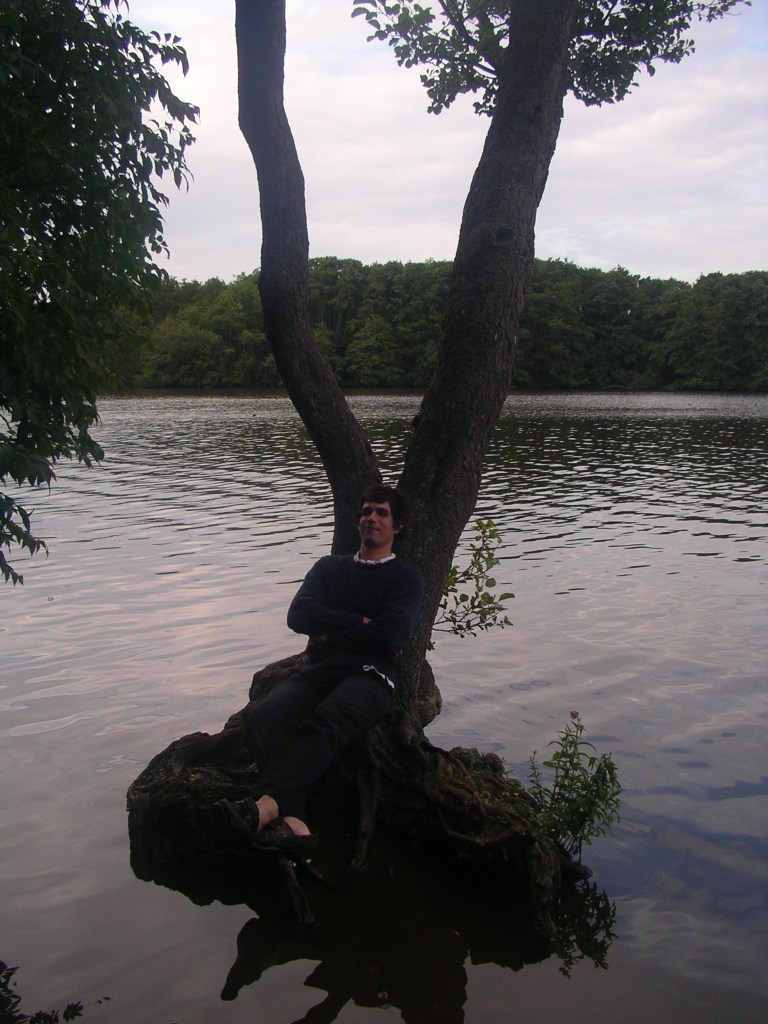
This evening (Day 3) sees us tucked up in Salhouse Broad, we’ve selected an idyllic spot, nestled amongst a tree. Other local highlights include the tree-seat island, and how I managed to procure a mudweight (and rope) for £5!! It had been lost by a hire boat, recovered by an enterprising local and sold to another!
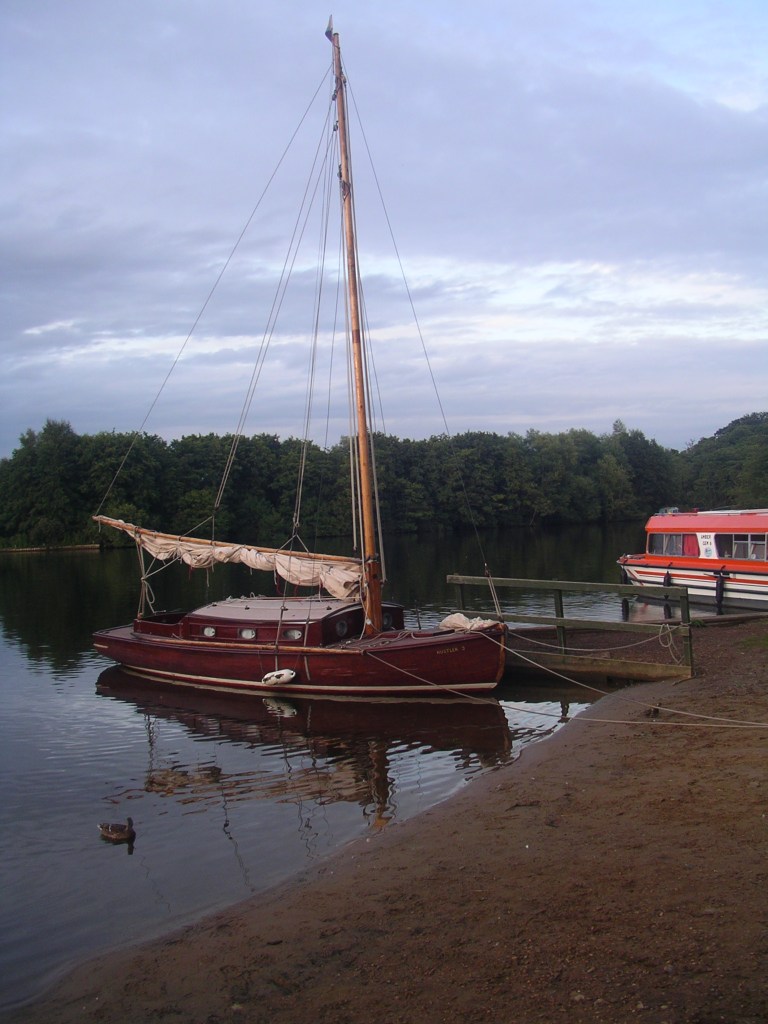
Very much in the spirit of Arthur Ransome, there is ‘Hustler 3’ tucked up onto the ‘beach’ at Salhouse tonight. All that remains is for us to drink a fair selection of Woodforde’s Ale.
Falcon
Falcon
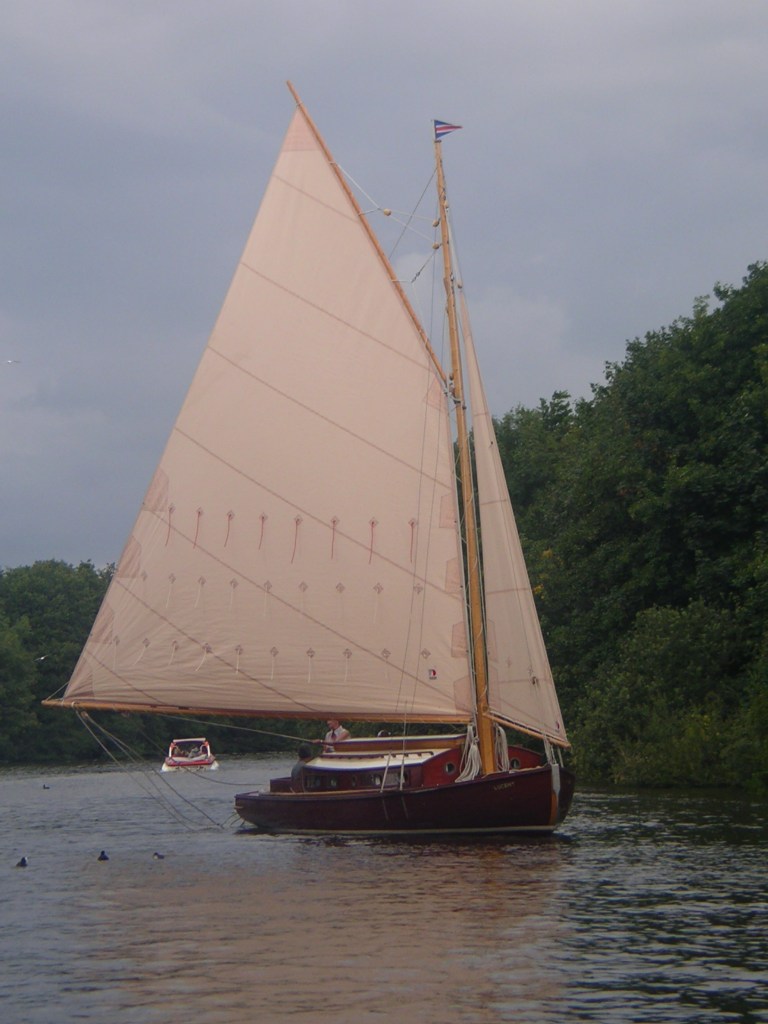
Lucent
Tree-seat Island
Hustler beached
Goodnight!
The photographer’s leap!
Our route
As a postscript, re-reading the log book (2019) is making me realise how much I was learning at the time. Being aboard ‘Corsair’ was very different, being able to accommodate 4 crew and their bags, which stayed dry when it rained! Luxury!
Also – the sailing was so different, having a full crew means you can pretty much dispense with the engine, everything takes so little time. Getting the boat ready for sail or putting the awning on would take less than 10 minutes! Very different to my singled-handed sailing.
Although, the lack of a proper cooker, and certain other domestic equipment did mean it was ‘rough and ready’ accommodation. (!) Plus there is a certain element of Editor’s discretion, some memories remain unpublished!!





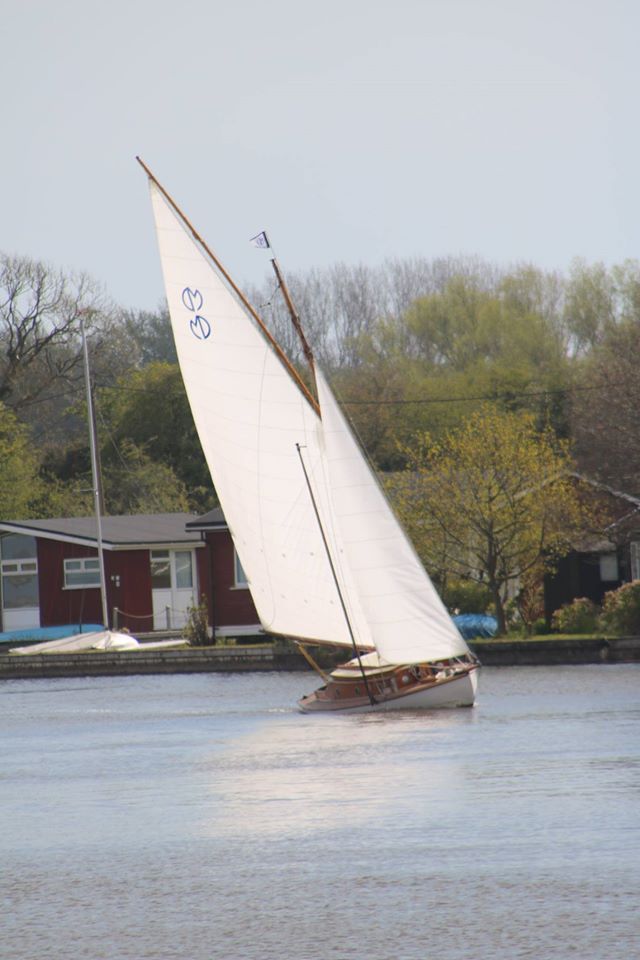

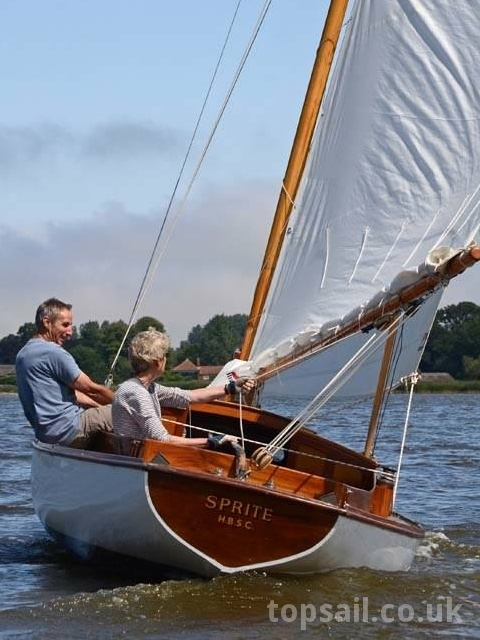
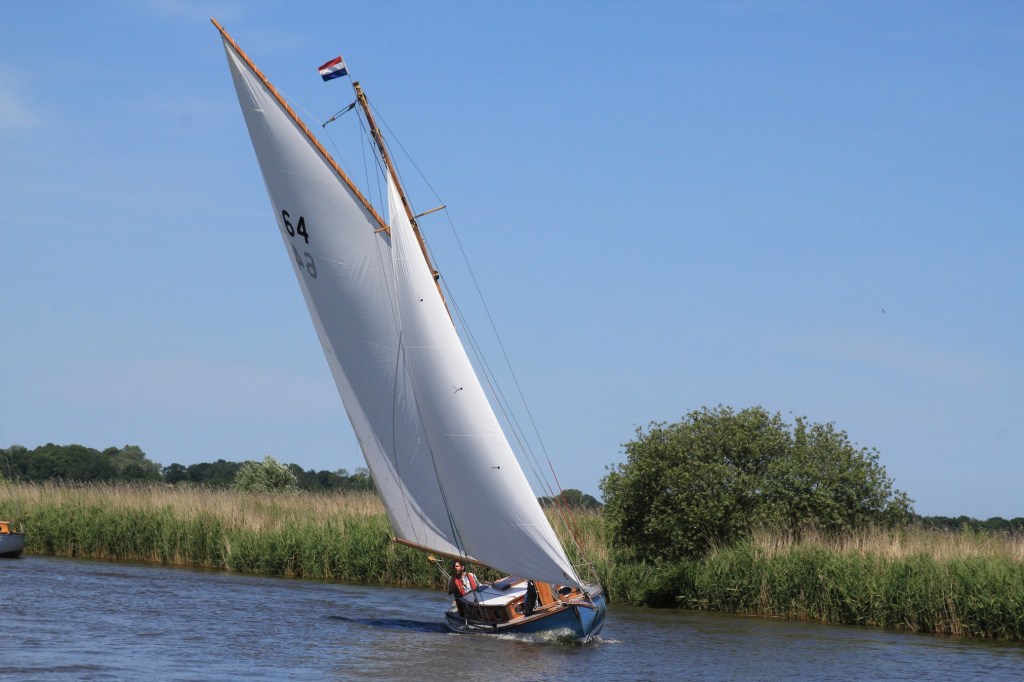






 A Broadsman