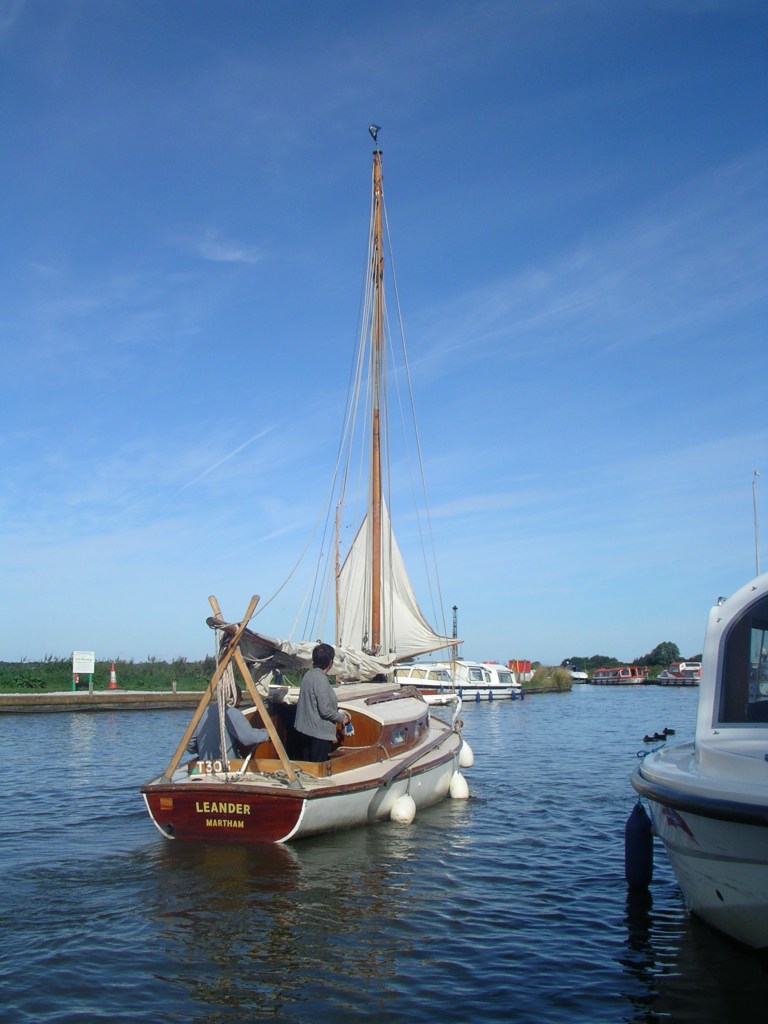
Today we started lazily if I’m honest, the Skipper began with attempting to steal a TE20 tractor from the boatyard & in a fit of benevolance we offered the crew of a ‘Leander’ to moor alongside us so they could access the freshwater hose.
It was quite strange really to compare the 2, considering that ‘Corsair’ came from the same yard – they really are completely different!
Our C&H ‘sister’; freshly re-watered.
(This was years before I understood the role A.L. Braithwaite had with the clippers – versus the reality of Alfred Yaxley from Belaugh, the postwar foreman of Chumley&Hawke who did however build ‘Corsair’ with Tim Whelpton, albeit with an extra plank)
Anyway, in a strange reversal of our now familiar daily routine, we took all reefs out – bunged the big jib on (!) & set full rig after 4 days!! We soon departed & headed for a wild-mooring opposite St. Benet’s abbey to perform housework. (Binky cleaned the cabin windows)
Enjoying full-rig, we set off again & navigated onto South Walsham Broad where we sailed well into the inner broad, circumnavigated the island & spotted RCC S/N70 ‘Don’ at mudweight. Coming out of Fleet Dyke, we engaged in some informal racing with a Devon yawl, with Mr Jalil proving himself quite competitive (surprising)
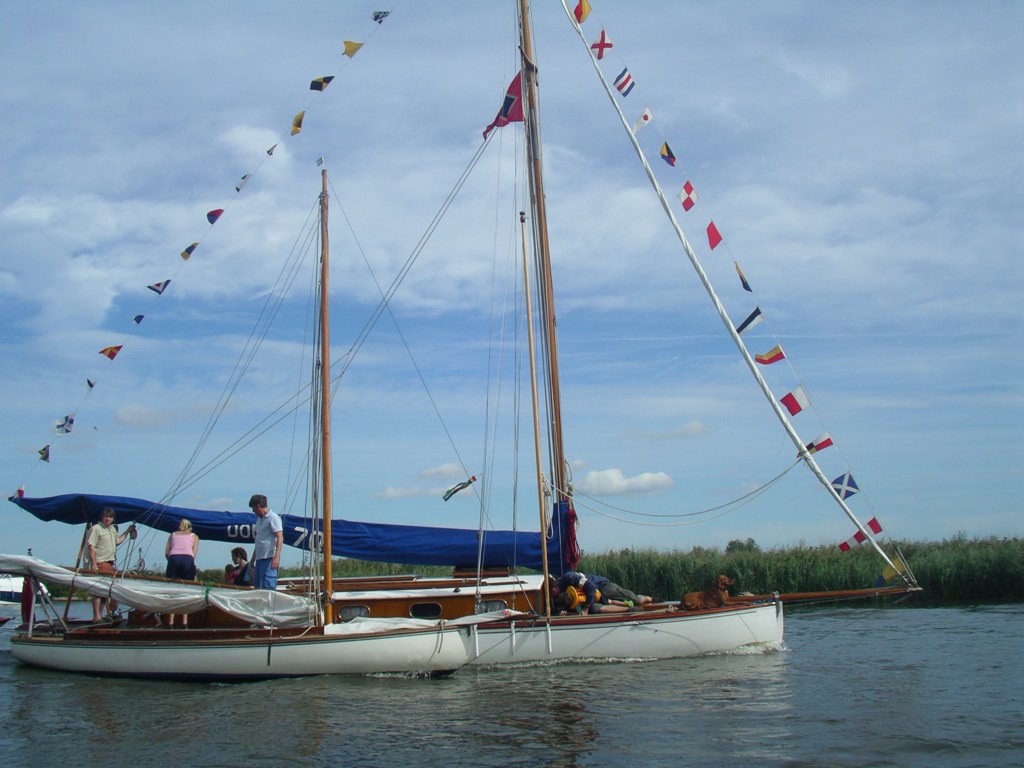
S/N70 ‘Don’ & assembled fleet!
HB was spotted on the St Benet’s moorings, where Theo promptly (and quite literally) jumped ship. The prospect of a warm & dry berth proving too tempting for his weak-willed traitorous ways!
Despite this treachery Binky & I enjoyed the gentle tack upto Ranworth, where to be fair ‘HB’ did tow us onto Malthouse broad, where we mudweighted close to the wherry ‘Albion’ where we then all unwisely leapt into a tiny dinghy for the passage to the Maltsers P.H.
The tack to Ranworth.
(At this point, a certain Judas displayed all the grace of a baby rhino on acid to get in/out of the said dinghy, nearly tipping us all in!)
After a reasonably boozy lunch, we motored upriver to the surprisingly expensive Salhouse Broad for the night. D is cooking, only tomorrow will tell if we survive…
Dear readers… this morning we managed to wake slowly, with no hysterics from Jalil… our temporary waterproofing HAS WORKED!
Despite the sheltered nature of the staithe – it was apparent that it was bloomin’ windy, something we discovered when we ventured onto Barton Broad. We set the ever familiar 2 reefs & middle jib, before storming across the Broad enjoying ourselves, and ignoring the chaos in the cabin (!)
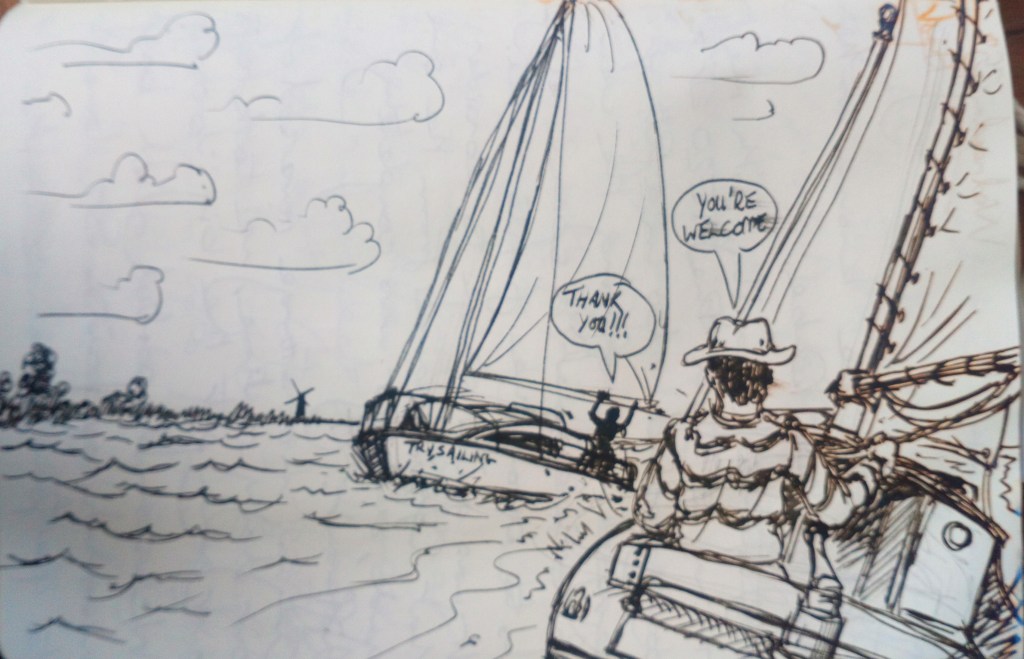
Whilst thundering around the Broad, we allowed ourselves a giggle at a hire-yacht branded with ‘TRY SAILING’ -which at times seemed a good suggestion for the helmsman to follow. (!)
This was said through gritted teeth!
Fun over, we decided that a tack down the Ant would be impossible – so we became tourist-esque. We motored to Stalham to wander around. It was at this point I bought a Tilley lamp, which turned out to be a complete lemon! (I think we were desperately trying to find ways of drying out the boat)
Sadly even the charms of Stalham weren’t enough to keep us there, despite a ‘en masse’ decision for hot showers at Richardson’s boatyard (behave! Not like that) So freshly laundered, we gave into the inevitable and motored downriver to Ludham Bridge, where we moored in half a bloody gale… holiday’s afloat eh?
The crew at this point abandoned me – choosing to sit in the cabin rather than endure another cold & wet slog into the rain. Can’t blame them! (but I will)
‘Enjoying’ ourselves in the summer weather.
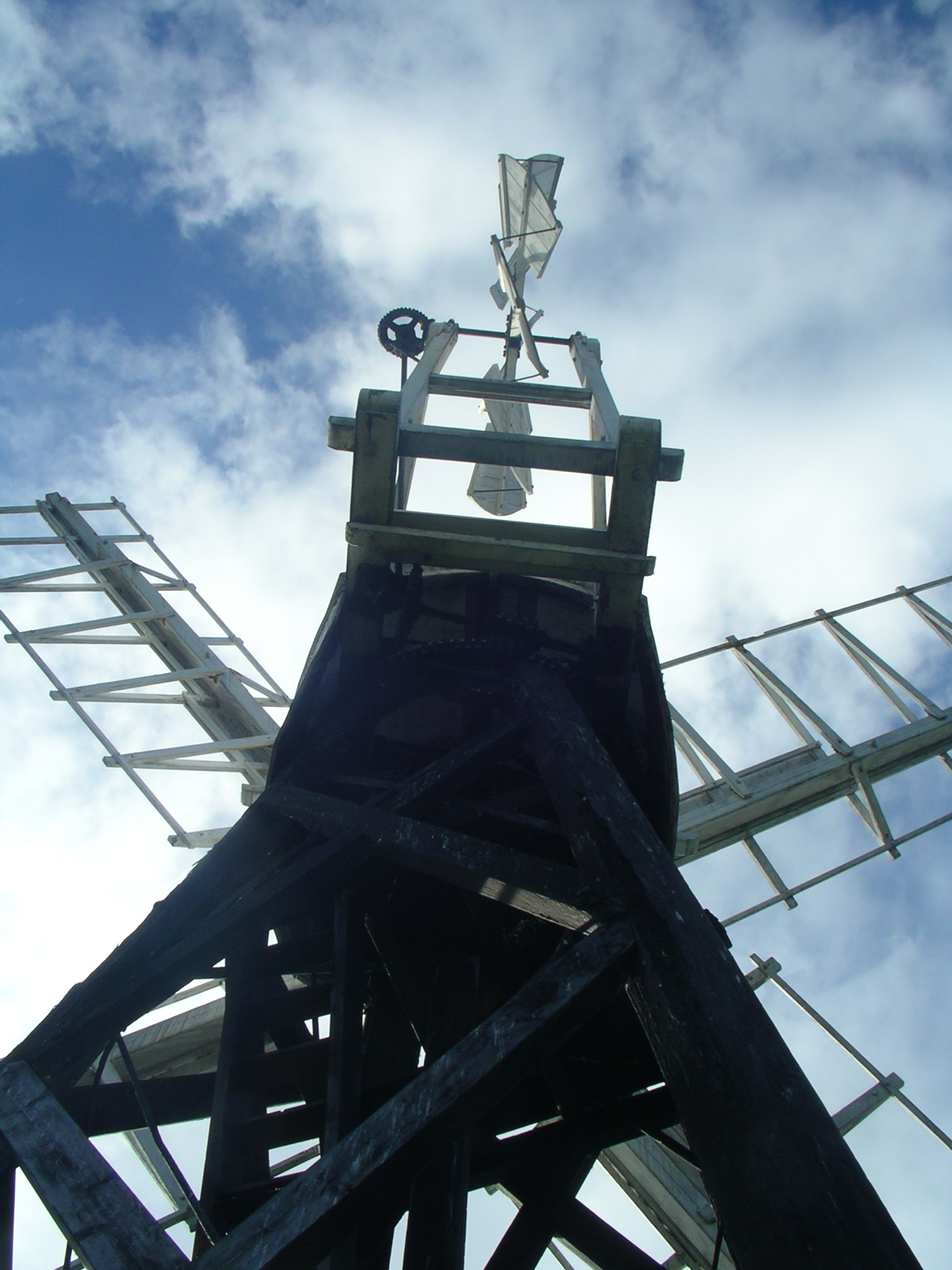
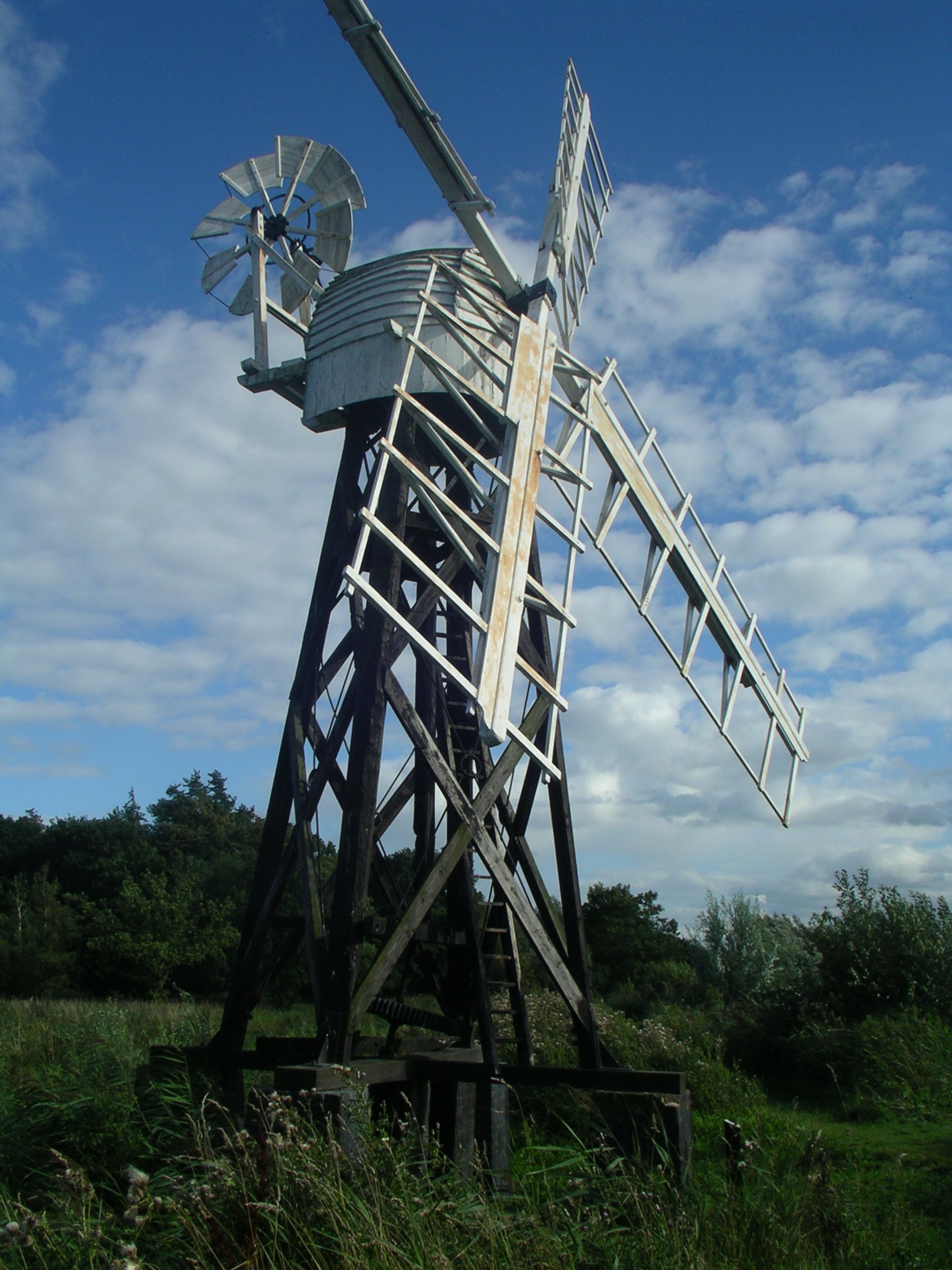
The weather did moderate a little, which enabled us to stop at ‘How Hill’ (more tourism) – walking around & inspecting both Toad Hole cottage & Boardman’s pump. Boardman’s pump is a trestle open frame mill, complete with its turbine pump (dating from 1897) – it’s amazing what you’ll read on an information board when you’re soaked through & fed up!
Sensibly at this point, we sought refuge in the ‘Dog Inn’ for the evening. Highlights (or not) was how we ended up in conversation with a film crew who were filming a short film called ‘Jam Today’ – for the UK independent film council. The weather meant these lads were stuck on a boat with beautiful young women. Bastards.
Today started with a sense of deja vu… Although without such a vibrant soundtrack, Mr Jalil was nontheless forced to vacate his bunk in search of drier sanctuary in the cockpit…
(At the time, we ended up duct-taping bin bans to the cabin side & routing them behind the bunk-shelf – diverting water mostly away from the mattress and sleeping crewmate)
This was to prove a persistant issue – and it wasn’t until 2016 I was in a position to attempt a permanent repair.
After such inclemency, the weather did improve somewhat. However before I divule such metrological bumphf I should mention the nice lay who sold us eggs… It’s all in aid of ex-battery hens & extensive testing of the said eggs (with bacon & fried bread) revealed that they are DELICIOUS!
Tacking out of Hickling – note the small rig (Day 3 of double reef / No. 2 jib!)
Despite this usual ‘slog’ – we bravely carried on! (I suspect heads may have been sore after the Greyhound P.H) and began a long tack into Potter. There’s little which can be said about tacking against the tie, however if you add a narrow river, moored boats, bungalows and trees… suddenly it becomes a more ‘entertaining’ scene. One small piece of Willow was our only trophy for our endeavours!
Mooring at Potter Heigham proved to be quite eventful… The Hunter’s yacht ‘Luna’ who after several abortive attempts made a down-tide mooring which saw our harassed bowsprit bending most alarmingly. Full credit to the skipper who performed a leap worthy of a gymnast which Theo was dragged along the bank trying to tether same yacht with its bow-line. Still… it’s only varnish!
Such excitement behind us, we motored slowly out down the Thurne, before tacking up the Bure toward St. Benets, this 2nd bout of tacking proved to be the only sunny interlude of the day – something which we remembered fondly later on…
I can’t speak much for our trip up the Ant, except that I was busy repairing No. 1 jib (three repairs) and en-route we selected Neatishead as our destination for the evening.
Mooring & navigating to Neatishead requires care at the best of times, you dodge trees, motor-boats & other obstacles all the way up the dyke. So we went slowly…
… our unusual caution meant us getting caught in a viscous downpour which soaked us all to the skin. In such circumstances, we moored & ‘awned’ in record time. With both burners going on in the galley – we recreated a sauna whilst re-waterproofing Theo’s bunk with more bin bags.
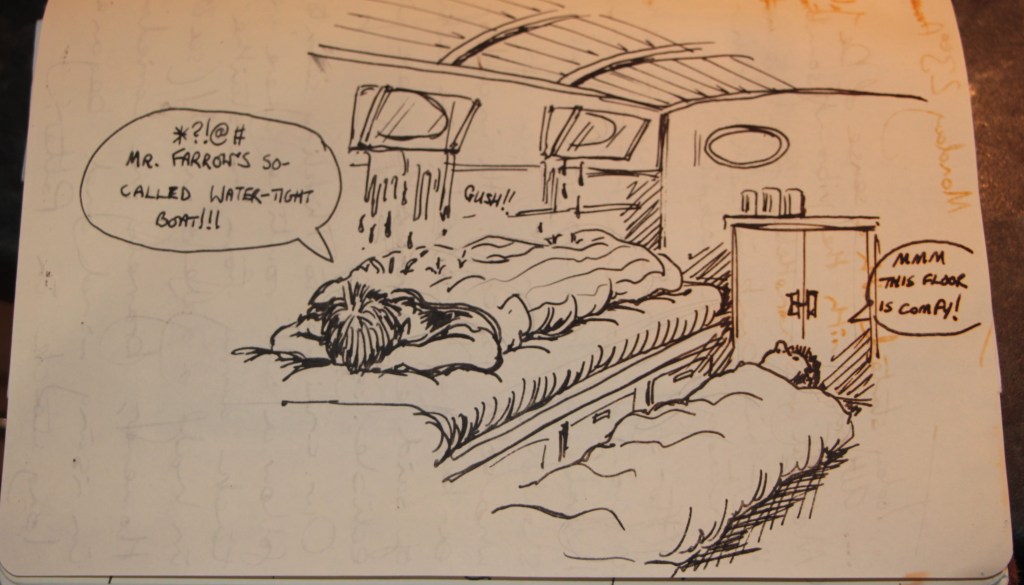
Last night there was rain, not your average ‘oh dear it’ll do the garden good’ rain… but biblical, bouncing off the cabin roof deluge.
Still – could be worse!
Truthfully my first conscious memory of the day was to see Mr Jalil storming indignantly out of the cabin (whilst still in his sleeping bag) muttering something about “Mr Farrow & his so called waterproof boat” (!)
Needless to say, he slept the rest of the evening in the cockpit – a miserable experience. ‘Corsair’s’ benches are just under 6ft long, and work ideally as seats – but not beds!
Sated with a cooked breakfast (these engineers are so very tempremental) we decided to keep our cut-down rig and sedately proceeded upriver to Potter Heigham, where with ice cream & burgers we lunched with CD & co.
The calming breakfast…
Having quanted through both bridges – we were treated at this juncture to the sight of several Hunter’s yachts scattering themselves across the river.
Evidently trying to ‘shoot’ the bridges, some had masts down, some halfway up, some just were a tangle of legs, string & quants… We noted all of them were ‘uptide’ of the new bridge (how brave!)
The Hunter fleet at Potter – with an interesting yacht below the bridge
Eventually, we set sail upriver toward Hickling, sliding along as we tacked through the bungalows to Kendal Dyke.
Here we were treated to a bit of champagne sailing, the wind had filled in to a steady sea breeze and ‘Corsair’ stormed across Hickling, narrowly beating local YBOD ‘Monarch’
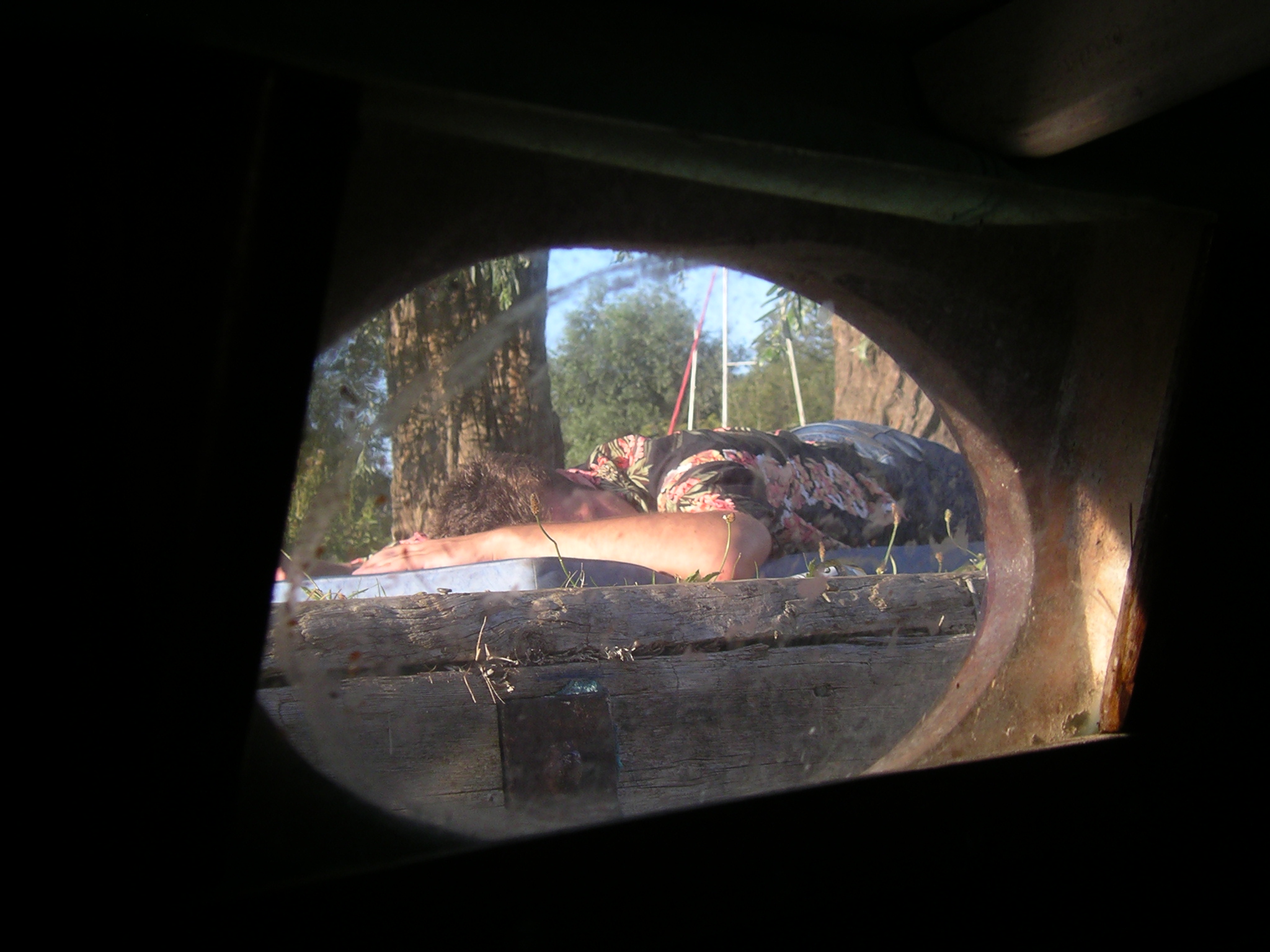
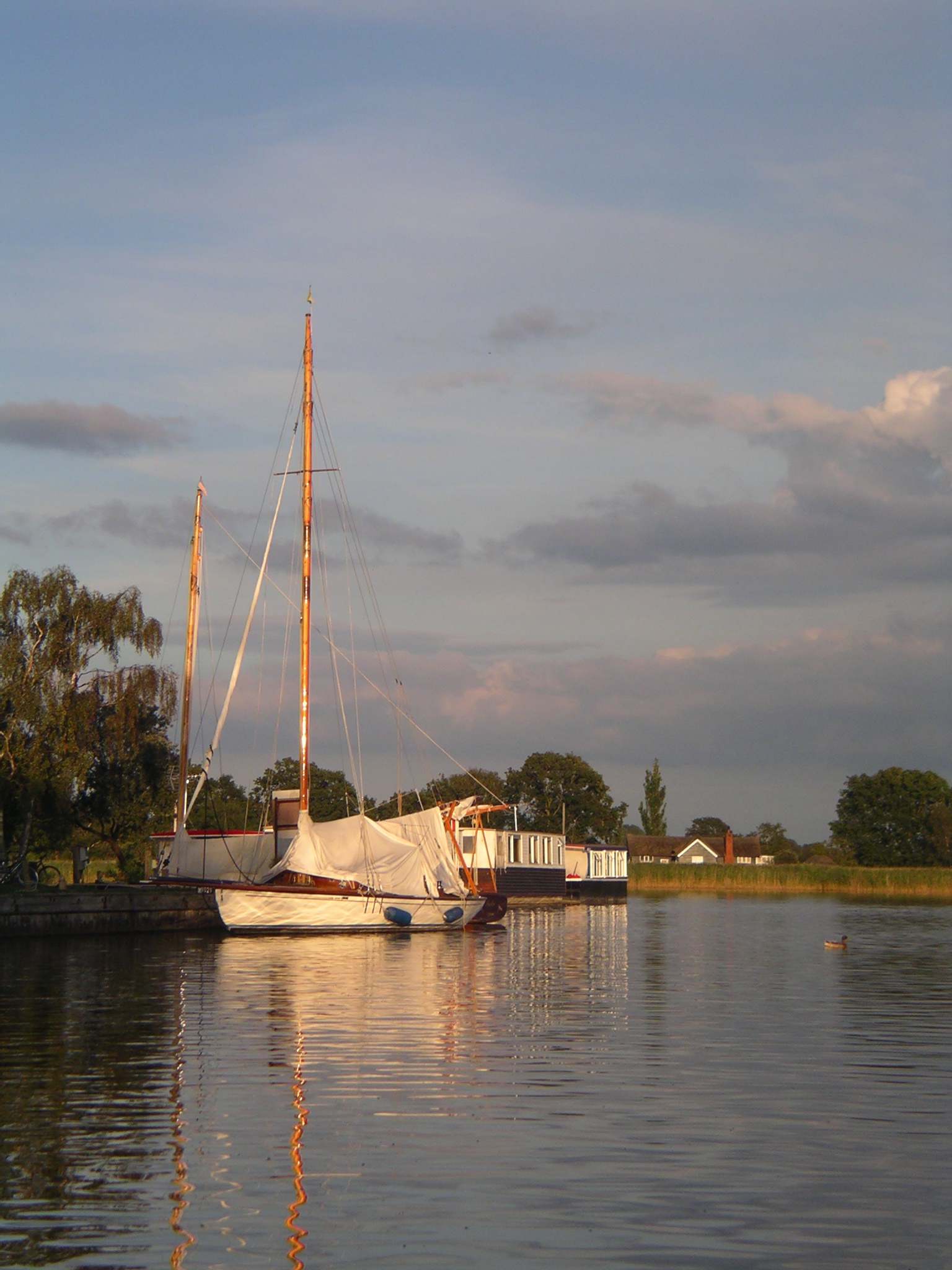
By now we felt truly ‘on holiday’ – Jalil managed to dry his bunk mattress in the evening sunshine, and as we were moored in the aforementioned sun, we sipped at Cab. Sauv. whilst writing this.
Afterwards in the wake of a spectacular sun-set we ventured ‘up the road’ to the Grayhound P.H. The skies were fantastic, purple even!
For those of you who’re familiar, each year the reality of having an old wooden boat meant I also holidayed… aboard my old wooden boat. 2010 was no different!
Day 1
Today, as ever was quite hectic (this stands true now – no matter how prepared I think I am – I still end up pulling a superhuman effort to leave the house on time with all the gear I need for a sailing trip)
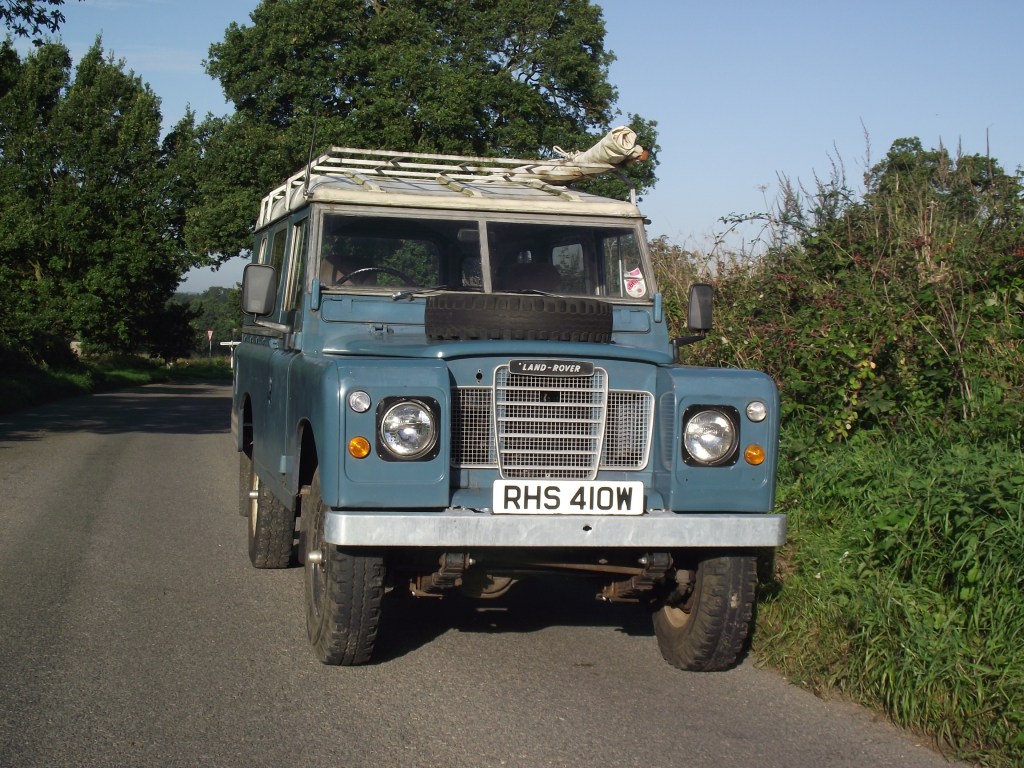
The precious/vital items you’ve forgotten, the last minute jobs etc. This year it was further compounded by ‘Boris’ a truculent 30yr old Land Rover;
The L/R
You get 2 choices at Oby – make several time-consuming trips, OR make one lung bursting, eyeball popping legs-bowed trudge – thinking stoic thoughts about pack mules. The path itself was also uneven, often muddy & with livestock to contend with…. Character building!
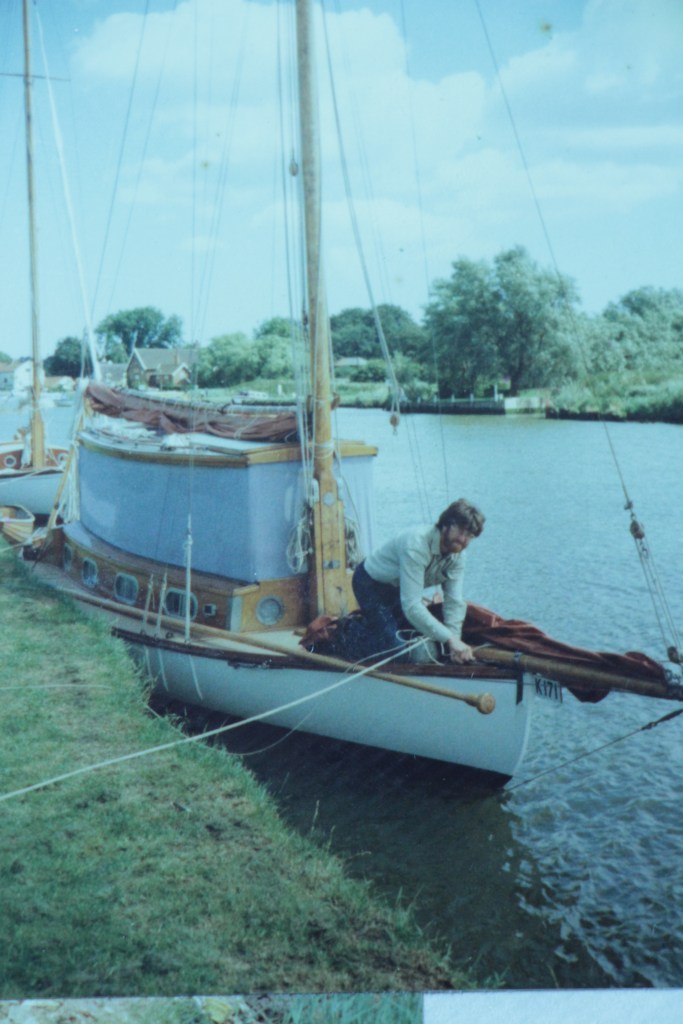
With ‘Corsair’ loaded – we then entered our usual underwater ploughing competition to leave the mooring. 3ft 8″ draft. Sigh.
(having just bought a L/R with a 2.6L straight six – I was resigned to sailing without the engine as I couldn’t afford petrol for both. Improves your sailing skills, but watching both quants bend like bananas as we forced ‘Corsair’ through the mud always was unnerving!)
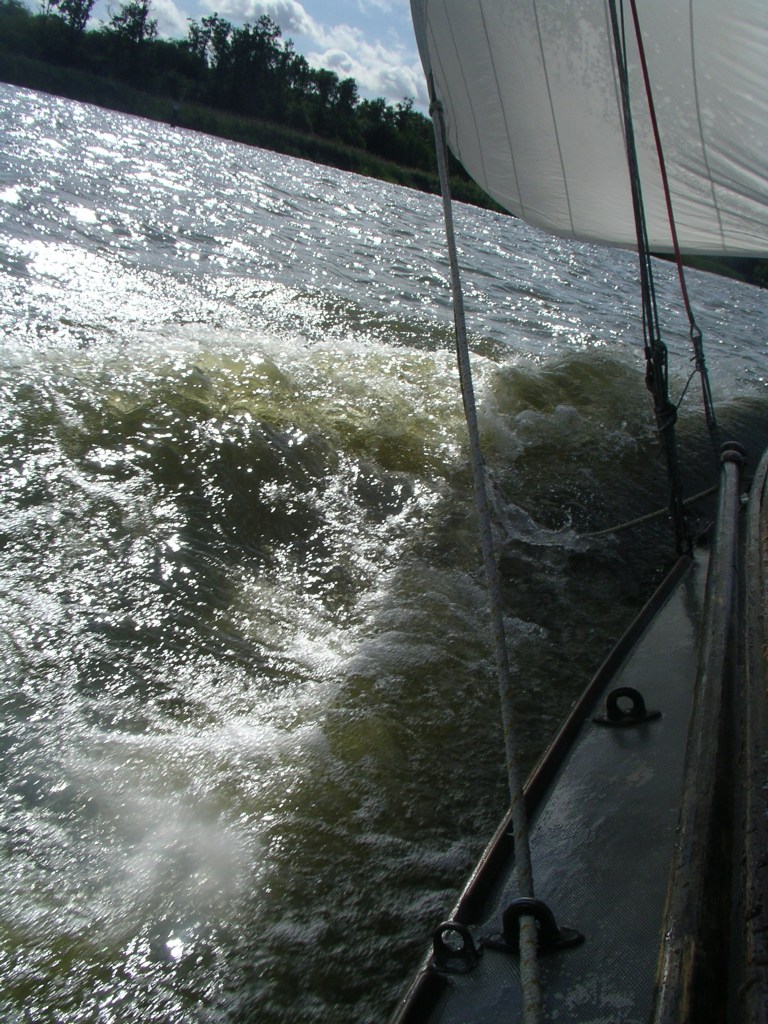
Freed, we set two reefs & middle jib saw us storming up the Bure toward Thurne junction. Despite our efforts at reefing, control soon became marginal (!)
Situation ‘not ideal’
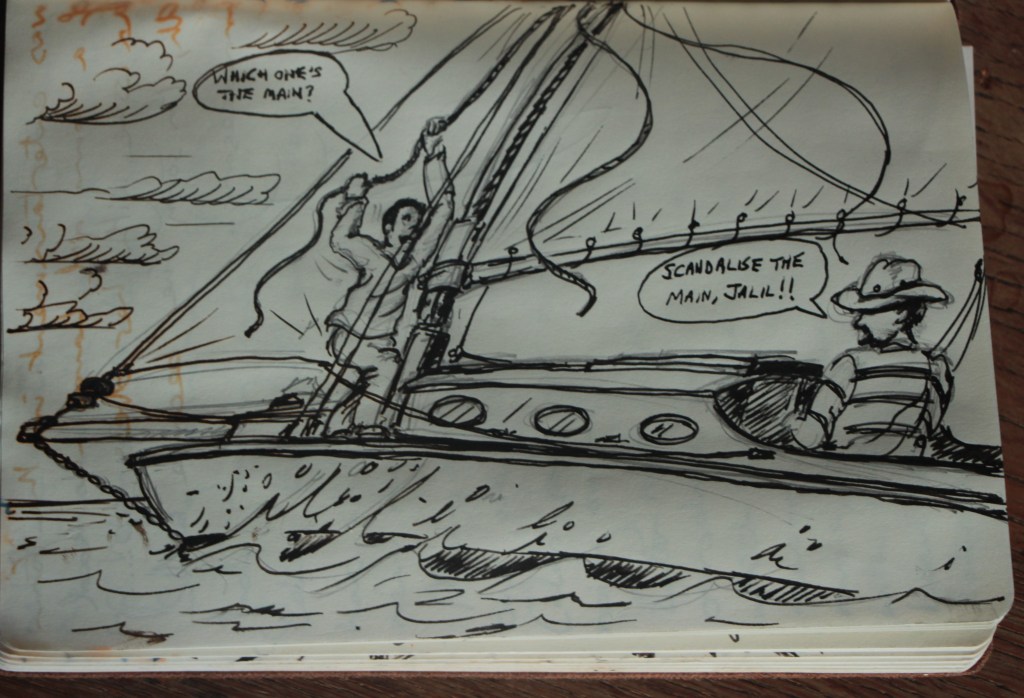
…and it was only the sterling work of Mr Jalil (who I note has been promoted for 2010?) that brought relative calm by scandalising the mainsail.
We ventured up Womack water for the evening, and sliding upriver we spotted ‘Pickin Jack’ looking quite forlorn outside Colin Buttifant’s yard. Evidently he has still yet to complete ‘Seabird’s’ new mast…
(nb ‘Seabird’ had sustained an injury whilst acting as start-boat for Reedham regatta. Colin B. being tasked with a new mast. ‘Seabird’s’ owners been reported as muttering “I wanted a new bloody windscreen not a new bloody mast” to much hilarity.)
Mooring at the staithe proved tricky but we slid into a little spot!! We adopted our usual trick of aiming at the gap – pushing in until the fenders sqweak, keep pushing then adjust the other boats mooring lines to make the space fit ‘Corsair’… works every time – especially with unsuspecting tourists.
In fact, my top-tip for mooring next to holiday-makers. First come alongside, then step aboard… Get a line on the nearest cleat. Then, and only then ask if its okay to moor alongside them. Got it?
(alas boat next door turned out to be noisy swines)
Later that night, we found ourselves in the King’s Arms, which for some inexplicable reason had a DJ and the music… more bloody noise!
Well peeling your eyelids with rusty nails would have been less painful. However later in the evening there was entertainment in the form of Laura (also a pub-goer) who had an issue with her dress zip(!)
(The logbook notes the skipper became all unnecessary at this point & ends abruptly)
I mentioned the white painted transom previously as an indication of an older yacht needing TLC… this perhaps was reflected in the price, £450!
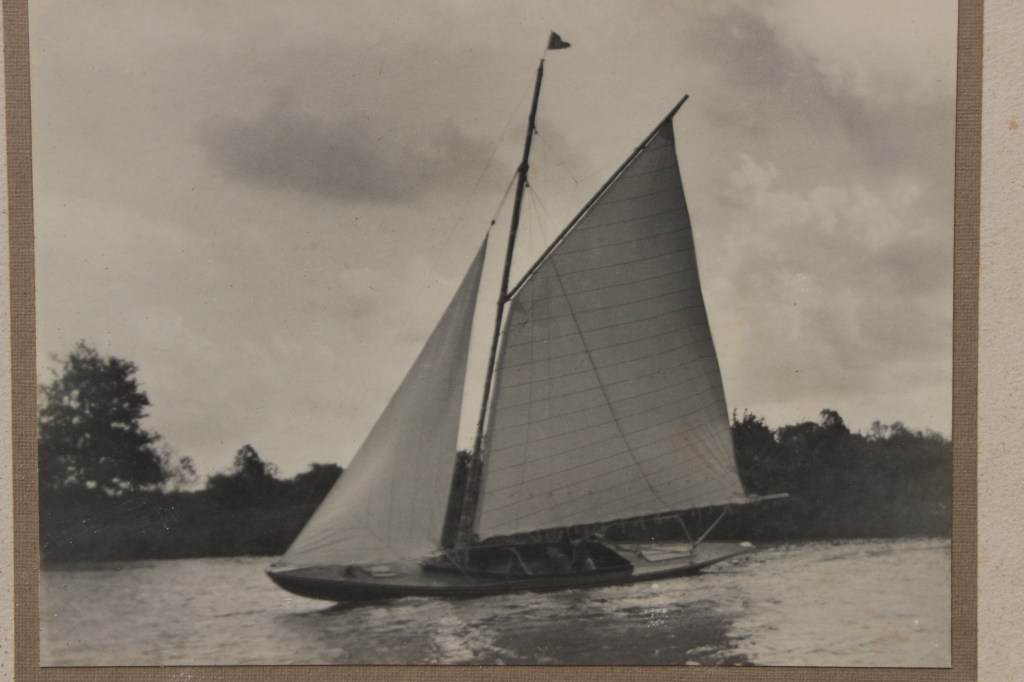
The Bown family duly put ‘Privateer’ to use, often sailing as a family. Compare this photograph from the early 1960’s to Privateer in 1936.
Privateer – early 1960’s
Alas this proved to be quite true, as Mr Bown senior undertook a significant amount of work in 1965 on ‘Privateer’. At that time, much of the planking & many of the ribs were replaced.
Paul Bown (Mr B’s son) recounted that there was little evidence of Privateer’s hire-career, aside from a repair to a cabin-side, which was a legacy of the Royal (!) cock up on Breydon in ’48.
Interestingly – Paul also discovered evidence that ‘Privateer’ had been altered throughout her hire career at C&H, there were multiple holes in the hog, indicating that the keel had been moved on at least two occasions (!)
I suspect, that Privateer when built was almost entirely balanced, and that the re-positioning of the keel was an attempt to bring some weather helm into play for safety reasons.
(most Broads hire cruisers had enormous weather helm, which meant if a hirer panicked, they just luffed themselves and stopped)
Unfortunately the 1965 rebuild cost £720 (!), which reflects the nature of the bargain price.
During the 1965 rebuild – ‘Privateer’ underwent a significant change in physical appearance. Many C&H yachts have cockpits which are ‘snug’, ‘Privateer’ being no exception. Hence the tiller linkage during her early years.
To provide useful additional space, Mr Bown senior re cut the coamings, raised the benches & splayed the short coamings ‘outboard’ to give a little extra space, as seen here.
Privateer with new windows & an enlarged cockpit. Moored at NBYC, Wroxham Broad.
The external sliding windows & their frames also disappeared at this point, apparently they could be opened by a jib-sheet – resulting in VERY wet bunks!
The final addition during Mr Bown senior’s ownership was the addition of a bowsprit, added in 1970. Paul Bown can be seen here – attaching the new jib!
The new bowsprit.
Mr Brittain had purchased new sails in 1956, aside from the larger jib for the bowsprit, that suit soldiered on until early 1990’s, another long-lived Jeckells suit. (not quite as long-lived as ‘Corsair’s’)
Privateer was sold in 1979, to Peter Dunham, who kept her in a boatshed at South Walsham (it appears S.Walsham has a ‘draw’ for C&H boats!). He didn’t keep her long however, as in 1983 she changed hands again…
… to Paul Bown! Mr Bown’s son. Evidently despite having sold her 1st time round because she was ‘abit much to handle’ -she was bought again!
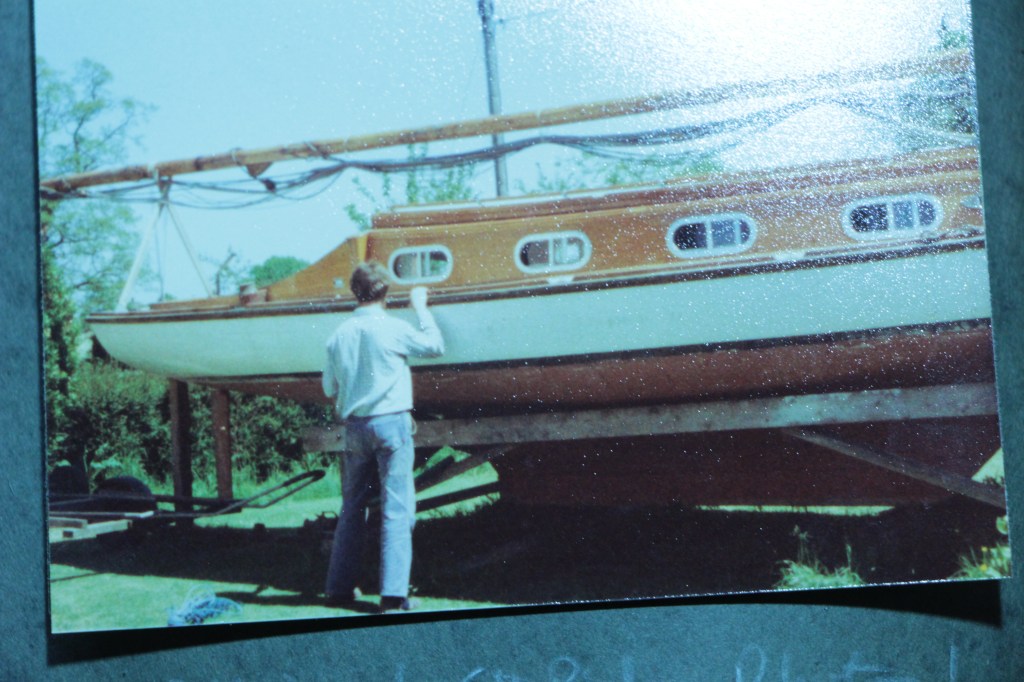
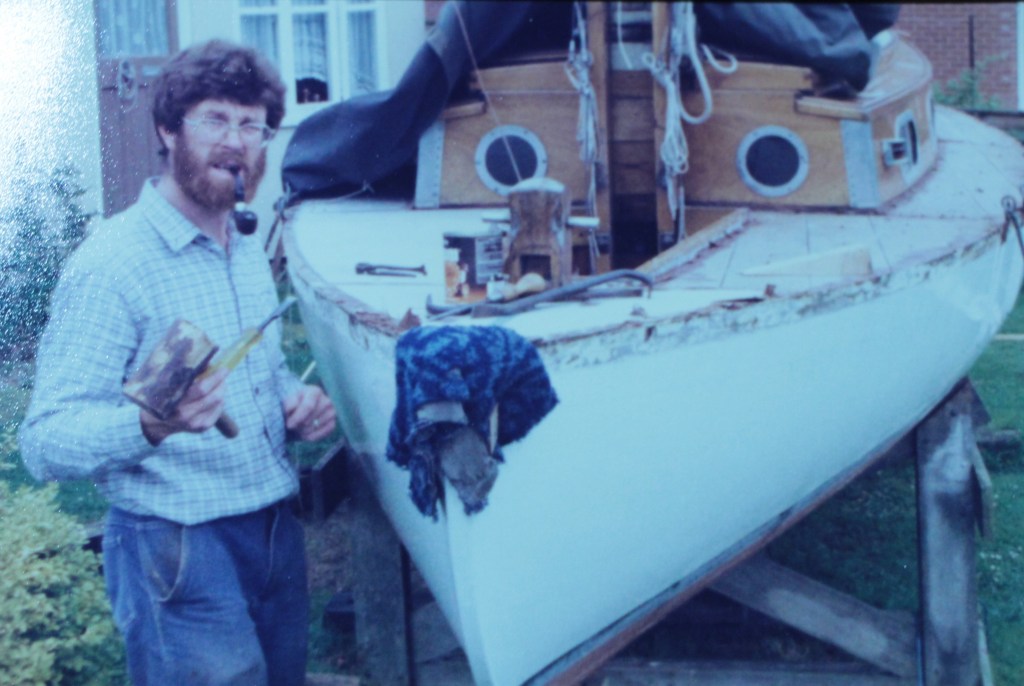
Following a similar pattern, after 2 years of family-sailing, Paul took the opportunity to undertake some signficant works to ‘Privateer’ during 1985;
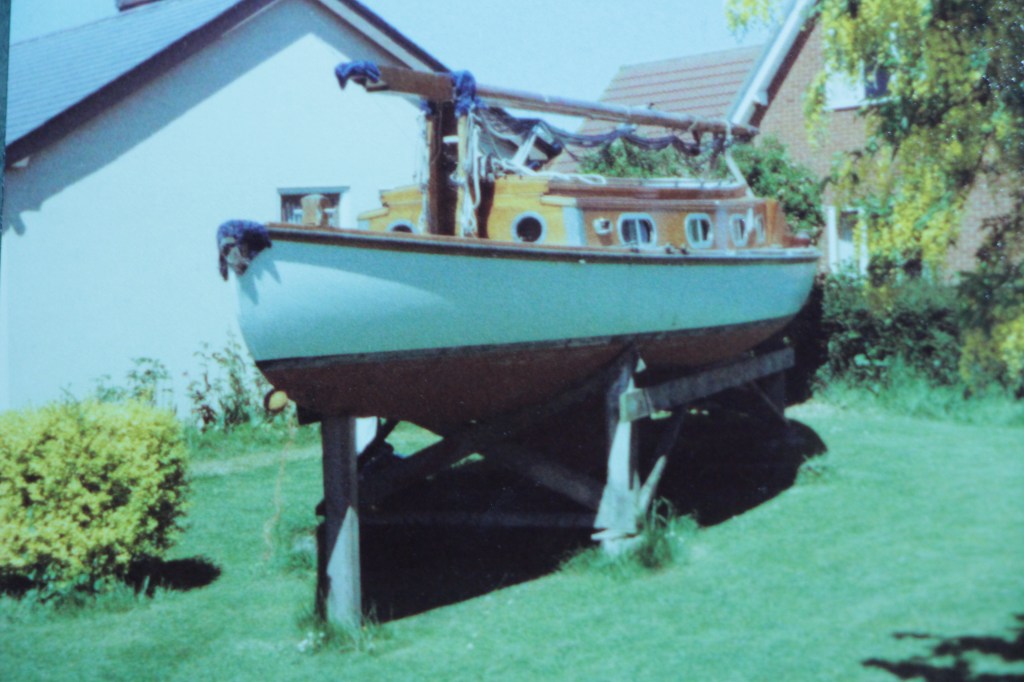
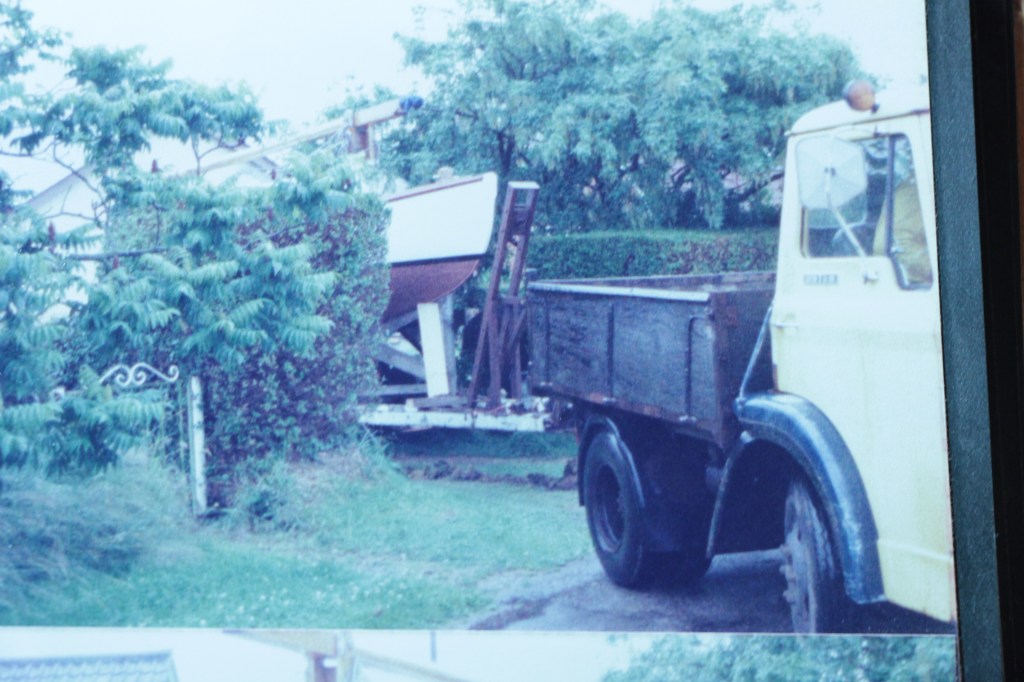
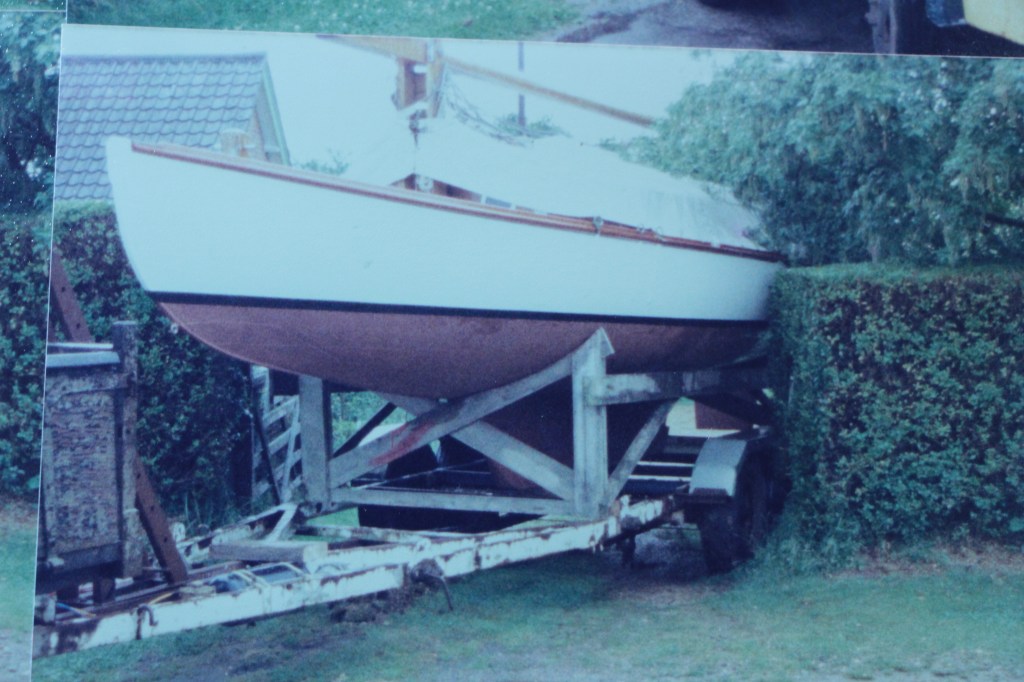
Paul managed to squeeze her into his front garden for this work!
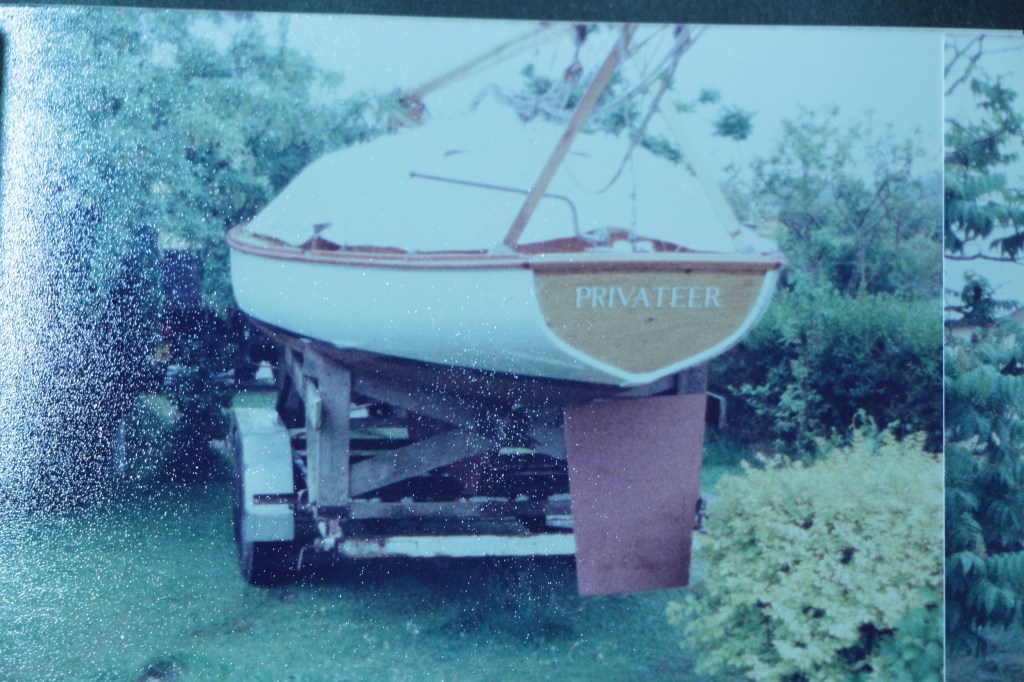
So, in 1985, with a new deck, and a new rudder – Paul was able to enjoy racing ‘Privateer’, predominantly at Wroxham Broad;
Privateer – racing – Paul Bown helming. S/N 52 ‘Maidie’ & S/N 119 ‘ButterCup’ also photo’d.
In 1990 though, Paul had another project lined up, and ‘Privateer’ soon changed hands again, this time going to Jean Vaughan & Terry Secker.
Jean Vaughan, was in fact Jean Oliver – whose family had regularly hired ‘Privateer’ in the 1950’s, the boat having made such an impact on Jean, she snatched her up given the opportunity!
Jean & Terry kept ‘Privateer’ at Oulton Broad for a further 8 years. During this time, the tan sails disappeared. She lived on a buoy in Oulton’s South Bay.
Privateer – Oulton Broad 1990’s
Their ownership wasn’t without the occasional excitement. One day having rowed out the buoy, the tiller was found lying on the deck… The rudder having detached itself & helpfully sunk!
A diver was summonsed, and with breathtaking luck, he jumped off the stern of ‘Privateer’, and stood straight on the rudder! Given that on a buoy, say about 40ft overall, that’s an 80ft diameter circle it could have been lost on the circumference, so 1st dive to find it is bloody amazing!!
In 1998, Jean & Terry sold ‘Privateer’ to Mr Child, who still owns her today – the longest period of single ownership ‘Privateer’ has had to date. Tim has continued to enhance her, starting with a jackyard topsail rig;
Privateer – Cantley Regatta 2006.
Undoubtedly the addition of a larger jib, and a topsail enhanced ‘Privateer’s’ sailing performance, and kept her a regular figure on the regatta circuit throughout the early 2000’s.
In fact, Tim further pushed for performance by introducing one of the first ‘integral’ topsail rigs to be seen on the Broads, seen here to good effect at another Yare Sailing Club event, Breydon Open Regatta;
Privateer – Breydon Regatta 2007
Aren’t they both fantastic photos? Really showing the A.L. Braithwaite ‘sleek’ look, with the added bonus of being a sunny day. Fantastic!
Which brings us upto now – Tim still owns ‘Privateer’, he was my next door neighbour for a prolonged period of time, re-enforcing that somehow, C&H boats are bizarrely never too far away from me or my life…
Next time, we go back to ‘Corsair’ – and how she came to be a ‘southern rivers’ boat…
Returning to the intended order of writing, it was early 2010 when I started looking into the fate of ‘Corsair’s’ sisters. In part this was spurred on by the C&H connection to Upton.
Of course the Clipper’s also have a bigger sister – ‘Privateer’, who I will write about next.
Having his head turned by ‘Loyalist’ – Stephen left ‘Corsair’ at a boat auction in Potter Heigham. This period of her life I don’t have many details about, save what’s printed in the class listings within the ‘Green Book’.
1978; sold at boat auction.
1979-1983; owned by K.T. Henson
1984-1987; owned by P. Willen
Bizarrely – during one change of ownership – the spelling of ‘Corsair’ was corrupted to ‘Coresair’ – which wasn’t corrected until 1986!
What I do know, is that for these 9 years, ‘Corsair’ lived on the Northern Rivers, with a prolong spell moored at South Walsham Broad. Given the proximity of S.W. Broad to Martham, it’s likely that she often saw her sisters, still hard at work in the business of hire.
The other C&H yachts went to a variety of owners, but sticking to the ‘Clipper’s’ – these found their way to Martham, where they became part of the Martham Boatbuilding & Dev. Co fleet.
Known locally as ‘Martham Boats’ – they still retain an extensive fleet of wooden sailing boats, and certainly they were the only yard who saved many beautiful yachts by keeping them working long enough that private owners could be found. More info on their fleet is available here; https://www.marthamboats.com/
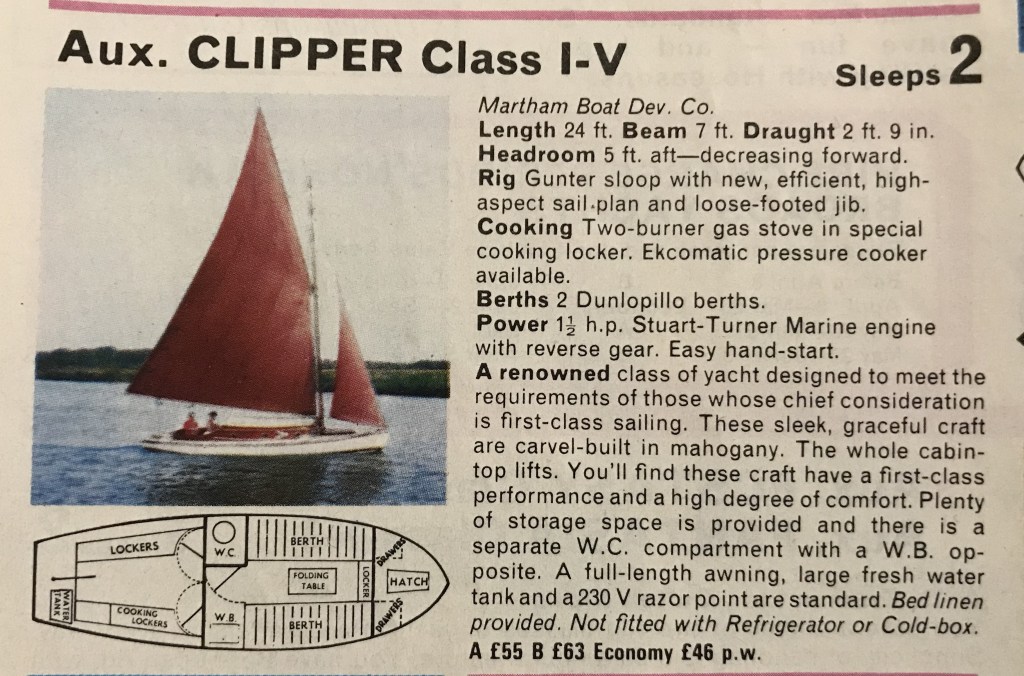
In 1961, Martham bought I – V, bolstering their existing fleet of yachts with these small pre-war yachts. Clipper’s I-III were still engineless (!), credit to their reputation as immortalised by ‘Blakes’ the hire agency;
“a design giving distinctly superior sailing qualities”
Perhaps more objectively, this is an insight into the post-war attitudes at Chumley & Hawke. Knowing they intended to dispose of the fleet, it may well have been economic to limit the investment in R3M Stuart Turner engines to the newer (just) yachts.
During 2010, I went and spoke with Gordon Curtis, one of the founders of the Martham fleet, to learn more about how the ‘Clipper’s’ had turned out in their ownership.
By 1965 Clipper’s I-V all had inboard engines, but had had their rigs adapted slightly. Gone were the self-tacking jibs, and in their place a smart tan suit of sails changed their appearance considerably. Also, gone the pre-war varnished top-sides replaced with white gloss.
Clipper’s – MBBD Co.
Credibly, Martham kept these pre-war yachts active for a number of years. If it hadn’t been for their intervention, I am not sure that all 6 would have survived.
They did however remain very basic with optional extras limited to a wireless radio & a rowing dinghy!
Digressing slightly, it would have been an exhilerating time for any wooden boat enthusiast to walk the bank at Martham. Woods, Powles, Chumley & Hawke, Press, Pegg & numerous other pre-war pedigree craft lined the Upper Thurne. Gordon even bought a wherry (or two)!
In fact, as a complete aside – Gordon bought the wherry ‘Hathor’ from infamous Broads navigator – ‘Claud Hamilton’. His previous wherry – ‘Claudian’ had sadly broken her back during the 1953 floods. Seen here in 1950 at Barton Regatta looking quite spritely, sailed by ‘Claud’;
Claudian – 1950 Barton Regatta
Whilst chatting, Gordon recounted how he quickly learnt how to sail ‘Hathor’ using the original pre-war cotton mainsail, until this disintegrated. She then became a houseboat, until saved by Peter Bower – founder of the current Wherry Yacht Charter Charitable Trust.
Hathor – Martham. pic; M. Gravener.
Anyway, yes. This is writing about Clipper’s not wherries. Sorry.
Over the years, Clipper II, IV & V gradually left Martham’s fleet, with Clipper I being the last to formally retire from hire, being sold in 1998.
1998? That’s 63 years work of hire, being sailed week in, week out from Easter through to October. I’m amazed at the resilience of these dainty yachts.
Clipper III remained in Martham’s ownership, and to my knowledge was withdrawn from hire at some point in the early 1990’s. I wasn’t allowed to photograph her, but by a bizarre turn of fate – my good friends Vince & Linda had hired her in the 1970’s!
Clipper III – Vince & Linda Perry aboard.
I’m confident in saying that Clipper III is the most original to how the Clipper’s would have been in hire, having now been sojourned at rest for 30 years in her barn.
However, what’s astonishing to me, is the way in which the ‘Clipper’s’ seemingly brushed past me closely, without me knowing about them. Clipper V was bought and owned by my primary school Headteacher for example!
Both Clipper IV & V are perhaps the most significantly altered from original. Both have had their cabin’s cut-down, cockpits extended and some very neat integral topsail rigs fitted. This has made them both extremely competitive!
As an aside, the modifications carried out also haven’t spoilt the aesthetic of the Clipper’s. They retain a very sleek look, as you can see here;
Clipper IV – racing rig!
Clipper V (S/N 290) – Barton Broad
Clipper II still lives close to Martham, in fact she spends much of her time in a wet boatshed at Potter Heigham. She was reverted to varnished topsides – and although she is seen here sailing with an outboard motor mounted (sacrilege), she provides the closest aesthetic to the pre-war Clipper’s. I suspect if given a self-tacking jib, she’d be a facsimile of a 1930’s Blakes photograph.
Clipper II – Horsey Mere
Finally – Clipper I. After her exhaustive career in hire – she was owned by Robert Harris as a private yacht, and then bought back into Martham’s fleet, circa 2015. They immediately treated her to a new suit of sails, giving her a VERY similar appearance to ‘Corsair’, early 1960’s.
Clipper I & VI
What is apparent when you compare Clipper’s I-V to ‘Corsair’ is the difference that extra plank makes in terms of internal volume. I’m VERY grateful that when ‘Corsair’ was built as Clipper VI, that extra plank was added!
In 2010, Clipper’s I & VI found themselves at rest, Horsey Dyke, which started this whole process.
Clipper I & Clipper VI at rest.
So yes, in a round about way that’s the fate of all the Clippers. One day I might be lucky to get all 6 in the same place.
Yesterday I enjoyed what is likely to be my penultimate sail of 2019. I know, I know yet again I’m deviating from the intended order of writing. That’s the joy of being the Editor though.
Yesterday was glorious. Bitterly cold, clear, sunny and calm. Very calm. We rigged whilst tied to our mooring, and headed off upriver to Surlingham Ferry, for the Turkey Race – next weekend.
I found myself checking and double checking the rigging again – I’m not sure if I need to re-order and change the cleats on the tabernacle, now the topsail is there. Currently the peak halyard is lead onto the port face, with the throat on the starboard face. The topsail spar has a neat trick of capturing the peak – at the lower end of the spar, which can make lowering the mainsail tricky.
This definitely needs looking at, for two reasons. One – the rig should work, and this is dangerous. Two – when you sail on/off moorings, I find the best way is to keep the way on as much as possible, and to be able to drop the sail – bloody quickly if needed.
Gorgeous!
The rig did present a more amusing quirk – if you tension the topsail forestay just right, it ‘thrums’ and buzzes… Took me ages to work that out, including removing the floorboards and checking on the bilge-pump to see if that was running!
Heading upriver, we were lucky enough to be photographed by a friend, whose currently building a house for his family. The scaffolding made an excellent platform, although if I’m critical – that peak is about 1 or 2 inches ‘out’ by the look of the creases.
I’m struggling to find superlatives to describe the day if I’m honest, it was perfect.
Typical of the season, a North wind with no warmth, a clear sky and a medley of colour in the riverbank, reds, browns, yellow and oranges all competing in the remnants of summer foliage. We sailed every inch of the way, and we knew we’d taken the best of the day for ourselves.
But. I wanted to talk about the starfish.
This links with the subtly of the Broads rivers – and the villages which surround them. There are features worth exploring, and a hidden history. There is a tenuous link to Chumley & Hawke as well…
Surlingham has a starfish. Something which shows the far-reach of war, into the boring fields of Norfolk. In truth both Norfolk & Suffolk were riddled with military action during WW2, and you’re never far from it.
Starfish sites were large decoys – developed in WW2 to act as a distraction to enemy bombers. Norwich took a pasting, in what’s known as the Baedeker raids, with the railway station/yard & nearby engineering works of Bolton & Paul being prime targets.
The solution was to create a decoy – which could emulate (from afar) what bomb damage might look like, including fires. The deception went further – it had to look realistic. There was a network of lights rigged, which could replicate the cadence of lit railway carriage passing by at night. Or a red glow to simulate a fire-box door being opened on a railway locomotive.
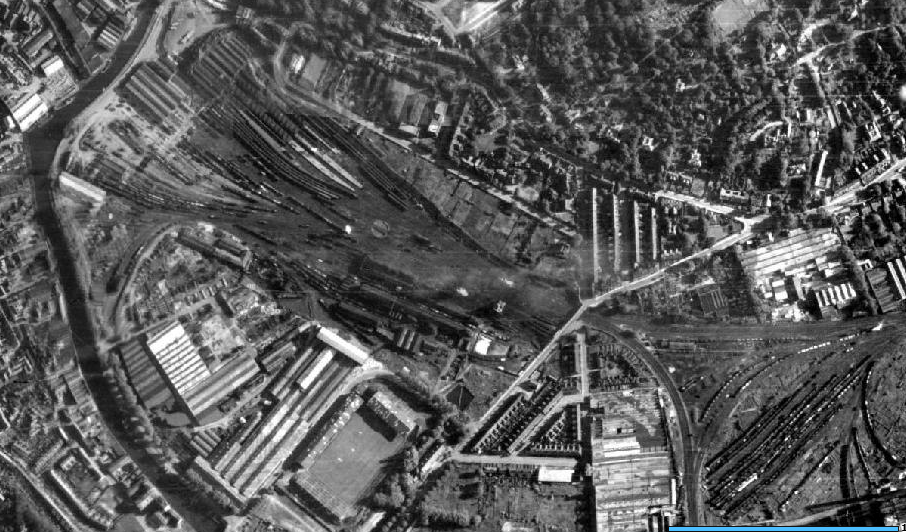
For reference – here’s a 1946 aerial photograph of Norwich railway station;
Norwich Thorpe railway station, including motive power depot, Crown Pint depot, Bolton & Paul engineering works. All very lucrative targets. The River Wensum snakes around the lefthand side of the image.
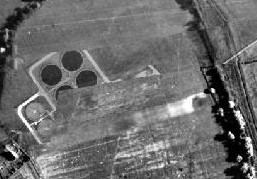
Interestingly – the 1946 aerial photographs also show the deception required. Outside of Norwich, you can just see a crude attempt at censoring the existence of what is either a fuel installation, or the present-day sewage station at Whitlingham;
Nothing to see here!!!
Surlingham was chosen to host a ‘starfish’. Local firms such as the Rockland Reed & Rush company would supply bundles of reeds to act as ‘wicks’ for the fires – whilst the pyrotechnics were handled through a series of heath robinson-esque contraptions – mixing oil & water to make dramatic explosions.
Interestingly – the knowledge & expertise behind the starfish sites is credited to expertise within the theatric industry – being able to use lights, smoke & explosions to good effect on stage can enable a mimic on a much larger scale.
It’s no exaggeration that these sites were vital. Norwich became so battered and bruised, you would see families walking out on the Drayton & Dereham roads on a nightly basis – preferring to sleep out in the open than risk another night of bombs.
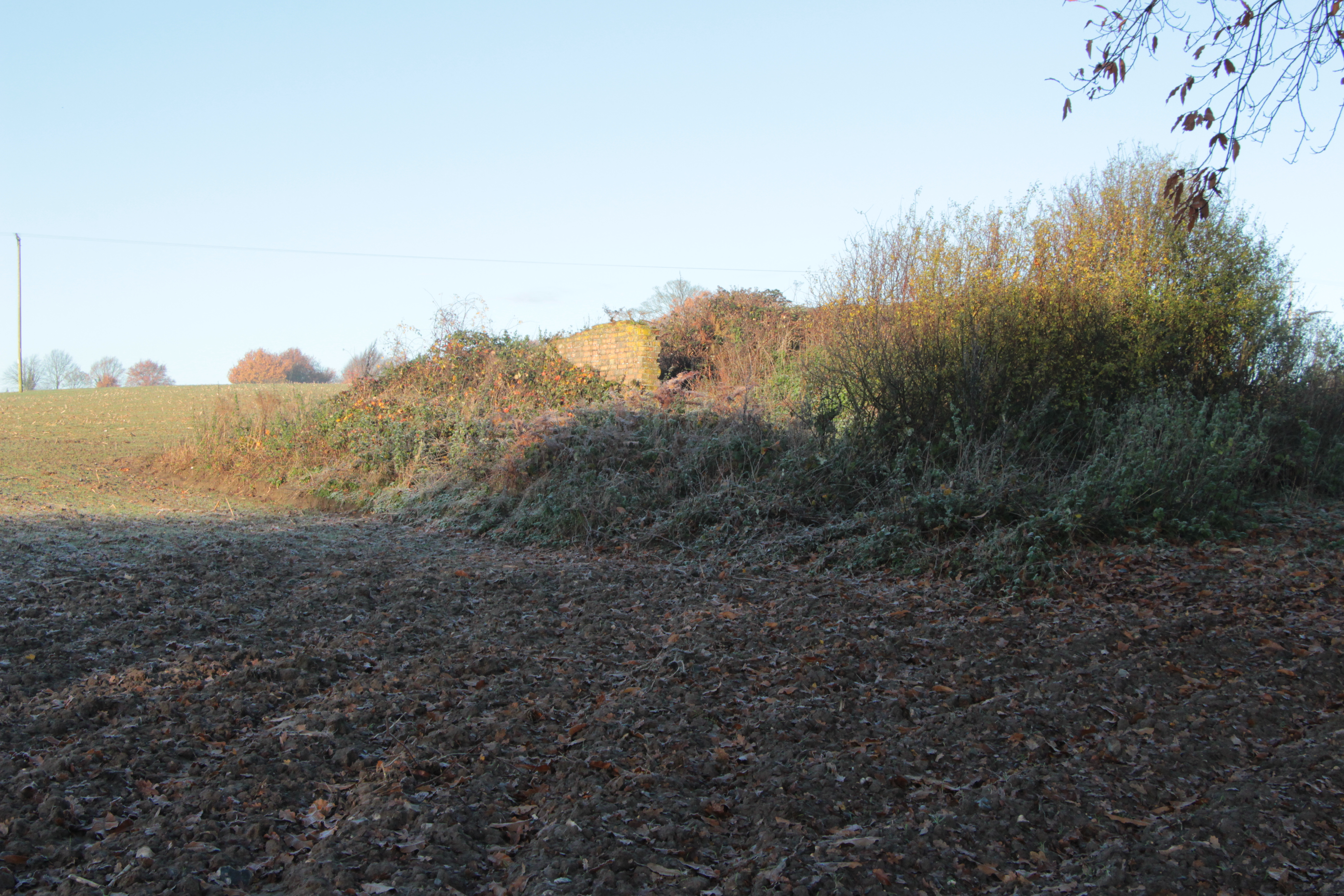
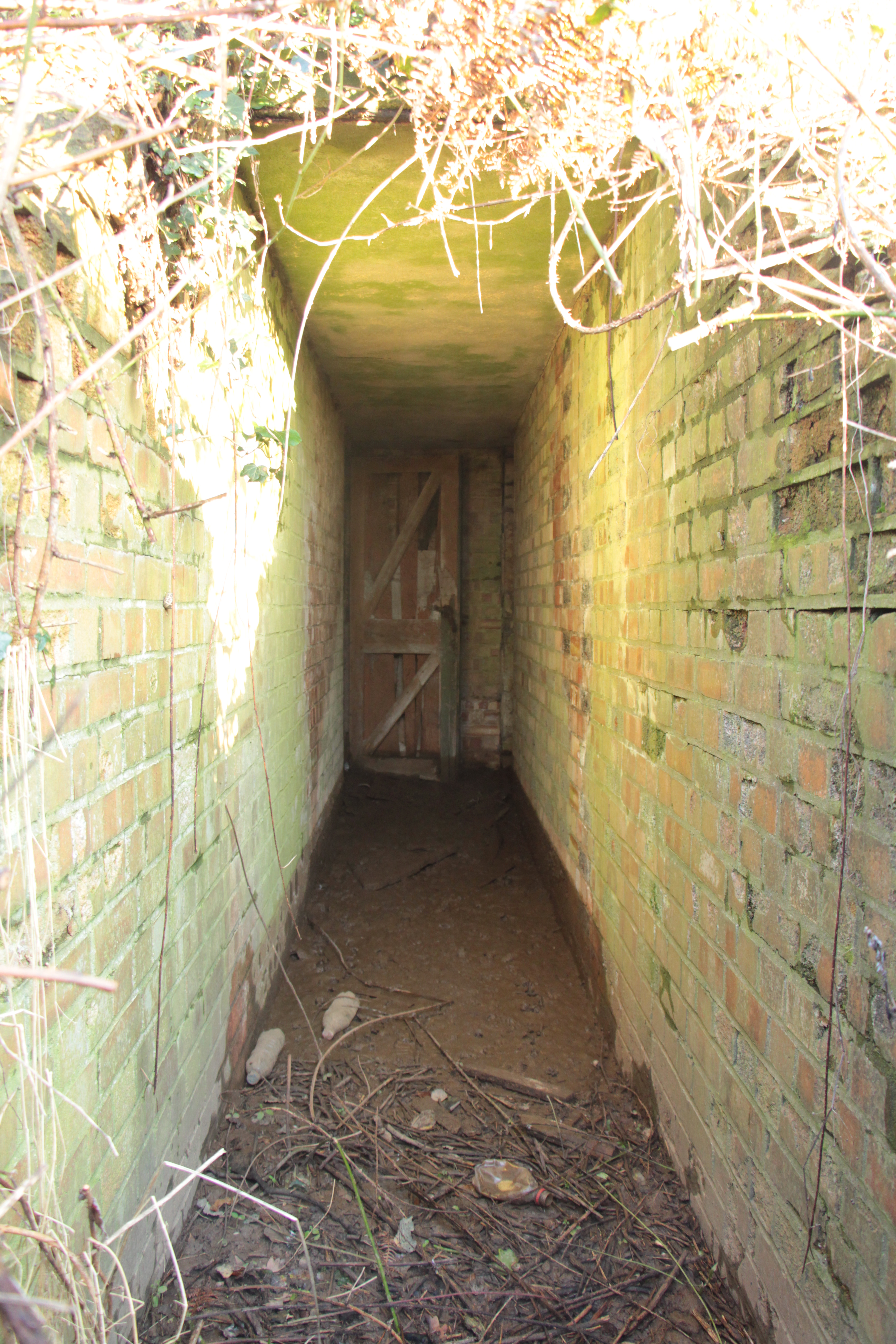
Today – the site of Surlingham’s starfish is much quieter. I stopped by, and knowing where to find the bunker – managed to capture it in its slumber;
Again – the hidden detail, and history of Norfolk’s rivers & surroundings amazes me. You can walk quite easily from Surlingham Ferry, and walk past this 100 times without knowing what it’s about.
I can’t imagine what it would have been like, orchestrating a site like this in the war – knowing it’d lure enemy bombs to drop adjacent to you instead of on an already burning city.
The link between this starfish and ‘Corsair’ is tenuous – but there. It links to Joseph Lejeune – foreman at Chumley & Hawke in the pre-war years, and the heyday of Alfred Lloyd Braithwaite’s design experiments. Lejeune’s & Braithwaite’s most extreme experiment was undoubtedly Khala Nag;
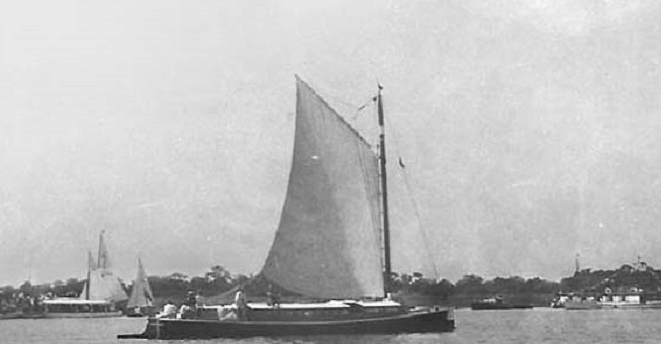
Khala Nag – sometime in the 1930’s, somewhere on the Broads near Horning.
I’m fortunate enough to own that photograph, which is to my knowledge the only extant photograph of Khala Nag – it was part of the treasure trove of ALB’s possessions which I found earlier this year, in Milford on Sea. See here for the highlights of that; https://broadssailing.blog/2019/07/18/on-the-trail-of-a-l-braithwaite/
‘KN’ was a flier. 27ft long, with only 4ft 6” (yes) beam and 3ft 6” draft she carried 2 separate rigs, one for the Broads, one for coastal waters. The extent of his commitment to balance, weight, sails & hullform is evident in this design & build.
Whilst Joseph Lejeune built the yacht, Braithwaite assisted throughout. Notably he weighed and recorded each and every component of ‘KN’. This eventually lead him not only to knowing the exact required weight of the ballast keel, but also how to trim the vessel, so that her centre of gravity could be altered to 1” in advance of the centre of buoyancy, calculated to counteract the weight of any crew. This simple calculation is often overlooked by designers, and pays dividends when sailing.
At the time of the outbreak of WW2 Joseph Lejeune was the foreman at Chumley & Hawke, and unquestionably there must have been a close working partnership between him, and Lt Cdr Braithwaite. They were close in age – and clearly shared a passion for experimenting with the limits of design at that time, to create some unique, and exciting craft.
For example, the noted cost of JL’s time during ‘KN’s’ build was £117, 4s 10d (!) The lead for KN’s keel only cost £7 9s 0d. ALB must have valued his input as a designer.
Sadly, this evidently close partnership wasn’t long lived. Whilst Lt Cdr Braithwaite went back into active service, Joseph Lejeune stayed in Horning.
I know that Alfred Lloyd Braithwaite felt very strongly about returning to active service. His age would have discriminated against him at the outbreak of war, and in fact I notice on the 1939 return there is a note which reads; ‘RNVR in Great War, but refused for present war’. ALB was not to be deterred, and was posted in 1940.
In Horning, during the evening of April 26th 1941, Horning village was subject to a stray bomb attack – which disastrous consequences.
(I actually sit, reading notes I first wrote – April 26th 2016).
It isn’t clear exactly, but it’s likely a Luftwaffe bomber was jettisoning bombs on the way back to the coast. And their attention was sufficiently drawn to drop their remaining payload of 15 bombs around Horning.
I wonder if they were aiming for the ferry itself – which may have been silhouetted. Else perhaps it was a chink of light as someone slipped into the pub?
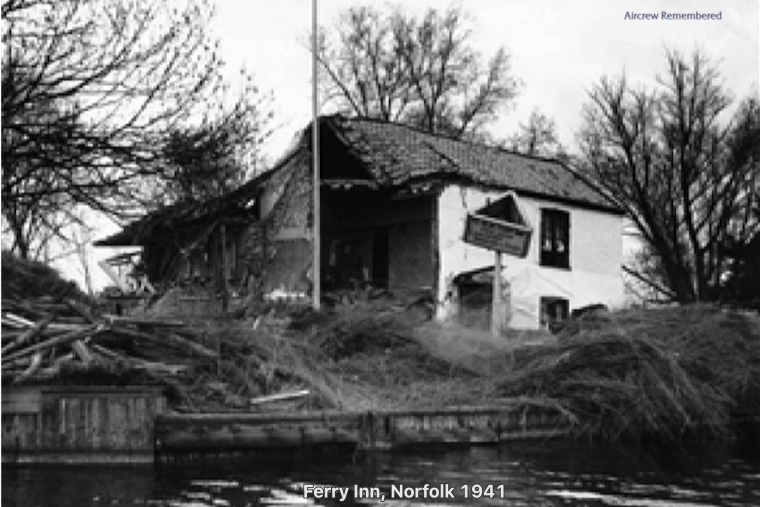
Whatever the circumstances, the most unfortunate target was the Horning Ferry pub, and amongst the 22 fatalities that night was Joseph Lejeune, aged 50.
The devastation was instantaneous;
The link between Surlingham’s starfish and this, is that sites like that, their flashing lights and theatrical pyrotechnics were desperately trying to stop destruction and loss of life like this. Sadly it’s reckoned that Starfish sites only drew 5% of the intended bombs away from the actual targets.
This accounts for how ‘Corsair’ came to be built post-war by the apprentice at Chumley & Hawke – Tim Whelpton, directed by the then yard foreman Alfred Yaxley.
Anyway – In a roundabout way, I hope I’ve explained another bit of Norfolk’s hidden history, and some more of ‘Corsair’s’ story.
Typically there’s always one. in this case it was Chief Engineer Jalil… He’d fallen in love with a barmaid at Cantley. This lead to an evening of heavy drinking – the junk box played on (and on), and things became blurred…
It was a VERY late return (or early) for those who were staying on ‘T.O.G’. The skipper showed some restraint… (!)
The Only Girl – s/N137.
Two cabins, four berths and ample space for drunkard, love-sick crew members!!
Now, the next day its worth noting that some were alert and fit for duty… Some… well. Less so.
Once again our plan was changed to suit the scale of our hang-overs… We’d head upriver to Surlingham, which gave us plenty of time to bring ourselves into the world slowly… with caffeine. Lots of caffeine.
It was light airs, so we raised the sails on both ‘Corsair’ and ‘Nulsec’ and beat up the Yare. It was even sunny! Yes, this was the life! H.B motored upriver, sweeping past.
Javelin No. 1 – sporting a fraudulent mainsail!
We sailed past Nulsec’s birthplace, at Buckenham Ferry. Here – the 1st 550 (yes, really!) Javelin’s were built. Nulsec is unusual – not least because she is S/N 1, but that she is probably the only wooden decked Javelin still in existence – by S/N 5, the boats were all fibreglass.
More information r/e the Javelin class, which celebrated it’s 50th anniversary in 2018, is available here; https://www.javelinuk.org/
‘Corsair’ moored at Brundall for victualling, and petrol. Strangely there was demand for energy drinks and paracetamol!!
Determined to rescue his reputation our Engineer leapt into action, as we walked upto the shops. His Uncle’s boat ‘Strongbow’ (aptly named) had some mechanical issues (it had a BMC1500 diesel)… ‘nuf said!
Returning from the shops, we looked longingly at the railway station, thinking about civilisation, showers, hot water!! Eventually – we all walked back to the boats!
get back to the boat!!
Jalil had managed to bring life to ancient iron – the subtle clattering and blue haze surrounding ‘Strongbow’ gave it away as we approached! ‘Strongbow’ also served as an excellent camera vessel for ‘Corsair’ as she tacked through Brundall.
Sadly – ‘S/B’ had to retire – oil pressure was scarily low. On ‘Corsair’ then amused ourselves by tacking onwards, aiming at lots of expensive boats, with a probing bowsprit!!!
‘Nulsec’ attempted the shortcut through Surlingham Broad, and ‘Corsair’ took the long way around via Brooms. We didn’t catch them – BUT we did enjoy ourselves, arriving at Surlingham last.
At Surlingham – it was the skipper’s turn. A thoroughly pleasant (for some) – and deeply amusing (for most) evening was spent attempting (and failing) to capture the attention of a barmaid…. (!)
Accepting failure, Chief Engineer Jalil & the skipper took a nightcap (or 4) aboard ‘Seabird’ – and set about getting wrecked commiserating eachother!
Sorry. As ever my ambitions to write regularly get thrown aside. However – a lot of the distraction has been sailing the boat, which is no bad thing.
‘Corsair’ had her topsail set recently. It’s the only sail remaining from the 1978 suit. To be honest I’ve never set a topsail on her before. In the true spirit of all ‘well thought’ out decisions, I dug the topsail out of my loft on the Thursday evening, rigging it Friday evening (on the quant pole in lieu of a proper spar) – and then raced with it on the Saturday morning.
It’s important to spend time on well founded (funded) development… (!)
The only down-side, was that the new mainsail doesn’t set quite ‘right’ with the old topsail. I’m considering narrowing the topsail by about 3 inches, which should allow the peak to sit better.
Also – using the quant as a topsail spar – it worked, kind of… Ultimately the sail needs its own spar, as the quant did bend. In fact I’m curious to see if a better spar will allow me to peak up the required amount.
Oh, and having put the boat in the reeds to get the rig up, you know what I needed to get out? The sodding quant…
In short – James had sunk, we’d got pissed, and then some dubious sailing had occurred. Situation normal really!
Day 2 – Cruise 2009.
There was a strange sense of de ja vu about the early morning at Somerleyton… The skipper shuffled through the cockpit, en-route to get the kettle going. A cursory glance astern. BOLLOCKS!
‘Nulsec’ had caught up on the quay, and as the tide fell, she had reached an unnatural angle of heel. The bugger would capsize any moment. A flurry of hungover people came busting out of various craft up and down the bank – and pyjama-clad, we proceeded to put ‘Nulsec’ back into the water.
Later, post breakfast and caffeine (plus some ‘feedback’ to James) us saily-types decided that we would sail from Somerleyton staithe, up the Waveney with the ultimate destination of Beccles. ‘Corsair’ and ‘Nulsec’ were first to depart, taking advantage of an early opening bridge to saunter in the direction of Beccles.
‘Corsair’ took a brief pit-spot at the Waveney River Centre, providing a glimpse at Sailing Barge GM. A vessel I had skippered on a delivery trip from London to the Waveney River Centre earlier in 2009. Anyway, ‘Dragonfly’ swept by majestically, being lead by ‘Seabird’, we needed to stop dawdling!
Dragonfly – S/N 6. Largest Broads yacht on the rivers.
Having set off again, ‘Corsair’ tacked her way up the Waveney. A very short interlude later, ‘Nulsec’ was sighted, firmly stuffed up the lee bank. ‘Corsair’ brought up on the weather bank, and after some encouragement – ‘Nulsec’ paddled across, enabling us to make a temporary repair to the rudder. (more of this later).
‘Nulsec’ then set off, and we took bets on how long before we’d see them again…
Inevitably – the rudder had suffered a terminal failure. Thankfully it was in eyesight! Wow. ‘Nulsec’ stormed across the river, the rudder and tiller parted ways. The adjacent hire boat stopped abruptly in an indignant cloud of diesel smoke.
They shouted. We cringed. James flinched and Alison screamed.
‘Nulsec’ however, she was still going! In a series of beautiful violent and uncontrolled gybes, twists, loops and spins she seemed reluctantly to go out quietly. (!) She did inevitably, cannon into the lee-shore with a final thumping gybe.
HB was despatched to act as salvage craft to tow ‘Nulsec’ to Beccles.
‘Corsair’ continued her gentle tack up the Waveney, now being in the tree-lined upper reaches. I manned the foredeck (read my book), or at least I tried. The skipper would like the record to state that Chris B tried to garotte me with the jib-sheets!
(I’ve never liked him).
Eventually Beccles was reached, with some weapons-grades Pimms, and a BBQ restoring everyone’s spirits. Simon was a sterling figure of ingenuity – he first fixed ‘Nulsec’s’ rudder – and then identified the cause of the leaks / sinking!
James had left the self-bailers open.
(insert descriptor here)
After berating him suitably, we sat about long after it’d got dark, everyone just chatting away (nobody could stand after the Pimms).














 A Broadsman