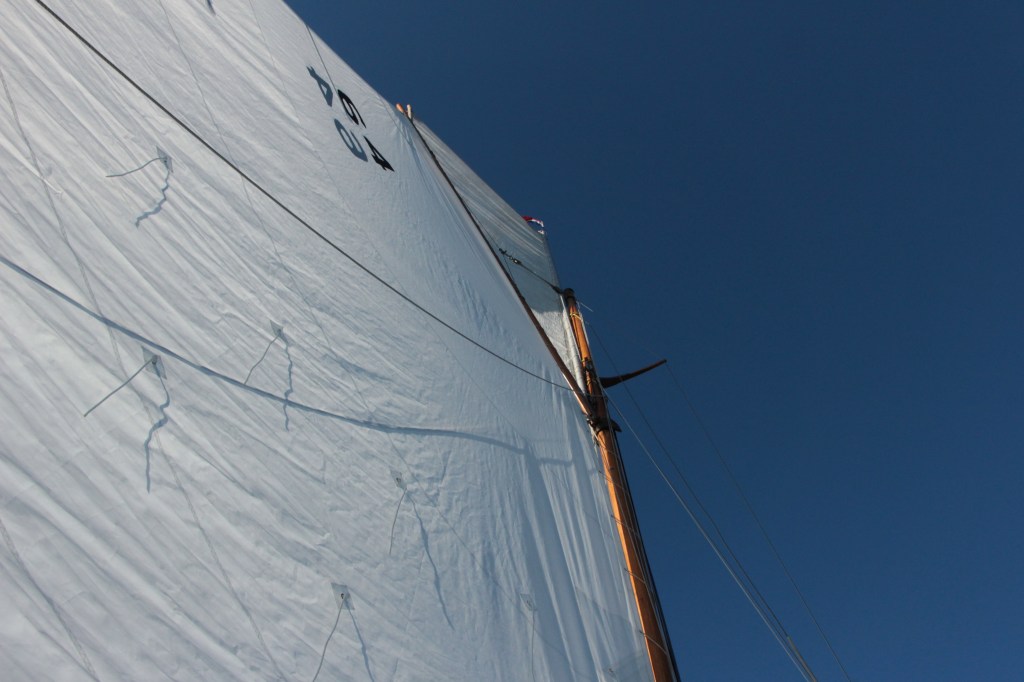
Upton; the C&H connection.

Returning to writing, after a long absence. At the end of last season, my head was full, and I needed to focus on wrapping ‘Corsair’ up. As you can see its taken a few weeks for me to feel like writing. Anyway.

This image has an empty alt attribute; its file name is corsairupton19.jpg
End of the 2019 season, 11th December.

I’ve previously stored ‘Corsair’ at Upton, during the 2009/2010 winter.

When that season had ended, I’d just learnt about the ‘Cruise of the Clipper’ – those of you interested can look here; https://broadssailing.blog/2019/11/18/cruise-of-the-clipper/

That year, I sailed ‘Corsair’ to Upton from her Oby mooring in late December, she was due to be lifted just before Christmas. It proved to be the only time I’ve sailed her in the SNOW, and to be honest it felt very intrepid (bl&%dy cold) when I’d reached Upton.

A few days after she’d been craned – Upton froze rather spectacularly!
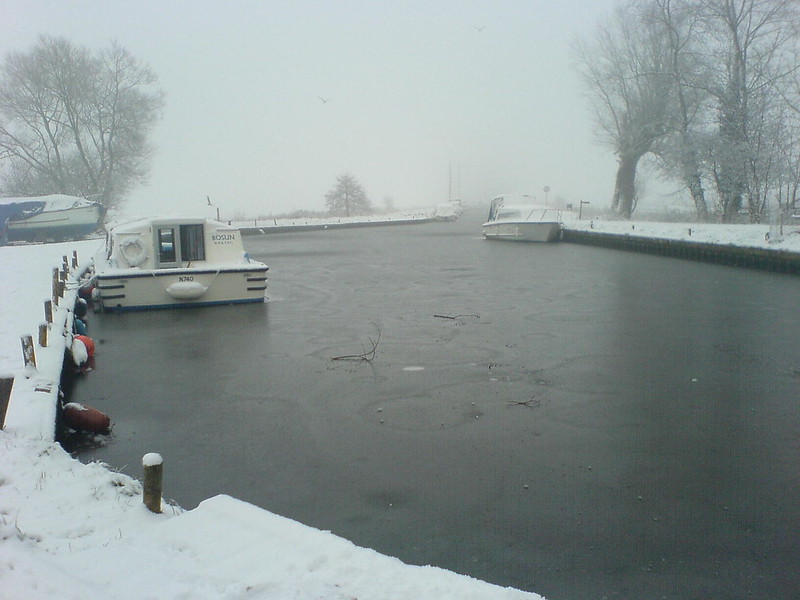
Cold!

In 2009 – when I worked on the boat, I’d live on ‘Corsair’ at weekends.  Luxury it wasn’t! Sleeping inside 2 sleeping bags, having first made the boat utterly disgusting by filling it with dust, etc!

It embarrasses me now, but looking back through notebooks I can see that during that winter a repair (!) was inflicted to the port side-deck which leaked.

It involved removing the cant-rail, and then carefully peeling back the trac-mark. I hadn’t money to buy new! Then, very carefully I dug out the rot, and the soggy bits… being VERY careful not to go through the boards completely. Then I sprayed everything with cuprinol wood hardener, before literally trowling epoxy in and smoothing it out.

Inside the boat, a mixture of masking tape and playing cards were sacrificed to stop the epoxy from leaking through… (!!!)

I also had to complete my 1st replacement plank. I made about every mistake I could have made. The plank was short (about 4ft), was butt-jointed to the adjacent timber with some good old ‘prayer books’ on the inside, and I think I used a linseed based frame sealant to caulk up.

Also – in view of my ‘ahem’ limited budget – that plank was fashioned from a 5ft length of 7 inch wide skirting board… If you cut the moulding off, you can just about get a short plank out of it (!)

I can’t defend these repairs today, as they were short-lived. But at a time when I was struggling financially, they meant I kept the boat afloat and sailing.

Thankfully no pictures exist…

And, having suitably disgraced myself, I will try and explain the connection between Upton and Chumley & Hawke…

Eastwood Whelpton boatyard was founded by Tim & Annie Whelpton. Tim having built ‘Clipper VI’ in 1951, we met him by chance during 2008; https://broadssailing.blog/2019/06/20/cruise-2008-days-4-5/

One of the post-war owners of Chumley & Hawke, Vic Harrison evidently supported Tim & Annie’s endeavour to run their own hire fleet. When they moved to Upton in 1958, it was in the midst of changes at Chumley & Hawke.

I understand that Vic was instrumental in Tim & Annie taking a number of the C & H yacht fleet with them;

– Reveries 1 – 6  (Press built)

– Brown Elf, Imp and Sprite (C&H built – ALB designed)

– Pixie (Press built)

R/e the builder’s notes above… I know they’re accurate in terms of ALB designs.

I’m not clear when the Reverie’s joined C&H, but given they are Press built boats, and Alfred Yaxley (the post-war foreman at C&H) came from the Press yard, I suspect the boats came with him post WW2, so to speak.

In fact, all these yachts were 2 berth, small yachts. Leading to the nickname that EW was the ‘honeymoon’ fleet!!

Design- wise, the Brown Elf class was the most interesting in the EW fleet at that time. They really show A.L Braithwaite’s tendency to experiment.

Originally these were ‘Una’ rigged, in the same way a ‘catboat’ is in the US. It certainly wouldn’t be the first instance of US design influencing boats on the Broads, its rumoured a local boatbuilder (from up Wroxham way!) used the ‘Rudder’ magazine as a source of inspiration!
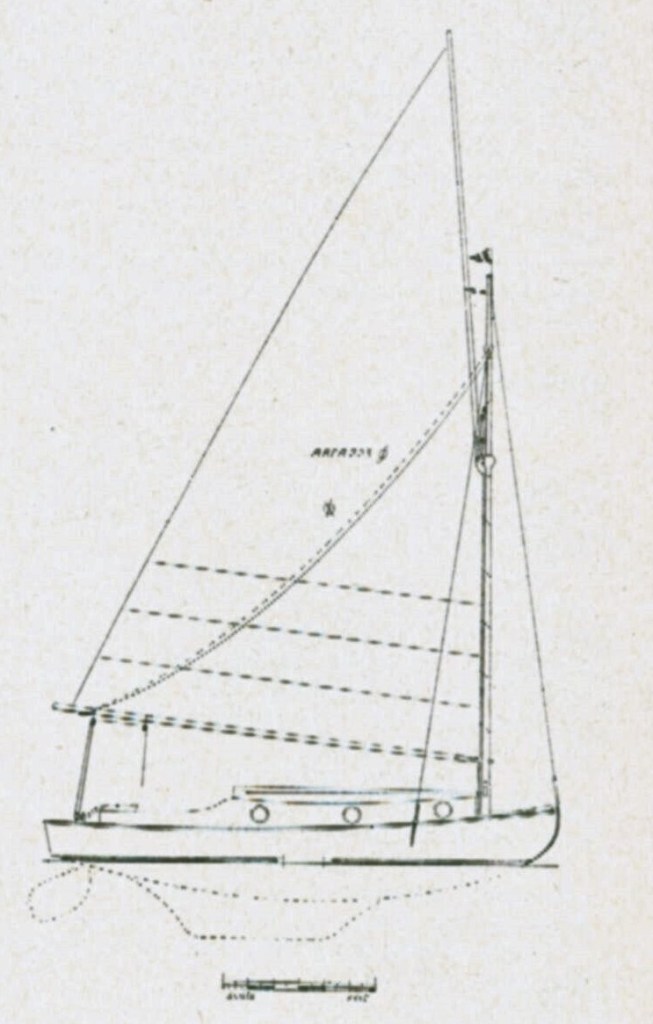
Brown Elf, Imp & Sprite

They are diminutive – vital statistics; 20 LOA, 17ft 3″ LWL, 7ft 6″ beam, with 3ft draft and 223sq. ft of sail & 580lb of external ballast.

Interestingly, Braithwaite wrote to Yachting Monthly in 1949 about the Brown Elf class – they were designed by him in 1930, and must have been one of his 1st designs for C&H.

Their rig differed from a typical gaff Broads yacht, not just with the lack of jib, but also that they carried jaws on the boom, and a down-haul to tension the luff. Much like a lugsail dinghy, although you could argue given their size, Brown Elf, Imp & Sprite were little more than half-deckers (in the nicest possible way).

The Una rig would have made alot of sense for a Broads hire-boat, it locates the mast well out of the way of any accomodation. There’s minimal standing & running rigging. and of course in a moment of panic, if the helm is abandoned they should luff & come to a halt.

Most sailing yachts in hire operated on that same principle. A large mainsail with weather-helm was considered safer with inexperienced sailors.

Happily, unlike the ‘Clippers’ there are lines plans which have been replicated for the Brown Elf class, and you can really see the metacentric theory being applied, look at the area curves, and how uniform they are.

It certainly looks like the maximum underwater sectional area is absolutely 50% along the DWL.
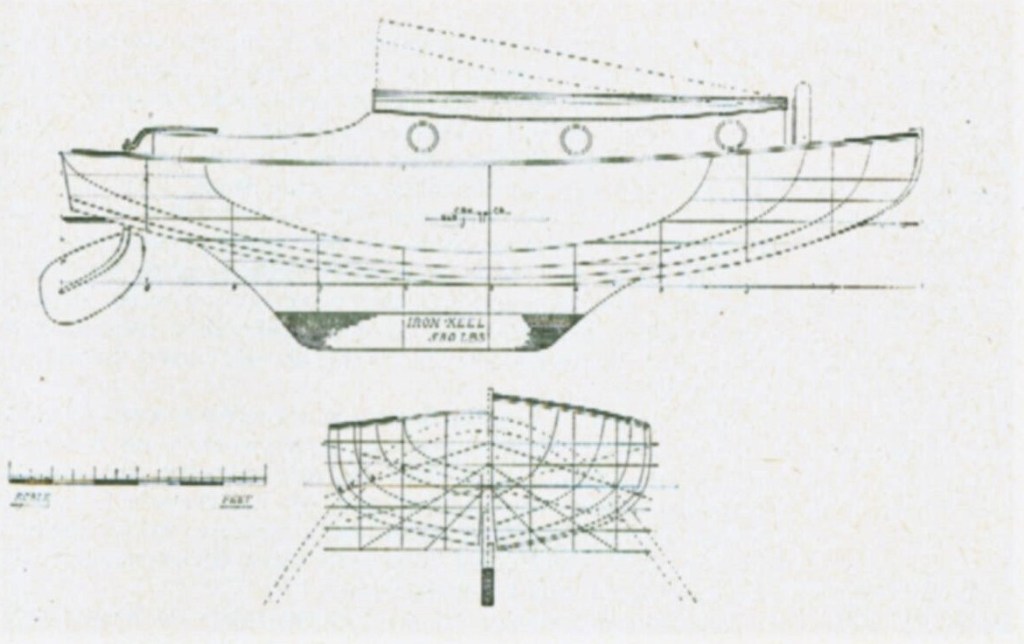
Brown Elf – lines plan

Once the Brown Elves were rehomed at Upton, it wasn’t long before Tim also took to altering them. The cabin’s were extended forward, and the Una rig abandoned for a Bermudian sloop configuration.

As a nice circuitous touch, here’s a photo of Brown Elf in 1962, outside Horning Ferry, whose link to C&H was the tragic demise of Joseph Lejeune, foreman.
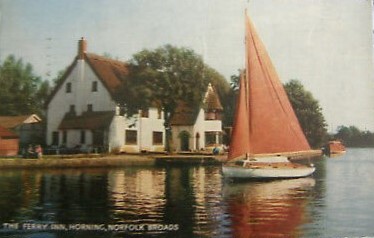
Brown Elf, Imp or Sprite – outside Horning Ferry 1962

I’ve no doubt that Lejeune oversaw the building of the Elf’s, at what must have been an exciting period in C&H’s history – a new owner, new designs and minor publicity in yachting press of time.

Anyway, I hope I’ve managed to narrate the link between Chumley & Hawke, Tim & Annie, Upton, and ‘Corsair’s’ history.

Goodnight.
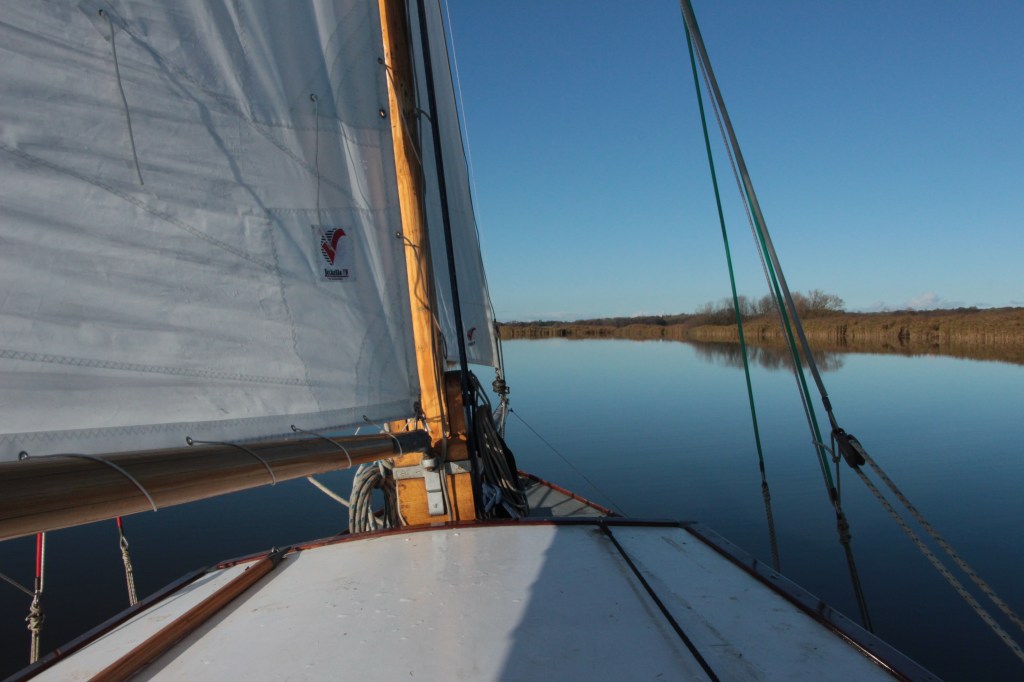
Starfishes & Sails.

Yesterday I enjoyed what is likely to be my penultimate sail of 2019. I know, I know yet again I’m deviating from the intended order of writing. That’s the joy of being the Editor though.

Yesterday was glorious. Bitterly cold, clear, sunny and calm. Very calm. We rigged whilst tied to our mooring, and headed off upriver to Surlingham Ferry, for the Turkey Race – next weekend.

I found myself checking and double checking the rigging again – I’m not sure if I need to re-order and change the cleats on the tabernacle, now the topsail is there. Currently the peak halyard is lead onto the port face, with the throat on the starboard face. The topsail spar has a neat trick of capturing the peak – at the lower end of the spar, which can make lowering the mainsail tricky.

This definitely needs looking at, for two reasons. One – the rig should work, and this is dangerous. Two – when you sail on/off moorings, I find the best way is to keep the way on as much as possible, and to be able to drop the sail – bloody quickly if needed.

Gorgeous!

The rig did present a more amusing quirk – if you tension the topsail forestay just right, it ‘thrums’ and buzzes… Took me ages to work that out, including removing the floorboards and checking on the bilge-pump to see if that was running!

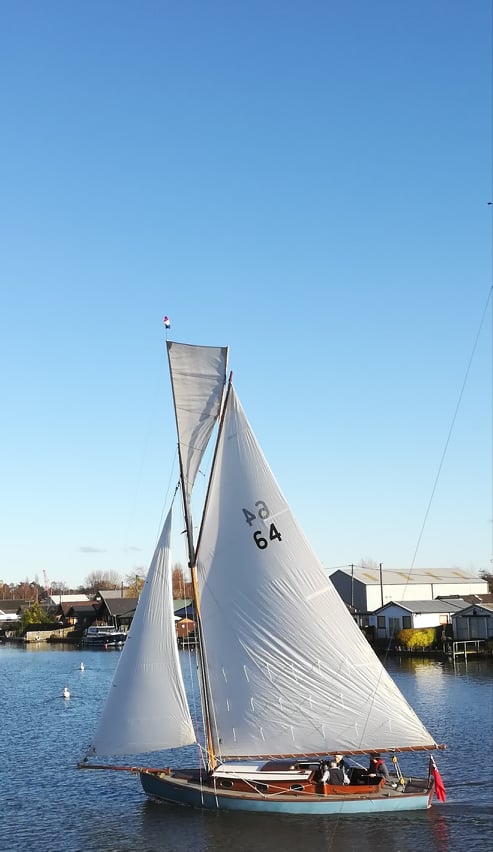
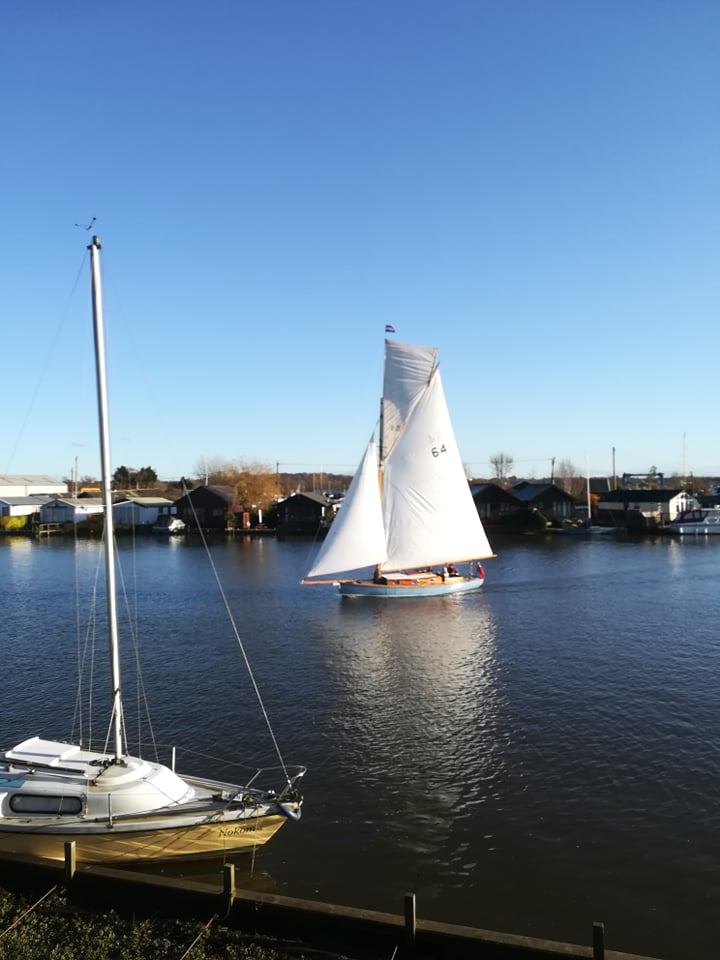
Heading upriver, we were lucky enough to be photographed by a friend, whose currently building a house for his family. The scaffolding made an excellent platform, although if I’m critical – that peak is about 1 or 2 inches ‘out’ by the look of the creases.

I’m struggling to find superlatives to describe the day if I’m honest, it was perfect.

Typical of the season, a North wind with no warmth, a clear sky and a medley of colour in the riverbank, reds, browns, yellow and oranges all competing in the remnants of summer foliage. We sailed every inch of the way, and we knew we’d taken the best of the day for ourselves.

But. I wanted to talk about the starfish.

This links with the subtly of the Broads rivers – and the villages which surround them. There are features worth exploring, and a hidden history. There is a tenuous link to Chumley & Hawke as well…

Surlingham has a starfish. Something which shows the far-reach of war, into the boring fields of Norfolk. In truth both Norfolk & Suffolk were riddled with military action during WW2, and you’re never far from it.

Starfish sites were large decoys – developed in WW2 to act as a distraction to enemy bombers. Norwich took a pasting, in what’s known as the Baedeker raids, with the railway station/yard & nearby engineering works of Bolton & Paul being prime targets.

The solution was to create a decoy – which could emulate (from afar) what bomb damage might look like, including fires. The deception went further – it had to look realistic. There was a network of lights rigged, which could replicate the cadence of lit railway carriage passing by at night. Or a red glow to simulate a fire-box door being opened on a railway locomotive.

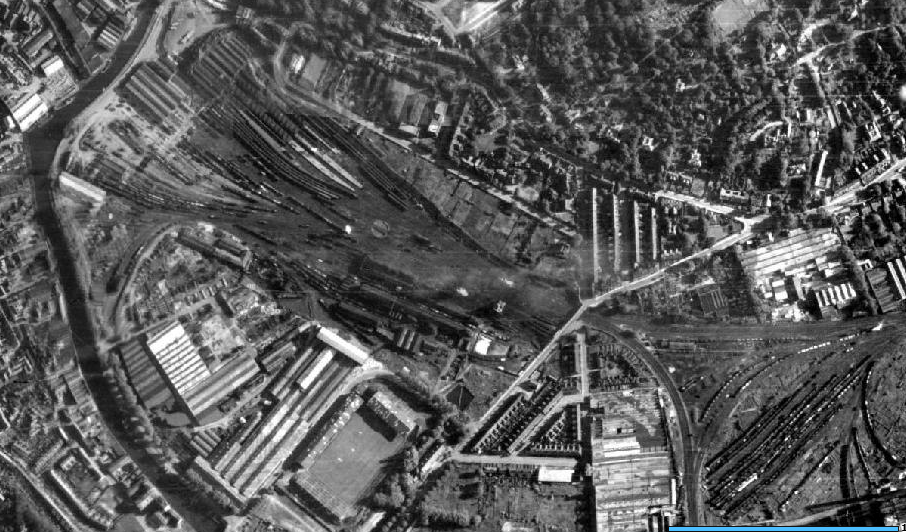
For reference – here’s a 1946 aerial photograph of Norwich railway station;

Norwich Thorpe railway station, including motive power depot, Crown Pint depot, Bolton & Paul engineering works. All very lucrative targets. The River Wensum snakes around the lefthand side of the image.

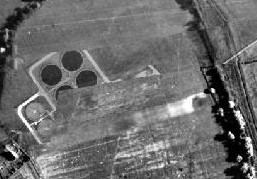
Interestingly – the 1946 aerial photographs also show the deception required. Outside of Norwich, you can just see a crude attempt at censoring the existence of what is either a fuel installation, or the present-day sewage station at Whitlingham;

Nothing to see here!!!

Surlingham was chosen to host a ‘starfish’. Local firms such as the Rockland Reed & Rush company would supply bundles of reeds to act as ‘wicks’ for the fires – whilst the pyrotechnics were handled through a series of heath robinson-esque contraptions – mixing oil & water to make dramatic explosions.

Interestingly – the knowledge & expertise behind the starfish sites is credited to expertise within the theatric industry – being able to use lights, smoke & explosions to good effect on stage can enable a mimic on a much larger scale.

It’s no exaggeration that these sites were vital. Norwich became so battered and bruised, you would see families walking out on the Drayton & Dereham roads on a nightly basis – preferring to sleep out in the open than risk another night of bombs.

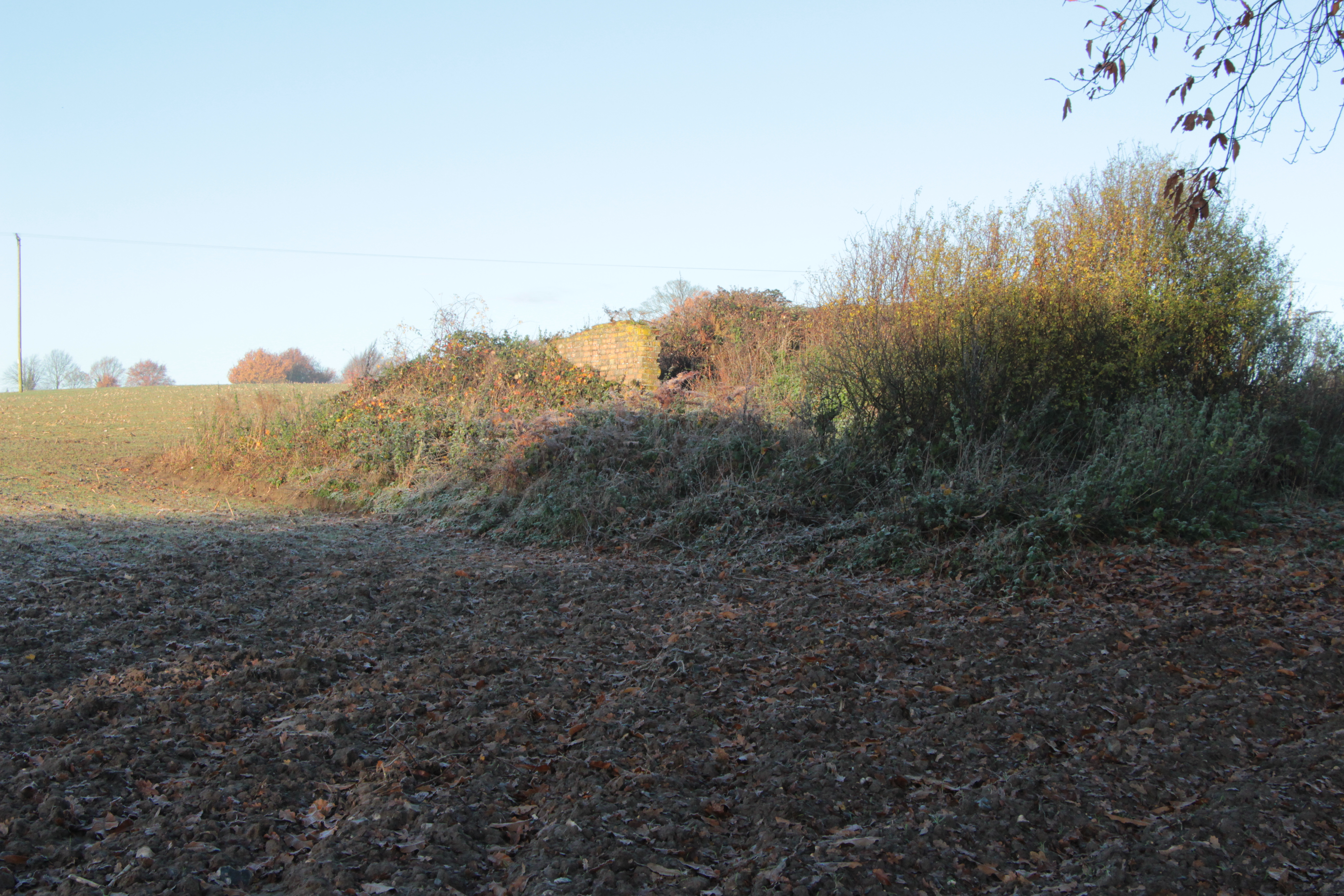
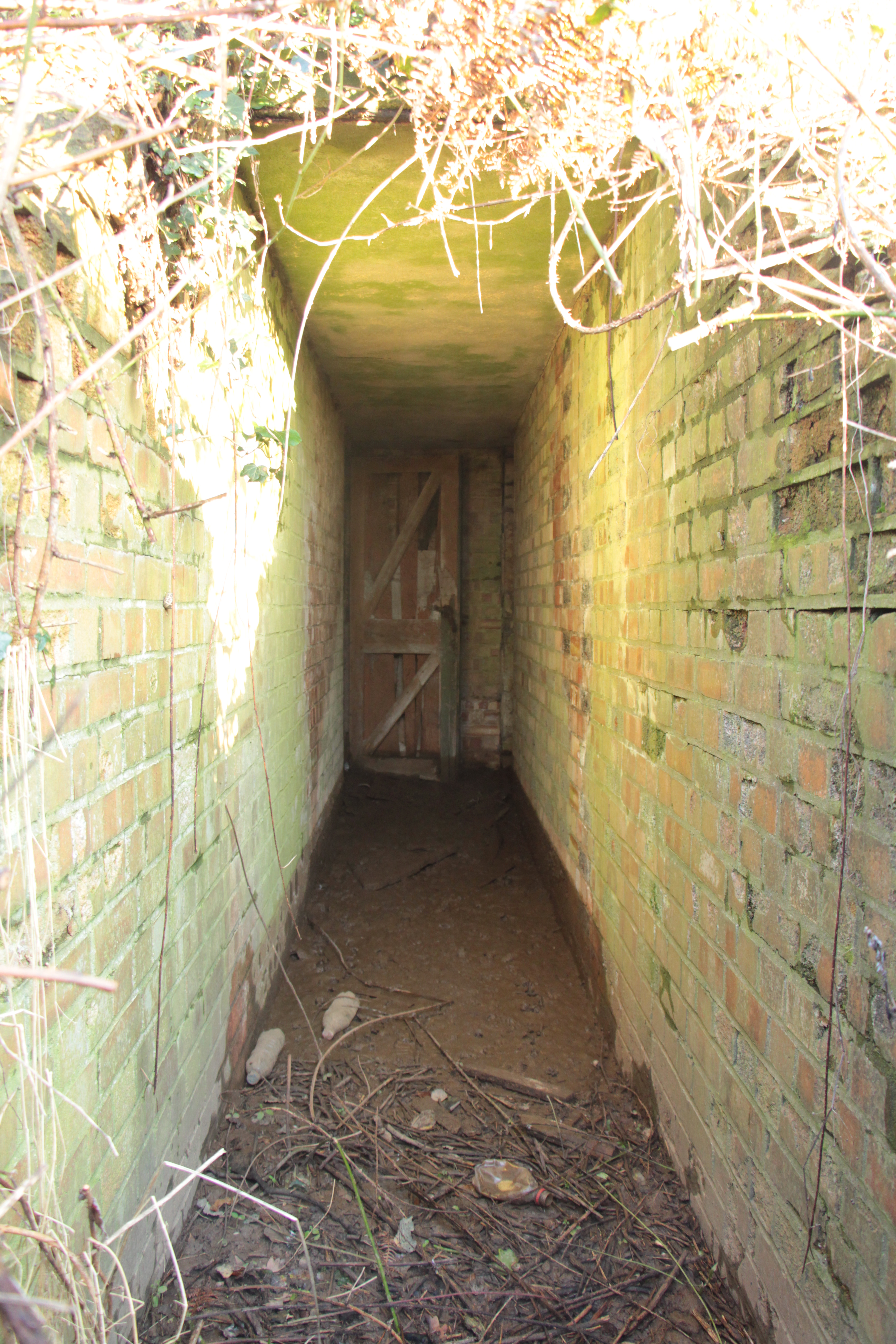
Today – the site of Surlingham’s starfish is much quieter. I stopped by, and knowing where to find the bunker – managed to capture it in its slumber;

Again – the hidden detail, and history of Norfolk’s rivers & surroundings amazes me. You can walk quite easily from Surlingham Ferry, and walk past this 100 times without knowing what it’s about.

I can’t imagine what it would have been like, orchestrating a site like this in the war – knowing it’d lure enemy bombs to drop adjacent to you instead of on an already burning city.

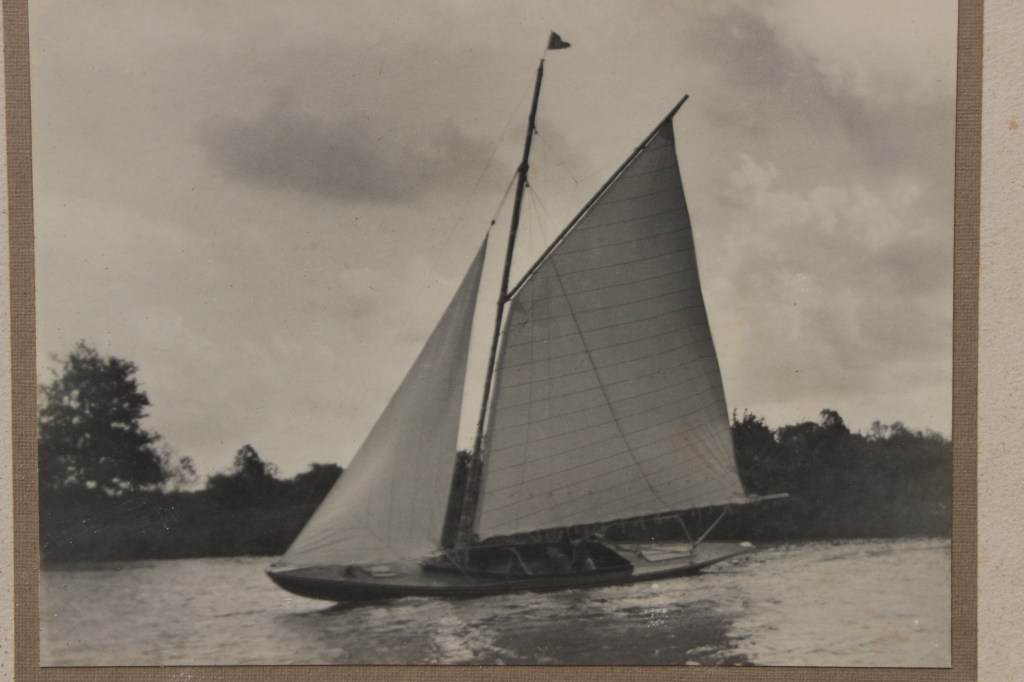
The link between this starfish and ‘Corsair’ is tenuous – but there. It links to Joseph Lejeune – foreman at Chumley & Hawke in the pre-war years, and the heyday of Alfred Lloyd Braithwaite’s design experiments. Lejeune’s & Braithwaite’s most extreme experiment was undoubtedly Khala Nag;

Khala Nag – sometime in the 1930’s, somewhere on the Broads near Horning.

I’m fortunate enough to own that photograph, which is to my knowledge the only extant photograph of Khala Nag – it was part of the treasure trove of ALB’s possessions which I found earlier this year, in Milford on Sea. See here for the highlights of that; https://broadssailing.blog/2019/07/18/on-the-trail-of-a-l-braithwaite/

‘KN’ was a flier.  27ft long, with only 4ft 6” (yes) beam and 3ft 6” draft she carried 2 separate rigs, one for the Broads, one for coastal waters.  The extent of his commitment to balance, weight, sails & hullform is evident in this design & build.

Whilst Joseph Lejeune built the yacht, Braithwaite assisted throughout.  Notably he weighed and recorded each and every component of ‘KN’. This eventually lead him not only to knowing the exact required weight of the ballast keel, but also how to trim the vessel, so that her centre of gravity could be altered to 1” in advance of the centre of buoyancy, calculated to counteract the weight of any crew.  This simple calculation is often overlooked by designers, and pays dividends when sailing. 

At the time of the outbreak of WW2 Joseph Lejeune was the foreman at Chumley & Hawke, and unquestionably there must have been a close working partnership between him, and Lt Cdr Braithwaite.  They were close in age – and clearly shared a passion for experimenting with the limits of design at that time, to create some unique, and exciting craft.

For example, the noted cost of JL’s time during ‘KN’s’ build was £117, 4s 10d (!) The lead for KN’s keel only cost £7 9s 0d. ALB must have valued his input as a designer.

Sadly, this evidently close partnership wasn’t long lived.  Whilst Lt Cdr Braithwaite went back into active service, Joseph Lejeune stayed in Horning.

I know that Alfred Lloyd Braithwaite felt very strongly about returning to active service. His age would have discriminated against him at the outbreak of war, and in fact I notice on the 1939 return there is a note which reads; ‘RNVR in Great War, but refused for present war’. ALB was not to be deterred, and was posted in 1940.

In Horning, during the evening of April 26th 1941, Horning village was subject to a stray bomb attack – which disastrous consequences.

(I actually sit, reading notes I first wrote – April 26th 2016). 

It isn’t clear exactly, but it’s likely a Luftwaffe bomber was jettisoning bombs on the way back to the coast.  And their attention was sufficiently drawn to drop their remaining payload of 15 bombs around Horning.

I wonder if they were aiming for the ferry itself – which may have been silhouetted. Else perhaps it was a chink of light as someone slipped into the pub?

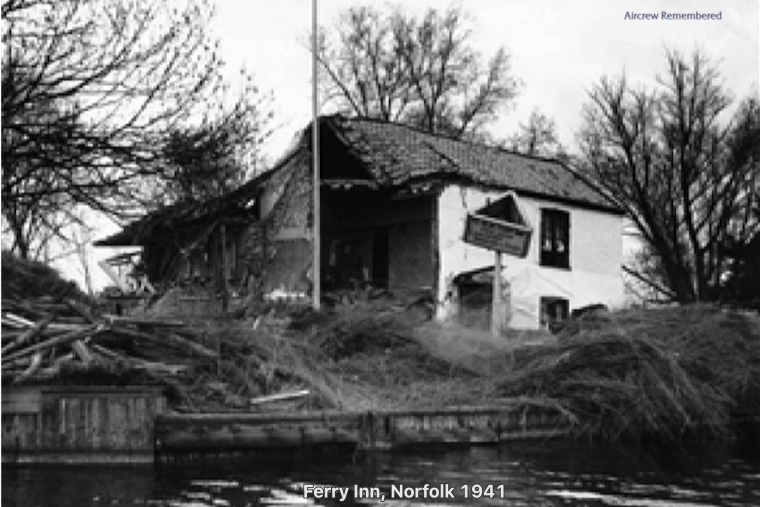
Whatever the circumstances, the most unfortunate target was the Horning Ferry pub, and amongst the 22 fatalities that night was Joseph Lejeune, aged 50.

The devastation was instantaneous;

The link between Surlingham’s starfish and this, is that sites like that, their flashing lights and theatrical pyrotechnics were desperately trying to stop destruction and loss of life like this. Sadly it’s reckoned that Starfish sites only drew 5% of the intended bombs away from the actual targets.

This accounts for how ‘Corsair’ came to be built post-war by the apprentice at Chumley & Hawke – Tim Whelpton, directed by the then yard foreman Alfred Yaxley.

Anyway – In a roundabout way, I hope I’ve explained another bit of Norfolk’s hidden history, and some more of ‘Corsair’s’ story.

Big skies.

Goodnight.