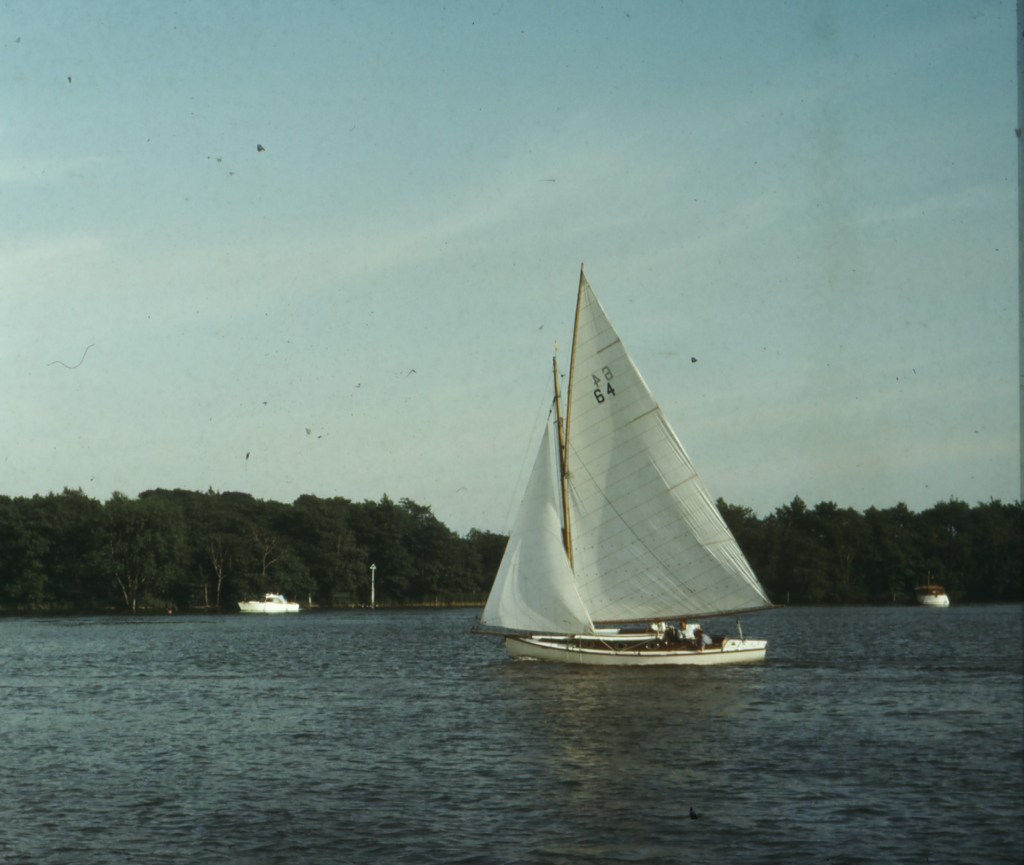
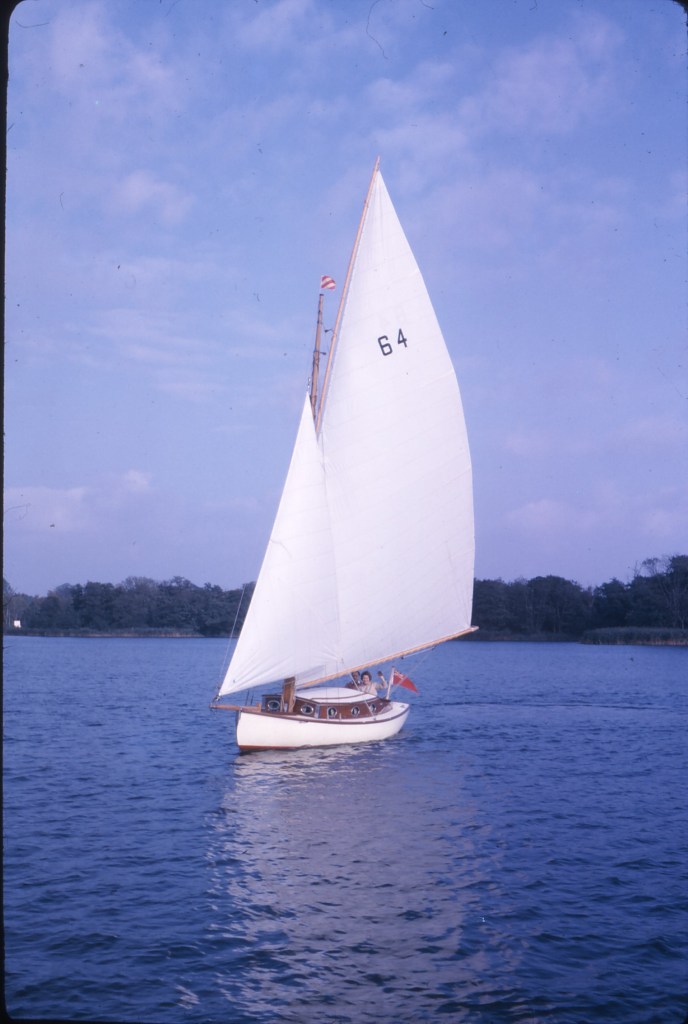
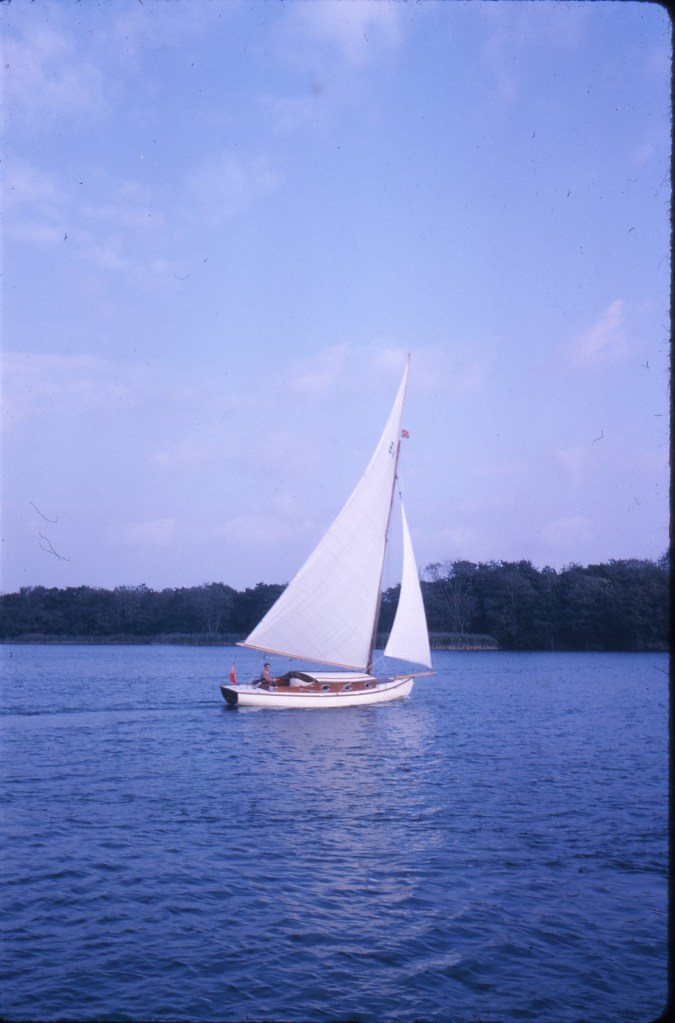
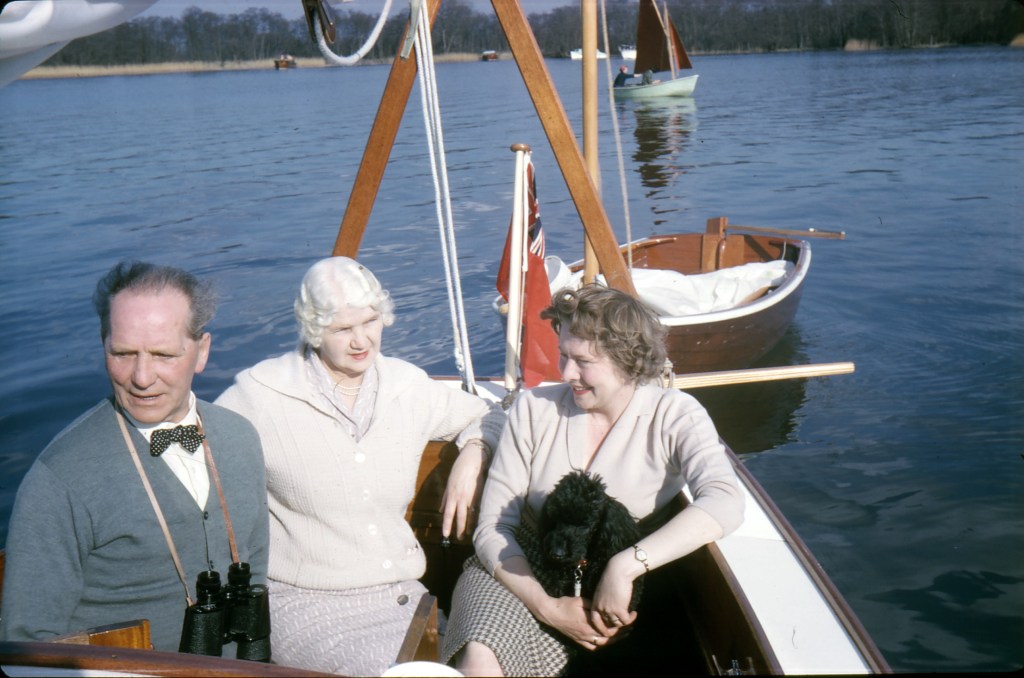
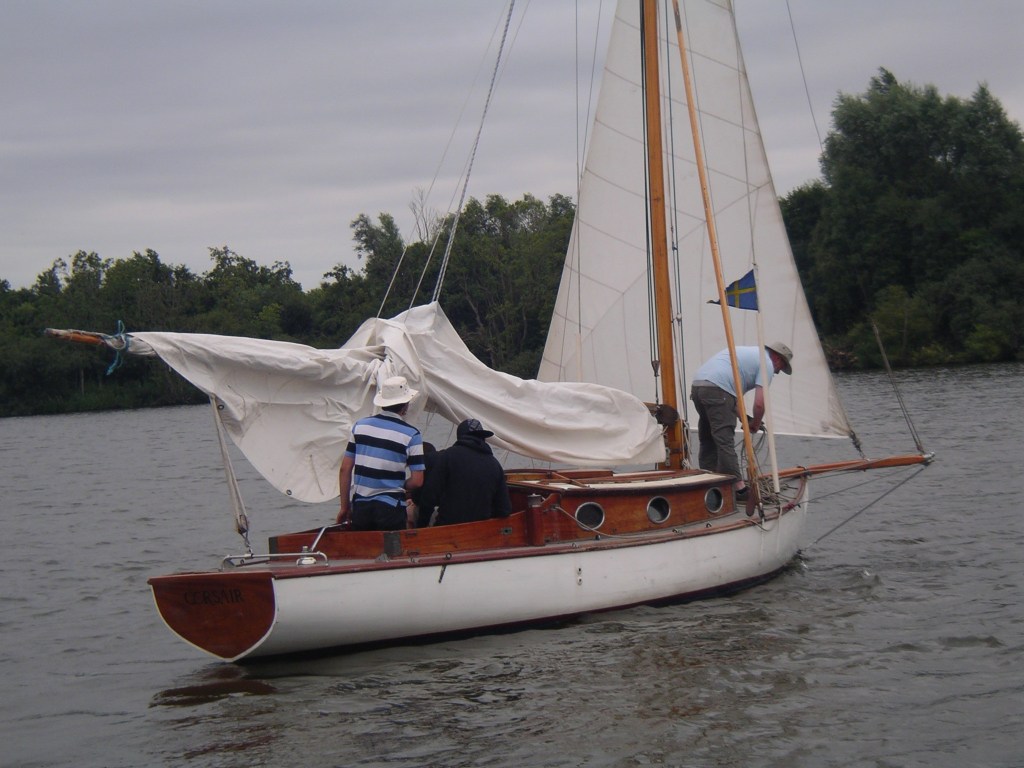
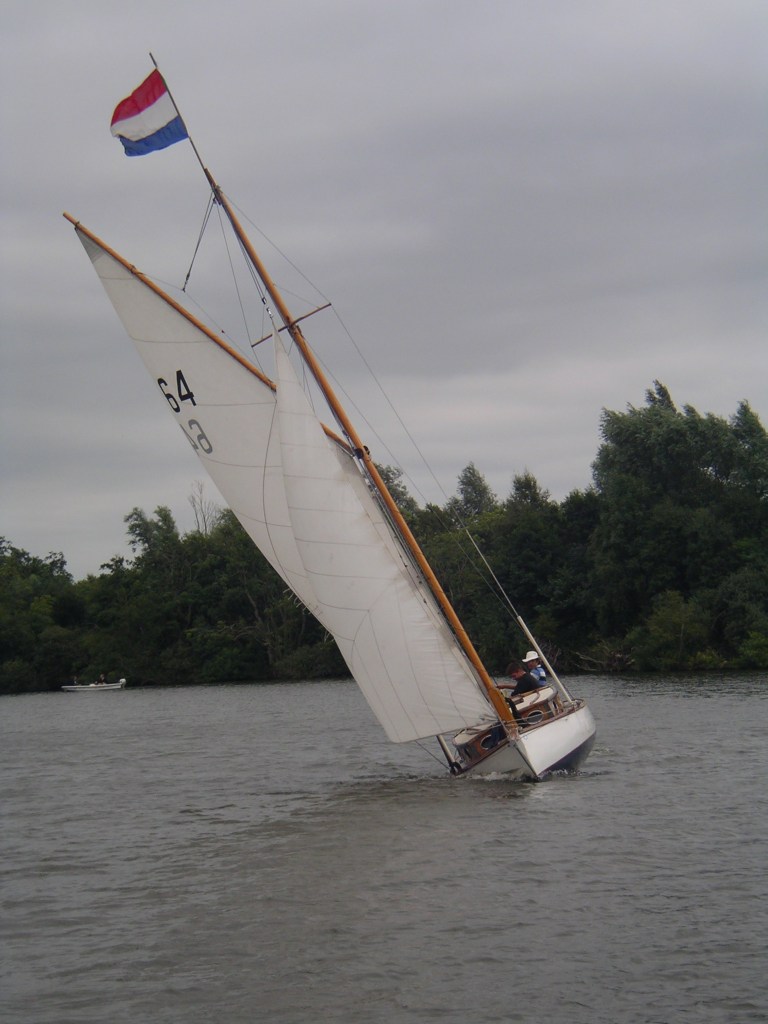
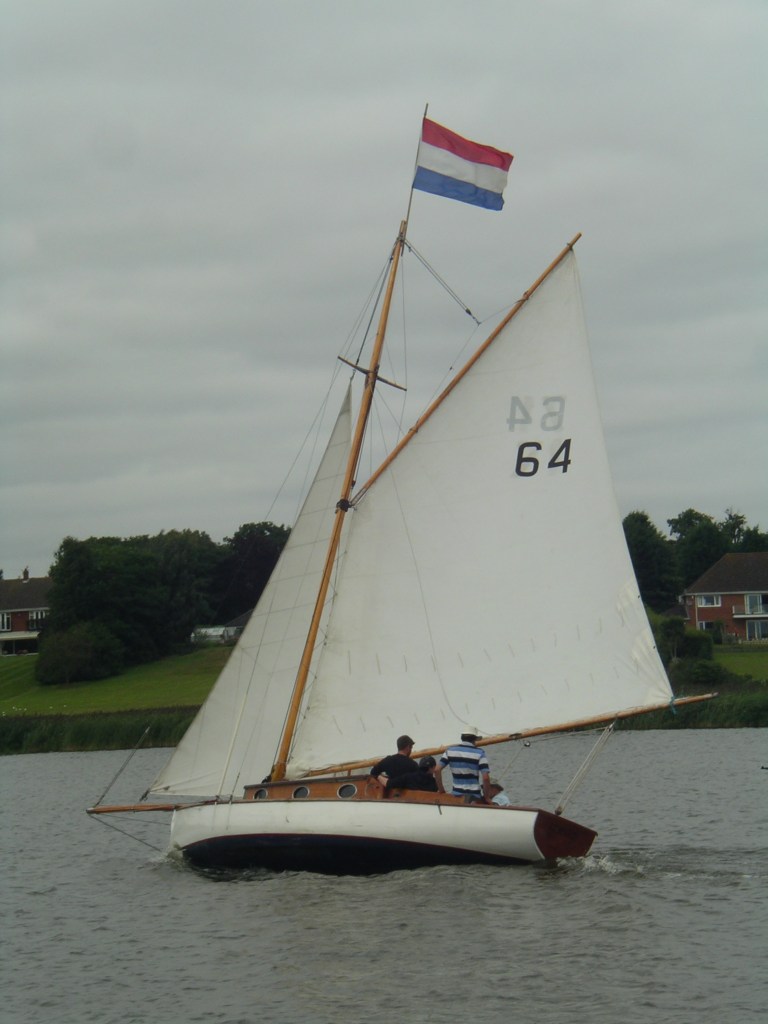
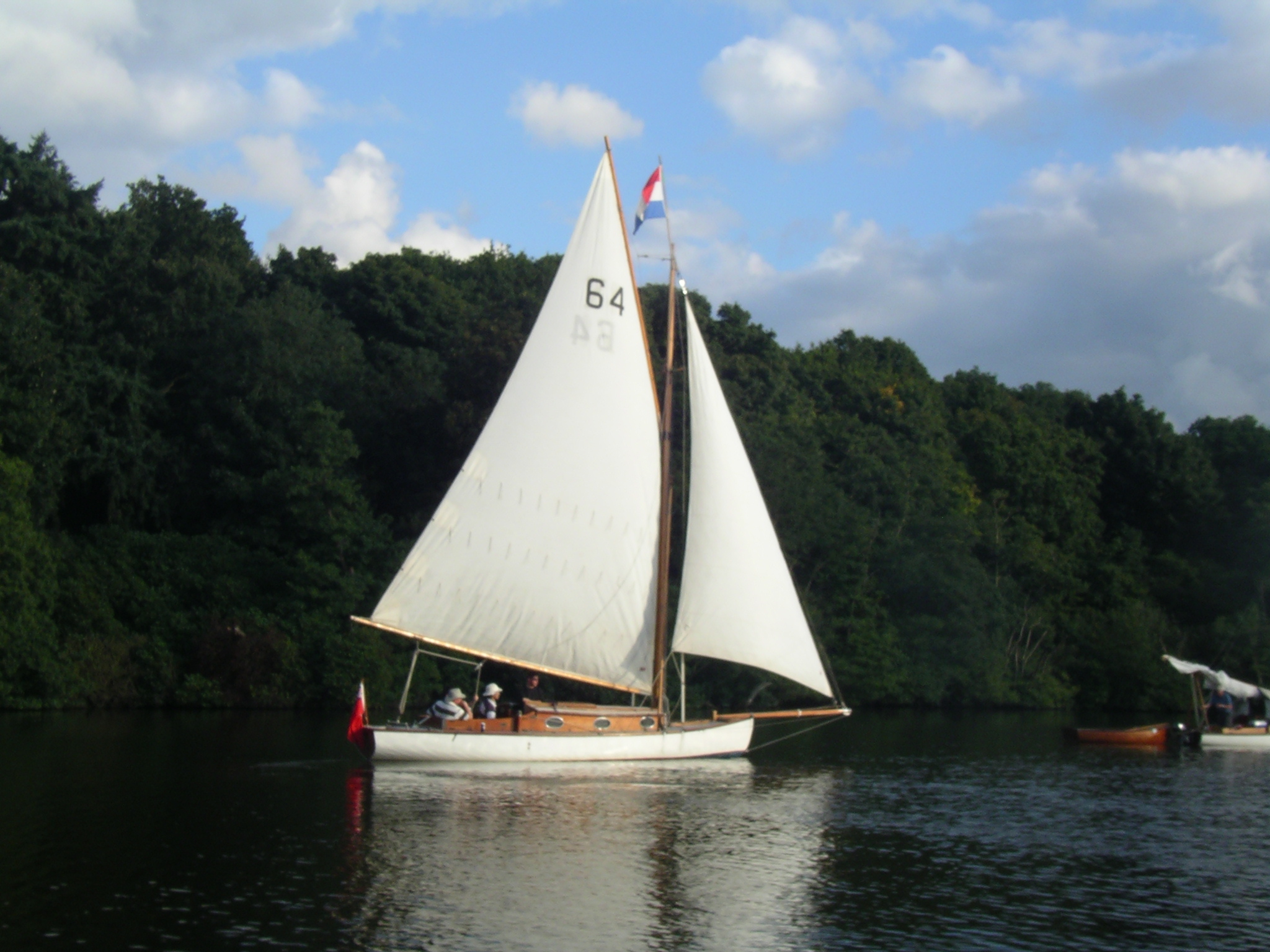
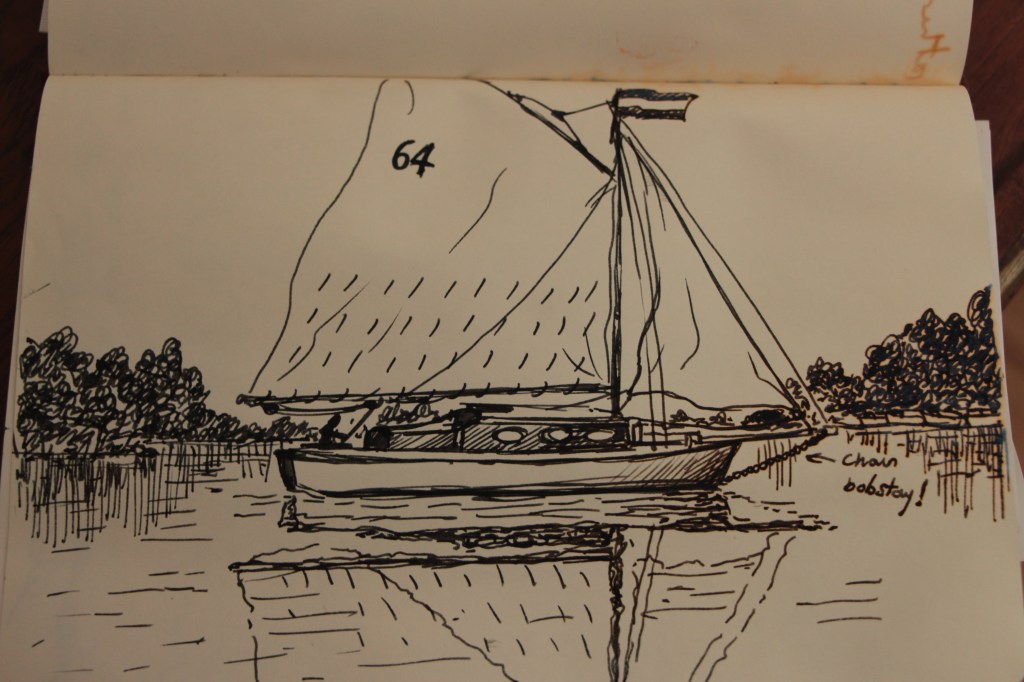
Summer storms & submarines

Phew.  Writing this now having had a forced absence from;

A.) writing and
B.) sailing. 

Weather in Norfolk hasn’t been the kindest.  Last Saturday instead of rowing across to ‘Corsair’, I was forced to walk a mile down the flood-bank on the opposite side of the river, and then wade through the rhond to get to her.

Mind you, I’m not complaining.  You walk south from Cold Harbour and the view west is fantastic. The vista includes St. Helen’s church, whose tower juts above the tree line at Ranworth, meanwhile to the right, the remains of St. Benets squat on the marsh, with Horning Hall obscured behind.

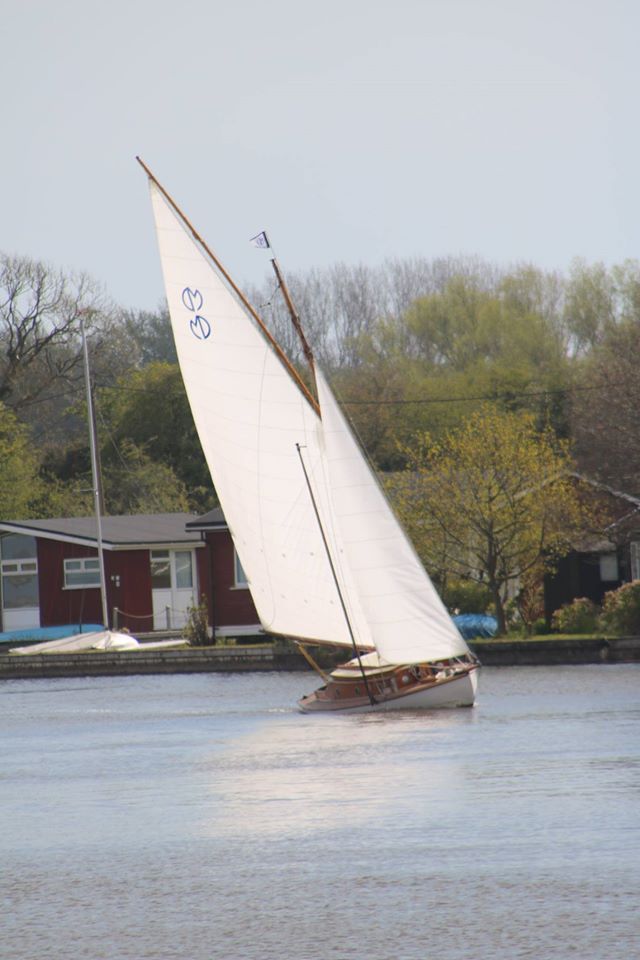
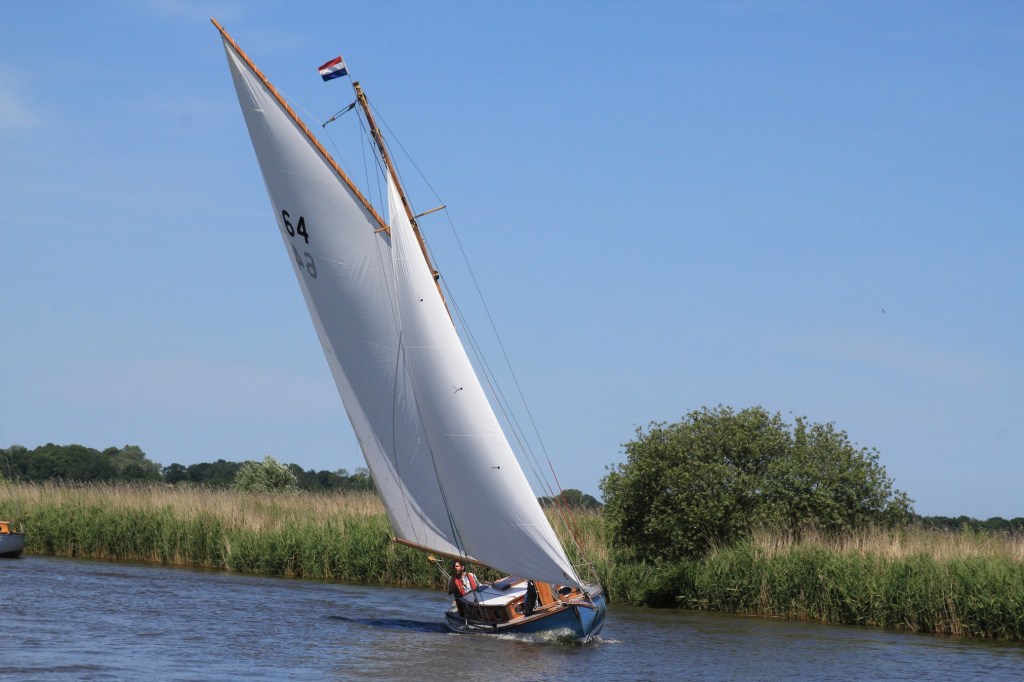
The f7 SW had laid the reeds flat, and as we walked, we watched a determined yacht tacking up the Bure.  Three reefs and a storm jib – good effort.  Even from couple of miles away, you could tell she was striding along.  Exhilarating conditions (for the right boat!)

All of this played out under a magnificent, leaden sky-scape.  8/8th’s cloud cover, and all scuddying along ahead of this incessant near-gale.  I tried to absorb it all, that sense of place in me taking over.  I’m very lucky to live in this part of the world, my advice is to make sure you see Norfolk in different weathers and in different seasons.

It’s hard to describe, but you’ll capture the different ‘moods’ of the days and seasons if you do.  You’ll see what’s a weather bank in a Northerly, or a westerly, where the trees will shelter you, how the wind bends along the reaches – all useful for when you’re sailing and need to find a decent mooring or take in a reef.  I don’t pretend

Edward Seago managed to capture the atmosphere of St. Benets under a storm better than me;

Seago – St. Benets abbey.

Anyway.  ‘Corsair’ was O.K. bilges were dry, covers still on.  Duty done, we trudged back to the car.  Odd isn’t it, boats are such a release in so many ways psychologically, and a constant responsibility physically.  I dread to think how many miles I’ve driven to check on her in similar situations. 

Back to 2009. 

2009 Cruise – Day 2

Cold. Cramped. And hungover once again. Not an unusual set of circumstances for the cruise…. Bleary eyed – I staggered through the cockpit and opened the awning.

Bollocks.

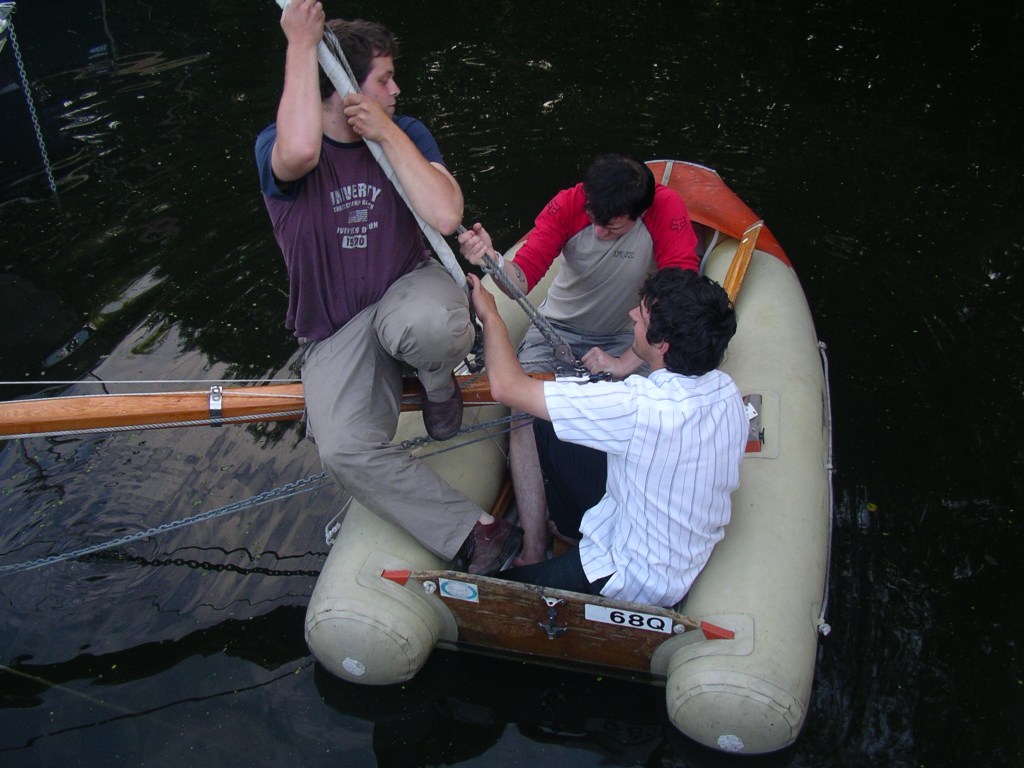
Opening the awning had focused my attention somewhat. What a bloody nuisance! James’ boat – ‘Nulsec’ had capsize itself in the night, quite unnoticed. After confirming with someone less hungover than me that in fact yes, the boat had sunk itself – we set about righting her. After I’d had a good think about what to do…
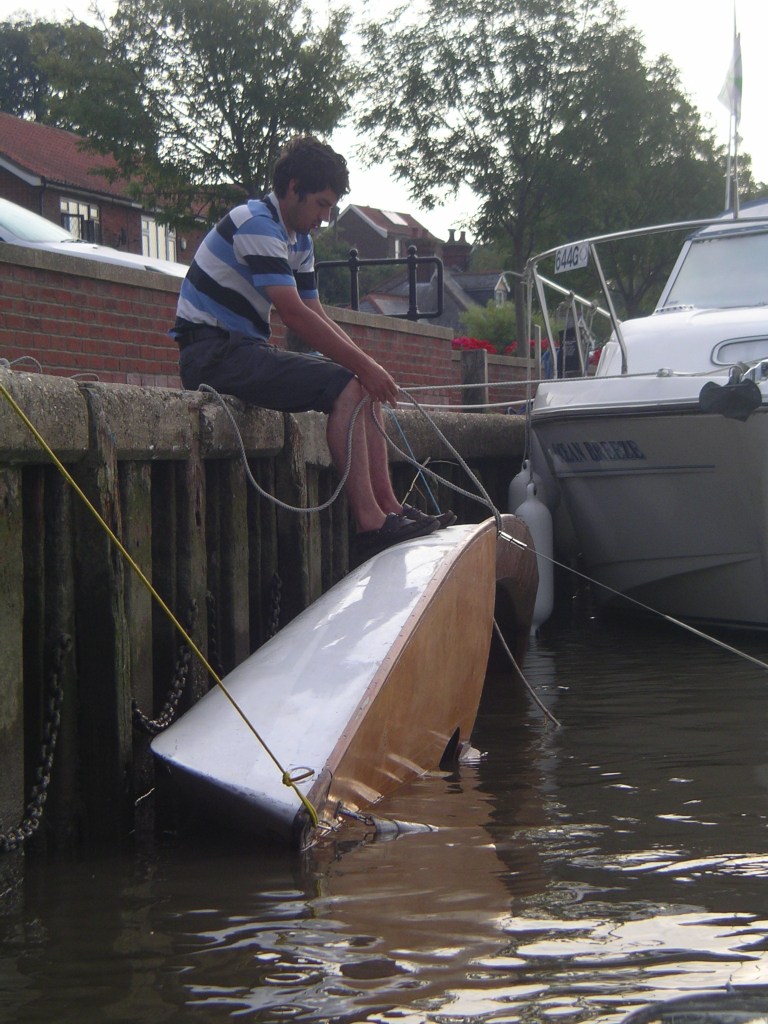
Do I need this?

What a hassle that was!! For a 17ft boat, there was a lot of water to be removed. Sterling bailing efforts by Rob, James & Chris removed most of the water, leaving ‘Nulsec’ mostly afloat.
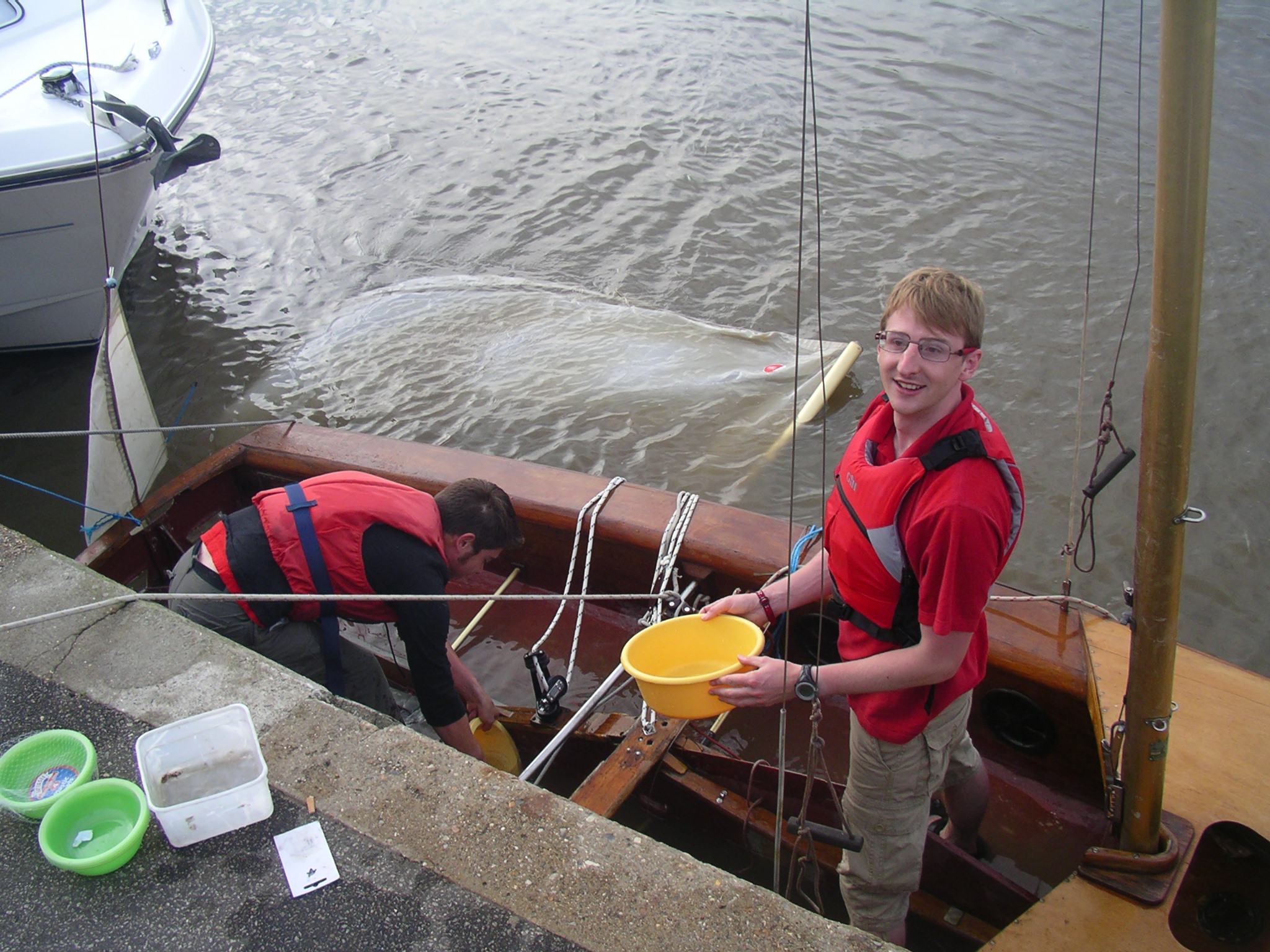
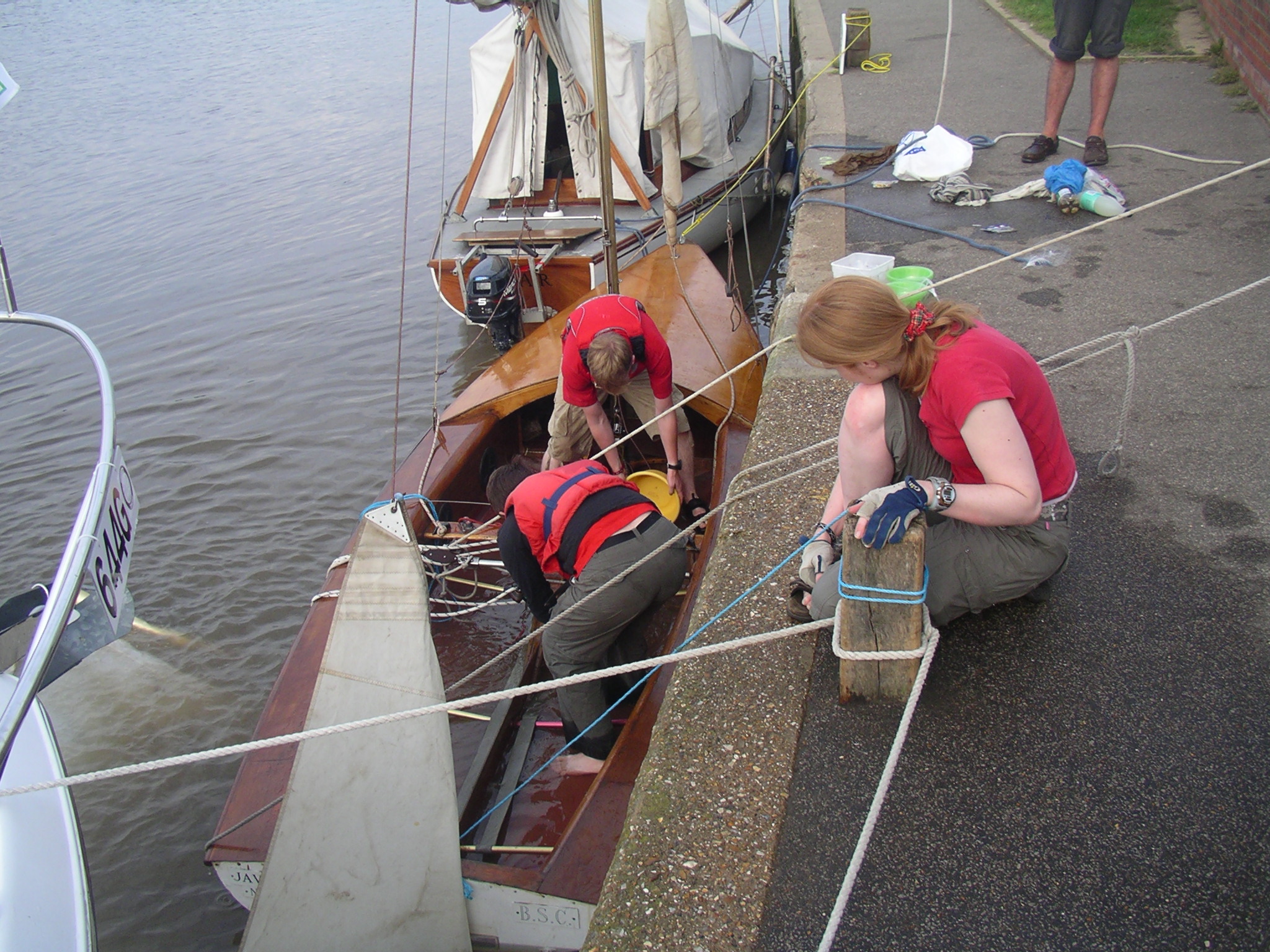
However, a brief phone call to Julia – the wonderful Hon. Secretary of the Yare Sailing Club produced a large, petrol powers salvage pump, which quickly drained the boat, leaving us with our fleet mostly intact.

Having lost time, we then set about motoring down the New Cut. For those of you not familiar, the New Cut is the result of some fairly aggressive Victorian power-playing. Yarmouth was a successful port – Norwich was not. No matter – Samuel Morton Peto dug a cut – linking Oulton Broad with Norwich, so you wouldn’t have to go through Yarmouth…

Yes. Not quite successful, it does however provide a useful function connecting the Yare with the Waveney – where we were heading. Whilst we motored, a fry up was produced, with the skipper resorting to hair of the dog!!

More amusement was to come though, how do you lower the mast on a 17ft racing dinghy?? With a lot of ‘faff’, bad language and brute force! I was still hungover, and unable to assist.

During this, ‘Dragonfly’ (S/N 6) came swishing past heading for Somerleyton. No doubt amused by the antics – they sensible opted to finding decent moorings.

Moored against a convenient crane barge at Haddiscoe – we set about raising the big white crinkly bits (sails!!)

In the short interval that followed, James attacked a moored pontoon, ran into the reeds on a lee-shore, lured a hire craft into towing him illegally, and generally produced much material (very kindly) for me to record.
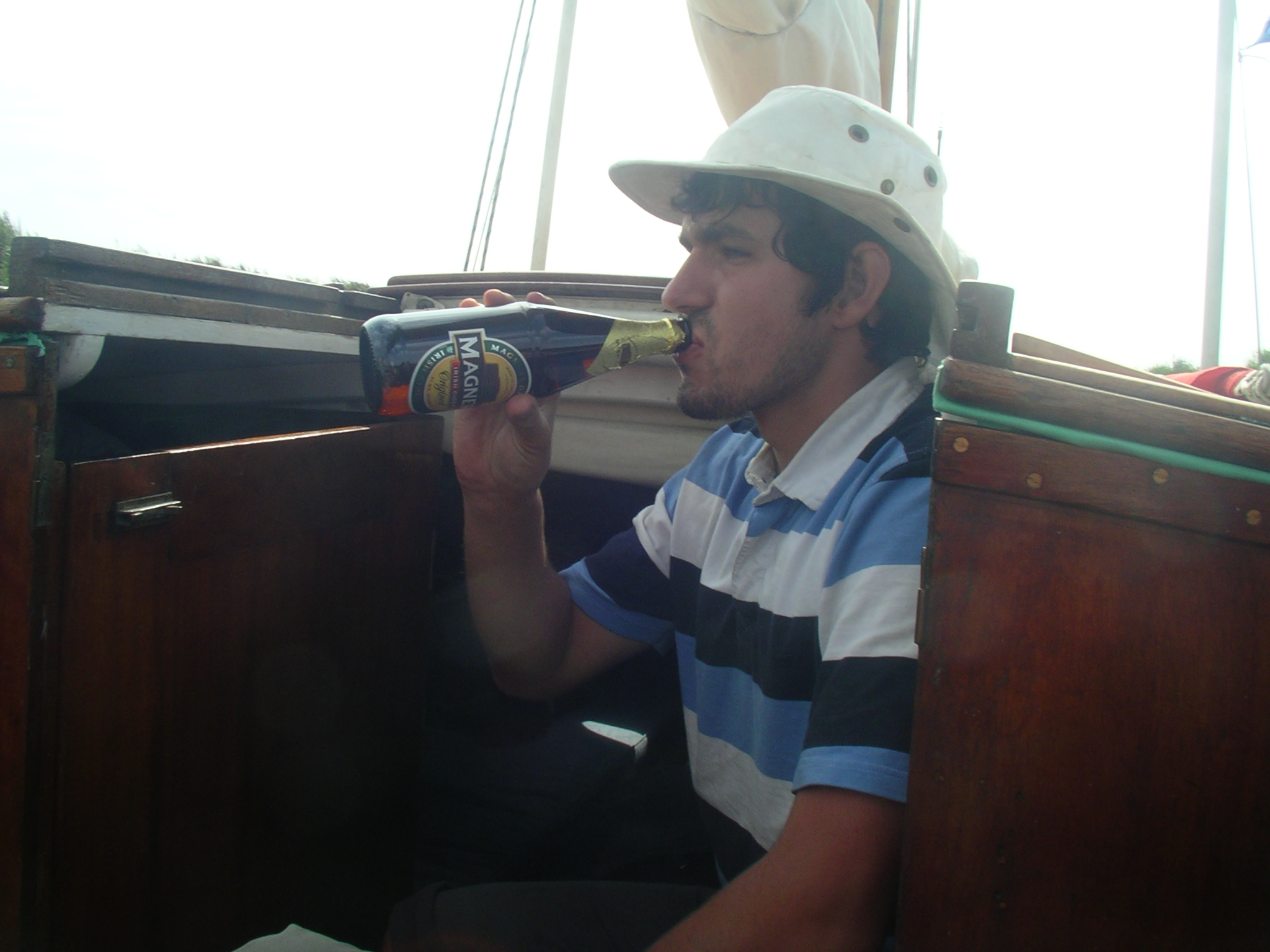
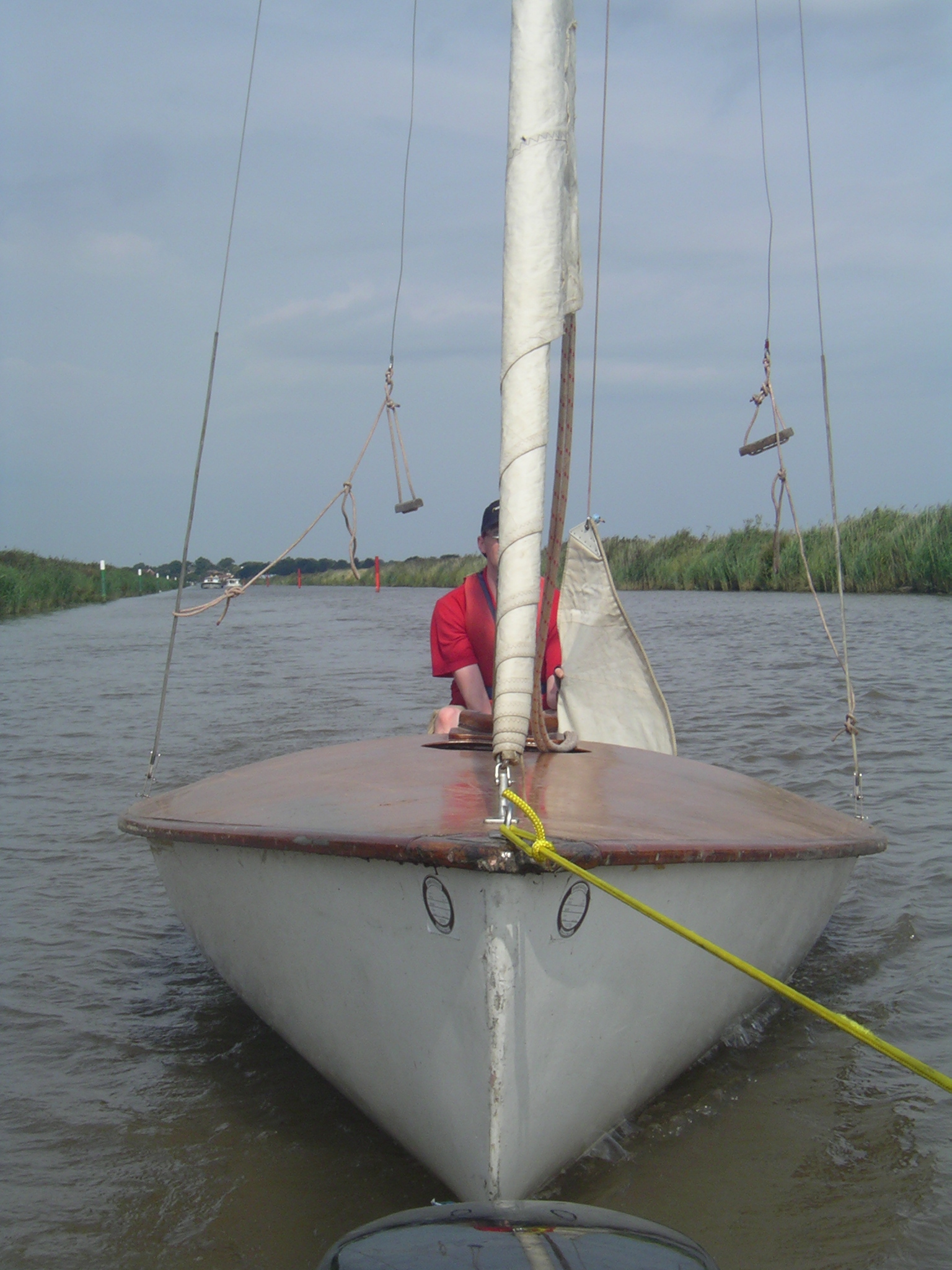
The fleet – now mostly assembled at Somerleyton consisted of ‘Seabird’, ‘Dragonfly’, ‘Corsair’ and ‘Nulsec’… Just HB & Herbie the wonder-dinghy and we’d be complete.

To pass the time, we inexplicably found ourselves in the pub – avoiding the rain, playing cards with a pint. Compared to yesterday’s excitement – this is more like it!!

Goodnight.
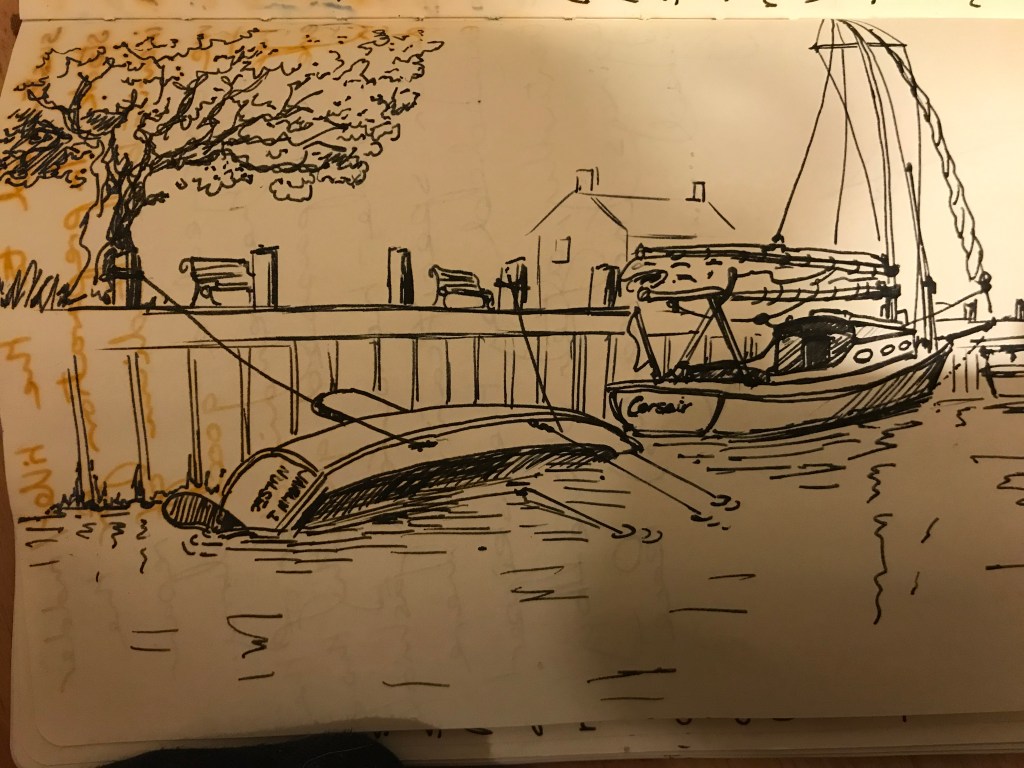
Sailplans & the Cruise 2009.

Jumbling the order of things (Editor’s privilege) – today I have spent a thoroughly enjoyable hour at Jeckells the sail makers. Based in Hoveton – the Jeckells family first started making sails in 1832.

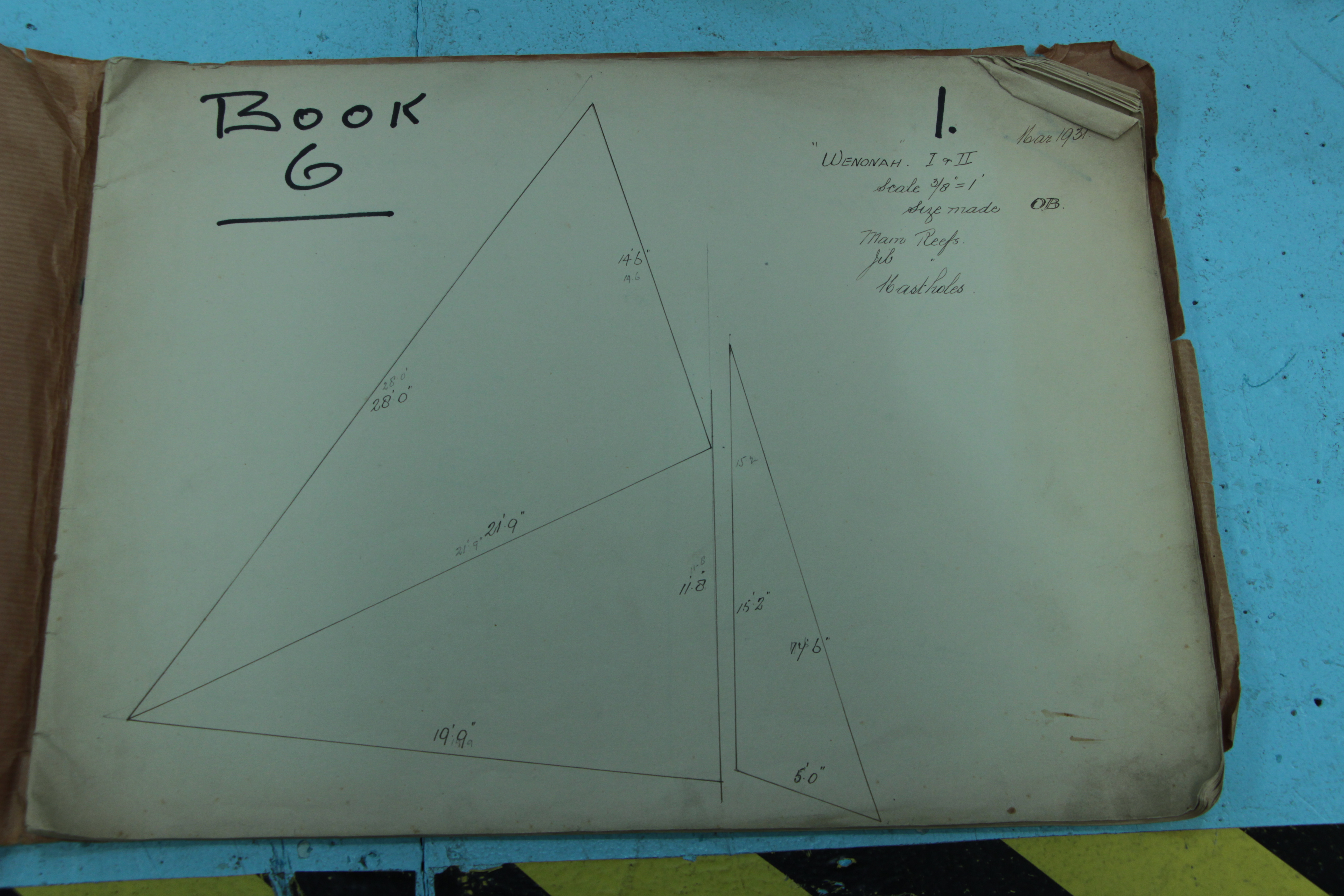
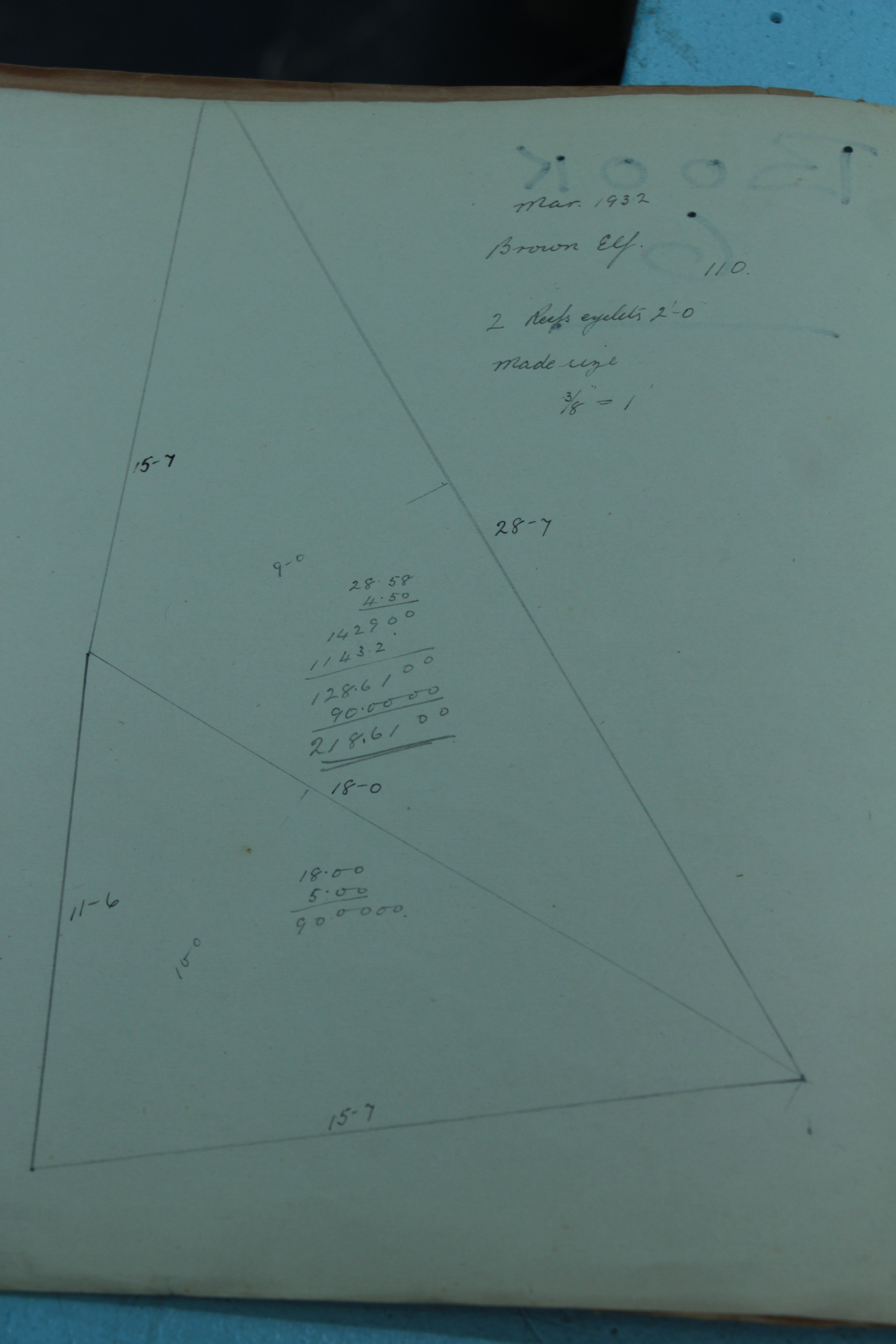
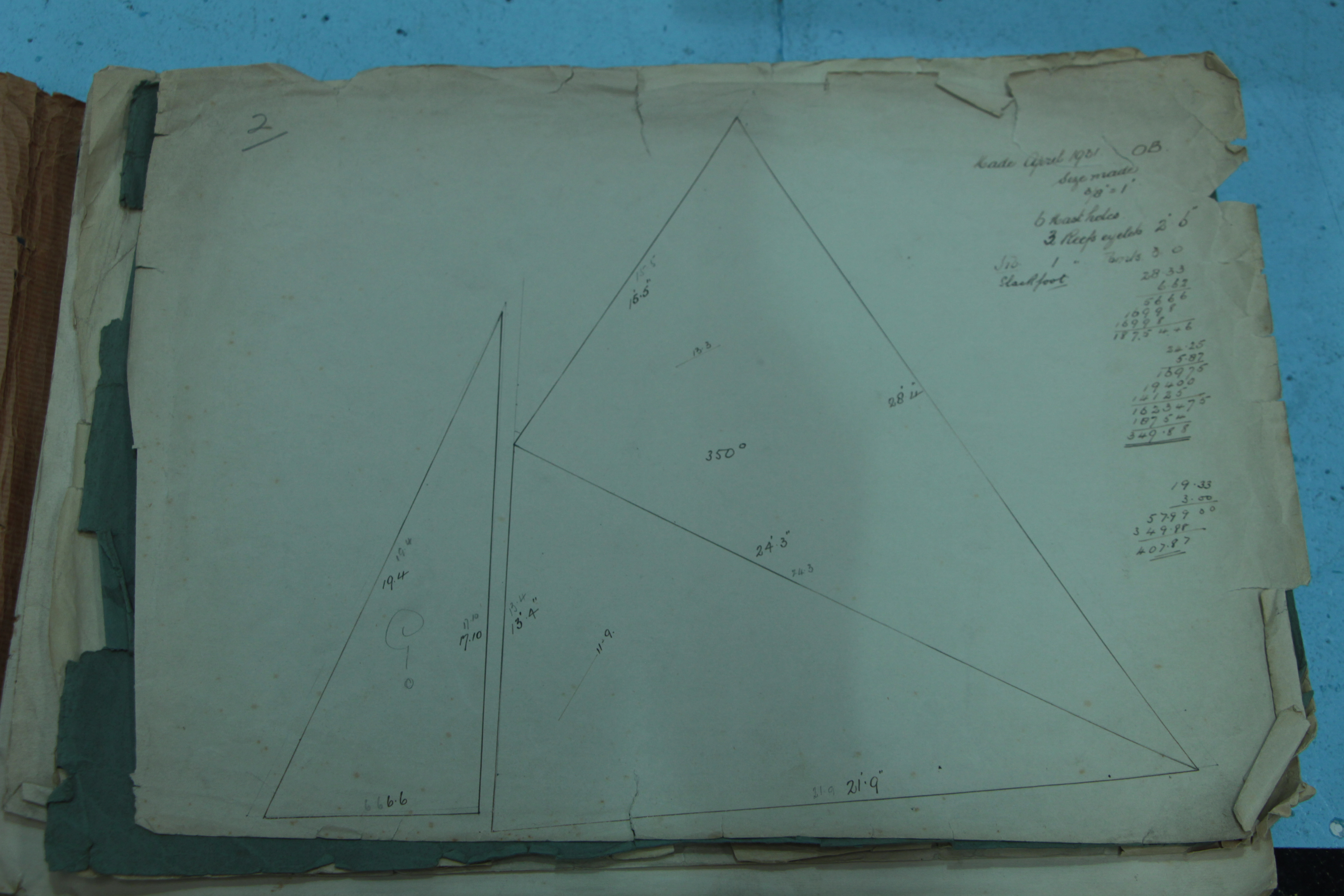
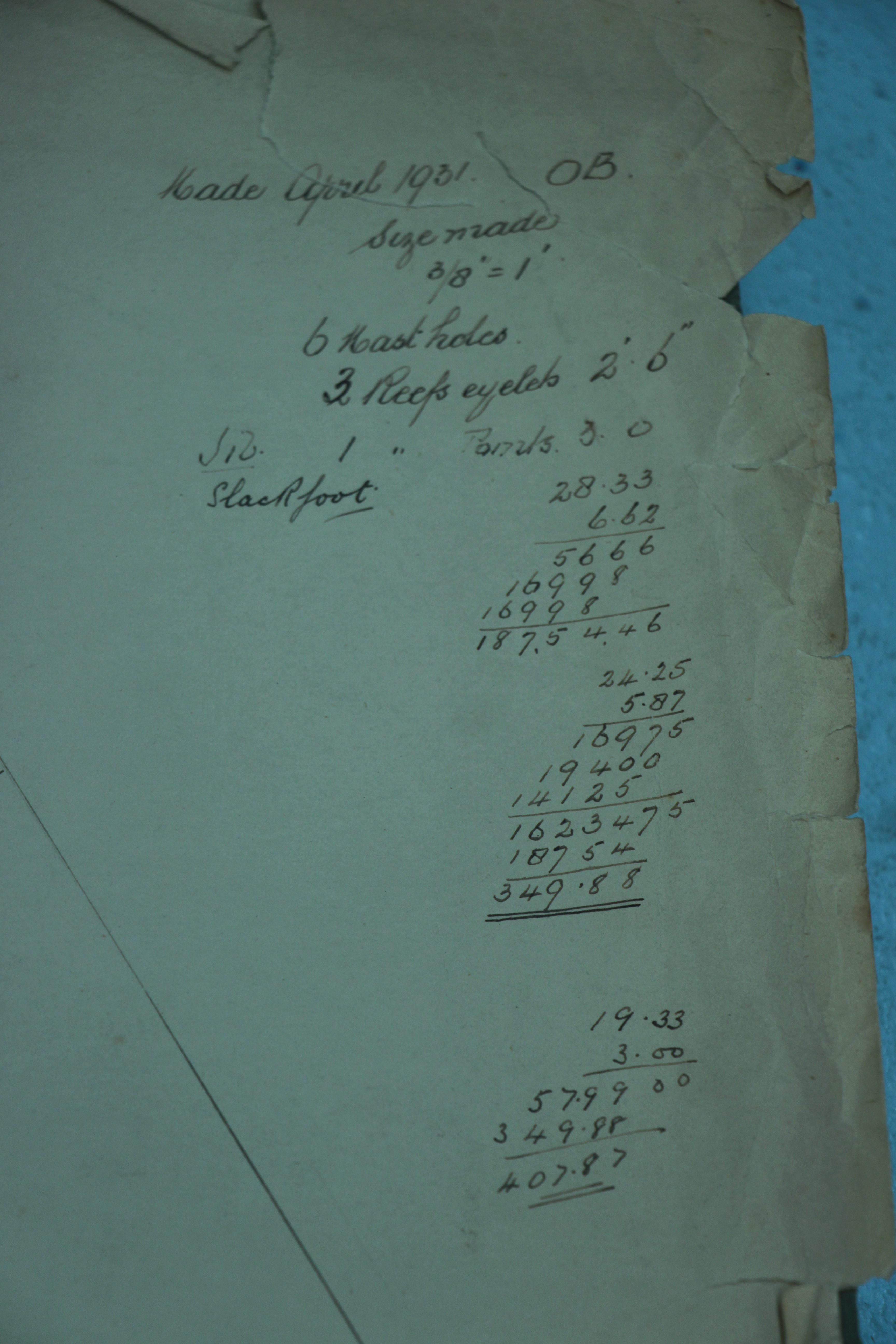
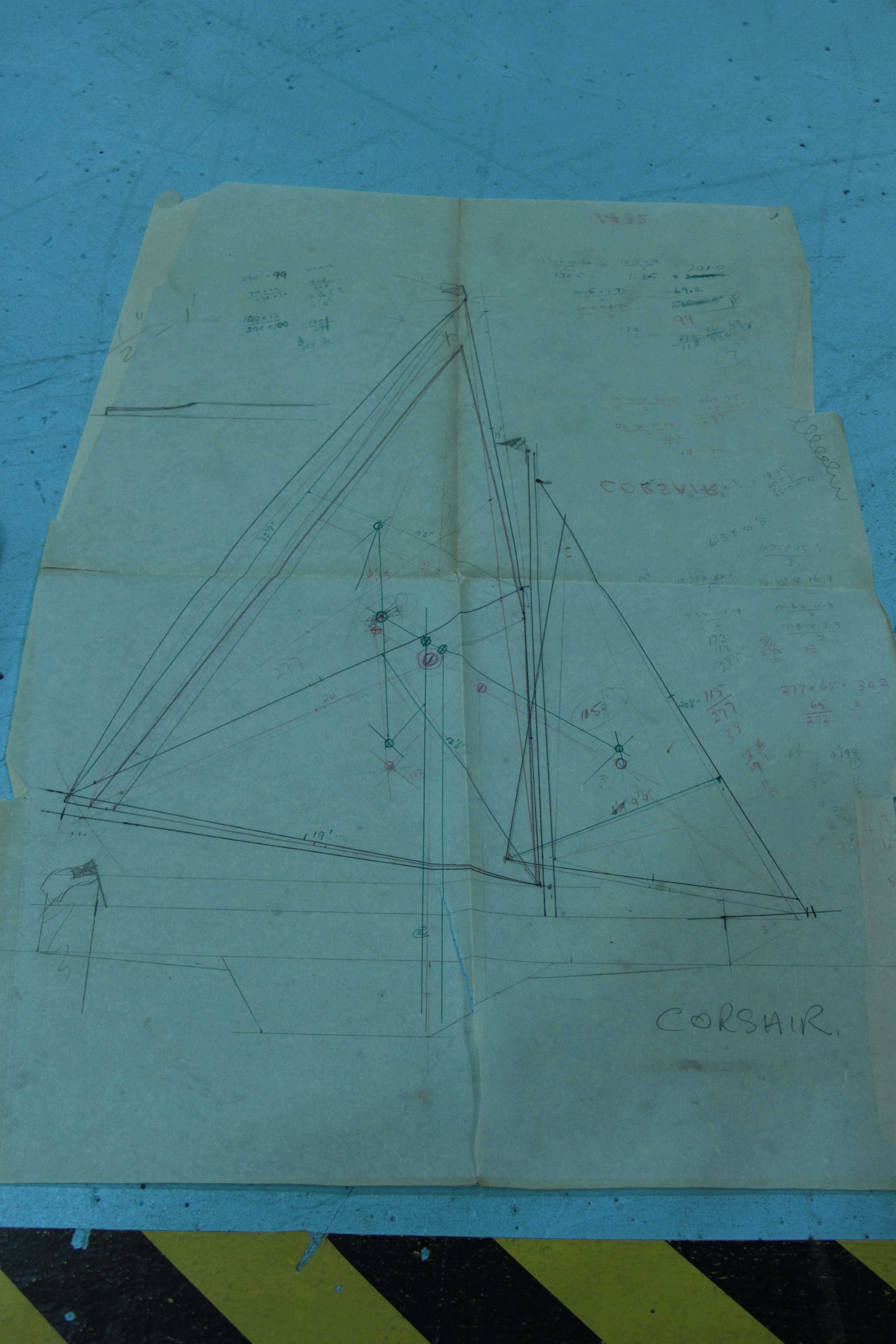
Thankfully – they have kept a fantastic archive of old drawings. I am, as ever incredibly grateful that they, like many have tolerated my bumbling presence, listened to some half-baked tale about an old Blakes model, and set me loose on the archives…

It was like seeing an old family photo album if I’m honest. ‘Bonito’, ‘Pirate’, ‘Wayfarer – now ‘The Only Girl’, Breeze, Maidie, Silver Arrow, Pixie, Mystery, White Wings… all familiar names. Looking at the sail plans from the 1920/30’s was an incredible experience.

Most of the old drawings are jumbled – so it did take some detective work. However; in the album above, you’ll see Wenonah, Brown Elf, Clipper – and ‘Corsair’s sail plans.

I’ll be using the Clipper sail-plan to aid the restoration of the Blakes model. Plus it’s interesting to look closely at the large sail-plan on transparency – which I believe it what was draw for the Campbell family – then the smaller diagram which shows how Peter Olorenshaw had the rig reduced.

My heartfelt thanks to the kindness of Chris Jeckells, Richie Dugdale and Sam Goodbourn for helping me today.

Cruise 2009 – Day 1

Now – back to 2009, and of course we had planned a sailing holiday. I’m going to add a footnote to the log-entry for Sunday 9th August 2009. It’s something that never made it into the official record (as it were), and. well. You can judge for yourself.

This year’s cruise started in an unorthodox fashion, with most of the fleet scattered across the Southern Rivers. ‘Corsair’ was slogging up the Yare against a persistant ebb-tide, towing a particularly heavy and unwieldy rescue boat. Honestly, there’s nothing as soul-destroying as motoring against the ebb.

However, with an excellent sense of timing – Chris B. stepped out of his Dad’s car, just as ‘Corsair’ was less than 30ft from Reedham Quay! It was a case of quickly mooring, and then about 1/2 hour later – Robert arrived.

But no, the motoring wasn’t done with, no. We had to continue upriver to collect ‘Nulsec’ with James & Alison. They had sustained some damage to the tiller/rudder stock and although launched, were stranded.

It took about 3 1/2 hours to get upriver to them, and then back to Reedham. In preparation for the inevitable tedium (!) of repair – I managed to cook a curry for everyone on the downriver leg… Oh. Yes! ‘Corsair’ now boasts a two burner Primus 535 stove.

I had found this beauty in the veritable treasure trove that is Andy Seedhouse’s chandlery at Woodbridge. An errant piece of Oak block-board kitchen counter ‘fell’ into my Volvo from the skip outside ‘Owl Kitchens’ in Bungay, and avoila! A galley unit and cooker installed. (it was about time – breakfasts were a chore on several elderly Primus stoves) all cooking was being done in the cockpit, and the disconnected gas cooker was purely ornamental.

Out with the old! New galley – 2009.


Plus – there was this new legislation called the Boat Safety Scheme – I knew I couldn’t afford to pay to have the respective safety measures put in for a gas installation… By some astonishing loophole – paraffin stoves aren’t included in the inspection!! (I’m not tight, just careful)

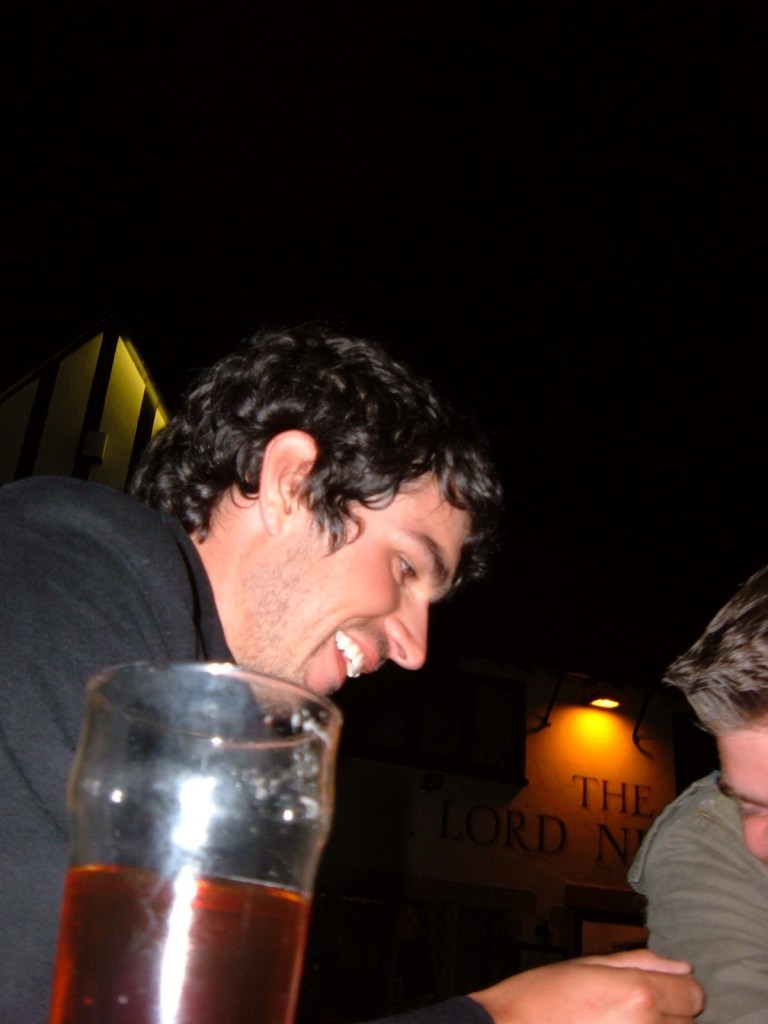
Typically the rest of our evening passed quietly (!) in a time honoured fashion outside the Nelson P.H. in Reedham. Although some design specifications were thoroughly exceeded by the skipper. (you can judge for yourselves…)

Added excitement came from being subject to some drive-by eggings (no, really!) from local yobs.

At about midnight, we retired.

Epilogue

Back to 2009, from 2019. That day’s entry was short. Deliberately so. We moored at Reedham at about 7pm, just down river from two large, ‘Caribbean’ type holiday boats. These were moored stern to stern, about 3 feet apart. Two families were staying on them.

We were sat, outside the Nelson P.H. – when suddenly there was a lot of screaming. Robert & I both jumped up and ran to the source.

Worst case scenario really – two adults in the water, a man and a woman – both screaming, the father thrashing wildly screaming a name, over, and over.

This gives me goosebumps now. We knew that a child was in the river, the ebb was pouring out to sea. It’s funny I’m typing this, and there’s a cold clarity in me. I remember running about halfway down the motor cruiser (down tide), before thudding into the cabinside like a rugby player – forcing it from the quayside.

Looking down – I could only see a child’s hand and wrist above the water, getting lower. I can remember how white they looked, against the inky black of the water in the shadow of the quay.

Next thing I know, I’ve thrown myself down on my belly and I’ve grabbed this hand. And then a VERY wet and frightened children is stood on the quayside by me. Thank god he was breathing – albeit clearly in shock.

In slow motion I’m running back to the stern – and with adrenalin pulsing Robert and I lift the Mother out of the river, before similar hoicking the Dad out.

None of them were wearing lifejackets.

At the time, I didn’t realise the significance of what’d happened. I take no pride from it, it could have easily ended so differently, and the juxtaposition was between being carefree on holiday, or being adjacent to a drowning.

Quietly, the family returned to the boat, and agreed that lifejackets would be worn from now on.

There is no bravado in this, I never wrote it down at the time – it wasn’t really absorbed. I wrote it now, simply because it’s part of the experience I’ve had, owning ‘Corsair’.

Goodnight.
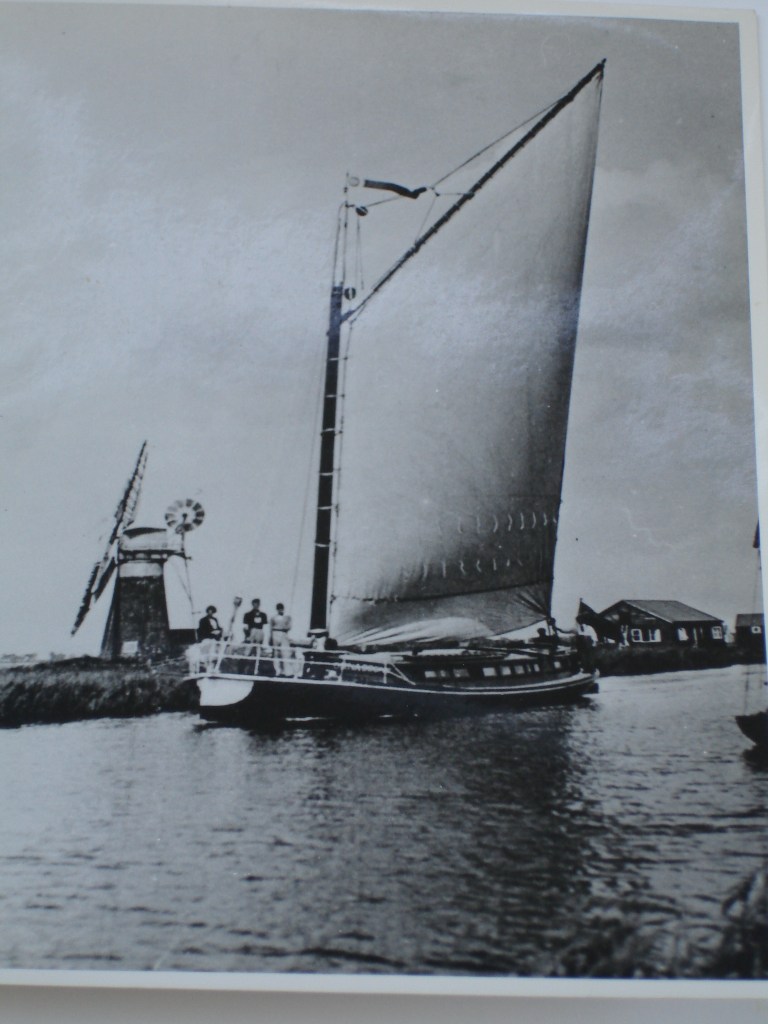
2009 – relaunch & my first YSC race.

Sorry – the delay in writing has been for the best reasons. I have been out sailing, a very enjoyable 4 day cruise to the head of navigation at Dilham.

‘Corsair’ at Dilham.

I’m always struck by how different the landscape is on the Broads when I go to Dilham, you are in gently undulating North Norfolk country-side, in a genuine canal setting. Very different from the rest of the rivers.

If you are lucky enough to sail on the Broads, do take yourself to the extremities in the navigation. You’ll see tremendous scenery. Moor at Horsey, and you look on at the Dunes of the North Sea, the next day you can be in a canal basin, and the day after on a huge tidal lagoon (as was) faced with a Roman Fort looking down on you.

One day I hope the North Walsham & Dilham canal trust https://www.facebook.com/NWDCT/ achieve their goal of connecting the canal back to the system.

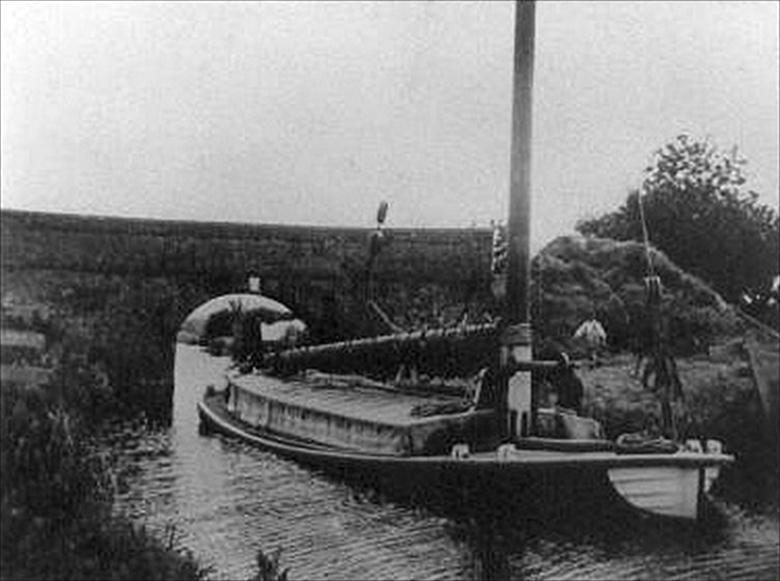
The canal itself, was authorised by parliament in 1812. Unfortunately it was finally abandoned in 1934. Don’t think the canal wasn’t useful though. In 1898 – 6,386 tons was received at wharves on the canal and shipped away. The wherries on the canal carried about 15-20 tons… So that’s nearly 319 wherry loads in a year!!

The last wherry to navigate it was the ‘Ella’. And in tribute, the canal trust have recently launched Ella II – a launch which will take you on the re-watered sections of the canal.

Wherry at Swaffield Bridge – NW & D canal

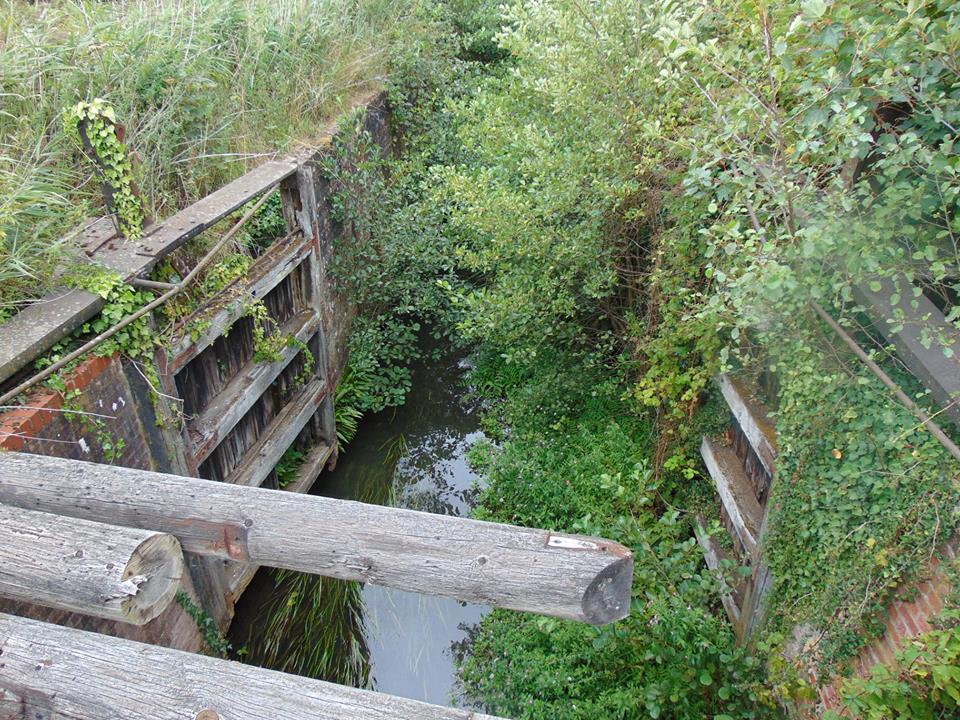
In its heyday, the canal boasted a small fleet of these very pretty, small wherries. About 2/3 the size of a typical trading wherry, sadly none have survived. If you visit the canal these days, well it’s very eery – dereliction has left pieces of it beautifully stagnant, like the lock chamber at Honing, just waiting.

Honing Lock

Anyway. I digress. But it’s worth going to look at the canal, if you ever get the chance. Running alongside it is the trackbed of the Midland & Great Northern Railway, the Stalham – North Walsham section of their network.

Such direct competition no doubt proved to be the undoing of the canal. But again, the old railway has been left in splendid isolation, and is full of hidden relics as you walk the trackbed.

Back in 2009, I was in the final throes of preparing ‘Corsair’ for launching. This would be my first run at it ‘solo’, I was nervous. Throughout the winter I’d done what I thought was best. I’d applied a liberal amount of Dulux gloss on the hull, and one whole tin of Screwfix ‘no nonsense’ yacht varnish on the toerails (! – horrible stuff). I was set!

Barton Turf – January 2009 – ‘Corsair’ is hidden behind S/N242 ‘Freedom’. Luxurious conditions!!

Or so I thought. ‘Corsair’ was launched on the allotted day, and surprisingly the ancient and defunct car battery worked adequately to keep the bilge pump humming and she floated (mostly) after a few hours. Eager to sail this year, I had aimed for an Easter weekend launch.

After work, there I was… Heave-ho, hauling away on the heel rope there was the usual strain as the mast rises the first few feet. Then a shroud snagged (cabin roof corner, the usual spot). I made fast, and then walked aft to un-snag.

CRUNCH.

Bollocks. As I had walked down the sidedeck, the mast had swayed about, not being fully in the tabernacle, it was free to pivot. The snagged shroud was snatching, arresting this oscillation. The crosstrees fell victim to this, and neatly folded themselves either side of the mast, snapped cleanly in half

Bollocks, bollocks, bollocks! I was filled with despair, then anger. I’d worked, I’d slaved! I’d gone hungry, through sodding winter. I’d dug a trench! All for this bloody boat, and now this!! Feeling very dejected, I lowered the mast, removed the detritus and left.

I’d planned a weekend away on the boat, what would I do? After a couple of hours, I realised that I wasn’t going to be bloody beaten by this bloody boat.

I eyed up an unsuspecting refectory-style Oak table…

Once again the conservatory was functioning as a workshop quite late into the night, and my housemate quietly despaired. It could have been noisy desperation in all honesty. I couldn’t hear above the noise of my jig-saw.

By midnight I had crosstrees again. They were rough – but they’d do! I was able to re-rig ‘Corsair’ the following day, and returned to Oby Dyke. Bizarrely, S/N 242 ‘Freedom’ who had acquired my old bowsprit, also picked up the second hand rig off ‘Clipper I’ – which suited her nicely. Whatever echelon of yachting I was in, it definitely was the ‘grass roots’ end of things!! We all loved wooden boats, just necessarily didn’t have the finance to keep them.

S/N242 – ‘Freedom’ at Oby, with Corsair’s bowsprit, and Clipper’s mainsail.

Remnants of the French-Polish stayed on those cross-trees for YEARS afterwards. They survive to this day, and somewhere the remains of that table lurk in the workshop.

Having overcome this difficulty, and starting to realise that wooden boats are tricky things I decided to venture south onto the Waveney in May 2009 – for my first Yare Sailing Club race, the Ray Perryman memorial passage race. This runs from Somerleyton to Beccles each year. It also would be my first navigation through Yarmouth with ‘Corsair’.

I survived Great Yarmouth, which is always tricky to get the tidal gate correct, and even arrived at Somerleyton in time for a few drinks at the Dukes Head before last orders.

The trouble with rushing to the pub of course is that when you come back to the boat, you’re too drunk to raise the cabin roof, or put the awning on. Something which you need to remember at 4am when you get up to pee… That cabin roof is solid, and low!!

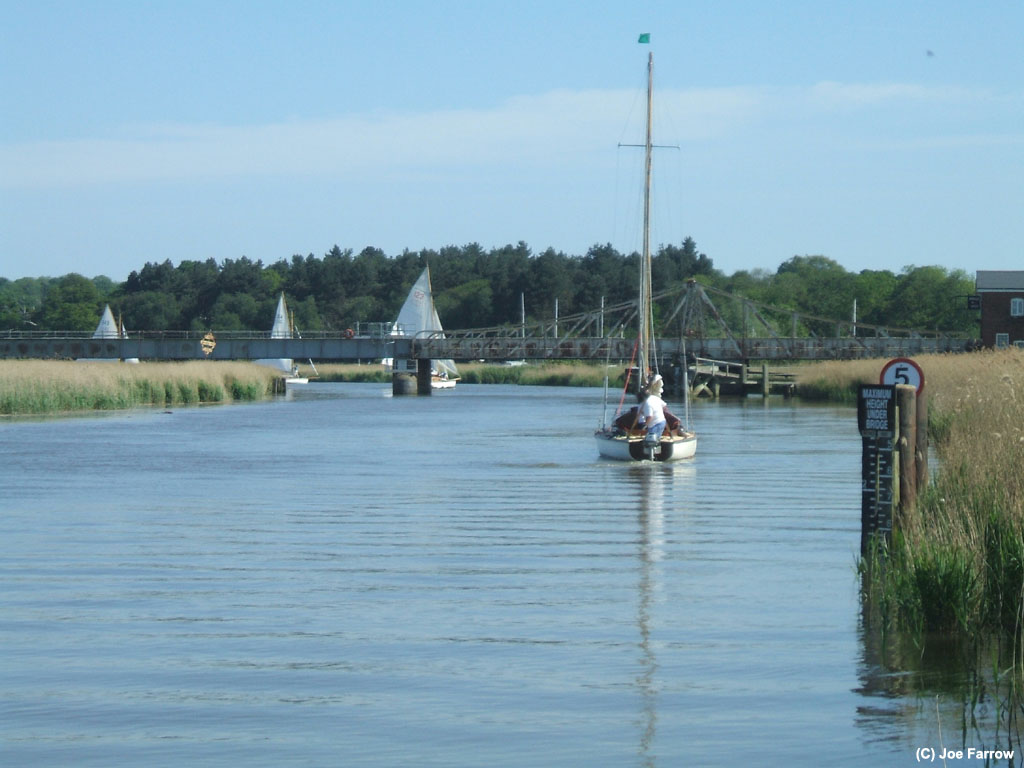
The course of the Perryman race takes you upstream from Somerleyton, starting adjacent to the railway bridge. Smart thinking is to get course-side of the bridge before the thing shuts and traps you the wrong side!! Every year the fleet gets split pre-start, to the great amusement of those who are the correct side…

The fleet, divided!!

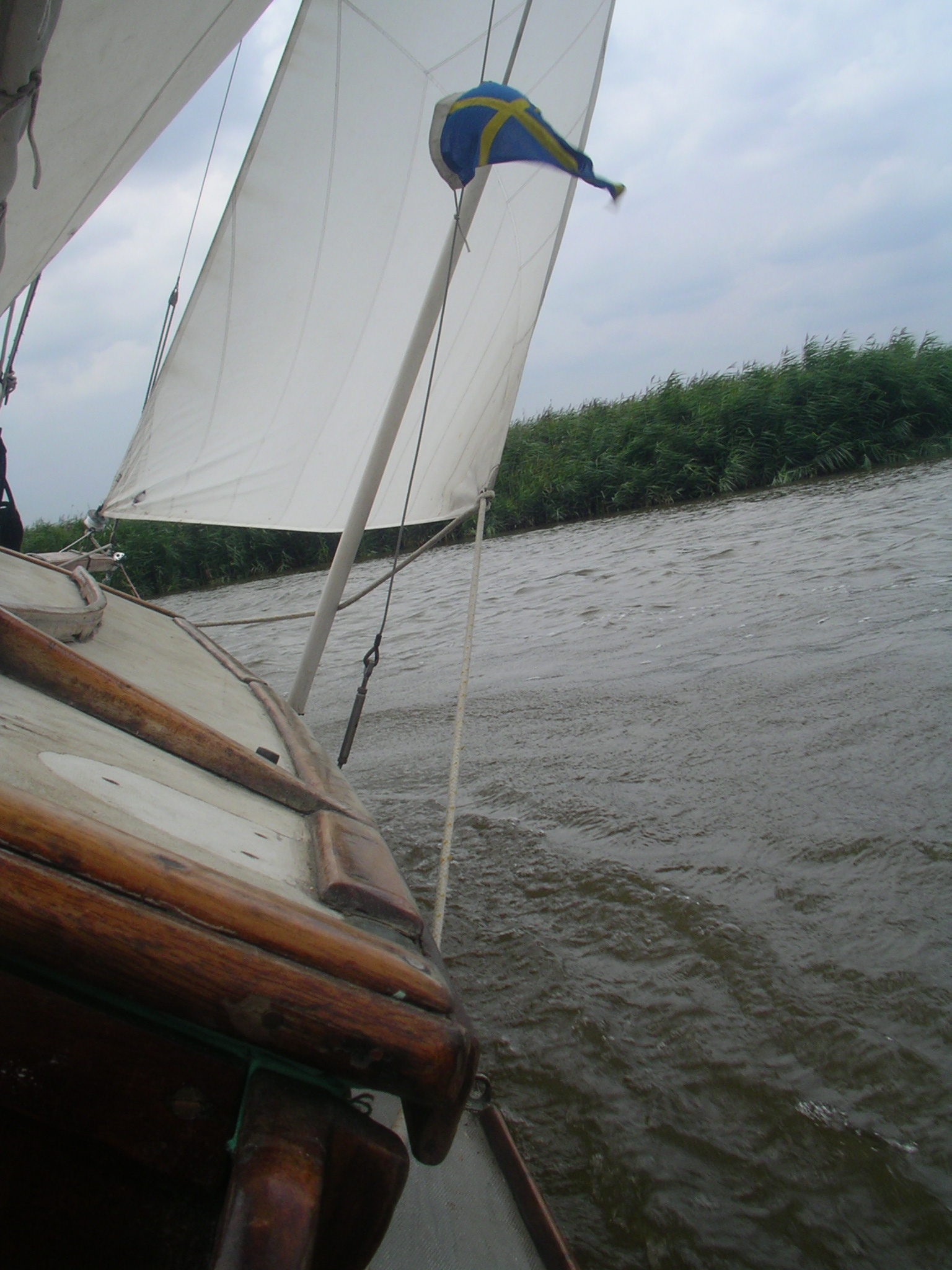
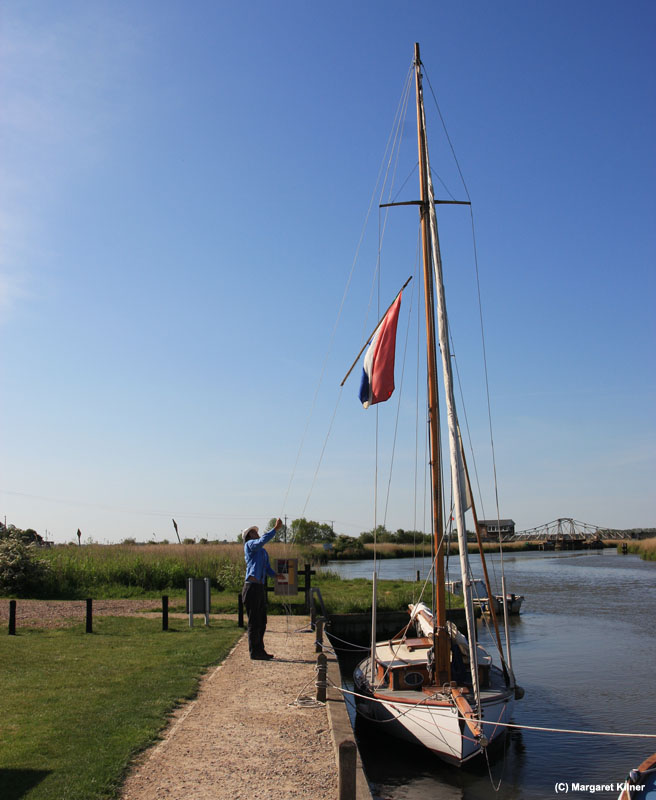
I did provide some amusement pre-start, as my flag of choice is, somewhat oversize!

Big flags. ‘That’ bridge in the background…

The race itself suits me, its a passage race, and presents as a mixed bag. You start in the open marshes with clear air, and a wide river. Soon after Burgh St. Peter and its unique church, you find yourself in a very pretty albeit tree-lined river. That’s when you use the tide, and every last puff of air to your advantage. The last section (2 miles ish) from Aldeby to Boaters Hill is very tricky, you need every bit of momentum to keep going!

‘Corsair’ didn’t set a world record, I believe she placed 7th out of 9th entries. We did start a mere 19 seconds after the gun, which I thought wasn’t too bad. These days if I’m much over 5 seconds off, I chastise myself!

However, we completed the course and nothing was broken. Success! We tussled throughout with a much larger, and heavier yacht S/N 149 ‘Stella Genesta’. I think we finished only 24 seconds apart after an 8 mile race. She is a beauty, and is credited with being sailed to Holland sometime in the pre-war years. A fine craft, but I’m not sure I’d take her across to Flushing!

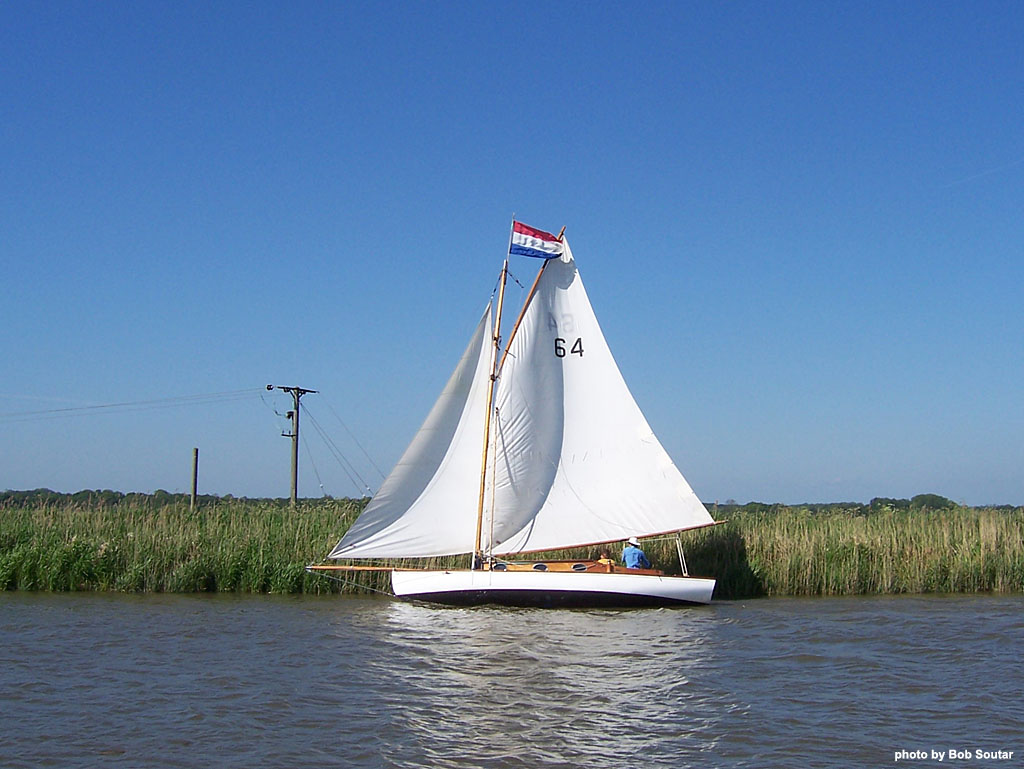
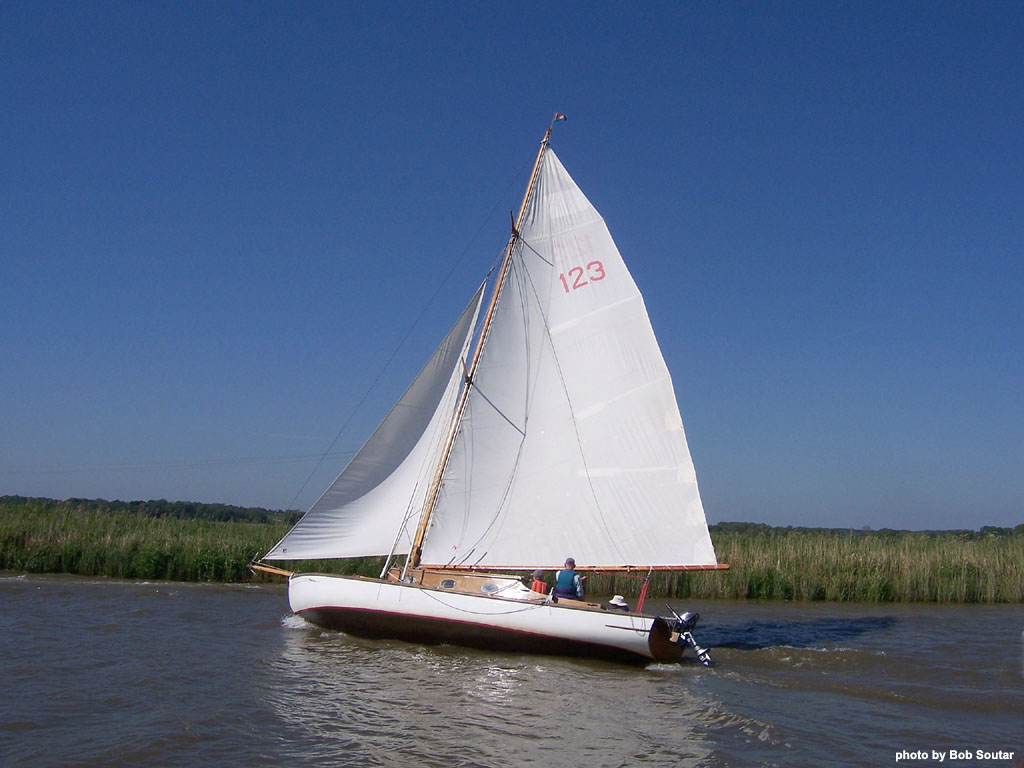
Line honours that year went to S/N 123 ‘Puck’, an ex Fine Lady from Herbert Woods. Albeit with a much more adventurous rig than her days in hire!

We celebrated the next day by sailing in company to Geldeston – another part of the rivers where you are faced with derelict lock chambers…. I wonder if it’s a condition??

Anyway – I’ll finish with some photographs of that weekend. Halcyon days again, after a somewhat frustrating winter.

The next prominent sailing event of 2009 of course, would be our annual sailing holiday! We’d already done it once on ‘Corsair’, what could go wrong!?

Olorenshaw & Hinde

So, back to the 1960’s – Peter Olorenshaw had disposed of ‘Corsair’ quite soon after acquiring her, and she was on the bank at Brundall. In truth, she was having an ignominious time of it.

Peter Olorenshaw is credited however with reducing the sail gear by lowering the peak slightly, and fitting an inboard engine.  A Vire 6hp, with a hotch-potch arrangement of different height cockpit seats to accommodate this.  

Whilst the engine itself is long gone, there is a remaining legacy, namely the ‘slot’ for the gear change lever in one of the cockpit lids.

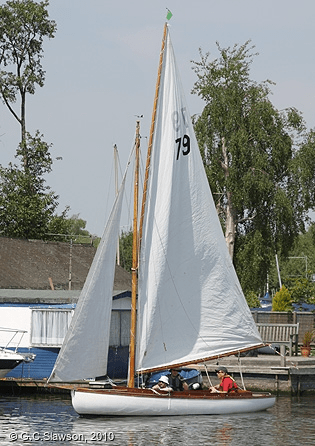
The Campbells had swapped her for a fairly new White Boat (No. 79 – The Old Lady), seen here in 2010;

Photo – G.C. Slawson.

In 1964 – brothers John & Peter Olorenshaw registered as a owners of Norfolk dinghy, essentially each time ‘Corsair’ found herself moved on, for a smaller boat!

The Norfolk Dinghy was originally conceived by Herbert Woods, legendary Broadsman and boatbuilder from Potter Heigham. The prototype is actually No. 2, that’s another story!! The first Norfolk dinghies were built in 1931, costing approximately £65. It’s rumoured they were an alternative to the International 14, which at that time cost 150 guineas. The Norfolks were mostly built pre-war.

For the Olorenshaws, their dinghy was built in a period where that class was slowing down. In fact from 1951 to 1968, only 9 new boats were built. In the pre-war days, averages of 6 or 7 new dinghies a year wasn’t uncommon! The Olorenshaw brothers only kept their Norfolk from 1964 until 1977.

Sorry – I’m supposed to be writing about my boat. But if you want some fantastic photographs of Norfolk Dinghies, please visit my friend Sandy’s page; https://sandymillerphotography.pixieset.com/norfolkdinghies/?fbclid=IwAR0L9aGkQDIYVF1ZGSzbtTLx_YtI7AqqnwBVA6iWT9BvEYKklAZtDtuY-eQ

Prior to the Olorenshaw’s passing ‘Corsair’ on to her next owner, (she was sold in 1969). Her next owner was in fact, across the Atlantic!

As a young man, Stephen Hinde had taken 6 months’ work in a department store in Detroit, Michigan, which lead to him being in a position to purchase ‘Corsair’.  Although he first covered approximately 12,000 miles on Greyhound buses, travelling around America. 

Once back in the UK, Stephen was mulling over which river cruiser to purchase – prospective craft being either ‘Corsair’ or ‘White Wings’ (S/N 1)

So yes. ‘Corsair’ was purchased at Brundall (Brooms Boats) there being a family connection between the Brooms, and the Olorenshaws. Her new owner Stephen Hinde. His family interestingly, also were business owners in Norwich. His great grandfather founded ‘Bonds’ department store, now part of the John Lewis chain.

If you are interested, some history of Bonds is available here; https://en.wikipedia.org/wiki/Bonds_of_Norwich

His grandfather Ernest Bond also owned the wherry ‘Lorna Doon’;

Wherry Lorna Doon – presumed onboard, Robert Bond & possibly his sons Ernest & William.

Again – ‘Corsair’ had secured the attentions of a devoted owner, thankfully with the means to keep her well. Stephen’s first impression was that a lovely boat, but in the wrong place!!

I have been lucky enough to correspond with Stephen, and having met both he and his wife Janice at their home – and as such I was able to piece together more of ‘Corsair’s’ history.

At this time, Stephen was a member of the river cruiser class committee, so it made sense for ‘Corsair’ to be kept at Wroxham broad, with her own buoy near the public beach.  Hence on the 29th June, 1969 he undertook his maiden cruise, sailing ‘Corsair’ from Brundall to the northern rivers. 

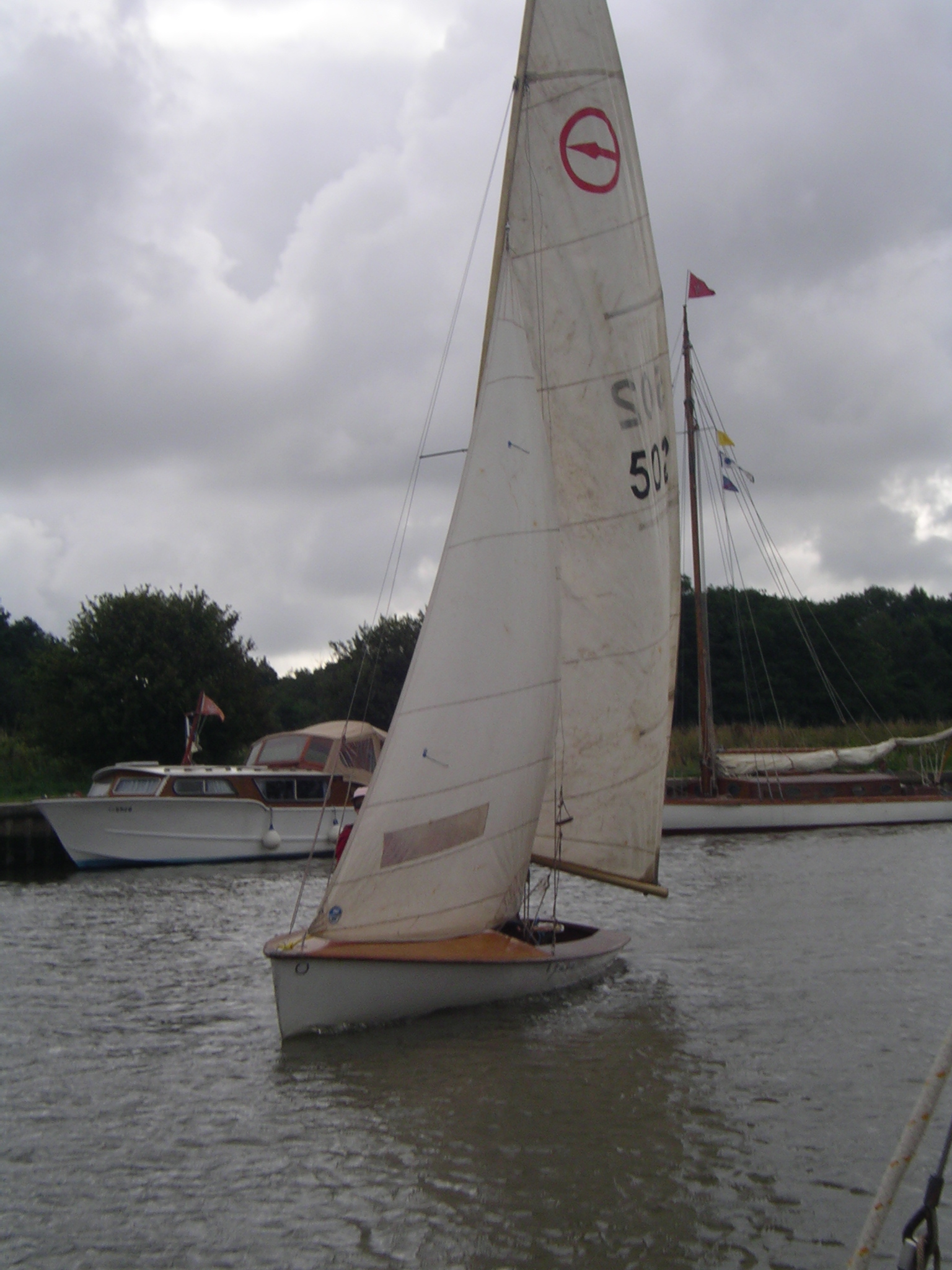
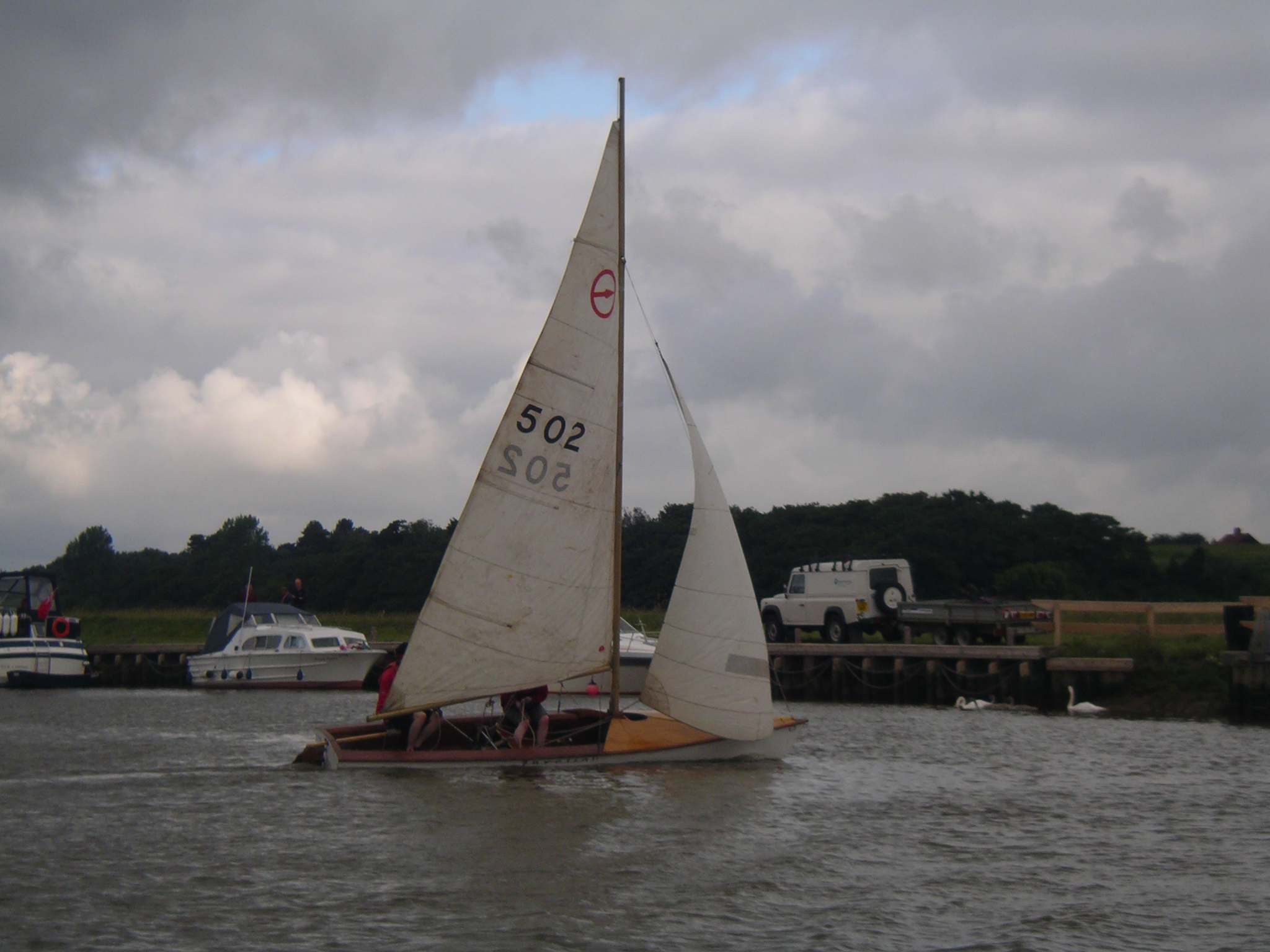
I am fortunate enough to have in my possession several photographs of Stephen’s ownership.  He not only sailed ‘Corsair’ actively within the river cruiser class, but also achieved some success, winning the ‘Rogue Tankard’ one Barton regatta.  He also competed in the 1970 3 rivers race, with the Bakelite plaque now kept in my desk drawer. 

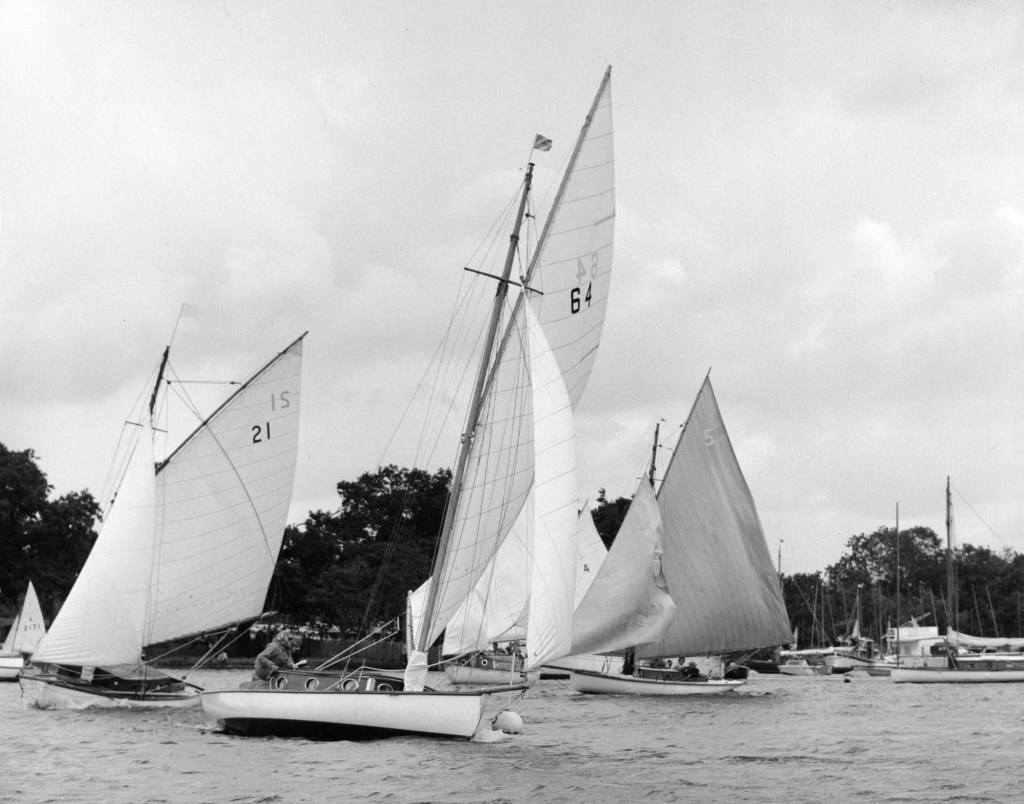
L-R; Rogue, Corsair (in the lead) Swallow & Barracuda – Wroxham c.1965

During this time, ‘Corsair’ was over-wintered at John Clabburn’s yard; ‘Dawncraft, where it was necessary to replace some of the original sapele planking, even at this comparatively early stage in her life. 

Also in 1970, he took ‘Corsair’ down Yarmouth harbour, just so she could sniff at the salt water – something to my knowledge which wasn’t repeated for her until 2012, where she was berthed at the Royal Norfolk & Suffolk Yacht Club for their regatta on Lake Lothing. 

Stephen had fitted an accessory which I understand is entirely bespoke to ‘Corsair’, and I’m not aware this has not been repeated by another Broads yacht before or since!

On the cabin roof, in the aftermost port corner, there is a shaped wooden holder, which receives a chromed spotlight.  This was to enable night-time sailing! It too, is retained and lives in the forward cabin drawer under the starboard bunk.

Given the context of Stephen’s work (he was part of the family business, Bonds department store) it is evident that the search light was actively used, particularly as Saturday was a working day for him.  He specifically recounted its’ use on a midnight navigation of Meadow Dyke, one summers’ evening – eventually mooring under the familiar silhouette of Horsey Mill. 

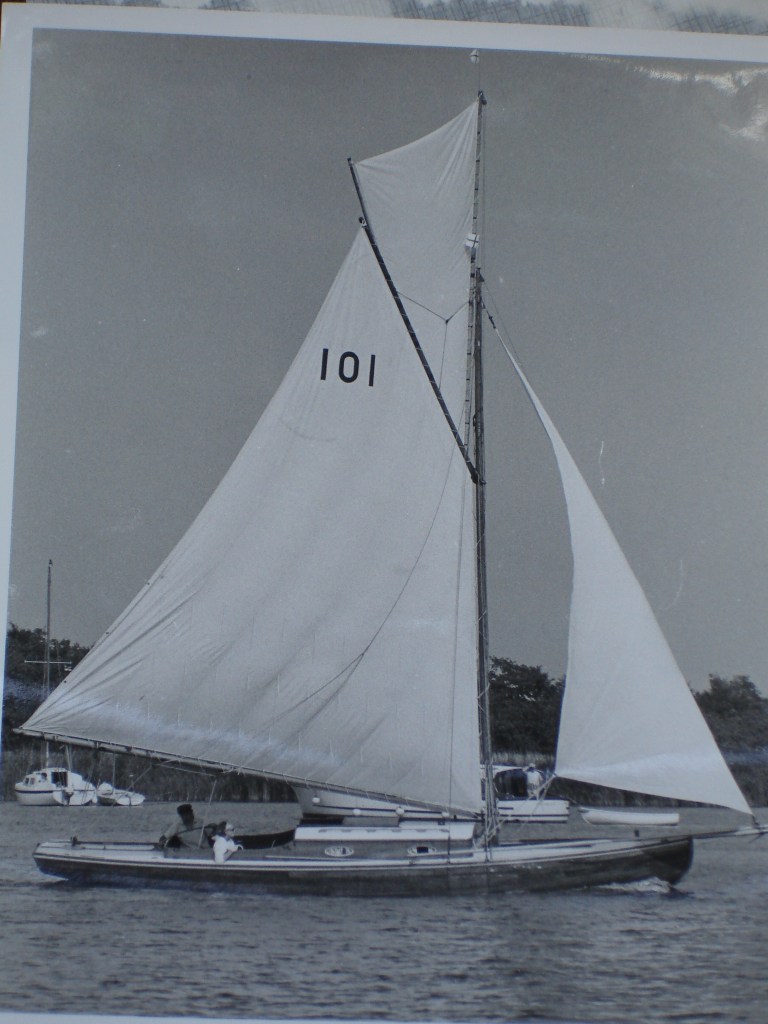
During 1974, after Stephen had married – another Broads yacht caught his eye – s/n 101 ‘Loyalist’, a larger fully varnished Broads yacht that had been built for estuary/coastal work in addition to Broads sailing.  He’d bought ‘Loyalist’ whilst still owning ‘Corsair’, and no doubt needed to focus his energies on the new…

RCC S/N101 – Loyalist. Built by Ernest Woods, as an estuary / inland cruiser. A beautiful and powerful boat.

As such, after a busy 6 years of racing and cruising, which included taking ‘Corsair’ to every single head of navigation on the Broads, Stephen put her into a boat auction at Potter Heigham.  He recounted to me that the price achieved was somewhat lower than he’d hoped, and as such he removed certain equipment from her itinerary. Much later (42 years in fact) I was able to reunite ‘Corsair’ with certain items, including a fitted winter cover, still bearing the legend “Jeckells Sailmakers, Wroxham).

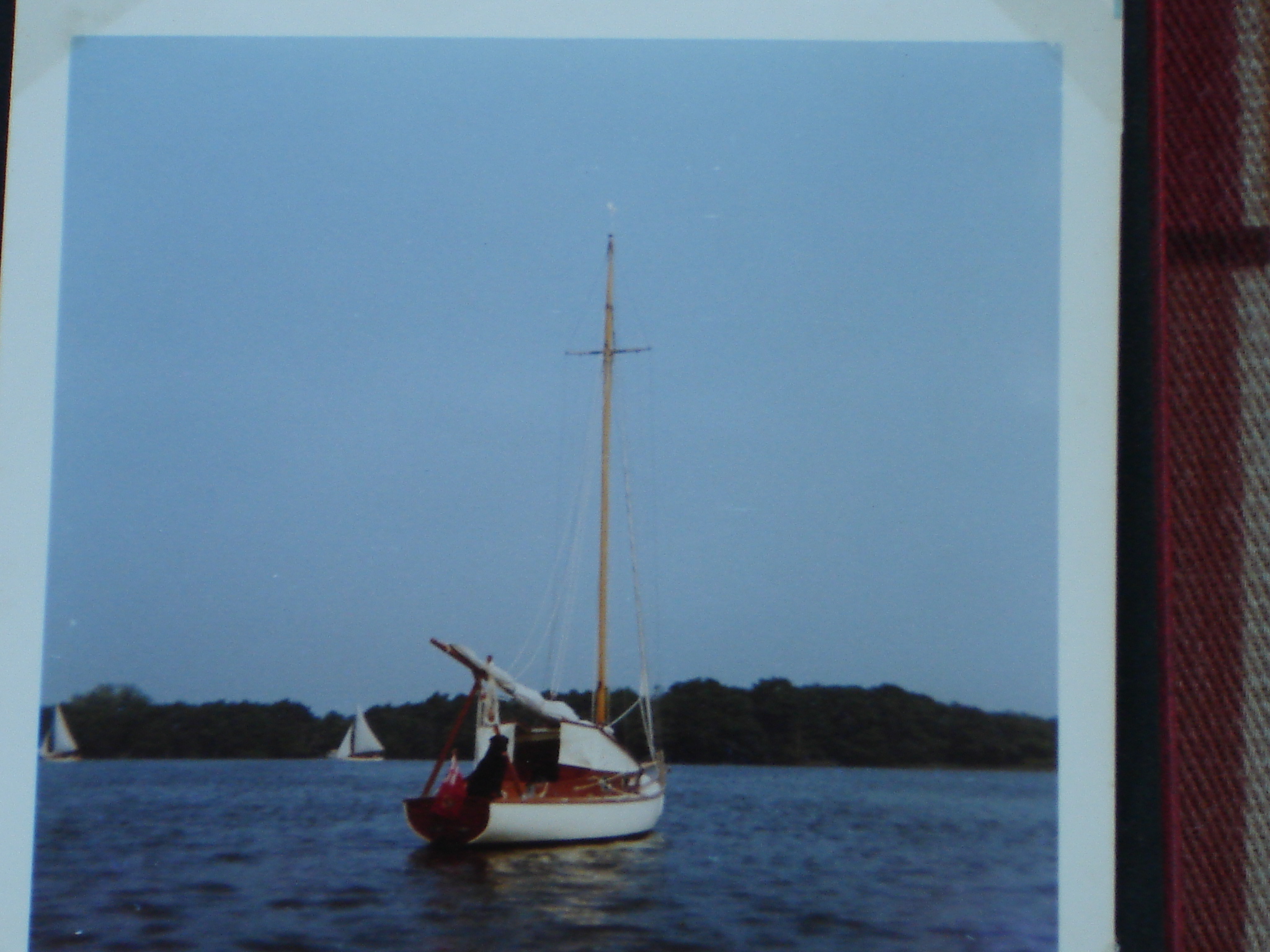
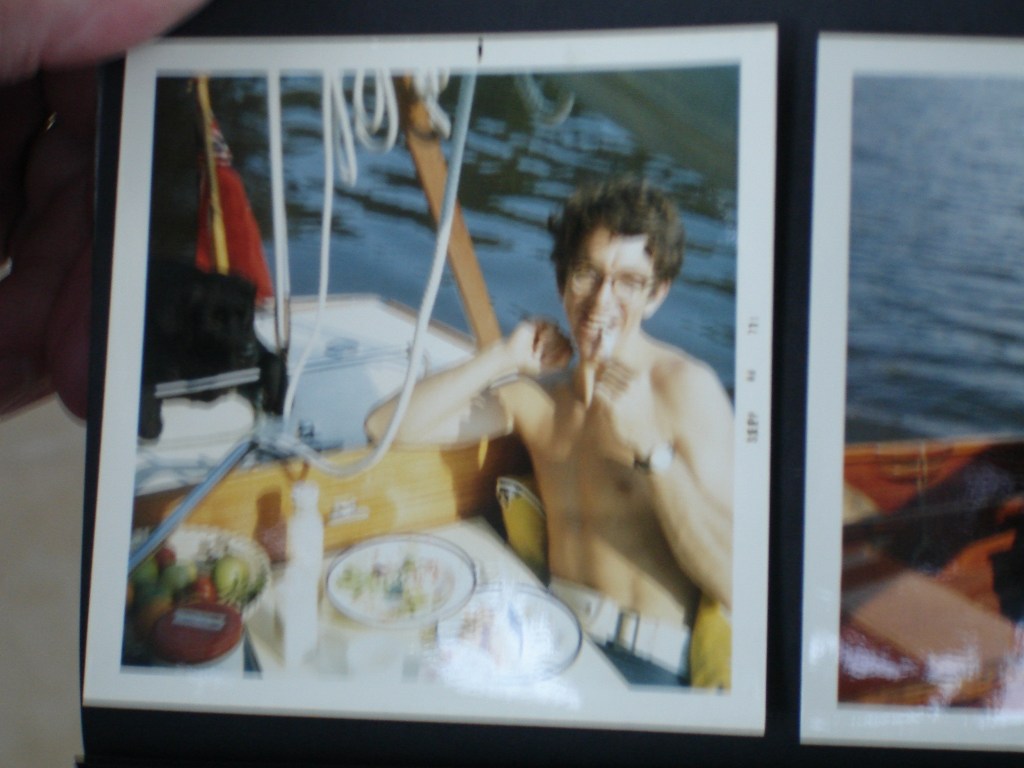
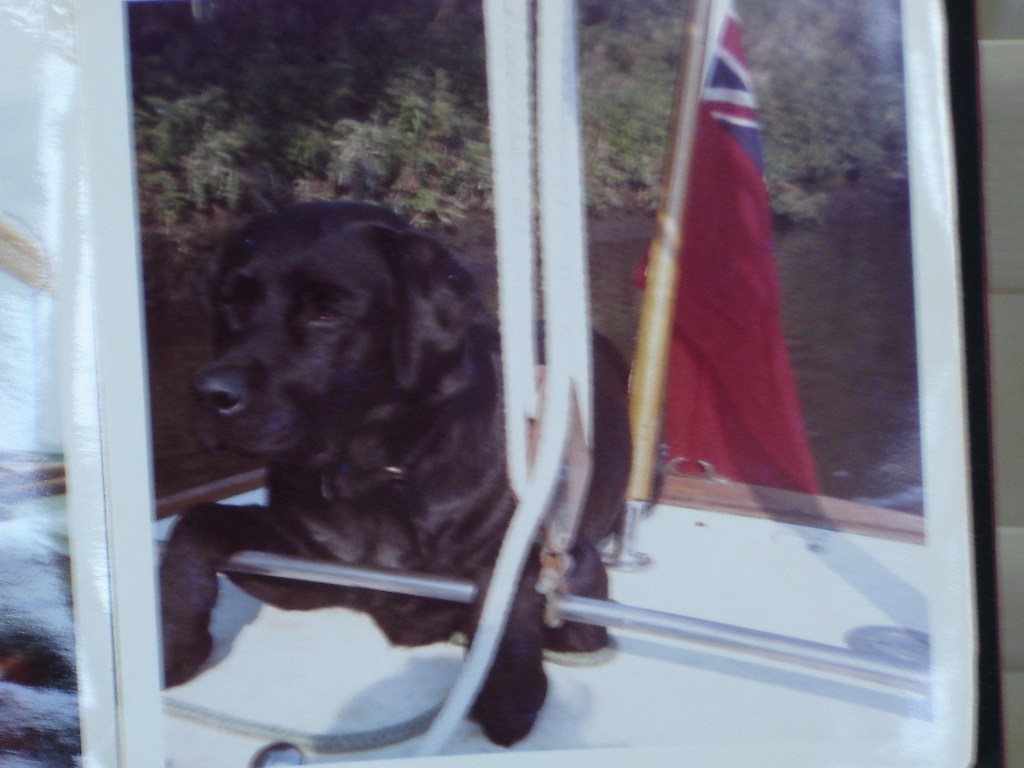
I’m going to finish now, with two my my favourite photographs of Stephen’s ownership. They show a young man, with his dog – enjoying the boat.

Which is exactly what me and the dogs are now going to do now.


On the trail of A.L. Braithwaite.

Broads boats rarely take you to the M25.  Yet, here I am. My ancient Land Rover rattles and drones away as I’m buffeted by passing lorries. 

I hate the M25.  Neither me or the Land Rover are designed for the M25.  

Put yourself in a skip. Fill it with some wasps, a strong smell of burning Oil and a diesel generator. That’s life in a Series on a motorway. Oh, and kick the skip off a cliff, whilst inside for authenticity.

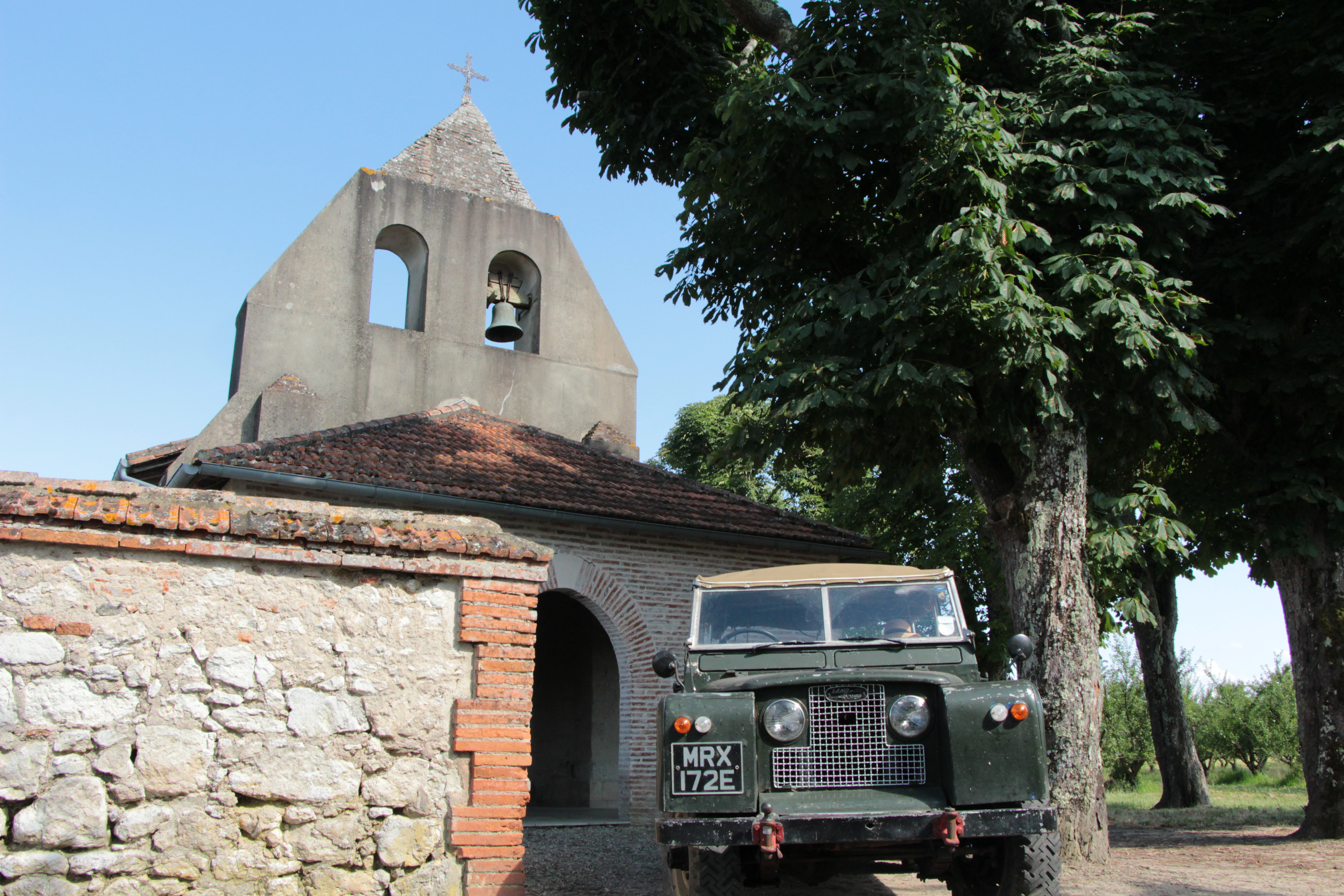
The Land Rover – outside the church of St. Christopher – ‘Go your way and go in safety’

(you need divine intervention in an elderly Land Rover!!)

I’m heading to Hampshire, and I’m about 100 miles away.  My destination will be a small village tucked away just outside the western end of the Solent.  It’s here, at Milford on Sea that A.L. Braithwaite, designer at Chumley & Hawke spent his final years. 

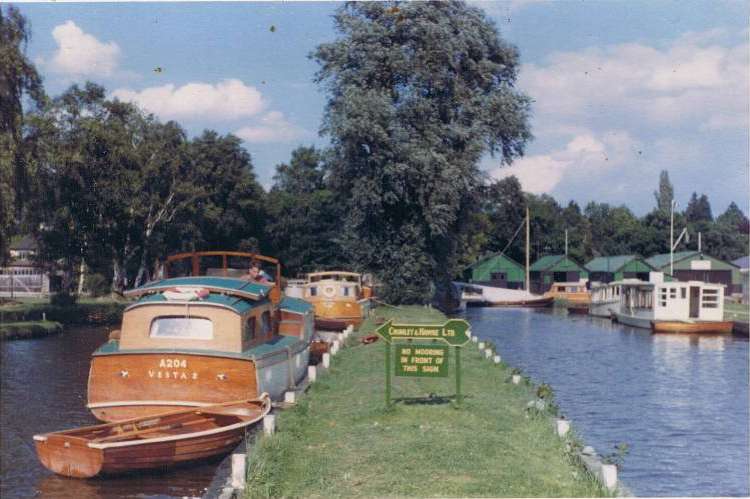
He came to Horning in 1930, and set up at C&H.  His designs for the hire-fleet were mostly drawn in the 1930’s and included ‘Clippers’, The Brown Elf & Imp classes, Viking and Privateer.  All corresponded with the metacentric shelf principle, and to my knowledge most survive. Certainly all 6 Clippers made it, which is unusual, I only know of one other hire boat class which has survived extant, the legendary ‘Sabrina’s’. 

From tracing A.L Braithwaites ancestry – I had learnt that his grave is located at ‘All Saints’ in Milford.  I also knew his probate had revealed his final estate, in Milford on Sea.  

So – I arrive at Milford, it’s hot.  I’m hot. It’s been loud, at a steady 50mph.  

But.  I’m here to collect a series of artifacts that belonged to A.L Braithwaite.  Yes. Somehow two weeks ago, having arrived here, I found the grave, which I photographed.  Then to be honest I just contemplated things.


I thanked him.  I thanked him for having the insight to draw such pretty boats, and I hoped that he knew how much pleasure his boats had given people.  Not just me, but the previous owners of ‘Corsair’ as well. She was, and is held very dear in the hearts of those lucky enough to own her. 

But.  Enough.  Whilst mulling over everything I decided to head toward A.L. Braithwaites last known address, in Milford.  I knew it had been derelict for some time, and I knew that I might, might just get a photograph.  

Pulling up, I noticed a phone-number for delivery, so I took a chance and rung it.  Within seconds I was speaking with Simon. Simon owns A.L. Braithwaites house now, and somewhat bemused invited me down to meet him. 

About an hour later, having had the thorough tour of the house and the grounds – I’d explained myself, and why I was here.  Simon was thrilled. I was thrilled. Somehow a collective interest had put us in the same place at the same time.

Over 200 miles from home, I’d genuinely thought that the grave side would be the finality of my research.  Somewhat grounding really. Suddenly there’s the end, and I had felt very mixed.

But.  Having spoken with Simon for about 1 ½ hours now. I commented on how it was such a shame that in 2009 Joan Braithwaite had moved out of the house, and if I had been quicker, I’dve met her. 

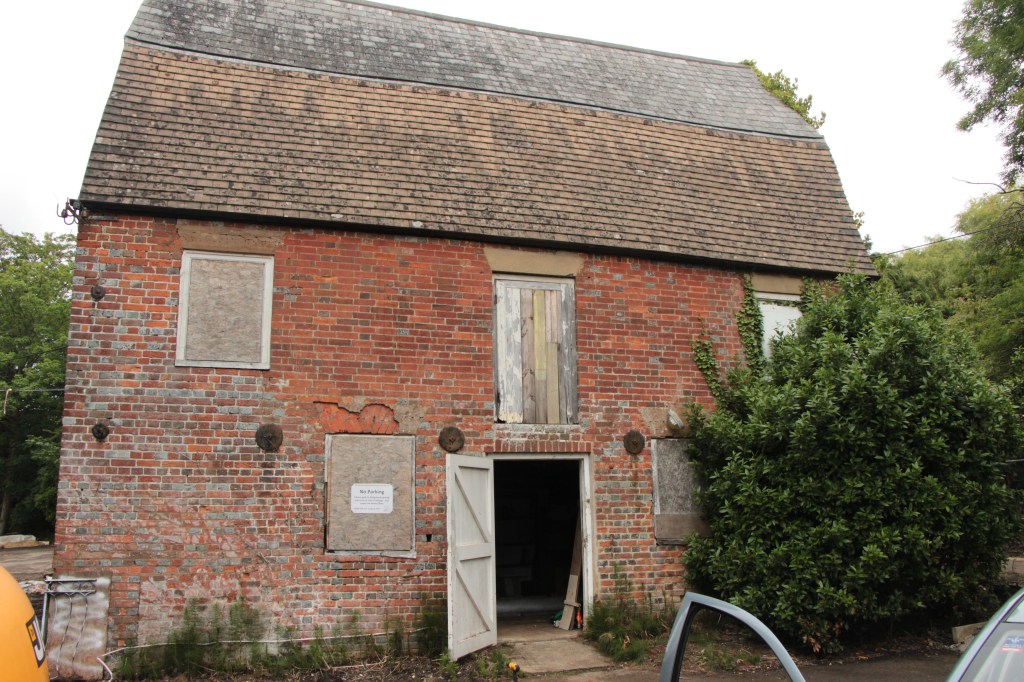
Then came a ‘source of the Nile’ moment…  Simon paused, and asked me if I wanted to see inside of the Old Mill.  Which we opened up.

The Old Mill.

Almost immediately I began to sift through some of A.L. Braithwaites old reference books… Some of his paintings, and incredibly a photograph of Khala Nag!  To my knowledge, this is the only photograph of her left in the world.  

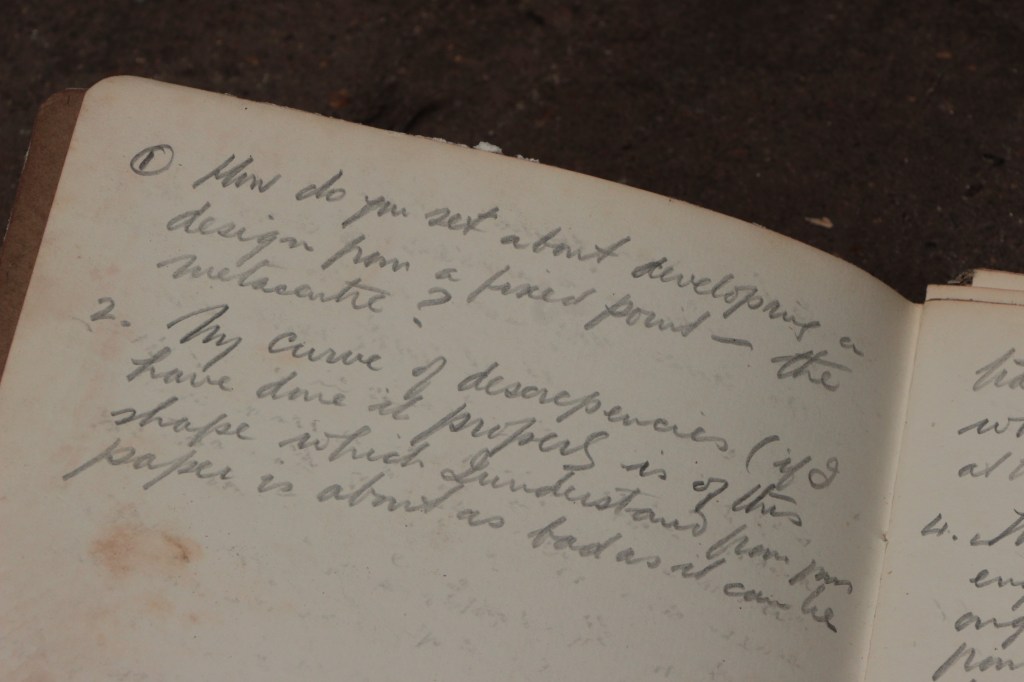
I also found some lines drawings, and the most breath-taking of all. I found his design notebook! Including notes of his response to an R.I.N.A paper on metacentric hull theory, and some of his calculations for at least two designs. ‘Khala Nag’ and ‘Redwings’.

Here was something real, something that definitively linked me with the thought processes that lead to my boat.

The design notes of A.L. Braithwaite.

There was so much!  It was dumb-founding.  Here I was, holding belongings of the designer of my boat.  I couldn’t believe it. I still can’t to be honest.

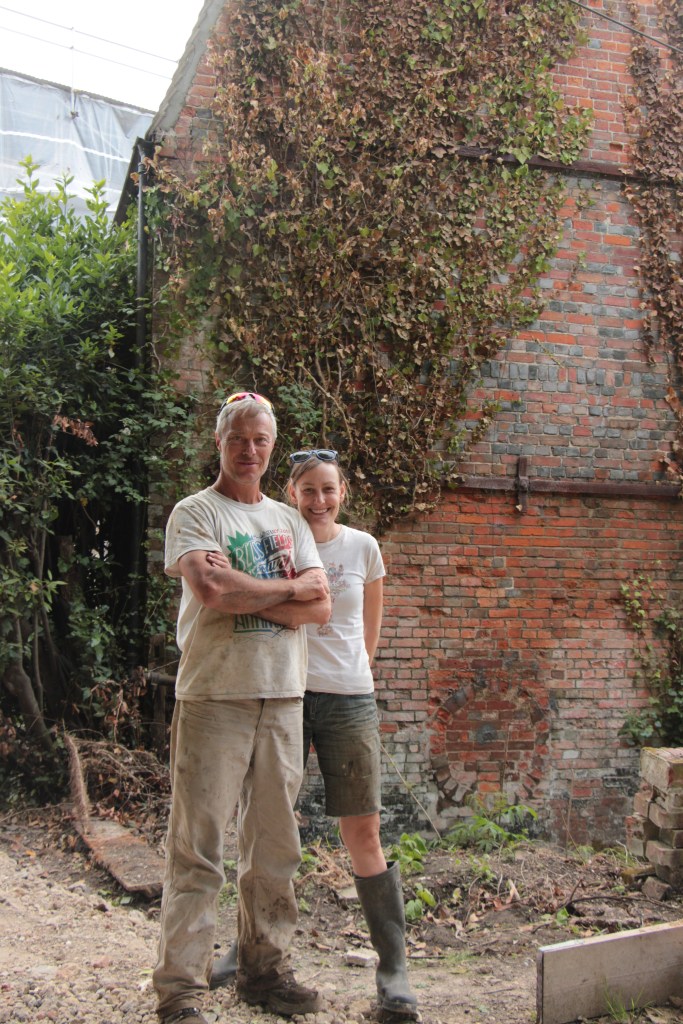
Now, I will write fully about this. I promise. I can’t not, not really. But I’m going to finish by saying I give my heartfelt thanks to Simon and Amy Davies, without whom none of this would be possible.

Simon & Amy

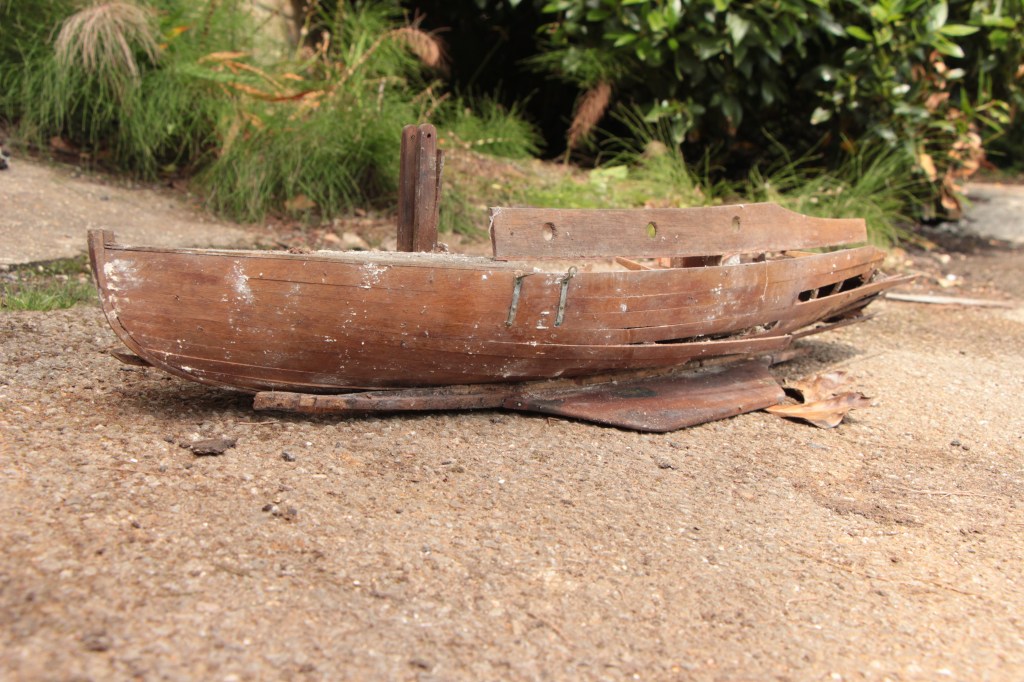
It’s not often I use this word. But what I’ve found is irreplaceable. Especially given that in amongst the wreckage (literally) was the remnants of a Blakes Model.

For those of you not familiar with this. Blakes the hire boat agency used to use large scale models as advertising material in the 1930’s and 1940’s. You could report to their offices, and see a miniature version of whatever boat you’d hire.

Now, call me a lucky S.O.B. – I certainly have. The wreckage I found, which Amy had miraculously saved… It’s the Blakes model, or Builders model of a ‘Clipper’. ‘Corsair’ was built as ‘Clipper Vi’.

I now own her builders model.

Clipper – the Chumley & Hawke Blakes model.


Chumley & Hawke… the designs

Sorry – I haven’t written for a few days. Not least that I have made a break-through in my research. Think ‘source of the Nile’ moment… I am going to break my rule of writing chronologically – and give you an update. Then I will write fully about what I’ve found later.

But. Back to Chumley & Hawke. Their fleet differed from most hire-fleets, in so much that they were mostly designed properly. This sounds harsh, but its unrelenting honest I’m afraid. Most broads yachts were build ‘by eye’, from half models… And, AND! They were badly built!! It’s easy to look at a river cruiser today, and get misty eyed, but in the ‘heyday’ – these boats were built to do a job, and to be disposable.

Look at ‘Corsair’ – she lasted 10 years in hire, then was sold off as redundant. Now, admittedly her first private ownership was a lavish environment, with all the right elements for a wooden boat. Money, dedication, money, enthusiasm and money. Oh, and Rolls Royce chrome.

Chumley & Hawke was run pre-war by Roland Hawke, and Alfred Lloyd Braithwaite (A.I.N.A.). Braithwaite had bought into the yard in 1930, moving to Horning. His first few designs but the emphasis on sailing qualities, with accommodation coming second. Proof of this, washis ‘Clipper’ class which won the challenge cup for small yachts, Horning 1935.

Clipper – 1939, showing the fine sailing they were capable of.

Aside from ‘Khala Nag’ – the best example I can think of this is ‘Viking’, built circa 1937. She is now a beautifully restored member of the River Cruiser class, however originally built as a 26ft halfdecker, and described as;

“Dayboat, mahogany built and designed for those who appreciate a really fine sailing boat, which compares favourably with a half-decker and has the advantage of a low cabin shelter…”

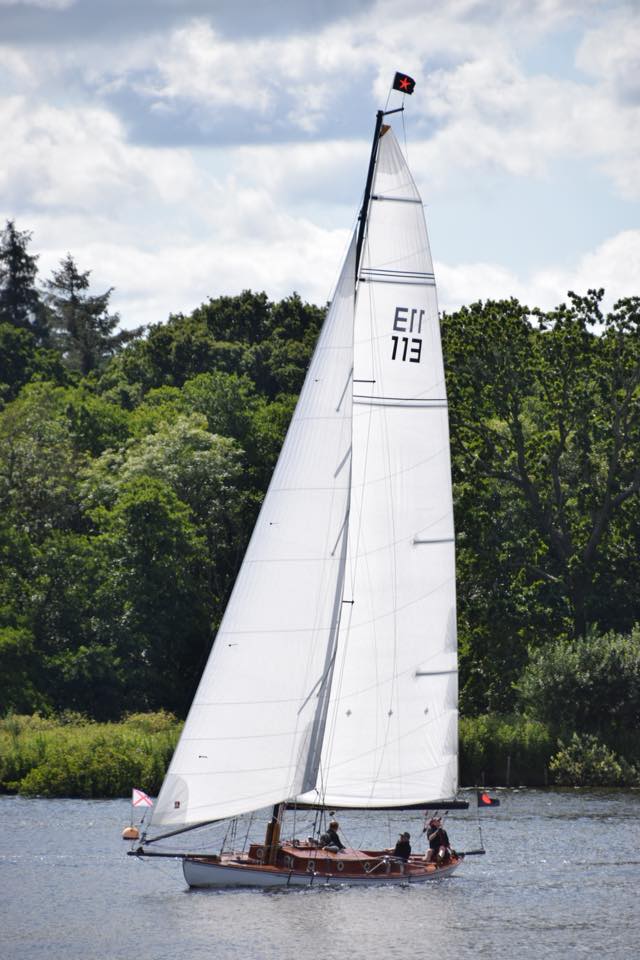
Nowadays, ‘Viking’ is a stunning vessel, having been modified to a canoe stern. Perhaps this is the biggest compliment to a devotee of metacentric hull theory – Viking was ably transformed to a canoe-stern yacht without major disfiguration. Here’s a picture of that indecently pretty hull;

RCC 113 – ‘Viking’, post rebuild at Broadland Boatbuilders.

Now, I can hear you ask ‘what’s metacentric hull theory’? No? Well I’ll tell you anyway. It was popular in the 1930’s. Mind you, so were airships and facism. So we’ll tread carefully.

A.L. Braithwaite was a supporter of the ‘metacentric shelf formula’, which aims to achieve good balance and handling under sail.   Other notable followers include Harrison Butler.

The theory is based on the principle that as a yacht heels over under sail, the balance of the rig forces and the hydro-dynamics will be influenced by the changes in the immersed form of the hull.  

Succinctly, a different shape underwater is presented as she heels and sails. The shape of the hull is defined at each ‘section’, and those different sections exert difference amounts of buoyancy.  Aft sections may possibly being more buoyant than forward sections, interestingly the faster boats sit ‘bows down’ without the crew in the cockpit so are level fore/aft when sailing… 

Metacentric shelf analysis plots the shifts in the varying buoyancies at each cross section of a boat, and defines a net value to windward or leeward and serves as a guide to achieving equal buoyancy in the dissimilar ends of a design.  For a designer, the key is to draw and build a boat which has its greatest cross section area, within a close tolerance of the mid-point in the waterline.

The challenge then is to couple that principle with a hull drawing that decreases its cross sectional surface area in a union manner – both fore & aft of the mid-section.  Further refinements can be made by accommodating the weight within a yacht into these calculations during design & build to ensure that the forces of hull buoyancy, rig power & centre of gravity all complement each other. 

A.L Braithwaite designed boats which corresponded to this metacentric theory, both ‘Viking’ & ‘Privateer’ being good examples.  Theoretically, their hulls change uniformly both fore & aft of the mid-section (usually within a small tolerance +/- 7-10%).

The ultimate test of course, being that a truly 100% metacentric hull should look almost identify from either direction.  This has been demonstrated with ‘Viking’

Typically, the application of metacentric formula gives a sweet handling boat that is aesthetically pleasing, and has a good sailing performance without arm-breaking cases of ‘weather helm-shoulder syndrome’(™).

It should also be noted that nowadays, these calculations are done at the click of a mouse button, for Braithwaite to have applied this theory whilst it was relatively uncommon, in limited numbers whilst working in a Horning boatshed for a fleet of hire craft is quite extraordinary.

All Chumley & Hawke yachts have a distinct ‘look’ about them, with low slung cabins and sweet sheerlines. Don’t believe me? Here’s a family album;

Finally – the stem repair I made during that first winter.

Having rough-planed the bows quite blunt, I made sure everything was square (ish) before cutting and laminating a series of oak laminates in place. These were screwed and glued, and clamped into place with large baulks of timber helping me bend them right down the hull.

I had no way of knowing if it’d work. I remember cutting the excess off each side, to preserve the ‘scallops’ where the stem is faired into the planking. Judicous use of primer and sandpaper faired it all in nicely.

12 years later, it’s still there, and it’s been not de-laminated or ‘sprung’, so I think I got it right. Evidently my nervous approach was paying off, I hadn’t done anything massively stupid (yet).

During that winter, I also donated the original 1951 short bowsprit to S/N 242 ‘Freedom, who also gained a Clipper mainsail from another. Seemingly I was surrounded by people with old wooden boats, and a perchant to recycling! Or else we were all broke. I know I was.

That winter I often had to choose to walk/cycle to work during the week. I couldn’t afford the diesel to commute AND get to the boatyard at weekends.

Next time I write, I’ll give you an update on why I’ve been so quiet. I promise it’s exciting (to me at least).

1961 – demobbed & ‘yachted’

In 1961, there was a lot of upheaval at Chumley & Hawke. For reasons I didn’t know at the time I was in correspondence with Jamie Campbell and learning when ‘Clipper VI’ was sold off.

However I know now – and will write about in the future. I’m trying to explain my ownership, and how I learnt what I did.

Chumley and Hawke were selling off their hire fleet of yachts. Rangers, Clippers, Privateer, Wenonah I & II, The Elfs, and Viking all up for grabs. To be fair, by the 1960’s the fleet would have been predominantly pre-war. The only yacht built post-war was ‘Corsair’, although she was built as ‘Clipper VI’;

Clipper VI – the hire boat.

Several local boatyards moved decisively – Martham Boats snatched up the Rangers, the Clippers and the Wenonahs. Tim Whelpton (her builder) bought the Elfs and the Imps from Chumley & Hawke, to start his own hire fleet at Upton.

The clippers certainly had enjoyed a fine history of being an exhilarating yacht to hire – featuring as the ‘cover’ boat in the yachts section of Blakes catalogues for several years. Although to be fair – all of Chumley & Hawkes fleet had been described as boats where ‘good sailing was the principle concern’. Even in 1960, Clippers were described as;

“a distinguished class of craft giving first class performance with a high degree of comfort”

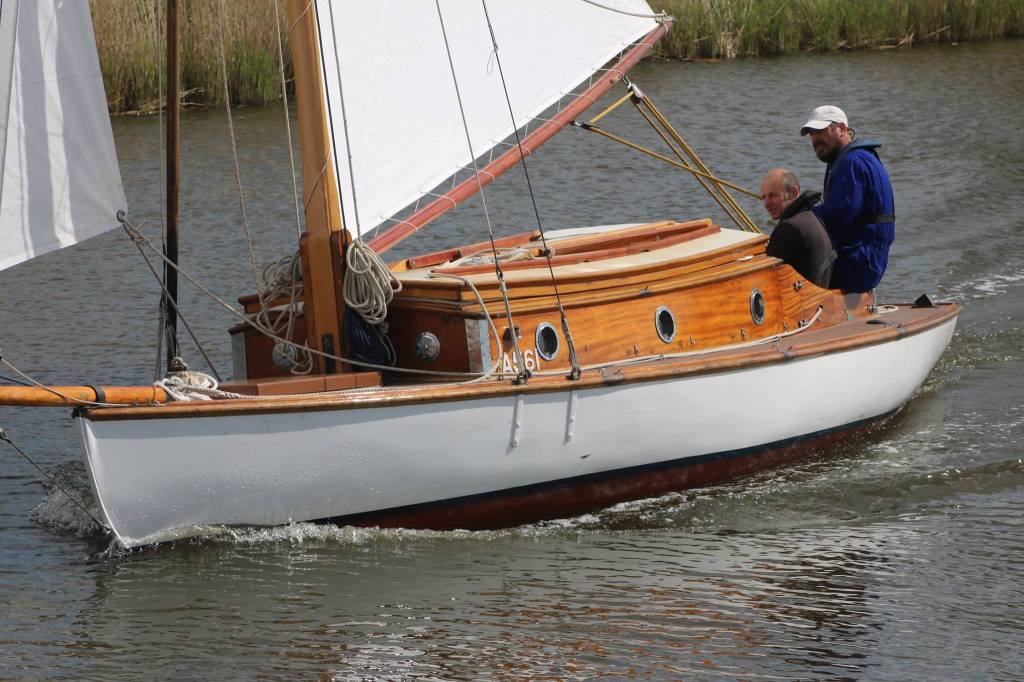
‘Corsair’ is actually built slightly differently to her sisters, with an extra plank in the hull. Certainly when she was in hire, this would have given her a ‘dumpy’ appearance when compared to her sister ships.

Anyway. Yes, in 1961 both ‘Clipper VI’ and ‘Privateer were sold privately. I can write about ‘Privateer’ another time, and will do I promise!

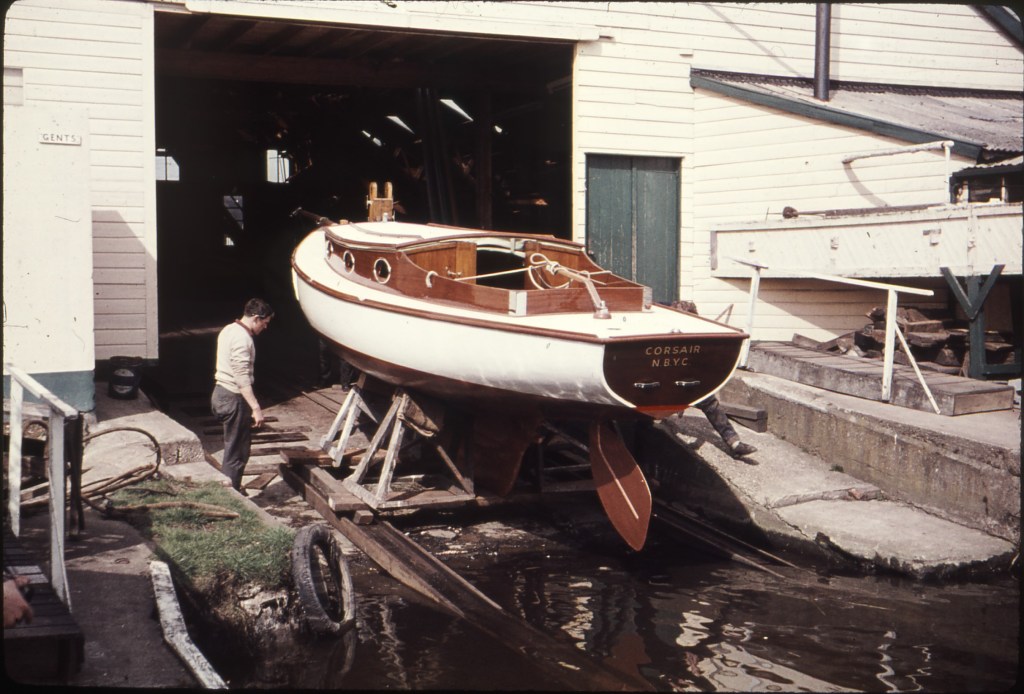
The Campbell family purchased ‘Clipper VI’, as they were warned off ‘Privateer’, which I understand was something they regretted, in terms of size. Meanwhile, ‘Corsair’ was whisked to Wroxham, where Leslie Landamore and Raymond Jeckells were tasked with making her ‘suitable for racing in private ownership’.

The budget was £500, which I understand those two nearly doubled! But, here she is, newly ‘yachted’ at Landamore’s shed in Wroxham;

‘Corsair’ the yacht.

At that time, her condition was mixed. Her original planking is Sapele, a poor substitute for Mahogany, and apparently even in the 1960’s there were problems with rot. Broken timbers also featured. Being in hire clearly came with lots of bumps and bashes! Chumley and Hawke had actually fitted some galvanised steel frames as sisters… (!) These hung around until 2018, where they were cut out by my irate boatbuilder – during the rebuild. (I’ll write about that later).

Her original round cabin ports had been cut and changed to ovals with hopper windows. This echos the arrangement on ‘Evening Flight’, a much larger river cruiser – which incidentally is now owned by Jamie Campbell.

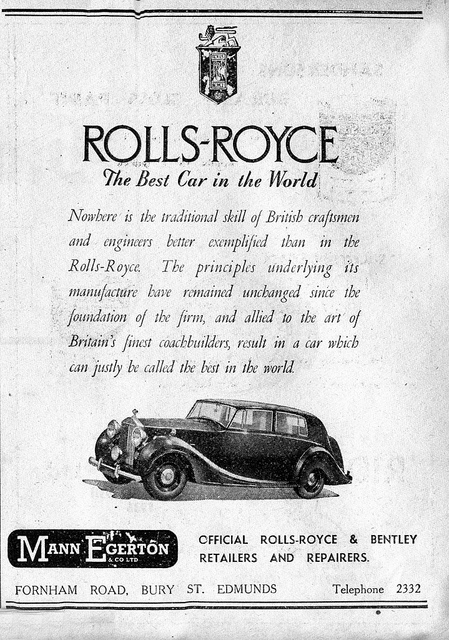
The porthole surrounds were fabricated and chromed courtesy of a local Rolls Royce dealership!

67 years on, all the chrome still looks fantastic.

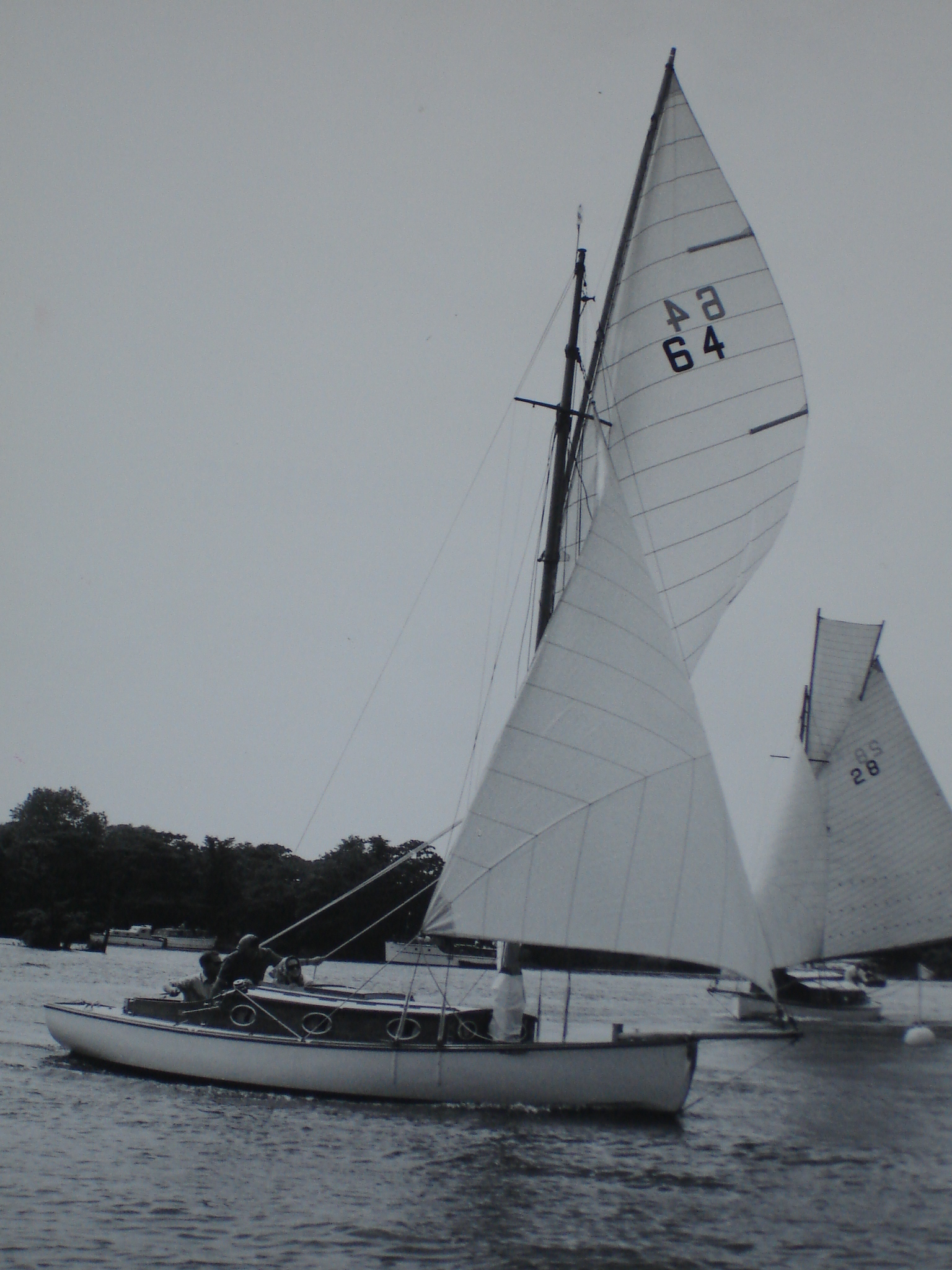
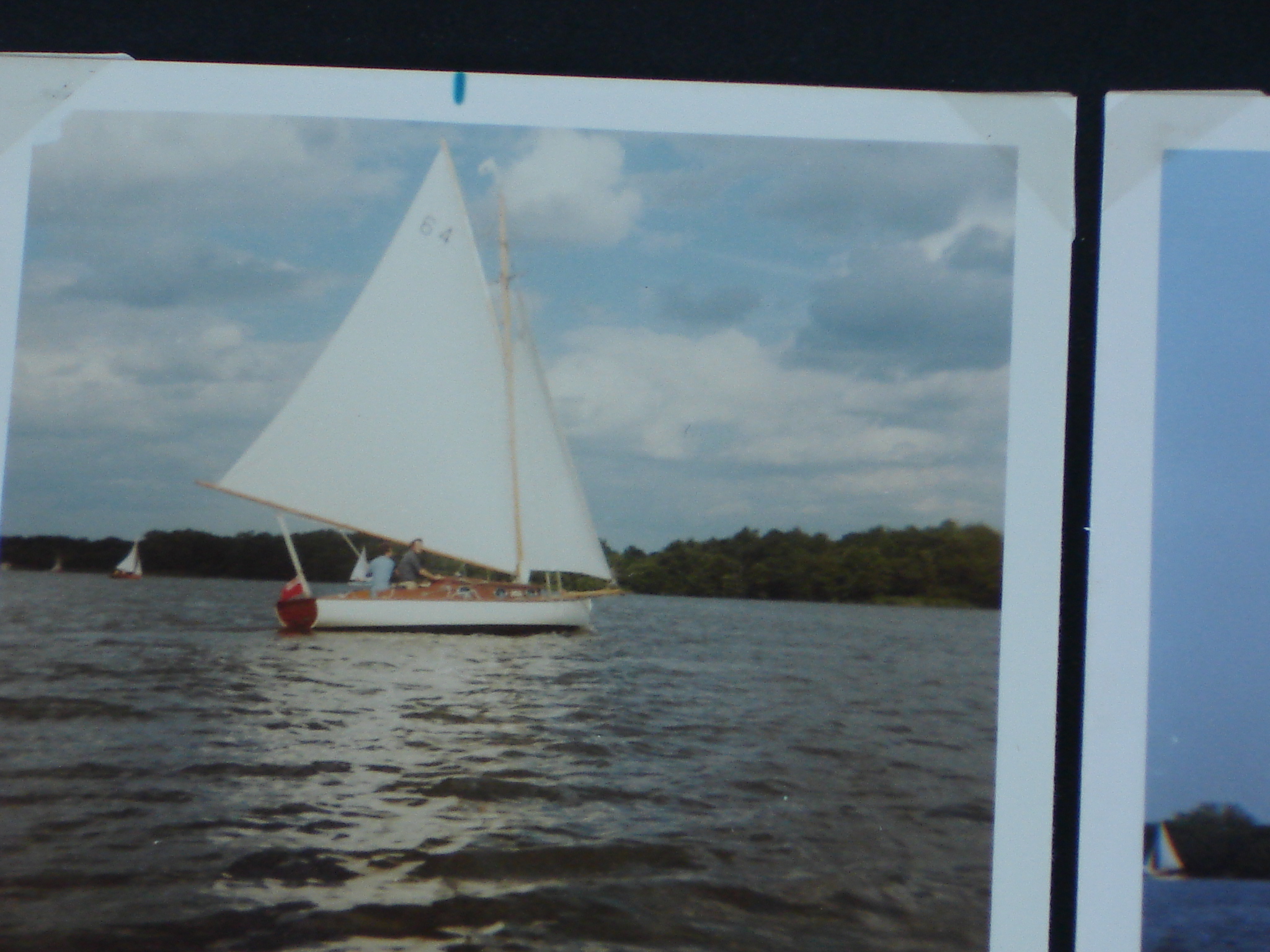
The conversion was obviously looked on favourably, as the Campbells were asked if she was glassfibre as they took her downriver for the first time. I have some photographs of their first sail, and some others.

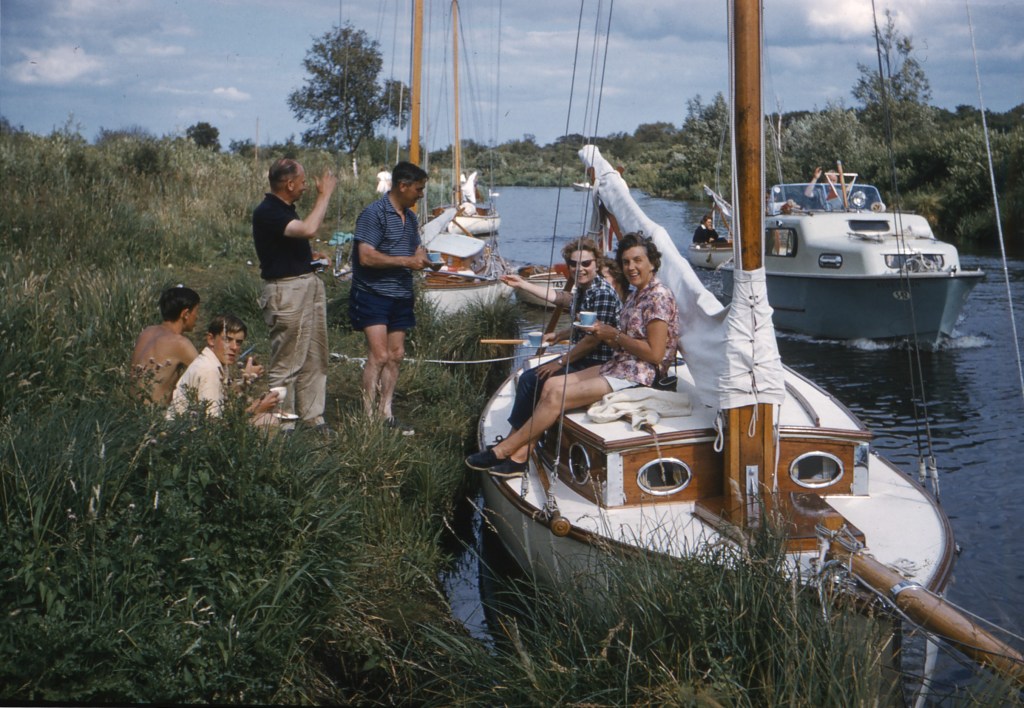
‘Corsair’ then moved to the Norfolk Broads Yacht Club – where she lived for some years during the 1960’s. It’s clear that during this time, she was a family boat. Just look at her condition from the photo with the riverside picnic!

Although, I have heard a rumour that the bodywork apprentices at Mann Egerton (a large coachbuilders) where often tasked with the painting and varnishing of ‘Corsair’, so no surprises that she looked gleaming.

Jamie Campbell actually won the first cruiser race he ever sailed in ‘Corsair’ in 1962. Although he does claim that as a 12 year old he had ‘no clue what I was doing’ – and was instructed to steer a straight course!!

You’ll also see a nice Lapstrake dinghy astern of ‘Corsair’ in the family portrait, this is still Jamie’s today.

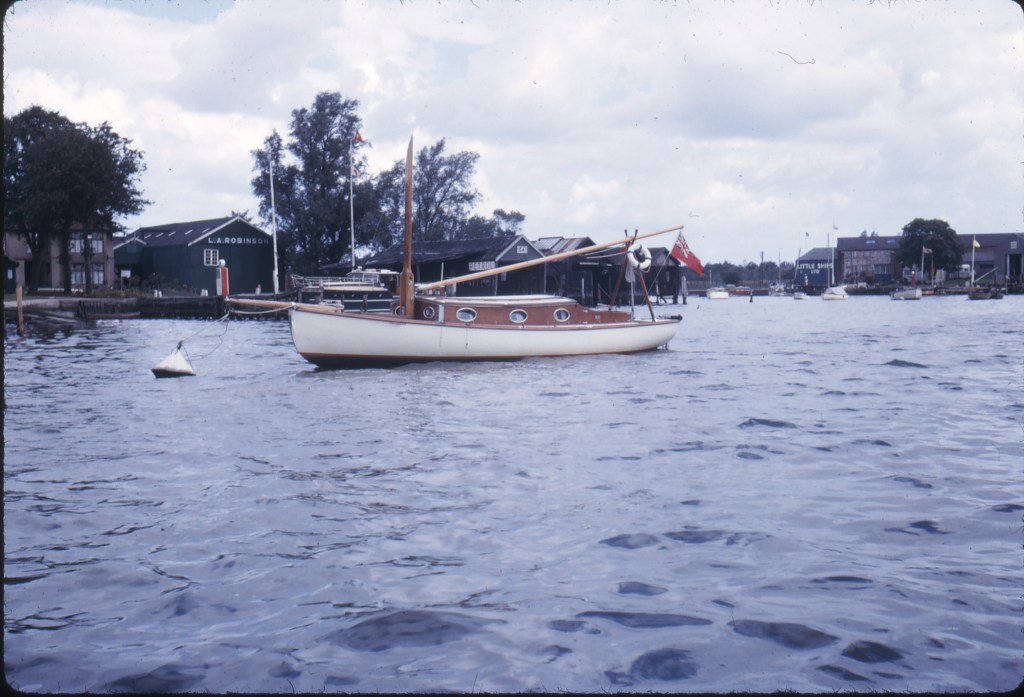
Her racing career with the Campbells was… chequered! In 1964, at Oulton week regatta they over-cooked it slightly, as Jamie recounted; “We moored at Leo Robinson’s yard for Oulton weeks, and I can remember seeing the mast ‘snowdropping’ – it was inevitable it was going to break for at least 100yards. Lowering the stump wasn’t easy against the lead counterweight!!”

In the end, the stump was cut short, and ‘Corsair’ was motored back to Wroxham with a venerable Seagull outboard. She got a new mast and a set of runners.

‘Corsair’ – 1964 with broken mast & Seagull outboard – Leo Robinson’s boatyard, Oulton Broad.

The Campbell family kept her for a comparatively short duration, compared to later owners. They swapped ‘Corsair’ for a nearly new ‘White Boat’ (Yare & Bure One Design) halfdecker with Peter Olorenshaw. Peter and his brother John were directors of the Norwich Motor Company, based on Prince of Wales road, so doubtless competitors of Mr Campbell at Mann Egerton (albeit friendly).

Sadly – Peter Olorenshaw died in 1990, and a conversation with his widow Elizabeth just elicited the information that they didn’t own the boat for very long at all. ‘Corsair’ was ignominiously placed on the bank at Brundall – in a boat auction.

So still a yacht – but as yet her future was uncertain.

I’ve written quite alot, so I’ll leave the stem repair for next time, when I’m able to introduce her next owner.

Early history & winter maintenance.

As you’ve read – that first season I relished all that’s good about wooden boat ownership. It was halcyon days, but my ignorance would soon come galloping to catch me up.

Artist’s impression of that 1st season.

First off – I know that this first winter I needed to address the rudder. It was extremely worrying, how little control I had under certain conditions. From talking with the previous owner – I learnt that it had already been modified/enlarged once!

Okay. So I studied boat design at University, this won’t be too tricky (oh ho ho ho!). Most Broads yachts have freestanding, rather than keel-hung rudders. But there are two main types. Teardrop shaped, and ‘spades’. ‘Corsair’ had a spade, with one corner lobbed off. The tricky bit, is to ensure that the blade and the shaft never part company.

n.b. in a scene worthy of Green’s ‘The Art of Coarse Sailing’, I have once attacked a Bungalow due to a rudder disintegrating… (different boat)

‘Corsair’ was lifted out at Coxes boatyard, at Barton Turf. I knew nothing about them at the time, just that their storage was cheap, their cranage cheap, and it was as close as Thurne had been.

Oh. Yes derigging. My halfdecker was simple. Sails could be folded, and most items placed in the boot of my ancient Volvo. Not so with a River Cruiser! The matresses, the cookers, the Tilley Lamp, the standing rigging, the cordage, the blocks, the sails (X3 jibs), the awning it was all… BIG! Plus it all needed storing.

These days, I’m quite good at folding everything, emptying the boat and storing it all. Not so in the early days.

My housemate at the time was quite shell-shocked. Our garden shed, attic and conservatory soon disappeared, the visual aesthetic was not dissimilar to an olde-world chandlery. The awning being natural canvas smelt lovely, if a little damp for the first few days.

Anyway, the rudder. This was drawn, in a scene reminiscent of the Somme. A rudder tube is about 31/2ft through the hull, and then there’s another 3ft through the blade. That’s a sodding great hole, which was dug with a pick and spade by me. UNDERNEATH the boat, by myself. I also learnt that boatyards are often made up of discarded rubble, which creates fine hard-standing. (oh my arms!).

The new rudder was based on the ‘barn-door’ principles of hydrodynamics. It’s about 40% bigger than the old rudder. It’s balanced, and achieved my desire. I can push it across in a tack, let go – tend the jib sheets/backstays and the tiller stays where I left it.

However, it wasn’t a piece of fine woodworking! I used whatever ply, softwood and cheap epoxy-esque glue I could get my hands on. 11 years later it has survived. Possibly I got lucky. I know that it cost less than £40 in materials, and has some ferrous screws hidden within it. (!)

The old rudder had been designed by a glider pilot. It worked beautifully at hull-speed. That’s about all I can say nicely. My ever-patient housemate watched with on aghast, as I built the new rudder in the conservatory after work, over a week. The use of an electric plane indoors created some excitement.

I was so bloody naïve, I even told people at the time ‘oh no, there’s nothing major this year. Just paint and varnish. Oh and this little job’. Yup. You’ve guessed it.

Rot.

The stem was rotten!!! There had been a deck leak, which had tracked down the stem, and now needed my attention. I was volubly upset. This wasn’t in the plan! How could I afford it. How could I repair it!

I am not a confident woodworker. Certainly not back then. I remember cutting off the offending rotten stem, having first removed the gammon iron, and the bobstay fitting. It was horrible! I cut back as far as I dared, and almost certainly into the apron. I was VERY close to some hood-ends, and had made the front of ‘Corsair’ very, very blunt.

Overall – I was quite dejected. I walked away from the boat with my head spinning. This has happened many times throughout my ownership. At the time, I didn’t realise it, but if you love old boats, owning them gets into your head and your heart much more than you’d believe.

At this time though, I had started the research project which I hope to write about from now on, (whilst re-counting other pitfalls and sailing holidays).

It all started with me being told that ‘Corsair’ had at one time, been the smartest little boat on the broads. She’d been owned by a Mr Campbell. The MD of Mann Egerton* – A large motor engineers in Norwich. Long-closed there are still some signs of its presence. Such as the ‘ghost sign’ still on Constitution Hill.

*there is a lot of interesting history on Mann Egerton – here; https://myntransportblog.com/tag/mann-egerton/

follow the tram lines!

I had written to his son, Jamie Campbell, who replied. It was the first of many ‘wow’ moments. His first communication confirmed that ‘Corsair’ had been owned by his family, and that they’d bought her out of hire in 1961.

Just think – in the early 1950’s, you could buy a lovely Broads Yacht, or you could go to Mann Egerton’s…

Jamie kindly proceeded to give me several photographs, and some personal memories of ‘Corsair’, which I’ll write about next time. Along with how I fixed the stem!!

Cruise 2008 – finale & postscript.

Day 8.

So – Monday 25th. The final day of our 1st cruise…

We started with minor hangovers (compared to yesterday!). Also, similarly to yesterday we were forced to make some further adjustments to the bobstay. We wanted chain, but also a rigging screw to tension said chain!

This was achieved by beaching ‘Corsair’ bows-on at the edge of Salhouse broad. The water came just over the skipper’s neatly folded trousers legs (!) But. The task was completed with far less shouting, splashing and conflicting ‘advice’ than at Gay’s Staithe the previous day.

It was almost like being sober improved our motor-skills. Weird.

We then motored to Black Horse Broad, and positioned ourselves alongside MH, to steel ourselves for a quick blast around the broad itself. Sailing on Black Horse would be a first for me, little did I know it was where ‘Corsair’ had her first sail under new ownership, back in 1961.

It was a fantastic sail! We’d reefed, and set the repaired jib. Theo managed to take some photographs of us as well;

One thing I had learnt, was that to get the best out of ‘Corsair’ was not to be shy of reefing. If you keep her rig balanced, she’ll sail in almost anything.

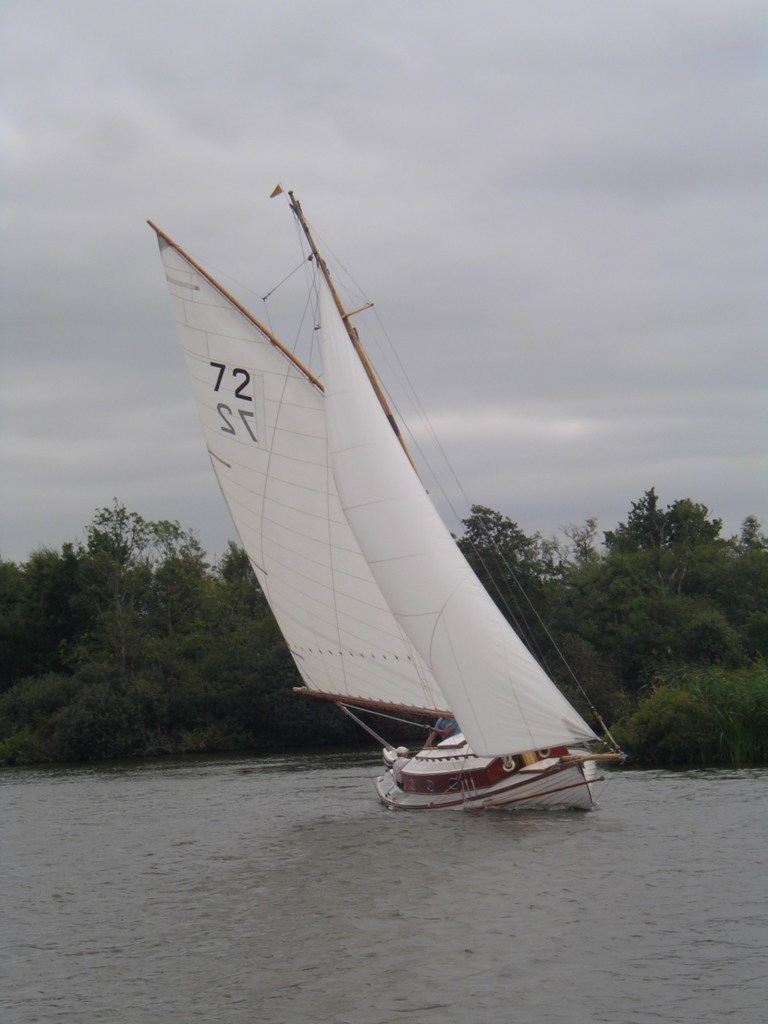
During our sail, we spotted RCC S/N 72 – ‘Brit’, a very beautiful clinker river cruiser. Her increased size, and beam meant she was handling the weather slightly better than us.

RCC ‘Brit’

However, more importantly, by sailing on Black Horse, it had meant that on this cruise, bar Bridge Broad (Belaugh Broad), we had sailed on every navigable broad on the Northern Rivers!! Quite pleased with that.

However, the need to return to civil life forced us to motor back to Oby Dyke, and to put ‘Corsair’ away for a few days.

So yes. The first cruise of ‘Corsair’ was brilliant, if at times somewhat ‘full on’ – we stayed out late, we drank too much, we generally enjoyed ourselves.

Success!

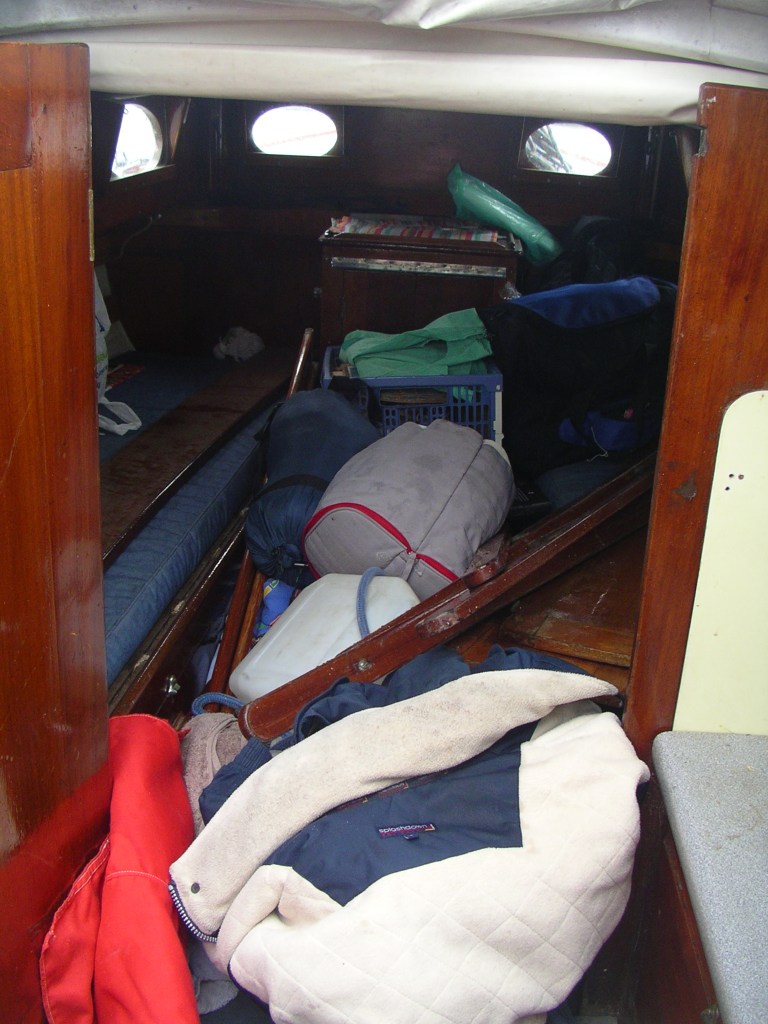
And what does the cabin look like, after 4 blokes have lived onboard for over a week…

Christ…

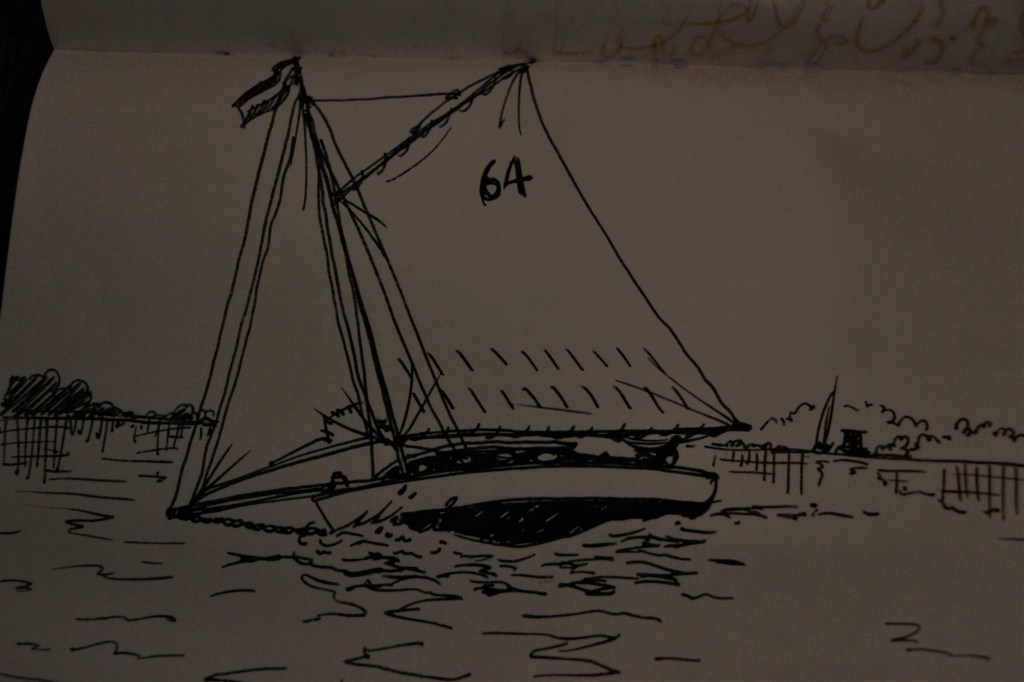
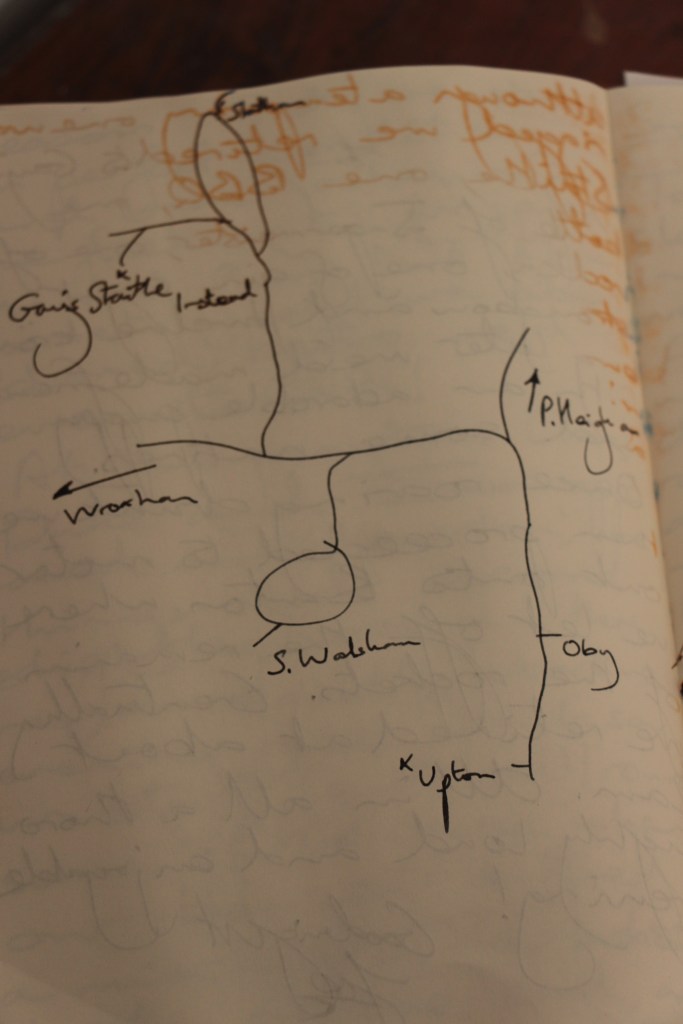
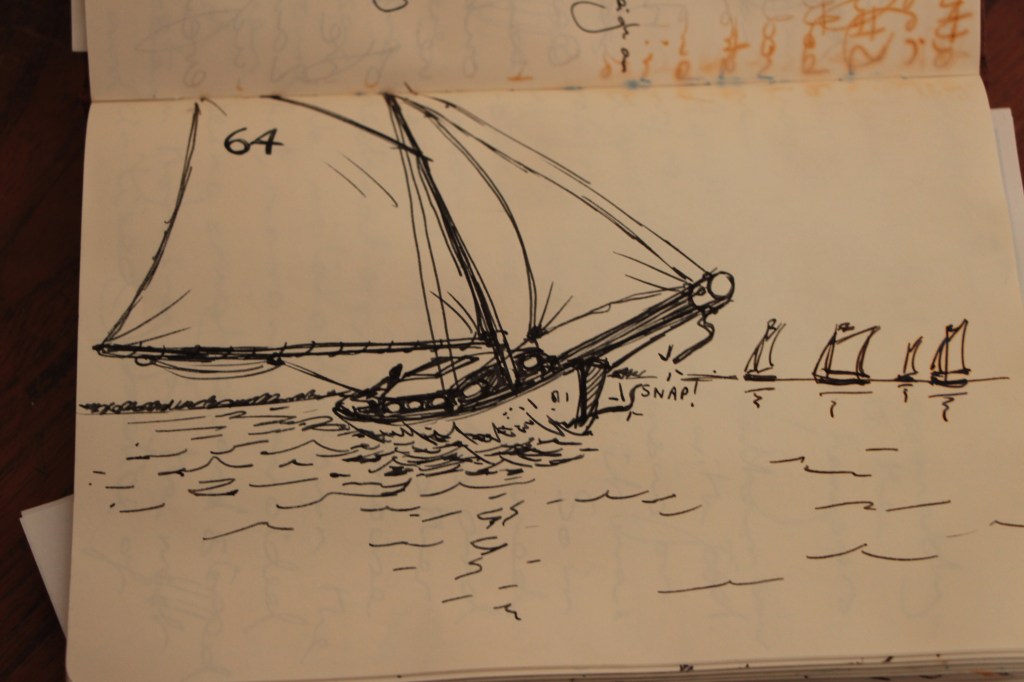
Theo provided one final illustration, and then we were back to the car. I’d given up on drawing the maps, because frankly they were crap compared to his efforts.

Black Horse broad – spot the jib repair & chain bobstay!

Postscript – 2008.

To write a summary of the cruise is always difficult. Mainly because lots of things happen, and once it’s all over, you are left with too much to choose from. Overall I am tinged with regret that the cruise is over, but once again really elated (exhausted) to have done it.

However. This year, if I were to point out my worst moment, I would say it was when the bobstay broke on Saturday afternoon, when we attempted to race ‘Corsair’ for the first time in my ownership. My disappointment came more to with how pleased I was, with everything. Then BANG. Rig failure.

The best moment however, well. Where do I start?

There is the thoroughly stormy sail across Hickling Broad where with a triple reefed main and storm jib I suspected I had reached the limits of ‘Corsair’. I was wrong.

or

I could choose the delightful light air sail we had Sunday evening, on Salhouse broad where we were relaxed and happy doing what every bunch of friends should be;

Simply messing about in boats.

Until 2009.

Joe

Cruise 2008 – Days 6 & 7

Day 6.

Well, having spent an enjoyable night in the White Horse, today we were forced to make a particularly early run from Upton to Ludham Bridge. I helmed, whilst cowering behind the awning as it pelted with rain. The engineer & first mate were quite sensible, they stayed in bed!! (Swines).

We had big plans for the lunchtime, as after motoring to Irstead we were due to start our illustrious racing career. Alas, it was definitely memorable (!), but for all the wrong reasons!!

First race, we rigged and got onto the Broad in perfect conditions. We ‘jockeyed’ around in the fleet, until we spied the red flag. No life-jackets onboard meant we were forced to abandon, before we’d even started! Heyho…

At this juncture, CD & JW appears on ‘MH’, and things did become slightly ‘hazy’…

There was an equally abortive evening race, which saw ‘Corsair’ start (quite well), and round some of the course when our bowsprit suffered a mischief. The bobstay (stainless steel wire) snapped cleanly at one end (and it was a flat calm, look at the photos!!). Although a temporary stay was rigged, we returned to Gay’s Staithe.

Rigging a new bowsprit was ‘interesting’ – we went for chain. It was rigged using a variety of the crew in various positions, all trying to bend the bowsprit into the right place, and get the chain to stretch! Eventually we used a nearby Tinker Tramp inflatable dinghy. After an hour and a half, it was fitted.

One BBQ, one bottle of Jägermeister (!), one of vodka, one of gin, eight strongbow and twelve kronenburg later, we’d made friends with most people we saw, several trees and at least one puppy.

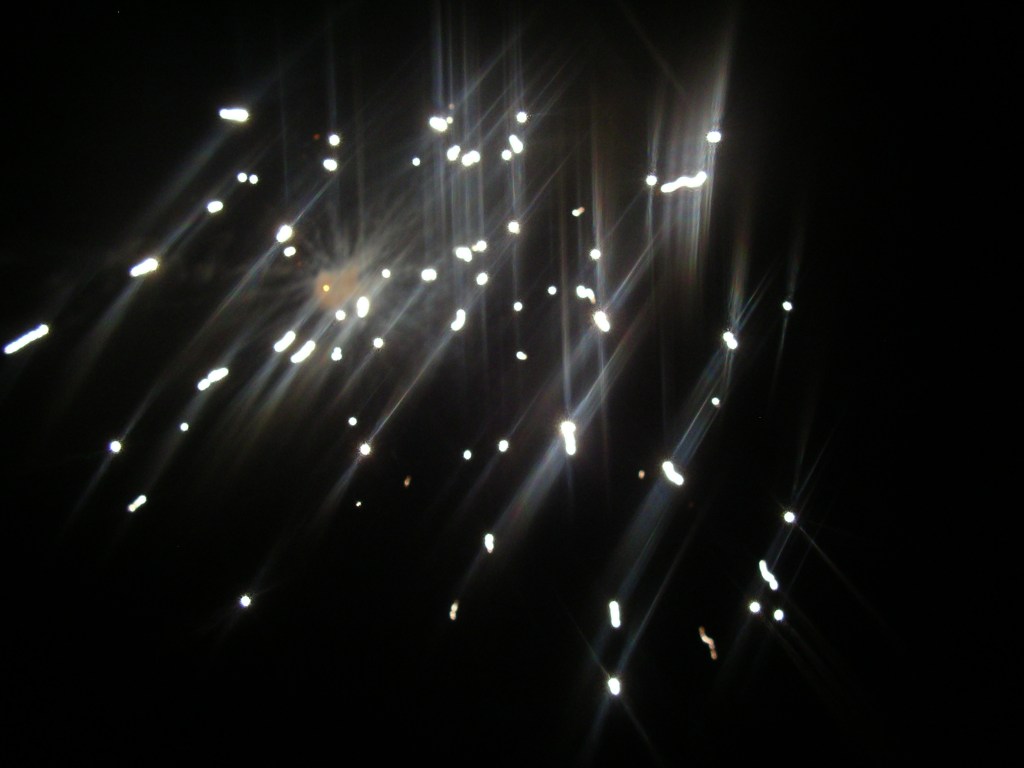
Finally, at the midnight hour, whilst roaring drunk, we motored out into Barton Broad, where we set-off the remains of our fireworks. These fitted nicely into the ensign staff of ‘Corsair’, whooshing up into the sky, only inches above the outboard and petrol tank. (!!!)

The effects were quite spectacular. At Barton regatta, all competitors mudweight on the broad, staying on their boats for 72 hours, in a series of large rafted up enclaves. Imagine. It’s midnight. Most are asleep, many of the boats have their families aboard.

BOOOOM! WHIZZZZZZZ! BOOM! BANG! KABOOM!

Pyrotechnics!

Judging by the plethora of lights that started coming on in boats, and the shouting that followed, our fellow sailors were just as impressed as us with the fireworks. Navigation lights doused, we fled.

(n.b; We were young, stupid, drunk and stupid. I would not EVER repeat this)

Eventually we retired at 2am, it had been a loud and enjoyable evening.

Goodnight.

Day 7.
Today started reasonably slowly… mostly due to the industrial sized hangovers we suffered from.

A quick motor to Stalham however saw us re-stocked with food, and a general consensus was reached that racing was a very bad idea. Plus it was raining and ‘orrible.

Racing in the rain – no thanks!

So instead, we ate restorative bacon sandwiches and decided that we would head to Salhouse Broad. Motoring down the Ant, we avoided the melee, and stopped in Horning for the most civilised practice (after last nights behaviour!) for an ice cream.

Horning to Salhouse was covered by sail, as by then most of us had recovered from the night before. Most enjoyable it was too! We gently tacked up the Bure, and drifted onto Salhouse Broad for a quiet sail on the last of the zepher like breeze available to us.

All of us went to bed early. (I didn’t even have the energy to draw a map)

Goodnight.