2012/2013 – downhill.

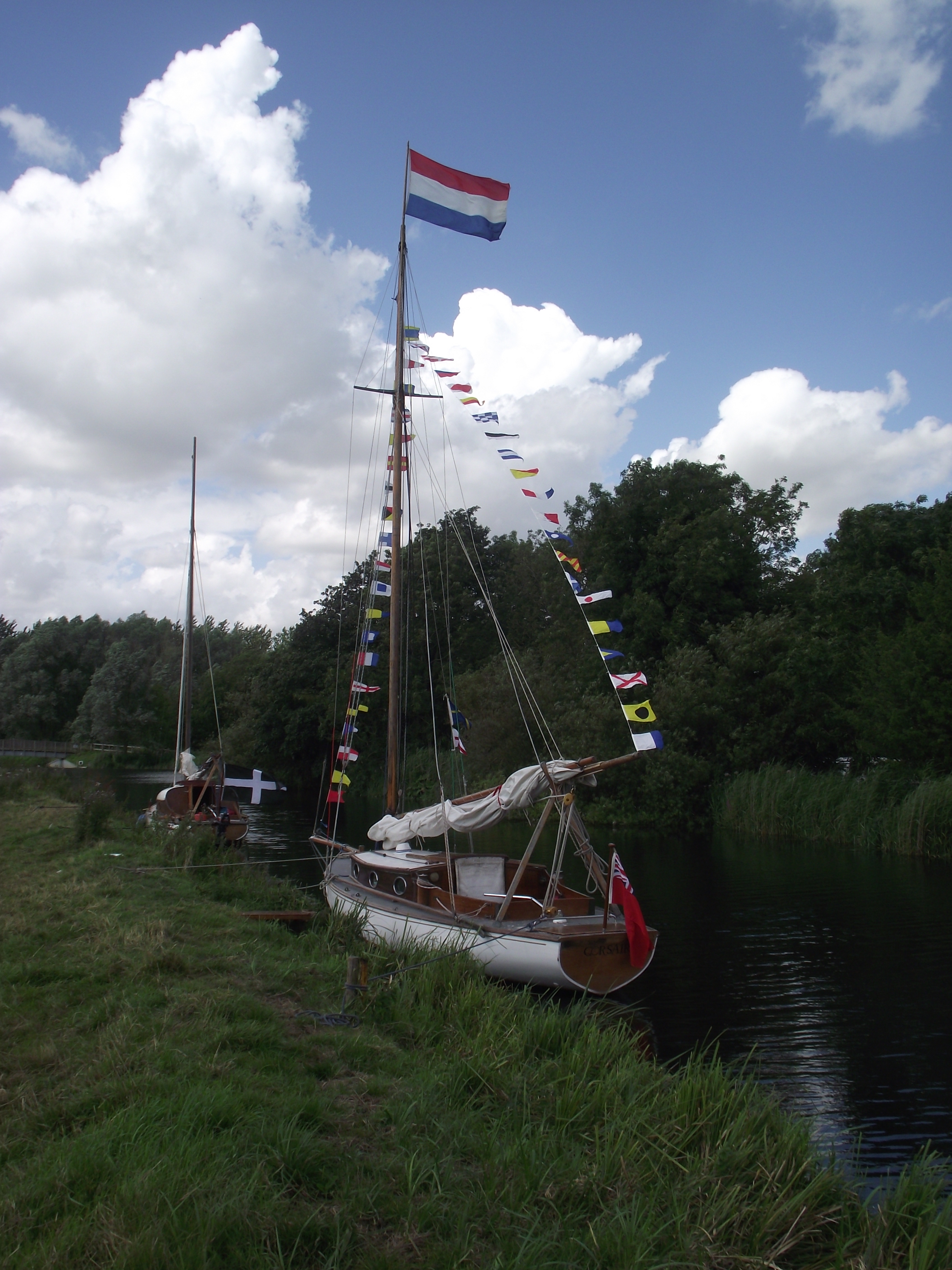
The remainder of the 2012 season passed without too many notable incidents, we manage a short cruise to Geldeston in the company of 2 other registered RCC yachts, but increasingly signs were apparent that ‘Corsair’ was showing her age, and I was showing my naivety / lack of funds to manage & maintain her properly.

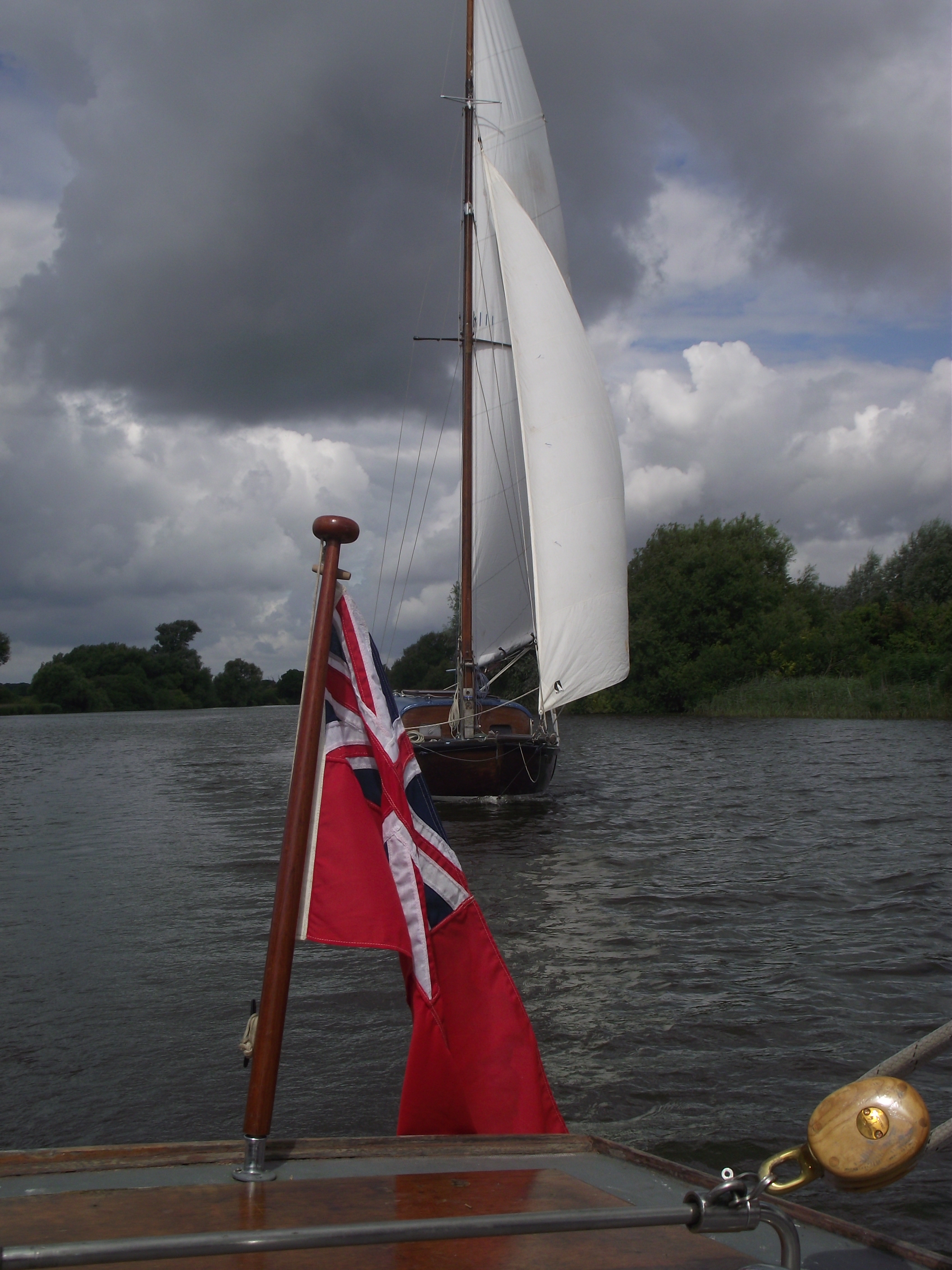
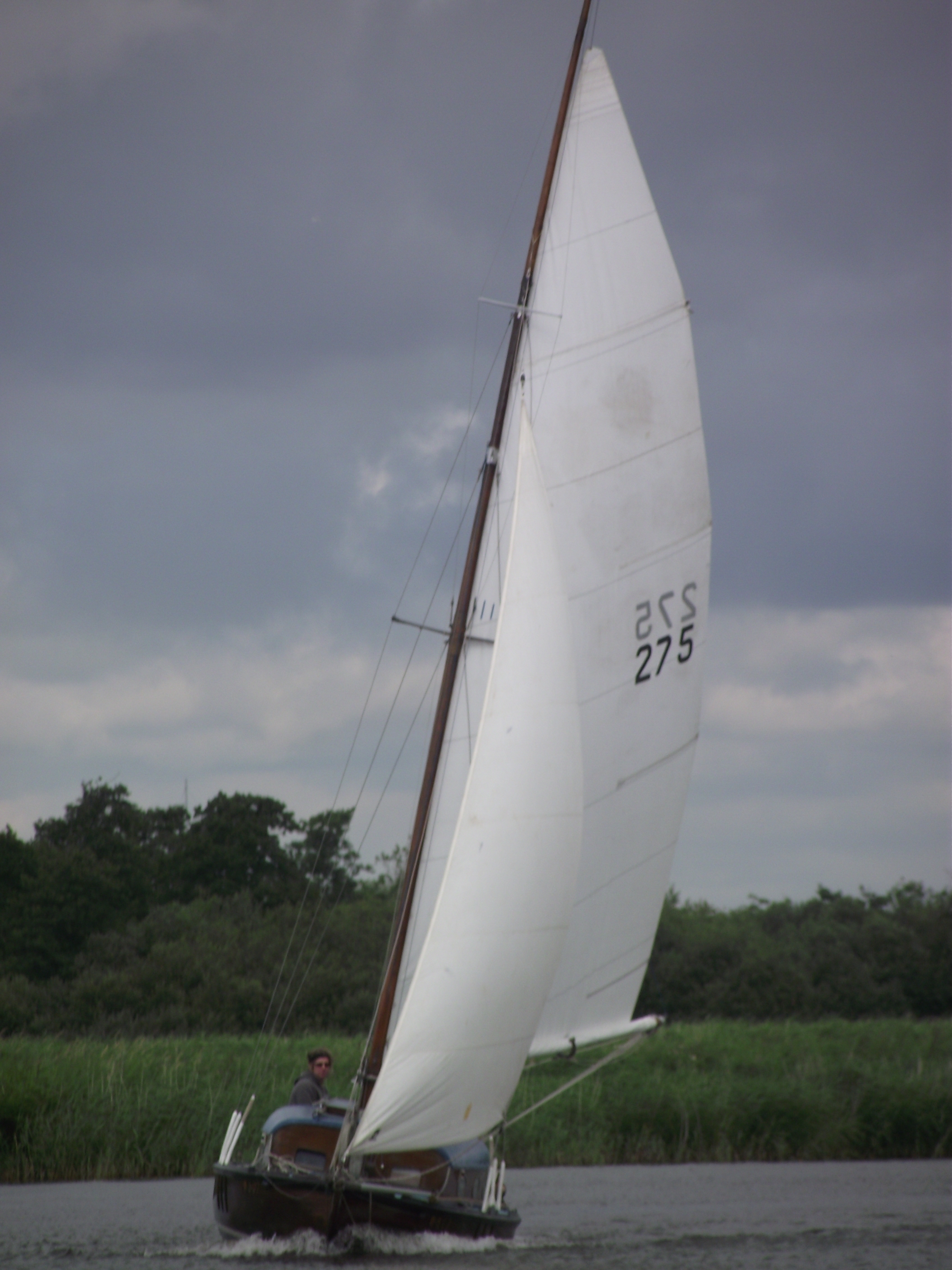
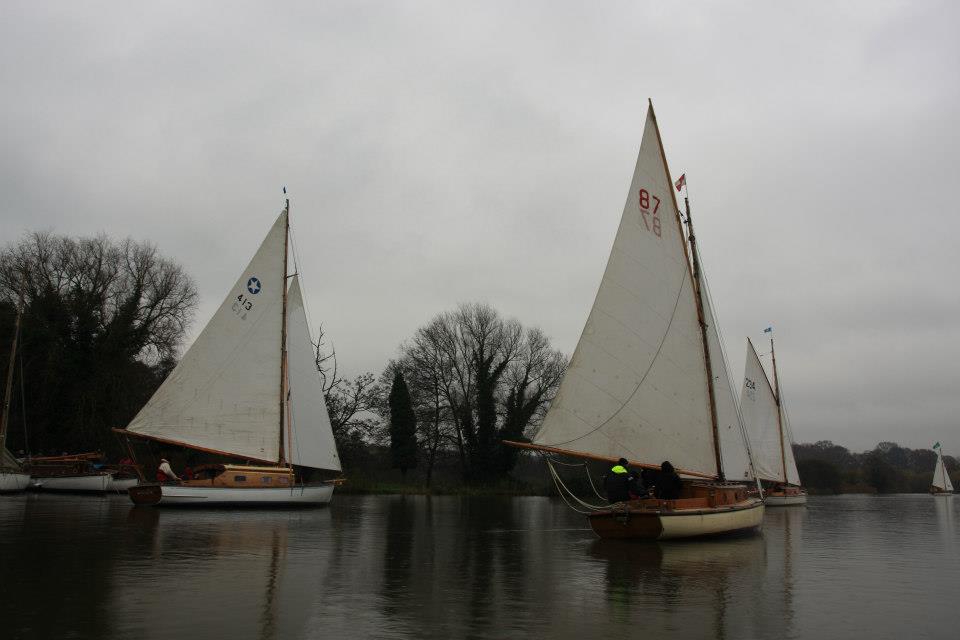
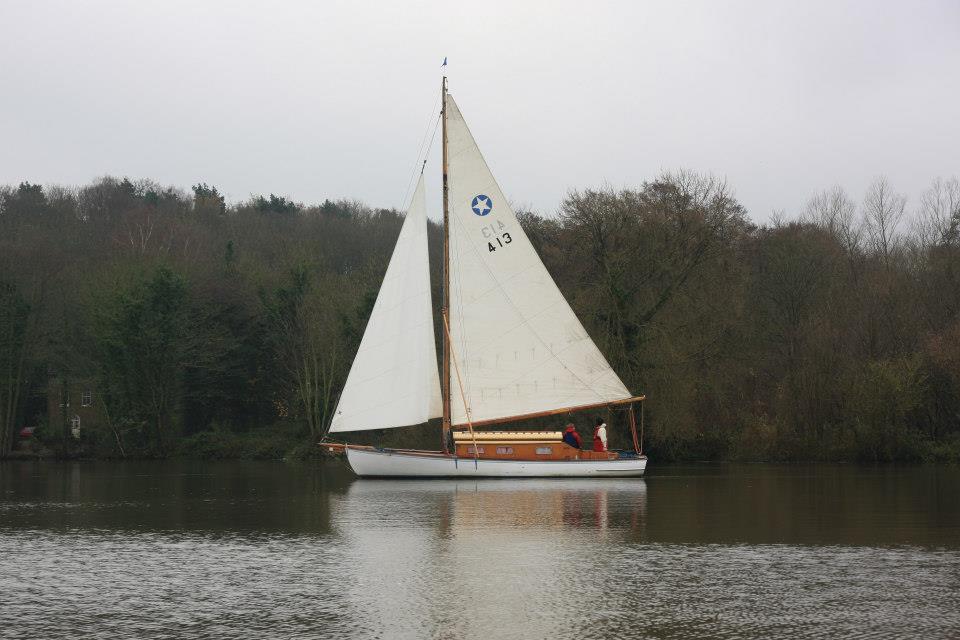
What was fantastic though, was sailing in a fleet of 3 such different yachts. We represented the oldest, pre-war design – & were accompanied by 2 RCC’s which showed how the concept had been modernised. S/N 275 ‘Breeze’ was a Derby-built boat, with an incredibly impressive racing career to her name, she’s owned by the family of a lifelong friend, and as photographed below – she’s come a long way from the hirefleet.
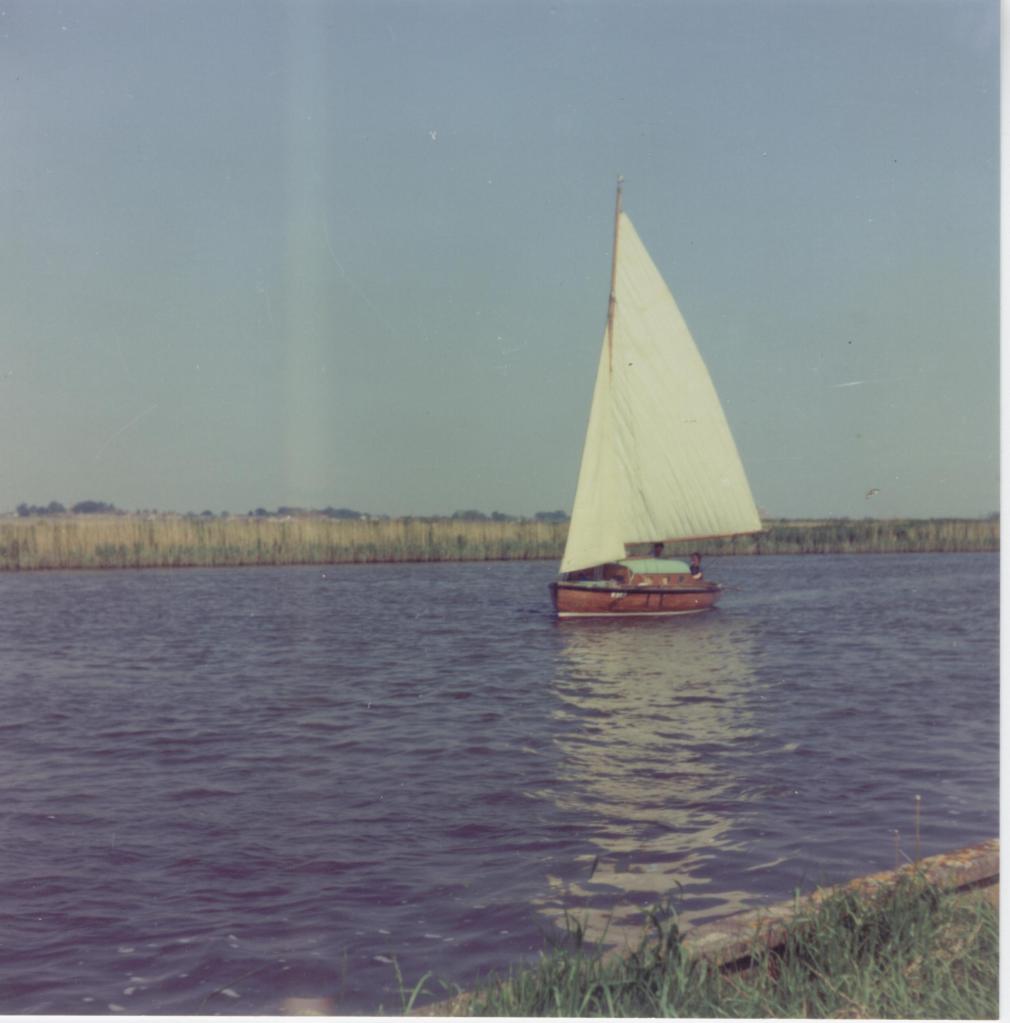
Breeze – ex hire fleet.

Her mainsail is from an international star one-design, giving her a powerful performance. Upwind in heavy-weather especially, she just takes off, and points, and points… A far cry from our own performance, sadly.
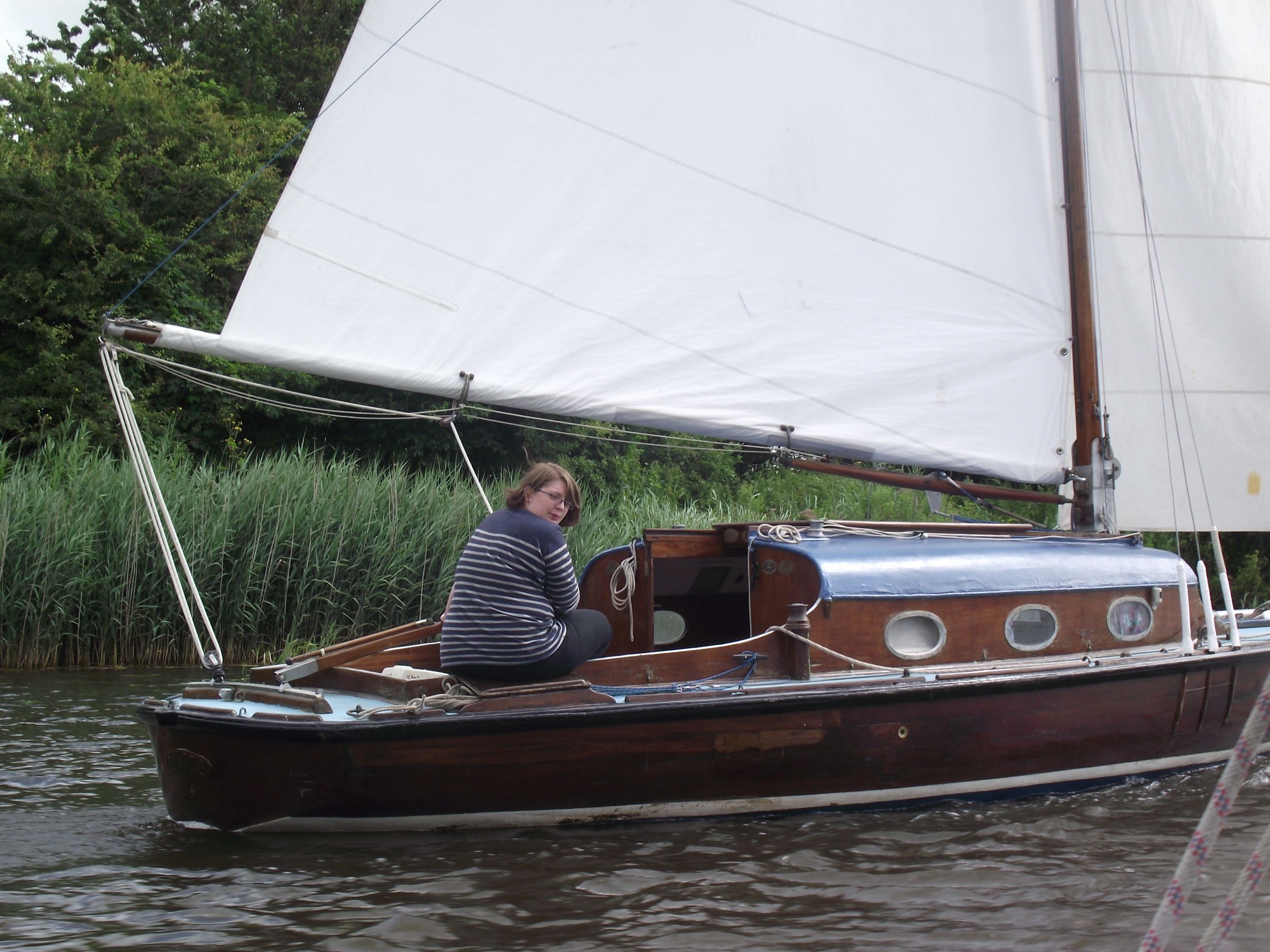
Whilst enjoyable, the predominant memory of the 2012 cruise is that as we were tacking into Beccles in light airs, our 1951 boom decided to snap directly above the mainsheet blocks. This swiftly became a fairly stark lesson in how the mainsail on a Broads yacht can (and will) become uncontrollable – and how quickly a jib that’s sheeted in can push you into the bank, HARD.

Without the funds to do anything else, I recall the frustration & resignation of the hot/dusty walk upto Jewsons in Beccles, where some cheap laths, a fence post & some galvanised grip-fast nails were purchased. A fairly brutal repair then followed – with my hammering the fence post inside the two broken segments of boom, and then applying the laths/grip-fast nails to stop everything sliding apart again. Ugly, yes. Cheap, yes. Long-lasting, no. Satisfying? Definitely not!!

At the time, although I knew I wasn’t keeping ‘Corsair’ as I should have, I also knew how powerless I was to do anything else. I just had to pray we’d somehow keep going. Which, without sounding like a complete idiot, is extremely hard, and simultaneously incredibly stupid. Wooden boats require an extremely high standard of maintenance, you cannot just ‘hope’ – and in my heart of hearts, I knew I was failing her.

There followed a litany of events for the remainder of the season which followed in the same vein, that torrential downpour at Breydon regatta, highlighting all the deck leaks / windows needing to be rebuilt, and ultimately the collision at our mooring which further broke our awning spreaders, tore the awning beyond repair & snapped our boom crutches (late August). All in all, it was a pretty horrid experience, spread out against the back-drop of knowing I needed to do more, if I was to keep ‘Corsair’ safe.
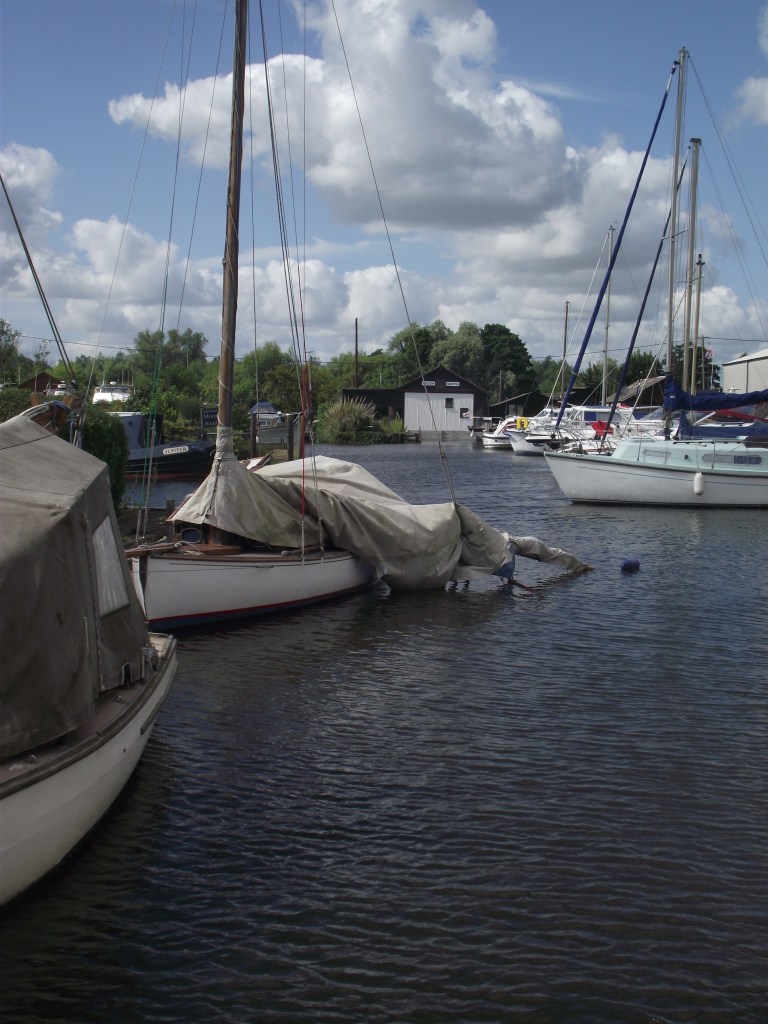
Some bastard simply motored off from here, having caused the damage.

I may have only been 5 years into owning her, but already I found she was a significant part of my life, something which echoed the feedback from previously owners I’d spoken with, they all fondly remembered her & talked at length about how she was centre to many fond memories & friendships for them. However hard it may be, I was determined to keep hold of her, and in truth – I knew I needed her.

By December – we’d taken the unusual step of de-rigging ‘Corsair’ & having her ready to be craned out. Despite having endured a litany of criticism from the red-tape brigade last year, it appeared we’d be able to use the riverside pub as a winter storage / impromptu boatyard again. With that in mind, ‘Corsair’ suffered the ignominy of being towed upstream, derigged & deposited on the moorings the night before the Turkey Race.
‘Corsair’ – dumped on the moorings as I sail past in a borrowed boat.

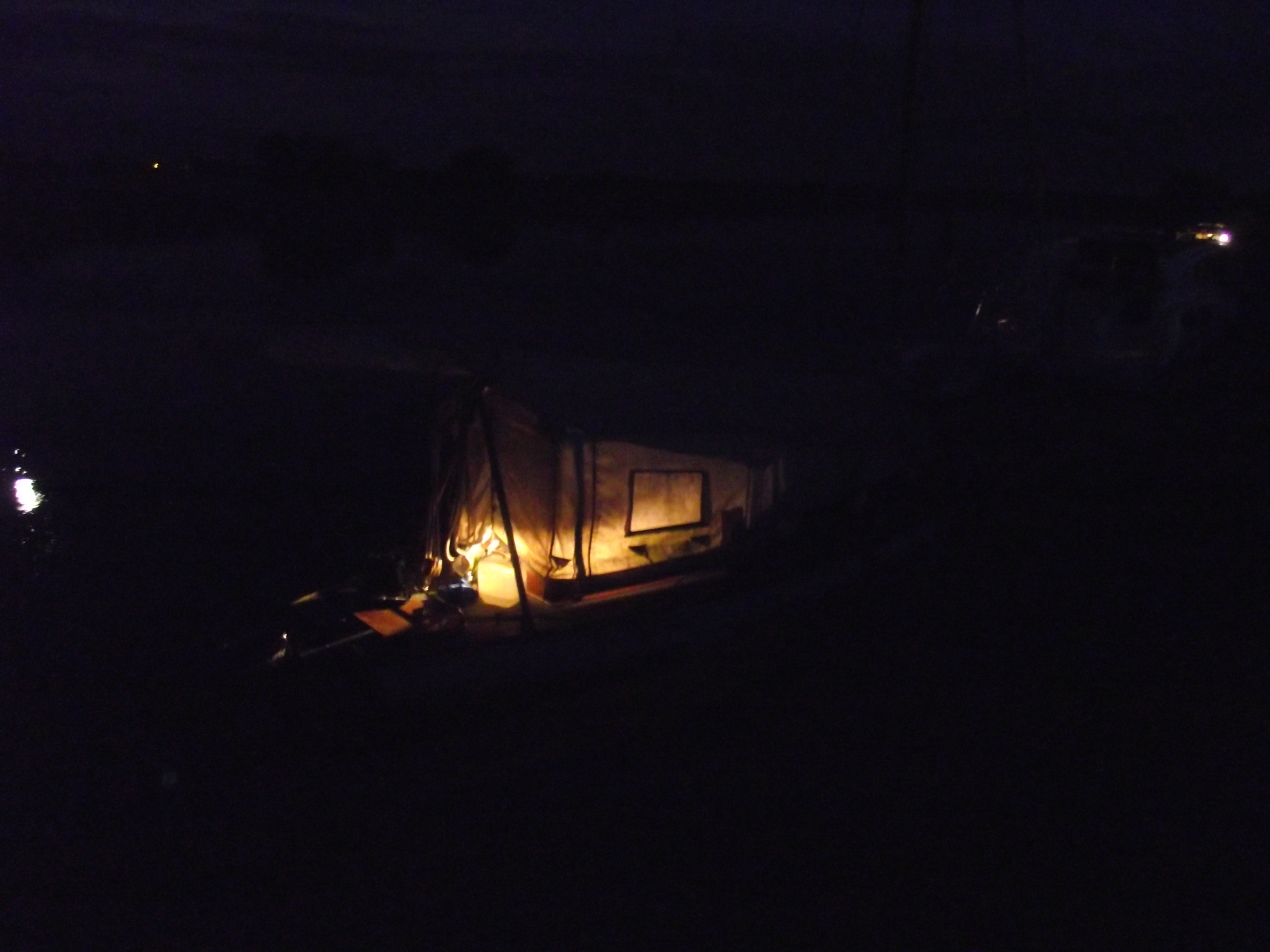
The race itself proved to be worth of the pages of J.D. Sleightholme… Firstly I stayed aboard a strange boat, in December, with no knowledge of how to work the heating (mistake no. 1) – then, I realised I couldn’t work the cooker… (mistake no. 2) – which lead to me being sub par on the morning of the race itself! I was half bloody frozen to death, starving hungry & for some idiotic reason I’d volunteered to run the race, including laying the course.

Unfolding a sail-cover & awning is no fun in the winter, when its wet you get soaked. What’s even less fun, is karete chopping the folds in, because the bugger is complete frozen solid! Ooopf. My finger’s turned blue, then white & numb. In fact every rope was frozen solid. I’d been promised that rigging a bermudian yacht was mere child’s play, it’d only take seconds… Pah!

We set off to lay the course, and naturally the cock up fairy wasn’t done with us yet. Thundering upstream (well, 6mph with a diesel clattering away) there was a sudden BANG… And the engine stopped. Bollocks. Wuuuuhhh, wuh, whuh wuhhhhhh groaned the starter, nothing, nada, zilch.

BOLLOCKS. I’d only dropped the lower mark, and there was no club boat to help, no vhf & no mobile signal. BOLLOCKS. Return to basic principles… ALWAYS keep the mainsail ready to hoist, tied down in crutches is no bloody good, same goes for the jib. Have it ready to unfurl. Somehow we managed to not hit anything, and I cut (always have a knife) some sail ties, BUT we got the main up & kept some way on… Now. A breather.

Oh no, oh NO! Can’t have that, a gust came down & with a mocking thump/gurgle – the weight & chain for the racing mark (stowed on the foredeck) rattled down to the lee-side & overboard. Oh bollocking bollocks.

Now, I want to you imagine that you’re walking briskly, and without warning I grab your left hand, refusing to let go, whilst you keep walking… that’s the sort of inertia we had, expect it was a 3 ton 28ft ex-hire boat fandango. We lunged to port, we involuntarily gybed, luffed, everything shook/banged like hell, we payed off, we gybed…., we swore, we tangled the ‘effin buoy it’s tackle under the keel, into the jib sheets & generally everyfuckingwhere…

Eventually, some order restored, I threw that buoy into the river with a rage normally associated with a family game of Monopoly.

It really wasn’t our year no matter whose boat we were on! We did manage to extricate ourselves, and get back to start the race on time. Eventually we finished a full 90 minutes behind everyone else (the wind dropped, and with no engine to use, there wasn’t any point in retiring, so forced to sail the course) – and definitely had developed mild hyperthermia as a result of rescuing that bloody buoy.
Post fandango – making our slow, slow way home…

Heyho.

Starfishes & Sails.

Yesterday I enjoyed what is likely to be my penultimate sail of 2019. I know, I know yet again I’m deviating from the intended order of writing. That’s the joy of being the Editor though.

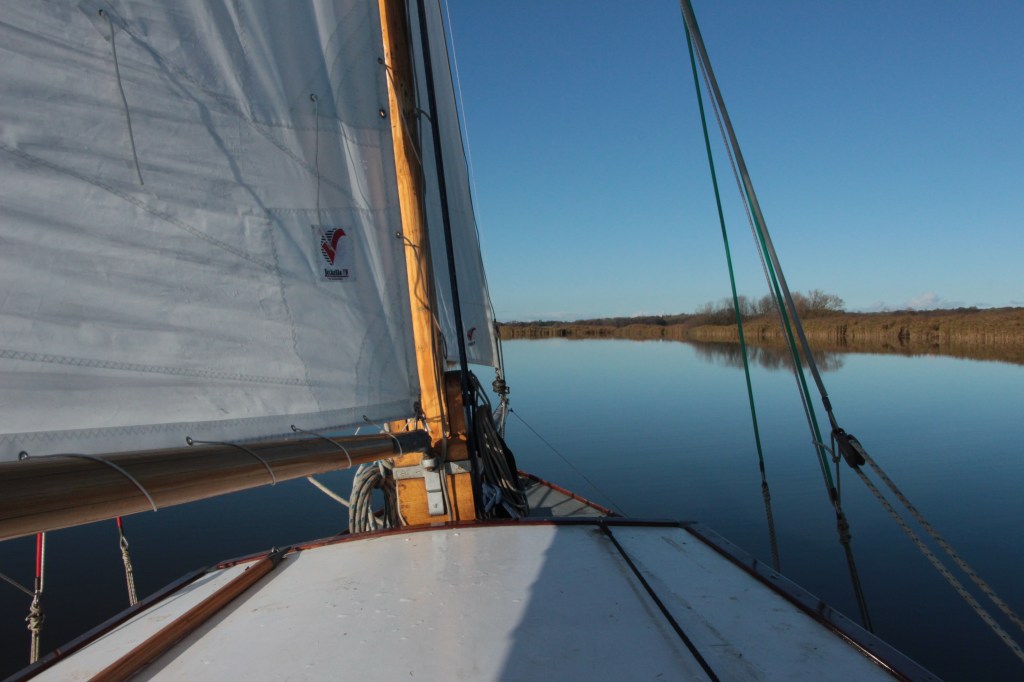
Yesterday was glorious. Bitterly cold, clear, sunny and calm. Very calm. We rigged whilst tied to our mooring, and headed off upriver to Surlingham Ferry, for the Turkey Race – next weekend.

I found myself checking and double checking the rigging again – I’m not sure if I need to re-order and change the cleats on the tabernacle, now the topsail is there. Currently the peak halyard is lead onto the port face, with the throat on the starboard face. The topsail spar has a neat trick of capturing the peak – at the lower end of the spar, which can make lowering the mainsail tricky.

This definitely needs looking at, for two reasons. One – the rig should work, and this is dangerous. Two – when you sail on/off moorings, I find the best way is to keep the way on as much as possible, and to be able to drop the sail – bloody quickly if needed.

Gorgeous!

The rig did present a more amusing quirk – if you tension the topsail forestay just right, it ‘thrums’ and buzzes… Took me ages to work that out, including removing the floorboards and checking on the bilge-pump to see if that was running!

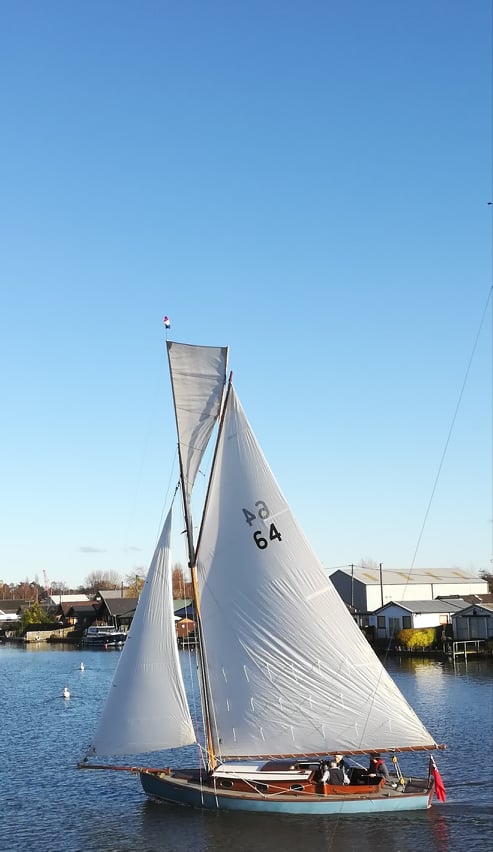
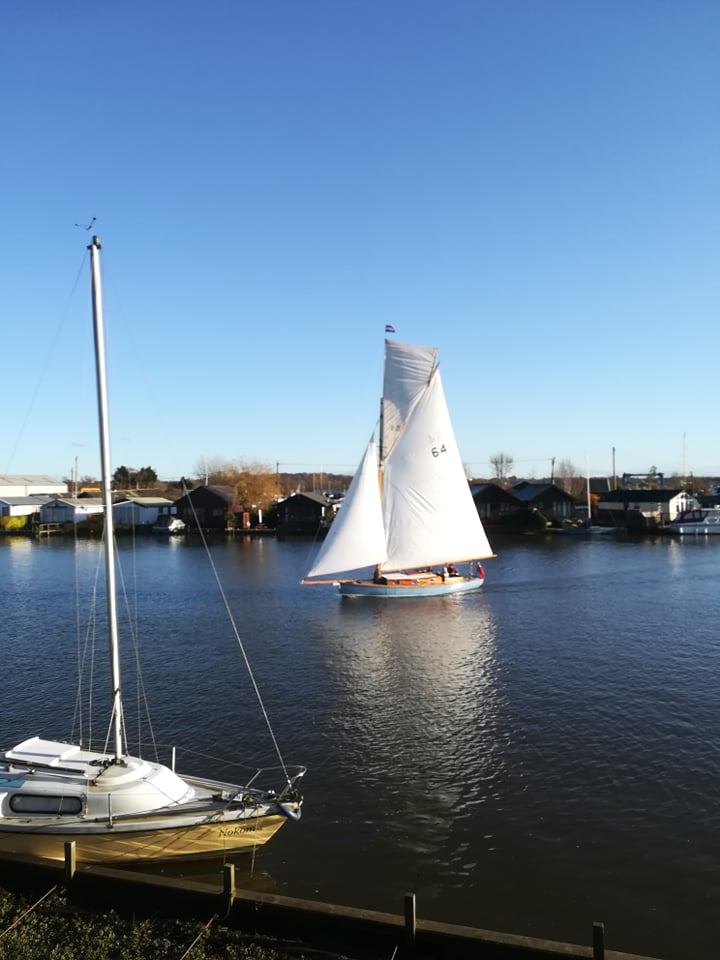
Heading upriver, we were lucky enough to be photographed by a friend, whose currently building a house for his family. The scaffolding made an excellent platform, although if I’m critical – that peak is about 1 or 2 inches ‘out’ by the look of the creases.

I’m struggling to find superlatives to describe the day if I’m honest, it was perfect.

Typical of the season, a North wind with no warmth, a clear sky and a medley of colour in the riverbank, reds, browns, yellow and oranges all competing in the remnants of summer foliage. We sailed every inch of the way, and we knew we’d taken the best of the day for ourselves.

But. I wanted to talk about the starfish.

This links with the subtly of the Broads rivers – and the villages which surround them. There are features worth exploring, and a hidden history. There is a tenuous link to Chumley & Hawke as well…

Surlingham has a starfish. Something which shows the far-reach of war, into the boring fields of Norfolk. In truth both Norfolk & Suffolk were riddled with military action during WW2, and you’re never far from it.

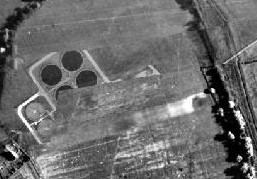
Starfish sites were large decoys – developed in WW2 to act as a distraction to enemy bombers. Norwich took a pasting, in what’s known as the Baedeker raids, with the railway station/yard & nearby engineering works of Bolton & Paul being prime targets.

The solution was to create a decoy – which could emulate (from afar) what bomb damage might look like, including fires. The deception went further – it had to look realistic. There was a network of lights rigged, which could replicate the cadence of lit railway carriage passing by at night. Or a red glow to simulate a fire-box door being opened on a railway locomotive.

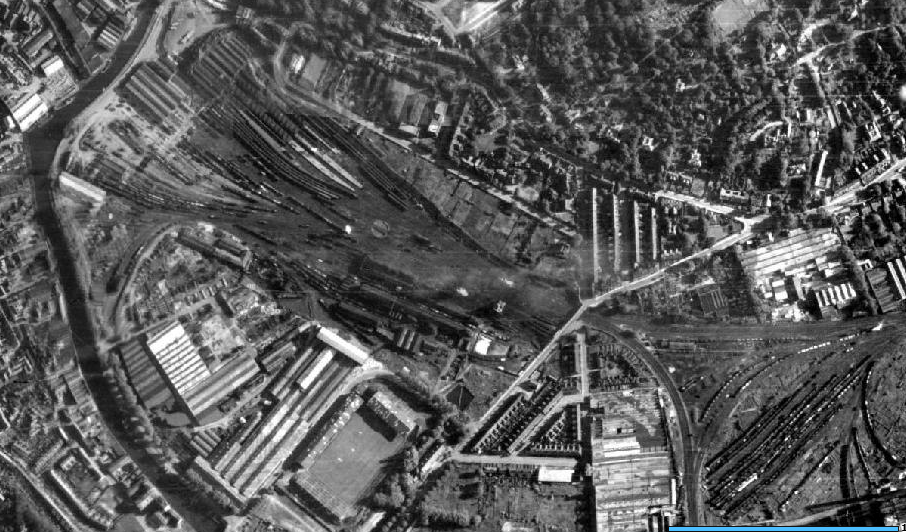
For reference – here’s a 1946 aerial photograph of Norwich railway station;

Norwich Thorpe railway station, including motive power depot, Crown Pint depot, Bolton & Paul engineering works. All very lucrative targets. The River Wensum snakes around the lefthand side of the image.

Interestingly – the 1946 aerial photographs also show the deception required. Outside of Norwich, you can just see a crude attempt at censoring the existence of what is either a fuel installation, or the present-day sewage station at Whitlingham;

Nothing to see here!!!

Surlingham was chosen to host a ‘starfish’. Local firms such as the Rockland Reed & Rush company would supply bundles of reeds to act as ‘wicks’ for the fires – whilst the pyrotechnics were handled through a series of heath robinson-esque contraptions – mixing oil & water to make dramatic explosions.

Interestingly – the knowledge & expertise behind the starfish sites is credited to expertise within the theatric industry – being able to use lights, smoke & explosions to good effect on stage can enable a mimic on a much larger scale.

It’s no exaggeration that these sites were vital. Norwich became so battered and bruised, you would see families walking out on the Drayton & Dereham roads on a nightly basis – preferring to sleep out in the open than risk another night of bombs.

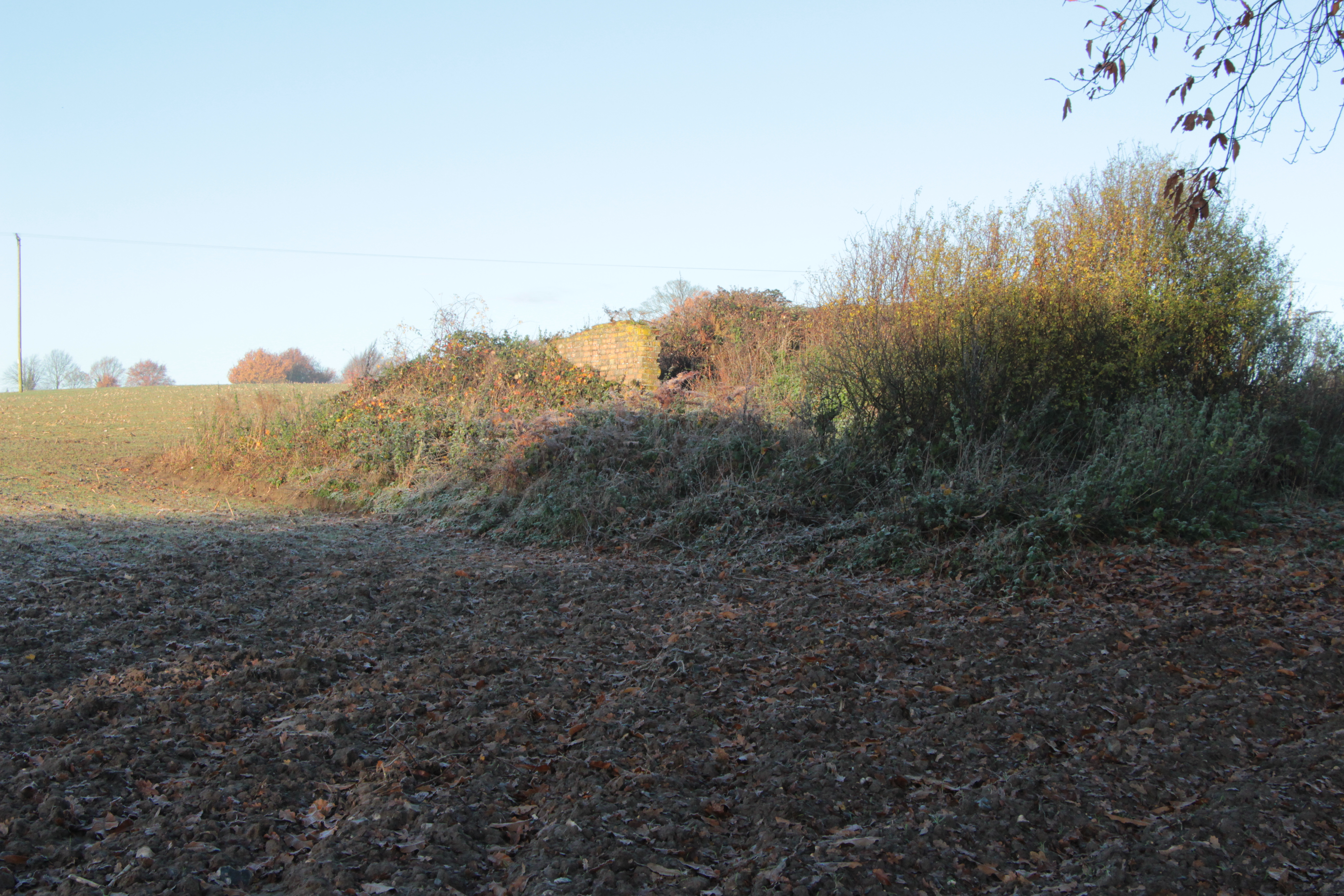
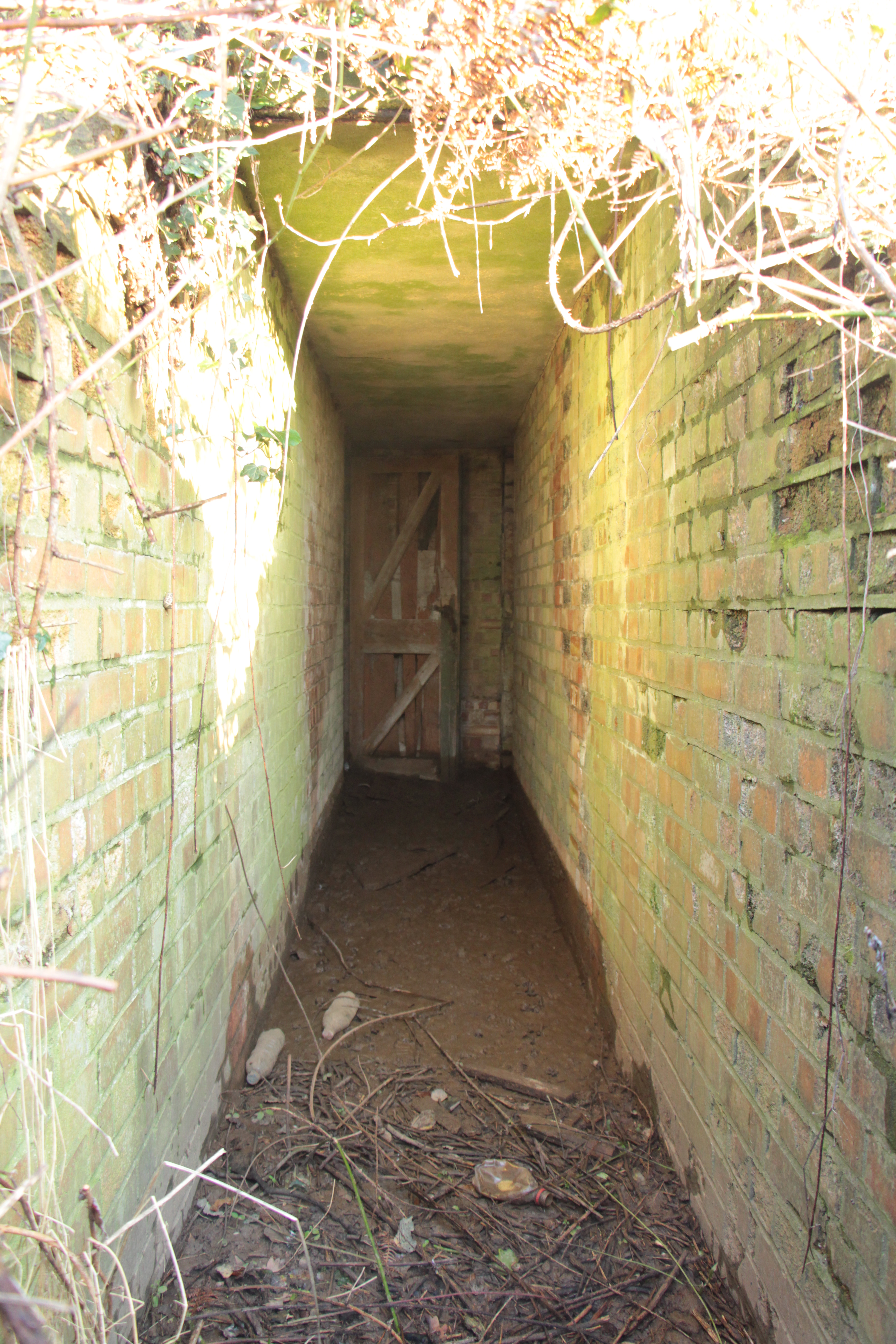
Today – the site of Surlingham’s starfish is much quieter. I stopped by, and knowing where to find the bunker – managed to capture it in its slumber;

Again – the hidden detail, and history of Norfolk’s rivers & surroundings amazes me. You can walk quite easily from Surlingham Ferry, and walk past this 100 times without knowing what it’s about.

I can’t imagine what it would have been like, orchestrating a site like this in the war – knowing it’d lure enemy bombs to drop adjacent to you instead of on an already burning city.

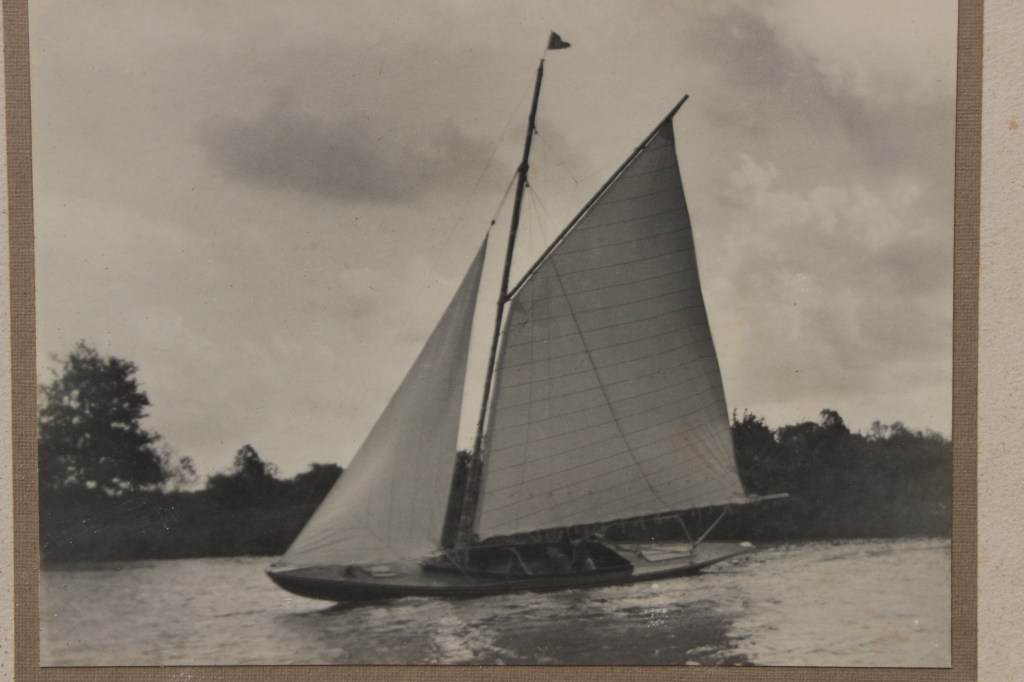
The link between this starfish and ‘Corsair’ is tenuous – but there. It links to Joseph Lejeune – foreman at Chumley & Hawke in the pre-war years, and the heyday of Alfred Lloyd Braithwaite’s design experiments. Lejeune’s & Braithwaite’s most extreme experiment was undoubtedly Khala Nag;

Khala Nag – sometime in the 1930’s, somewhere on the Broads near Horning.

I’m fortunate enough to own that photograph, which is to my knowledge the only extant photograph of Khala Nag – it was part of the treasure trove of ALB’s possessions which I found earlier this year, in Milford on Sea. See here for the highlights of that; https://broadssailing.blog/2019/07/18/on-the-trail-of-a-l-braithwaite/

‘KN’ was a flier.  27ft long, with only 4ft 6” (yes) beam and 3ft 6” draft she carried 2 separate rigs, one for the Broads, one for coastal waters.  The extent of his commitment to balance, weight, sails & hullform is evident in this design & build.

Whilst Joseph Lejeune built the yacht, Braithwaite assisted throughout.  Notably he weighed and recorded each and every component of ‘KN’. This eventually lead him not only to knowing the exact required weight of the ballast keel, but also how to trim the vessel, so that her centre of gravity could be altered to 1” in advance of the centre of buoyancy, calculated to counteract the weight of any crew.  This simple calculation is often overlooked by designers, and pays dividends when sailing. 

At the time of the outbreak of WW2 Joseph Lejeune was the foreman at Chumley & Hawke, and unquestionably there must have been a close working partnership between him, and Lt Cdr Braithwaite.  They were close in age – and clearly shared a passion for experimenting with the limits of design at that time, to create some unique, and exciting craft.

For example, the noted cost of JL’s time during ‘KN’s’ build was £117, 4s 10d (!) The lead for KN’s keel only cost £7 9s 0d. ALB must have valued his input as a designer.

Sadly, this evidently close partnership wasn’t long lived.  Whilst Lt Cdr Braithwaite went back into active service, Joseph Lejeune stayed in Horning.

I know that Alfred Lloyd Braithwaite felt very strongly about returning to active service. His age would have discriminated against him at the outbreak of war, and in fact I notice on the 1939 return there is a note which reads; ‘RNVR in Great War, but refused for present war’. ALB was not to be deterred, and was posted in 1940.

In Horning, during the evening of April 26th 1941, Horning village was subject to a stray bomb attack – which disastrous consequences.

(I actually sit, reading notes I first wrote – April 26th 2016). 

It isn’t clear exactly, but it’s likely a Luftwaffe bomber was jettisoning bombs on the way back to the coast.  And their attention was sufficiently drawn to drop their remaining payload of 15 bombs around Horning.

I wonder if they were aiming for the ferry itself – which may have been silhouetted. Else perhaps it was a chink of light as someone slipped into the pub?

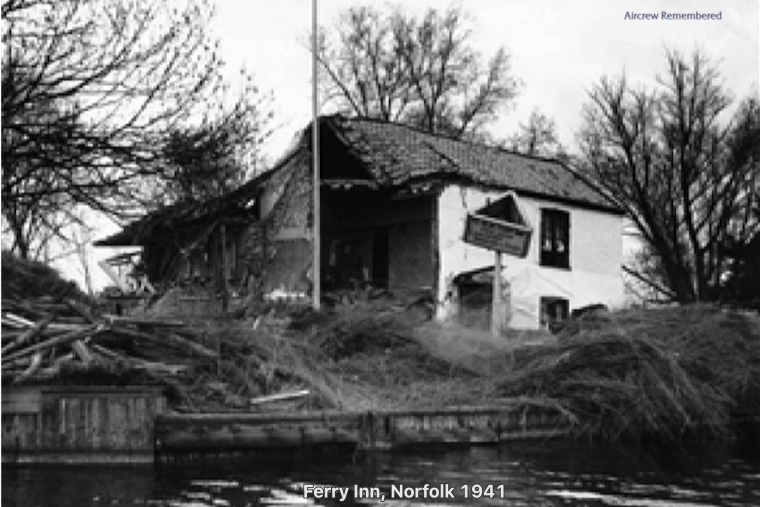
Whatever the circumstances, the most unfortunate target was the Horning Ferry pub, and amongst the 22 fatalities that night was Joseph Lejeune, aged 50.

The devastation was instantaneous;

The link between Surlingham’s starfish and this, is that sites like that, their flashing lights and theatrical pyrotechnics were desperately trying to stop destruction and loss of life like this. Sadly it’s reckoned that Starfish sites only drew 5% of the intended bombs away from the actual targets.

This accounts for how ‘Corsair’ came to be built post-war by the apprentice at Chumley & Hawke – Tim Whelpton, directed by the then yard foreman Alfred Yaxley.

Anyway – In a roundabout way, I hope I’ve explained another bit of Norfolk’s hidden history, and some more of ‘Corsair’s’ story.

Big skies.

Goodnight.