Our 2013 ‘season’, if you can call it that came to a dramatic conclusion in that December.
On the evening of 5th December, with shades of the 1953 floods, the weather turned nasty. Strong winds, high tides, & a large volume of rain water in the rivers could mean only one thing. We were in for a trying time – and it’d be bloody damp.
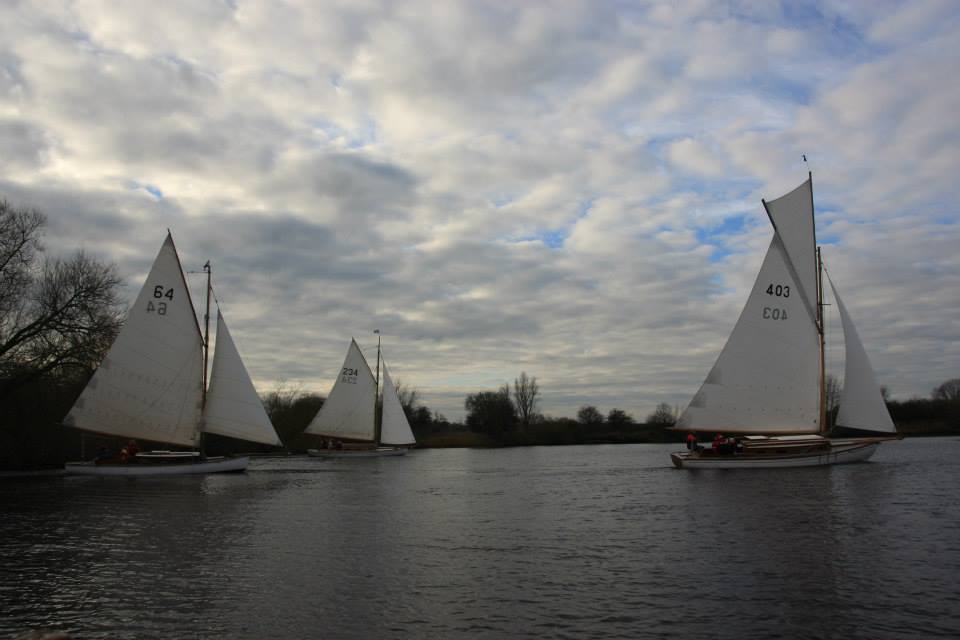
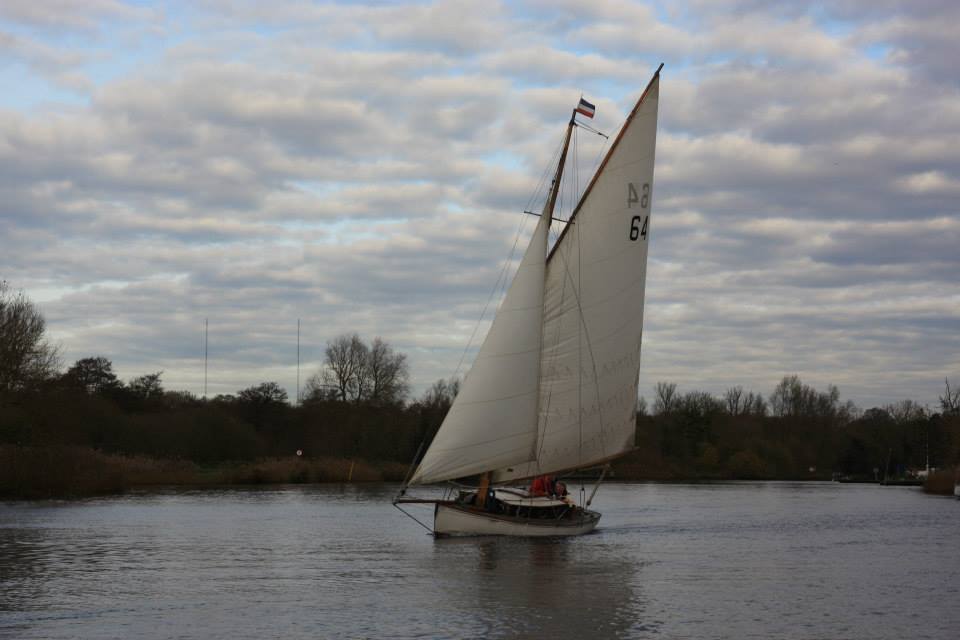
To give you a clue of why this storm surge was significant, like many other river cruiser owners, my year is dictated by the various events/fixtures which we attend. Now, for reasons to numerous to mention – my sailing club runs a race in December, where you race for a Christmas Turkey. Something which is more fun than it sounds. (although as I write this, I’m less than a fortnight away from the Turkey Race, and it’s 3 degrees outside / pouring with rain… I do wonder about my choices sometime!)
Anyway, 2013. Through the week, with the weather looking so atrocious – with each updated forecast, the commitee of the club devised alternative plans. Ultimately though we agreed (reluctantly) that we’d be bringing at least 3 boats to race – no matter what the weather. (gulp).
So on the Friday afternoon, I’d packed a bag – and sat at my desk looking at the frozen rain thundering against the office window. Yet again I could see an ‘interesting’ time ahead. By 6pm – it was pitch black, and the river was already 2ft higher than it ought to be. Oh & it was blowing a genuine f8 by this time. Deepest joy.
Slowly, we crept down the road to our mooring – at times having an old Land Rover is a real bonus! The water sloshed around inside, meaning we were now wading in at least 3ft of water. In driving rain, we carefully found the edge of the jetty, untied our mooring lines & crept out into the main river.
The water was HIGH all over the river network.
River, what river? Thank goodness for a roof-mounted search light. We motored gingerly up the Yare, all our usual landmarks gone. You couldn’t see the edges, there was no real boundary between land & water – all we could do was follow our noses & try not to get frostbite. Sadly, as our searchlight featured a genuinely antique, battery-flattening bulb – all we could do was use it sparingly when we thought we’d hit something.
Eventually, ‘Corsair’ reached Surlingham Ferry – we had to find the edge of the moorings using the quant as a depth sounder (falling in would have been a bad idea!) – and again, we tied up on underwater mooring posts, stuck our quant in to stop her over-riding the bank, and waded to the pub.
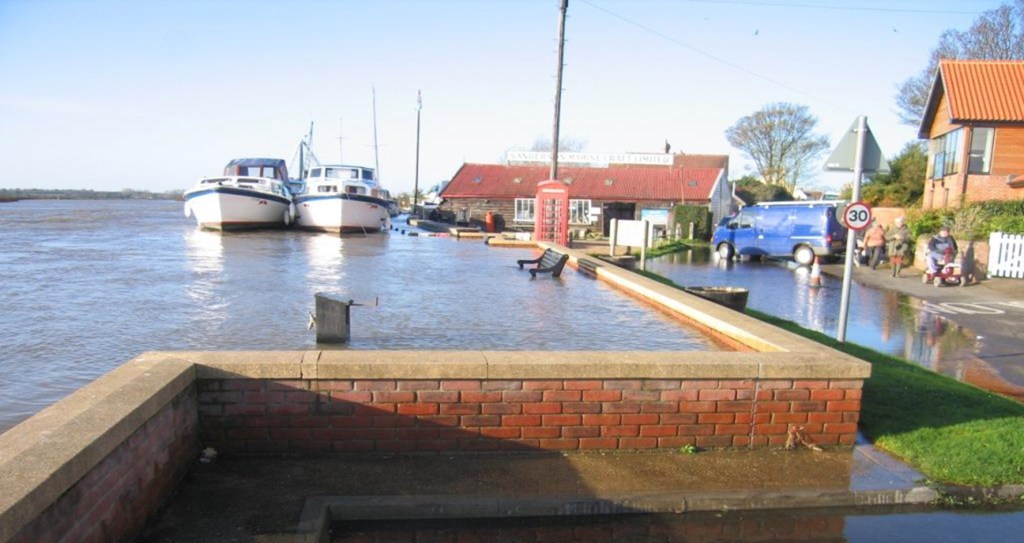
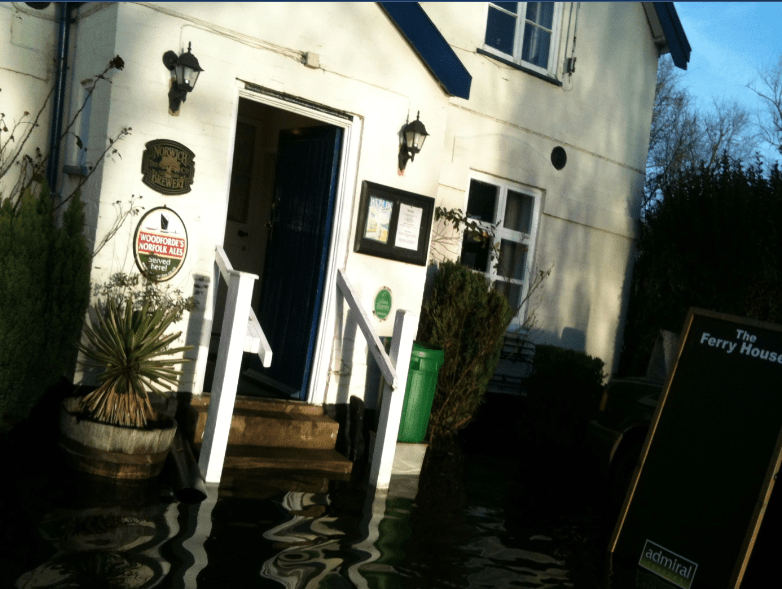
It was closed!! Thankfully we managed to persuade S the landlady we were thirsty & hungry – and very kindly she openedup – providing us with warming food & beer. I’d never seen the river this high – it was upto the front door!
High water, the next day…
Typically, being in a warm pub helps change your perspective on any situation, I can’t say I’d forgotten the freezing rain or the savage gusts. Ultimately though the boat was safe, as was I… and we’d see what tomorrow would bring.
Elsewhere – the high water levels had played havoc with the yachts who’d wanted to attend. Bridges were un-navigable, as were large sections of road. We counted our blessings & went sailing for a short, but cold race.
Sadly – ‘Corsair’ suffered a gear failure whilst sailing – another sign of her increasing issues / lack of care I was able to show.
Being as objective as I can, every year I lay up the boat. Each season starts/finishes with the same rituals, it’s methodical. You de-rig, sails are folded, lofts are crammed with gear & eventually the vessel is tucked up under her cover & you get some respite for a few weekends at least…
In 2013 however, it all had a knell of finality about it. I’d gained a whalloping overdraft – ‘Corsair’ was sailed to her winter storage on a blowly, cold day (December 28th) – and I was genuinely sad. I didn’t see a way I could commission her for the following year. With that over-arching thought, once de-rigged & left ready for the crane, I slammed the L/R door & drove home.
The remainder of the 2012 season passed without too many notable incidents, we manage a short cruise to Geldeston in the company of 2 other registered RCC yachts, but increasingly signs were apparent that ‘Corsair’ was showing her age, and I was showing my naivety / lack of funds to manage & maintain her properly.
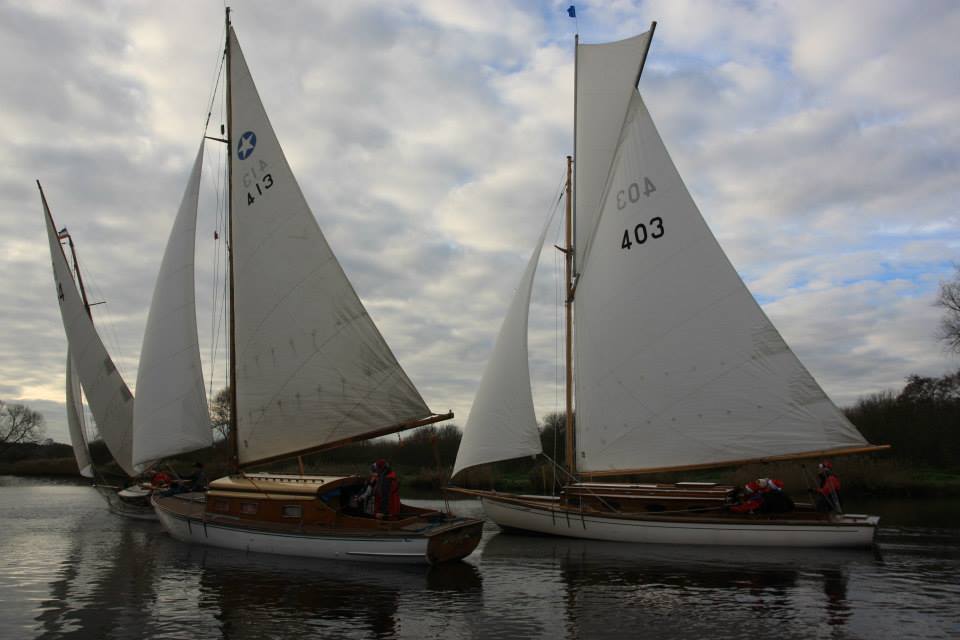
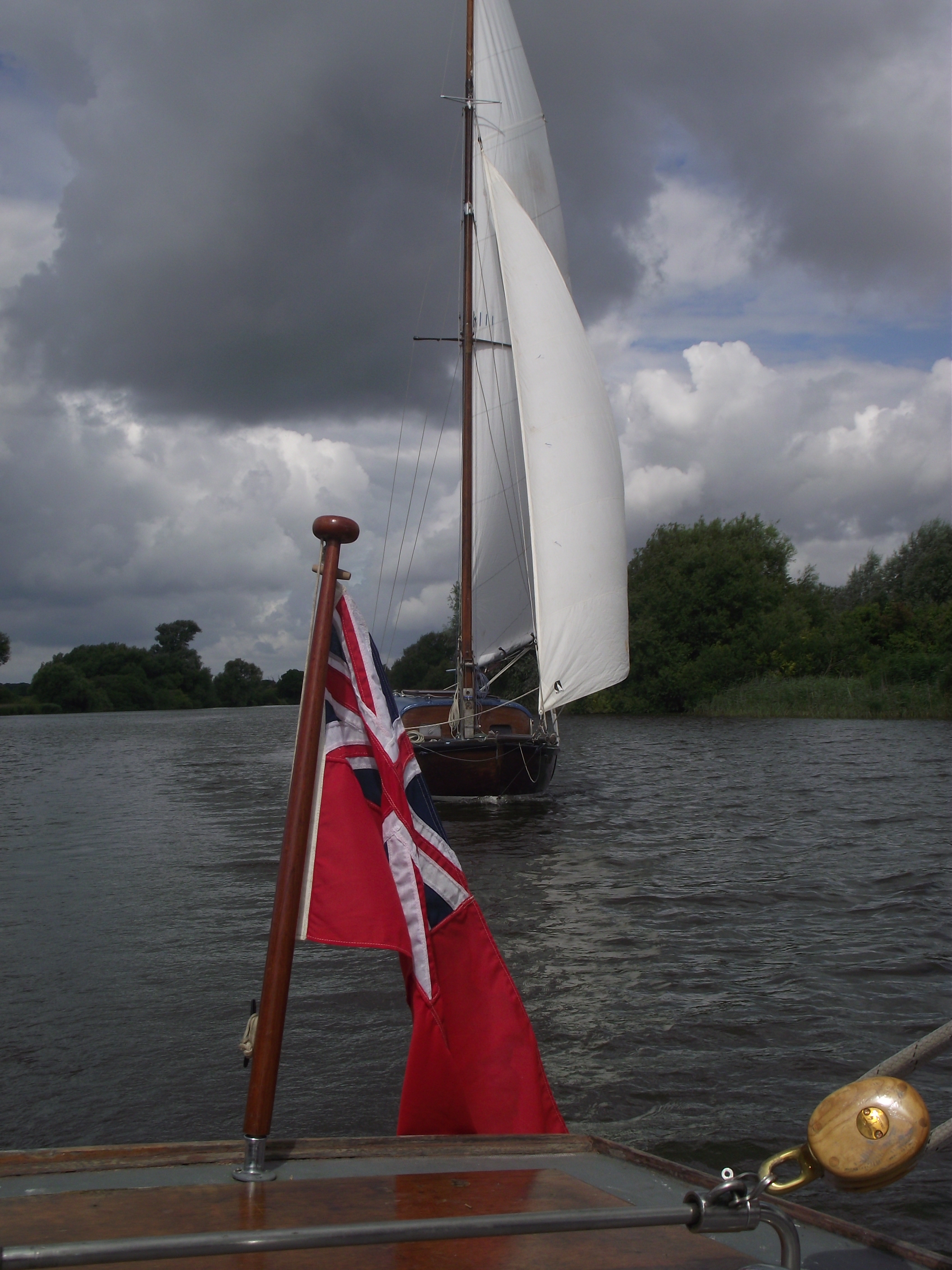
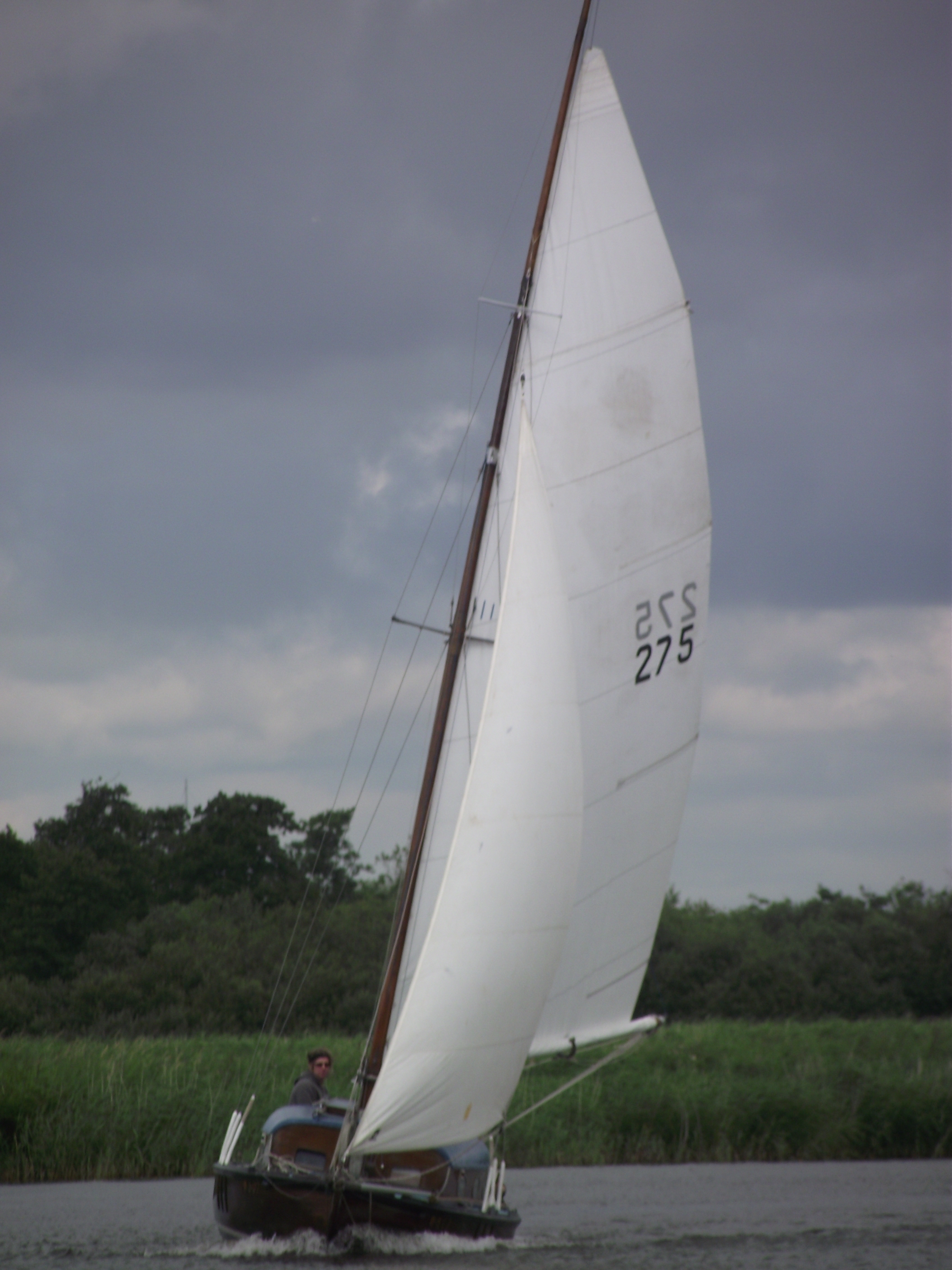
What was fantastic though, was sailing in a fleet of 3 such different yachts. We represented the oldest, pre-war design – & were accompanied by 2 RCC’s which showed how the concept had been modernised. S/N 275 ‘Breeze’ was a Derby-built boat, with an incredibly impressive racing career to her name, she’s owned by the family of a lifelong friend, and as photographed below – she’s come a long way from the hirefleet.
Breeze – ex hire fleet.
Her mainsail is from an international star one-design, giving her a powerful performance. Upwind in heavy-weather especially, she just takes off, and points, and points… A far cry from our own performance, sadly.
Whilst enjoyable, the predominant memory of the 2012 cruise is that as we were tacking into Beccles in light airs, our 1951 boom decided to snap directly above the mainsheet blocks. This swiftly became a fairly stark lesson in how the mainsail on a Broads yacht can (and will) become uncontrollable – and how quickly a jib that’s sheeted in can push you into the bank, HARD.
Without the funds to do anything else, I recall the frustration & resignation of the hot/dusty walk upto Jewsons in Beccles, where some cheap laths, a fence post & some galvanised grip-fast nails were purchased. A fairly brutal repair then followed – with my hammering the fence post inside the two broken segments of boom, and then applying the laths/grip-fast nails to stop everything sliding apart again. Ugly, yes. Cheap, yes. Long-lasting, no. Satisfying? Definitely not!!
At the time, although I knew I wasn’t keeping ‘Corsair’ as I should have, I also knew how powerless I was to do anything else. I just had to pray we’d somehow keep going. Which, without sounding like a complete idiot, is extremely hard, and simultaneously incredibly stupid. Wooden boats require an extremely high standard of maintenance, you cannot just ‘hope’ – and in my heart of hearts, I knew I was failing her.
There followed a litany of events for the remainder of the season which followed in the same vein, that torrential downpour at Breydon regatta, highlighting all the deck leaks / windows needing to be rebuilt, and ultimately the collision at our mooring which further broke our awning spreaders, tore the awning beyond repair & snapped our boom crutches (late August). All in all, it was a pretty horrid experience, spread out against the back-drop of knowing I needed to do more, if I was to keep ‘Corsair’ safe.
Some bastard simply motored off from here, having caused the damage.
I may have only been 5 years into owning her, but already I found she was a significant part of my life, something which echoed the feedback from previously owners I’d spoken with, they all fondly remembered her & talked at length about how she was centre to many fond memories & friendships for them. However hard it may be, I was determined to keep hold of her, and in truth – I knew I needed her.
By December – we’d taken the unusual step of de-rigging ‘Corsair’ & having her ready to be craned out. Despite having endured a litany of criticism from the red-tape brigade last year, it appeared we’d be able to use the riverside pub as a winter storage / impromptu boatyard again. With that in mind, ‘Corsair’ suffered the ignominy of being towed upstream, derigged & deposited on the moorings the night before the Turkey Race.
‘Corsair’ – dumped on the moorings as I sail past in a borrowed boat.
The race itself proved to be worth of the pages of J.D. Sleightholme… Firstly I stayed aboard a strange boat, in December, with no knowledge of how to work the heating (mistake no. 1) – then, I realised I couldn’t work the cooker… (mistake no. 2) – which lead to me being sub par on the morning of the race itself! I was half bloody frozen to death, starving hungry & for some idiotic reason I’d volunteered to run the race, including laying the course.
Unfolding a sail-cover & awning is no fun in the winter, when its wet you get soaked. What’s even less fun, is karete chopping the folds in, because the bugger is complete frozen solid! Ooopf. My finger’s turned blue, then white & numb. In fact every rope was frozen solid. I’d been promised that rigging a bermudian yacht was mere child’s play, it’d only take seconds… Pah!
We set off to lay the course, and naturally the cock up fairy wasn’t done with us yet. Thundering upstream (well, 6mph with a diesel clattering away) there was a sudden BANG… And the engine stopped. Bollocks. Wuuuuhhh, wuh, whuh wuhhhhhh groaned the starter, nothing, nada, zilch.
BOLLOCKS. I’d only dropped the lower mark, and there was no club boat to help, no vhf & no mobile signal. BOLLOCKS. Return to basic principles… ALWAYS keep the mainsail ready to hoist, tied down in crutches is no bloody good, same goes for the jib. Have it ready to unfurl. Somehow we managed to not hit anything, and I cut (always have a knife) some sail ties, BUT we got the main up & kept some way on… Now. A breather.
Oh no, oh NO! Can’t have that, a gust came down & with a mocking thump/gurgle – the weight & chain for the racing mark (stowed on the foredeck) rattled down to the lee-side & overboard. Oh bollocking bollocks.
Now, I want to you imagine that you’re walking briskly, and without warning I grab your left hand, refusing to let go, whilst you keep walking… that’s the sort of inertia we had, expect it was a 3 ton 28ft ex-hire boat fandango. We lunged to port, we involuntarily gybed, luffed, everything shook/banged like hell, we payed off, we gybed…., we swore, we tangled the ‘effin buoy it’s tackle under the keel, into the jib sheets & generally everyfuckingwhere…
Eventually, some order restored, I threw that buoy into the river with a rage normally associated with a family game of Monopoly.
It really wasn’t our year no matter whose boat we were on! We did manage to extricate ourselves, and get back to start the race on time. Eventually we finished a full 90 minutes behind everyone else (the wind dropped, and with no engine to use, there wasn’t any point in retiring, so forced to sail the course) – and definitely had developed mild hyperthermia as a result of rescuing that bloody buoy.
Throughout 2011, I perfected the art of leaving ‘Corsair’ on a convenient mooring between sailing, rather than necessarily slogging back to Brundall each weekend.
Mostly – this worked well, I did occasionally take a ‘flexible’ view of the Broads Authority 24 hour moorings to facilitate this, but at this point of course I’m duty-bound to point out all fictitious references to that sort of thing should be treated as baseless rumour…
Anyway – the cruise for 2011 was to be a Northern rivers affair, especially as we’d covered a significant portion of the southern rivers in our ‘normal’ sailing having moved to Brundall.
Day 1
With news of the Reedham riverside beer festival ringing in my ears – ‘Corsair’ motored downstream in cool, calm conditions. Typically – we’d be gathering crew / boats today & tomorrow.
Meeting RCC S/N219 ‘Farthing’ moored up en-route – exchanging muted greetings across the river & above the engine noise (!). Maybe they were shouting? Who knows… Anyway. We moored just upstream of the BA hut on Reedham quay, to await the arrival of Binky on the 20:00 train.
Duly aboard – we agreed a quick dinner was the best approach, lets get at the beer!
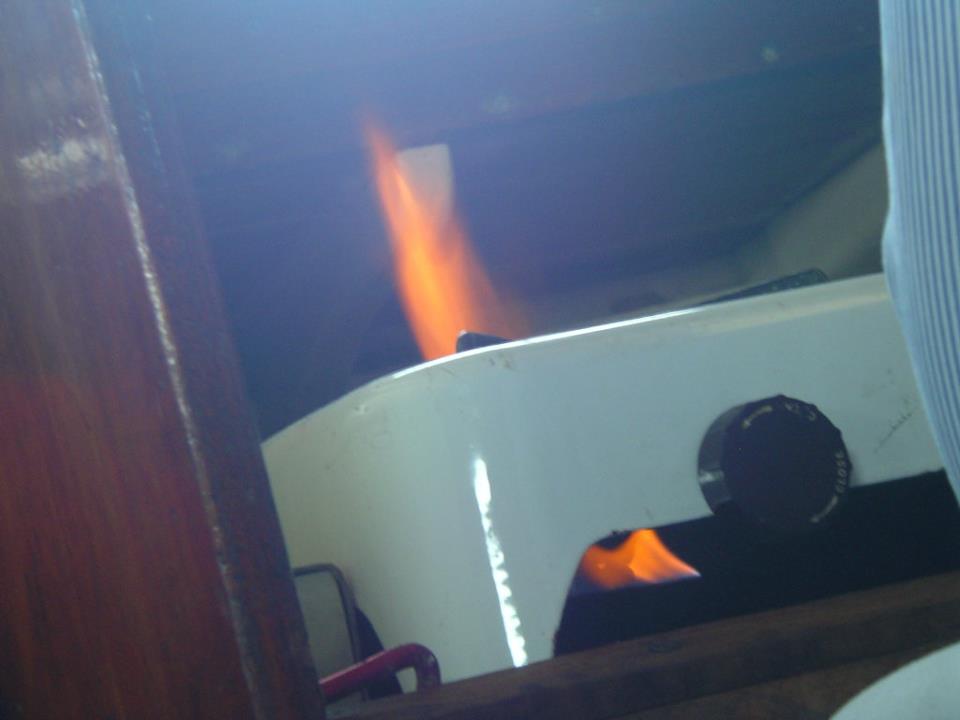
There was however much consternation from Mr B – he’d not yet had the ‘pleasure’ of being upclose & personal with a primus stove… and I was still learning!
To be fair, the flames did die down… but he’s still twitchy from our last fire onboard. (another story!)
Before we could get ashore however, with shades of Michael Green… we’d found ourselves in possesion of a cat! Quite how the bloody thing got aboard is one mystery we’ll never resolve. The ‘shadow puppet’ theatre for the quay-side as the awning buckled/bulged/swayed to the tune of “bugger off! Come here, whose fucking cat is this anyway!?” Must have been popular.
Order restored, we swiftly walked to the Lord Nelson to calm our nerves…
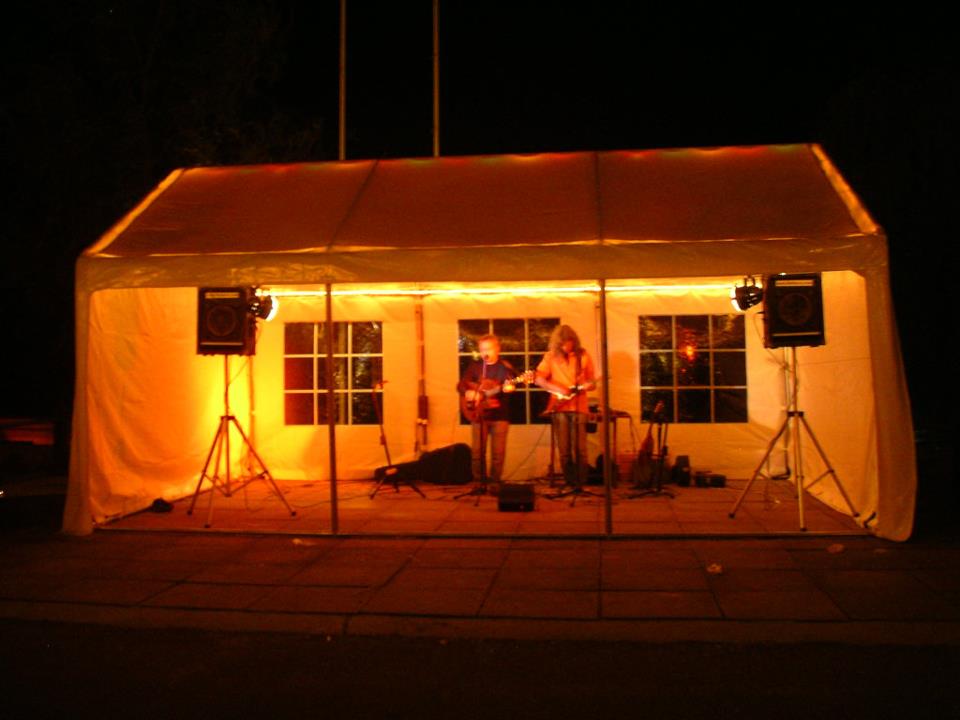
The music festival – pre the Kazoo solo.
Much later, nerves calmed, we were ‘treated’ to some solo kazoo playing, from ‘The Harvs’ band. Wishing them great fortunes, we retired to the boat.
2011 saw us winter at Upton again, with further repairs being made in an attempt to keep the port sidedeck waterproof (largely unsuccessful – in the long run) – but we were tucked up at the Northern end of the yard, in good company.
For this period we were ashore adjacent to a Woodbrige-builtcraft, a Ranzo 4 ½ tonner designed by William Maxwell Blake – built by Robertson’s yard. She was (is) a beautiful yacht, very different to anything local to the Broads, and both us owners could enjoy chatting away – avoiding real work.
However, 2011 was an anniversary year for ‘Corsair’ – I thought I would do all I could to make her look good. Her cabin sides had been stained last year (the eagle eyed amongst you will have spotted no chrome trim last year).
In fact – that wasn’t entirely an aesthetic choice – I was finding the financial implications of owning a wooden boat really tough. This photo from late 2010 shows myself & a girlfriend heading out to St. Benet’s abbey for the day (November, some beautiful sailing can be had in Autumn) – and you’ll spot where I rain out of masking tape applying the boot top that year!
November sailing – 2010 excuse the lack of boot top!
So, for 2011 I was determined to do better – I’m not sure I necessarily succeeded, but ‘Corsair’ did make it into the water fully painted, with a cove-line, and some more varnish on the cabin sides. Our launch caused a certain amount of concern – as ‘Corsair’ did her best to take in as much water as possible in the shortest time…
The night before I brought both boats south – I stayed on ‘TOG’ in the basin at Upton. Whilst during the winter often this is an exposed spot – by spring the trees are in leaf & it becomes a snug little mooring which if I’m honest, gives you the best seat in the house to have your dinner.
Open air dining
It was chilly, but you can’t beat being afloat – or eating in the open air (IMHO). But yes, back to ‘Corsair’
The extra attention that winter wasn’t in vain – I had plans! ‘Corsair’ was moving south to a new mooring on the southern rivers in Brundall, and was to celebrate her 60th birthday in style, competing in the ‘Ray Perryman’ race over the late May B.H.
The journey south wasn’t without ‘incident’ – it has to be said, having completed the winter work on both ‘Corsair’ & ‘TOG’ – I was expressly forbidden to exit the dyke with both vessels at the same time, by the then yard owner. Well… what can I say??!
Bit of a squeeze!
It was genuinely abit tight in a couple of places… we rubbed fenders twice with moored boats & then set off for our tidal window at Great Yarmouth.
Coming to the southern rivers, the ebb tends to run alot longer in the Bure than it will the Yare – so you can come down much later than you’d think & be guaranteed a good flood tide up Breydon. Today was no exception, as I turned at the yellow post, both craft found themselves whisked up the channel nicely, thank you very much…
Except. The exhaust note had changed from its usual tone, to one more redolent of a dirty phone call… ‘huffahuffahuffahuff’. Quick check over my shoulder. No water from the exhaust. Sod it! Shut down the engine pronto.
Leaping from boat to boat, whilst digging an outboard bracket out of the forepeak, putting it on, repeating that process twice for the engine & fueltank. Well I won’t bore you with the details, but needless to say I am confident I’ve set a world record. Both ‘TOG’ & ‘Corsair’ were gently pirouetting their way to the mudbanks – I had to move fast.
Some minutes later, with my 5hp outboard roaring its head off, we began the slog trek up Breydon. Phew. Wooden boats eh?
‘Corsair’ was kept at South Walsham broad, moored in a private dyke under the ownership of a M.Doleac. I’m uncertain as to whether she was actively for sale, but as is the way with many old Broads yachts, there was someone looking – and ultimately most boats are for sale if you ask very nicely.
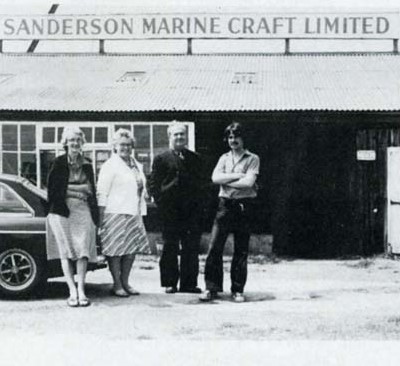
The someone being Steve Sanderson, a local boatbuilder from Reedham.
The Sanderson family – 1981; Steve Sanderson far right.
He’d been tasked with finding a Broads yacht for Joe Kilner (from whom I bought ‘Corsair’) – although Steve & his family also deserve a mention…
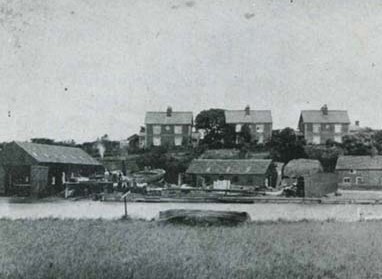
The Sanderson family bought their boatyard in 1932, the site being known as ‘Hall’s yard’, wherry builders who’d built some absolute beauties.
Hall’s yard – Reedham. At least 2 wherries on the slip.
2 Halls built wherries survive, ‘Hathor’ (with her own rich & varied history) – and ‘Maud’, the last surviving clinker built trading wherry. A grandson of the Hall family worked for the Sanderson’s until the 1950’s.
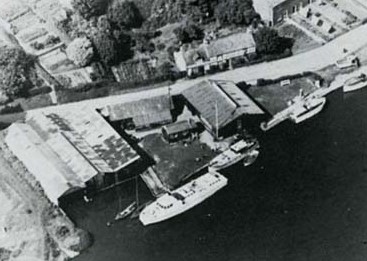
The Sanderson’s lived aboard a sizeable ex-RAF launch ‘Astral’ for 28years, with brothers Colin & Steve joining the family business as they were able to. So when Steve was asked to source a suitable Broads yacht for Joe K. – he duly pointed him in the direction of ‘Corsair’.
Astral – moored outside Sanderson’s.
(Later I was to learn that ‘Corsair’ had transferred ownership via circuititous routes more than once!)
At this point, it’s very hard not to digress but in the mid-late 1980’s there was a huge resurgence of interest in old Broads yachts, their sailing & racing. The Broads legend (s) Maidie & M.Barnes in 1984 found themselves at Sanderson’s – the beginning of an ownership/story which is still ongoing today; 84_maidieeastored.jpg (600×1463) (broadlandmemories.co.uk).
As part of this resurgence, in 1985 a proposal to re-form the Yare Sailing Club was made – which caught the interest of Joe. ‘Corsair’ was purchased, and arrangements made to bring her south to Reedham – to a mooring in Sanderson’s Dyke.
Joe & Julia both lived out of Norfolk at this point, Julia recalls on her 1st trip down, her Mini clubman broke down outside of King’s Lynn, making a long journey to Reedham even longer. Salvation came in the form of a friend couple who drove Julia to their house nearby, enabling the RAC to be called (life before mobile phones!). The car was resurrected & after several hours the Ferry Inn lit up in the headlights, and an indroctrination in Broads sailing started.
(what a beginning!)
Despite the breakdown, the Mini was pressed into service almost immediately – with the mast counterweight being loaded into the back (!), something which I’m certain made the steering a lot lighter!!
After an early start ‘Corsair’ was fastened alongside the motorboat ‘Tinga’, owned by Brian Holden of the GWYC – and towed through Yarmouth. Tidally it’s always worth getting to Breydon at the right time, as wind over tide can create abit of a ‘slop’.
One of ‘Corsair’s’ many quirks came to light at this point… the forrad cabin ports will only close if the roof is raised! And, like all boats being towed alongside in even mild wind over tide conditions – torrents of water begun to fling about – especially as the towing boat bounces to a different ‘sync’ than the towed vessel. Cue lots of water flooding past those open cabin ports!
Julia at this point resorted to crouching in the cabin, holding both panes of glass in an attempt to keep the cabin dry! I’m not sure of the success of this tactic, but a ‘pit stop’ at the Berney Arms Inn restored spirits (or should that read restorative spirits?) for ‘Corsair’ to motor to Reedham & slip into Sanderson’s Dyke.
Joe & Julia’s ownership of ‘Corsair’ brought well-needed stability & care to the boat. When you own a boat for a long time you’re able to properly invest in its future. Joe set about a comprehensive programme of modifications / structural works to ‘Corsair’, which included a new rig. Since 1961, she’d carried a neat gunter rig which Joe replaced with a gaff-topsail set-up from ‘Sabrina’, then in the ownership of another GWYC member, Robin Stewart.
In the early days of Joe’s ownership – ‘Corsair’ had a tendency not to respond to the helm, this was solved with an extension to the rudder, and eventually alterations to the position of the keel. Many, many years later when rebuilding ‘Corsair’ we were able to utilise one of the original floors, which at the time was not fitted with a keelbolt – such was the distance the keel was repositioned!
Joe oversaw the replacement of many planks, fitment of a gas locker & deck hatch in the aft deck, repositioning the winches from the cabin roof onto the deck (their previous location on the roof can still be seen today). Interestingly, although the mast & bowsprit were extended – fittings were added to enable the original ‘small’ rig to be set on the same spars.
Early in their ownership (1988) ‘Corsair’ won the Turkey race, an annual event originally sponsored by Steve Sanderson, 1st prize. Celebrations post-race also included the Reedham Ferry, where interestingly enough, there’s a link to another story…
My favourite recollection of Joe & Julia’s ownership – is one from a very early sail… Whilst running down the Yare – Joe advised Julia not to let the tiller come up, as to avoid a gybe.
This advice duly given – Joe was gathering fenders in on the sidedeck, when a crash gybe flung him (and the fenders) straight into the river Yare! When questioned why she’d tell the tiller ‘up’ Julia calmly responded that it only moved from side to side… (!)
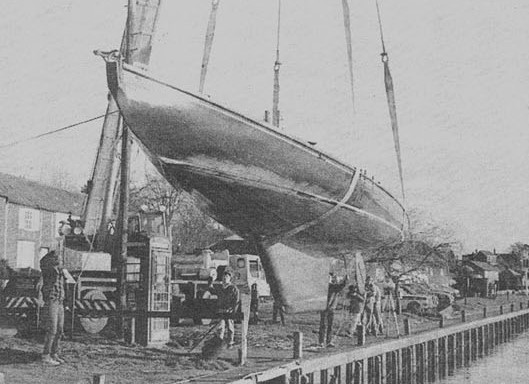
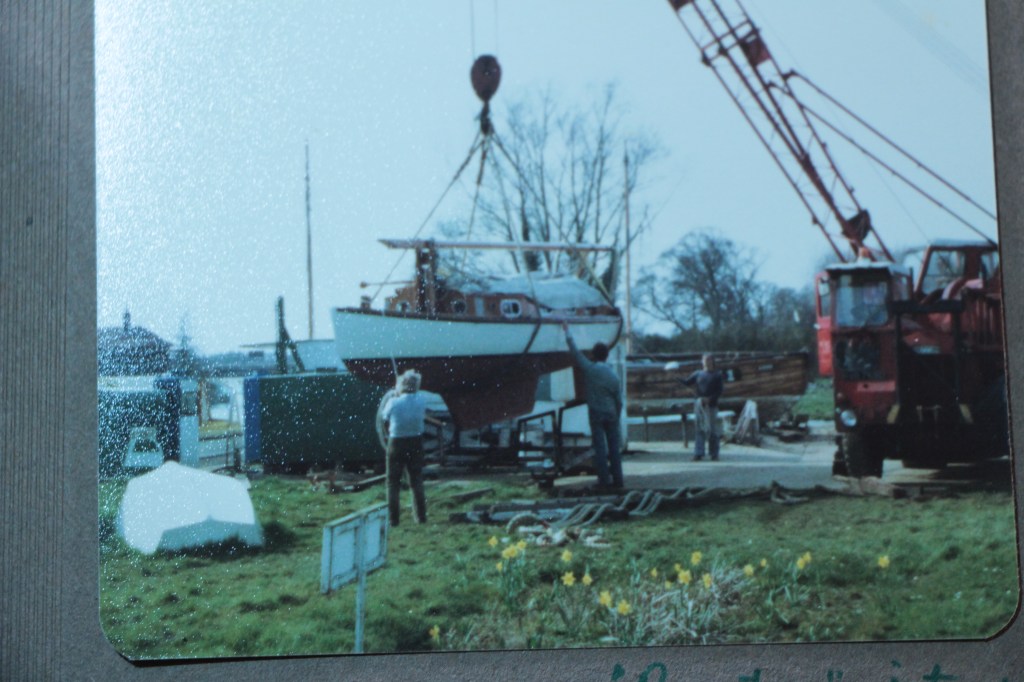
Although another good tale, is the day ‘Corsair’ was in the strops of Sanderson’s big crane;
The infamous ‘big crane’ – seen here in 1984 lifting the Broads racer Maidie S/N52.
This crane has personality… with ‘Corsair’ hanging just above the barrels – it took off slewing with no input at the controls – boat conkers! Although I think the planks & ribs which suffered have now all been replaced thankfully.
Living in Holly Farm Dyke, wintering in Holly Farm barn, Reedham was home for ‘Corair’ the next 20 years, truly becoming a ‘southern rivers’ boat.
Corsair & her friends – Holly Farm Dyke, late 1980’s.
Next time we’ll re-visit 2010’s sailing holiday, and start to unpick the trail of Corsair’s designer, A.L. Braithwaite.
I mentioned the white painted transom previously as an indication of an older yacht needing TLC… this perhaps was reflected in the price, £450!
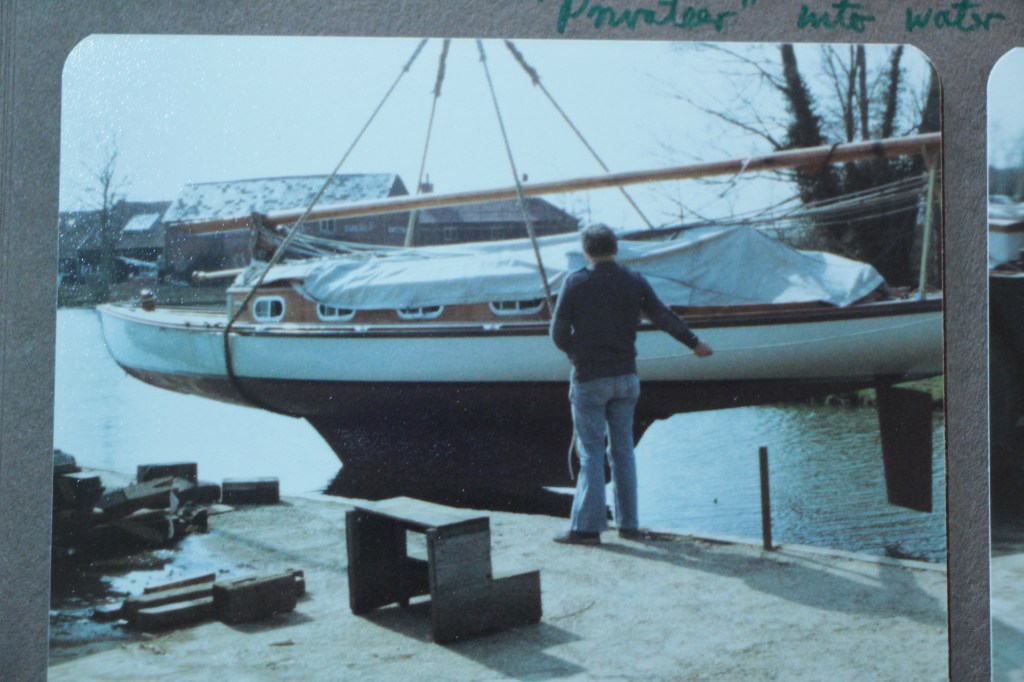
The Bown family duly put ‘Privateer’ to use, often sailing as a family. Compare this photograph from the early 1960’s to Privateer in 1936.
Privateer – early 1960’s
Alas this proved to be quite true, as Mr Bown senior undertook a significant amount of work in 1965 on ‘Privateer’. At that time, much of the planking & many of the ribs were replaced.
Paul Bown (Mr B’s son) recounted that there was little evidence of Privateer’s hire-career, aside from a repair to a cabin-side, which was a legacy of the Royal (!) cock up on Breydon in ’48.
Interestingly – Paul also discovered evidence that ‘Privateer’ had been altered throughout her hire career at C&H, there were multiple holes in the hog, indicating that the keel had been moved on at least two occasions (!)
I suspect, that Privateer when built was almost entirely balanced, and that the re-positioning of the keel was an attempt to bring some weather helm into play for safety reasons.
(most Broads hire cruisers had enormous weather helm, which meant if a hirer panicked, they just luffed themselves and stopped)
Unfortunately the 1965 rebuild cost £720 (!), which reflects the nature of the bargain price.
During the 1965 rebuild – ‘Privateer’ underwent a significant change in physical appearance. Many C&H yachts have cockpits which are ‘snug’, ‘Privateer’ being no exception. Hence the tiller linkage during her early years.
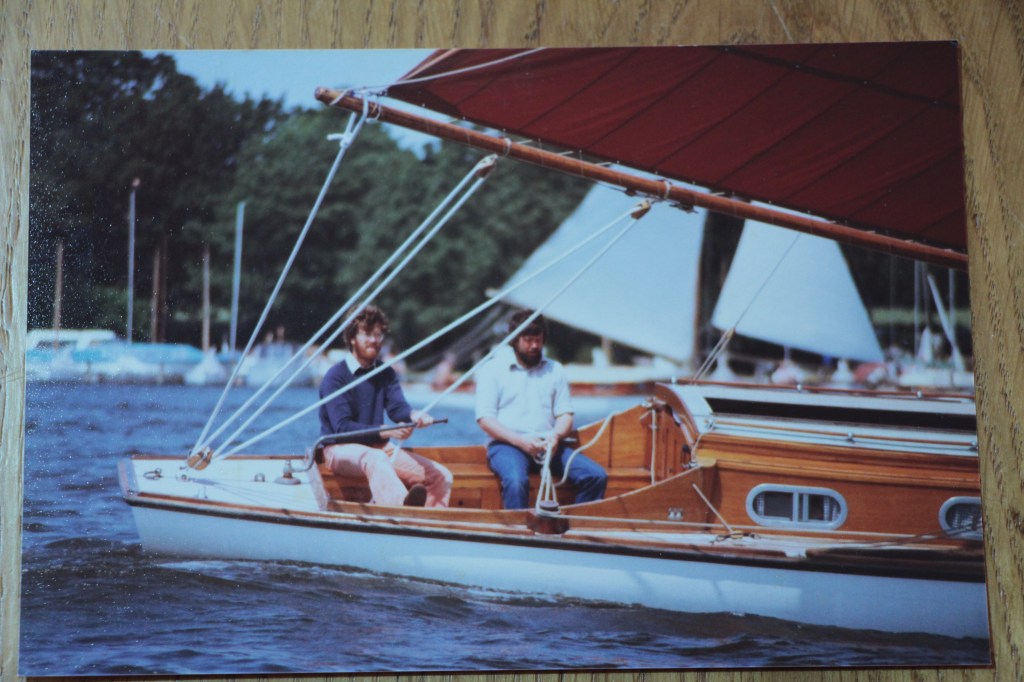
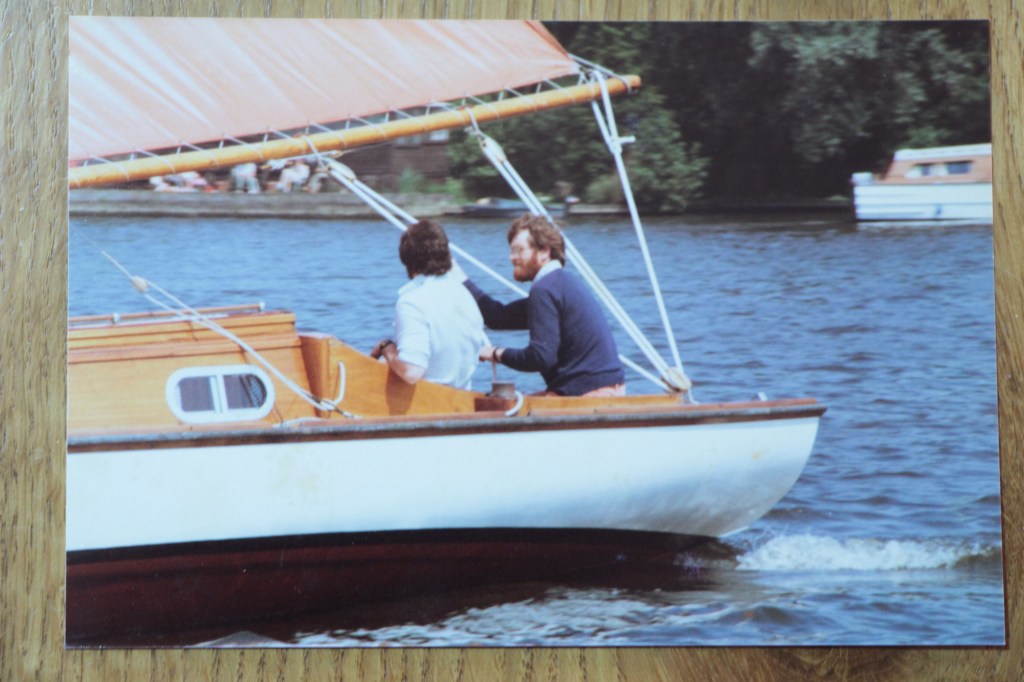
To provide useful additional space, Mr Bown senior re cut the coamings, raised the benches & splayed the short coamings ‘outboard’ to give a little extra space, as seen here.
Privateer with new windows & an enlarged cockpit. Moored at NBYC, Wroxham Broad.
The external sliding windows & their frames also disappeared at this point, apparently they could be opened by a jib-sheet – resulting in VERY wet bunks!
The final addition during Mr Bown senior’s ownership was the addition of a bowsprit, added in 1970. Paul Bown can be seen here – attaching the new jib!
The new bowsprit.
Mr Brittain had purchased new sails in 1956, aside from the larger jib for the bowsprit, that suit soldiered on until early 1990’s, another long-lived Jeckells suit. (not quite as long-lived as ‘Corsair’s’)
Privateer was sold in 1979, to Peter Dunham, who kept her in a boatshed at South Walsham (it appears S.Walsham has a ‘draw’ for C&H boats!). He didn’t keep her long however, as in 1983 she changed hands again…
… to Paul Bown! Mr Bown’s son. Evidently despite having sold her 1st time round because she was ‘abit much to handle’ -she was bought again!
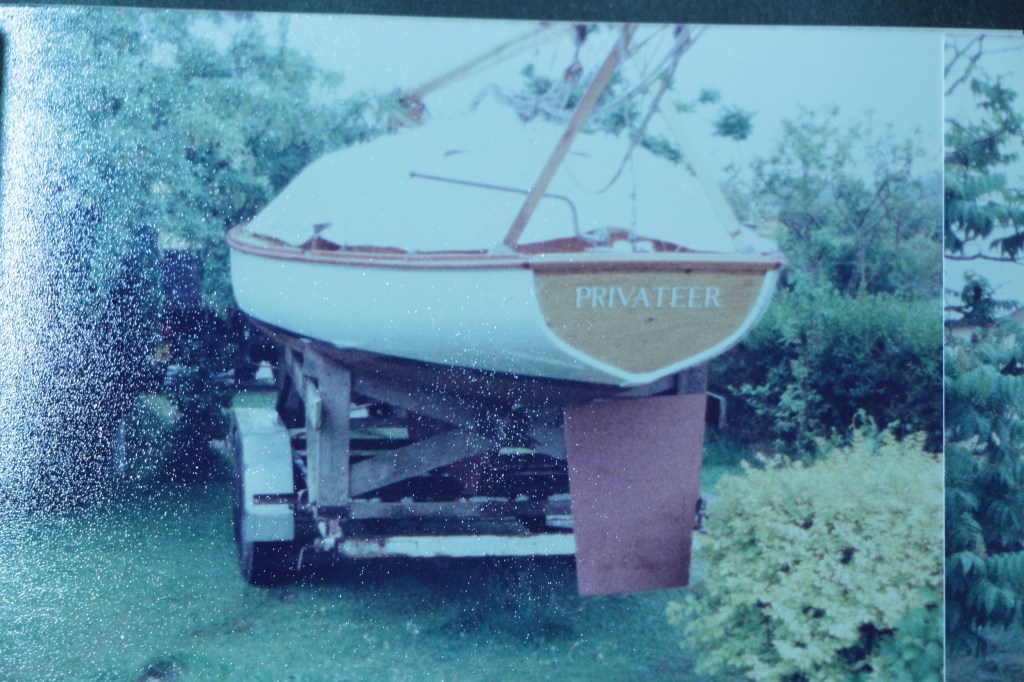
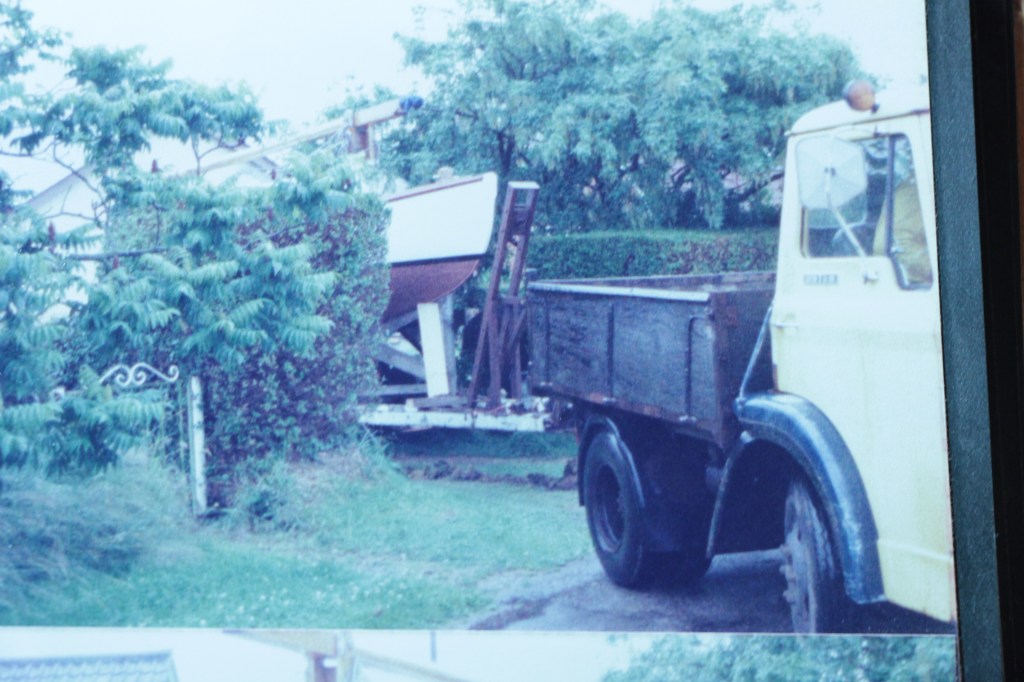
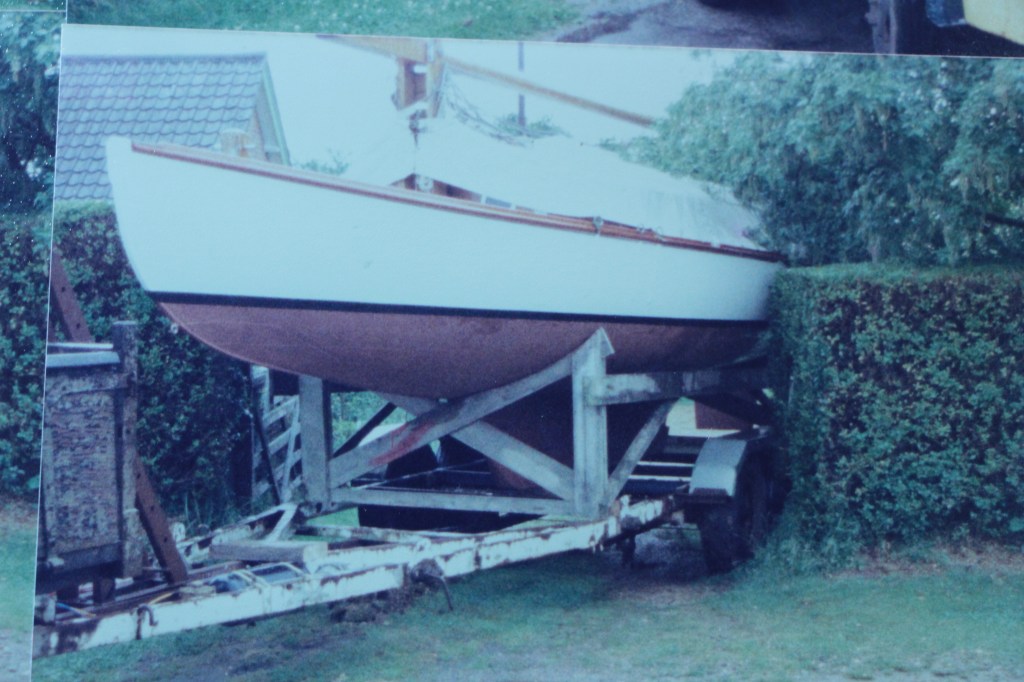
Following a similar pattern, after 2 years of family-sailing, Paul took the opportunity to undertake some signficant works to ‘Privateer’ during 1985;
Paul managed to squeeze her into his front garden for this work!
So, in 1985, with a new deck, and a new rudder – Paul was able to enjoy racing ‘Privateer’, predominantly at Wroxham Broad;
Privateer – racing – Paul Bown helming. S/N 52 ‘Maidie’ & S/N 119 ‘ButterCup’ also photo’d.
In 1990 though, Paul had another project lined up, and ‘Privateer’ soon changed hands again, this time going to Jean Vaughan & Terry Secker.
Jean Vaughan, was in fact Jean Oliver – whose family had regularly hired ‘Privateer’ in the 1950’s, the boat having made such an impact on Jean, she snatched her up given the opportunity!
Jean & Terry kept ‘Privateer’ at Oulton Broad for a further 8 years. During this time, the tan sails disappeared. She lived on a buoy in Oulton’s South Bay.
Privateer – Oulton Broad 1990’s
Their ownership wasn’t without the occasional excitement. One day having rowed out the buoy, the tiller was found lying on the deck… The rudder having detached itself & helpfully sunk!
A diver was summonsed, and with breathtaking luck, he jumped off the stern of ‘Privateer’, and stood straight on the rudder! Given that on a buoy, say about 40ft overall, that’s an 80ft diameter circle it could have been lost on the circumference, so 1st dive to find it is bloody amazing!!
In 1998, Jean & Terry sold ‘Privateer’ to Mr Child, who still owns her today – the longest period of single ownership ‘Privateer’ has had to date. Tim has continued to enhance her, starting with a jackyard topsail rig;
Privateer – Cantley Regatta 2006.
Undoubtedly the addition of a larger jib, and a topsail enhanced ‘Privateer’s’ sailing performance, and kept her a regular figure on the regatta circuit throughout the early 2000’s.
In fact, Tim further pushed for performance by introducing one of the first ‘integral’ topsail rigs to be seen on the Broads, seen here to good effect at another Yare Sailing Club event, Breydon Open Regatta;
Privateer – Breydon Regatta 2007
Aren’t they both fantastic photos? Really showing the A.L. Braithwaite ‘sleek’ look, with the added bonus of being a sunny day. Fantastic!
Which brings us upto now – Tim still owns ‘Privateer’, he was my next door neighbour for a prolonged period of time, re-enforcing that somehow, C&H boats are bizarrely never too far away from me or my life…
Next time, we go back to ‘Corsair’ – and how she came to be a ‘southern rivers’ boat…
Yesterday I enjoyed what is likely to be my penultimate sail of 2019. I know, I know yet again I’m deviating from the intended order of writing. That’s the joy of being the Editor though.
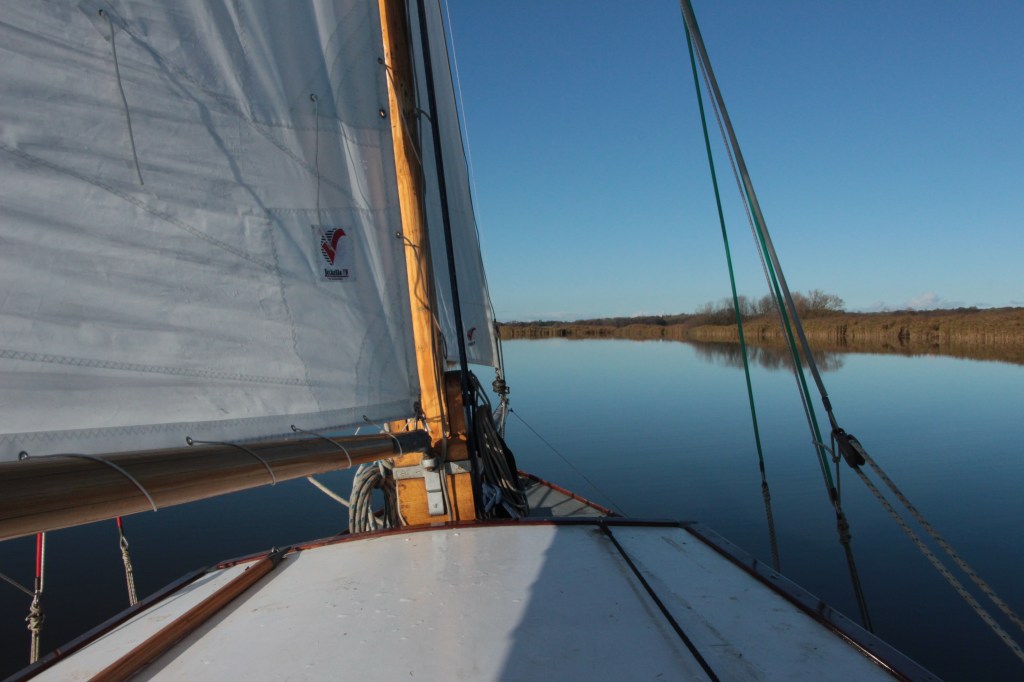
Yesterday was glorious. Bitterly cold, clear, sunny and calm. Very calm. We rigged whilst tied to our mooring, and headed off upriver to Surlingham Ferry, for the Turkey Race – next weekend.
I found myself checking and double checking the rigging again – I’m not sure if I need to re-order and change the cleats on the tabernacle, now the topsail is there. Currently the peak halyard is lead onto the port face, with the throat on the starboard face. The topsail spar has a neat trick of capturing the peak – at the lower end of the spar, which can make lowering the mainsail tricky.
This definitely needs looking at, for two reasons. One – the rig should work, and this is dangerous. Two – when you sail on/off moorings, I find the best way is to keep the way on as much as possible, and to be able to drop the sail – bloody quickly if needed.
Gorgeous!
The rig did present a more amusing quirk – if you tension the topsail forestay just right, it ‘thrums’ and buzzes… Took me ages to work that out, including removing the floorboards and checking on the bilge-pump to see if that was running!
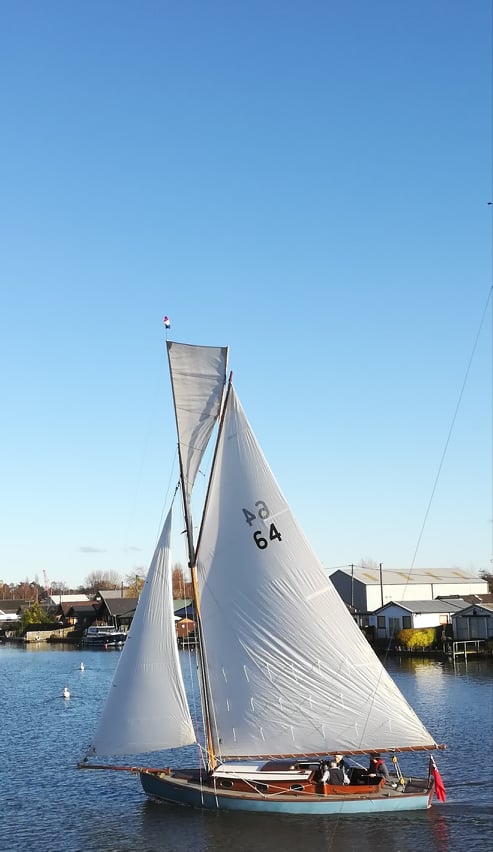
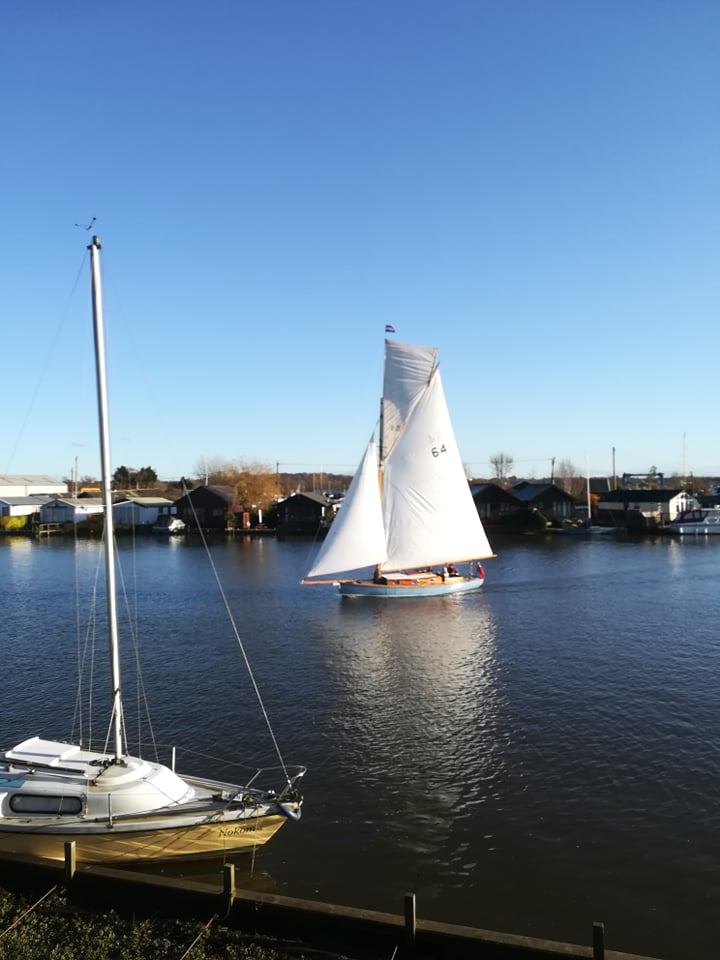
Heading upriver, we were lucky enough to be photographed by a friend, whose currently building a house for his family. The scaffolding made an excellent platform, although if I’m critical – that peak is about 1 or 2 inches ‘out’ by the look of the creases.
I’m struggling to find superlatives to describe the day if I’m honest, it was perfect.
Typical of the season, a North wind with no warmth, a clear sky and a medley of colour in the riverbank, reds, browns, yellow and oranges all competing in the remnants of summer foliage. We sailed every inch of the way, and we knew we’d taken the best of the day for ourselves.
But. I wanted to talk about the starfish.
This links with the subtly of the Broads rivers – and the villages which surround them. There are features worth exploring, and a hidden history. There is a tenuous link to Chumley & Hawke as well…
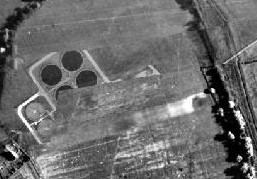
Surlingham has a starfish. Something which shows the far-reach of war, into the boring fields of Norfolk. In truth both Norfolk & Suffolk were riddled with military action during WW2, and you’re never far from it.
Starfish sites were large decoys – developed in WW2 to act as a distraction to enemy bombers. Norwich took a pasting, in what’s known as the Baedeker raids, with the railway station/yard & nearby engineering works of Bolton & Paul being prime targets.
The solution was to create a decoy – which could emulate (from afar) what bomb damage might look like, including fires. The deception went further – it had to look realistic. There was a network of lights rigged, which could replicate the cadence of lit railway carriage passing by at night. Or a red glow to simulate a fire-box door being opened on a railway locomotive.
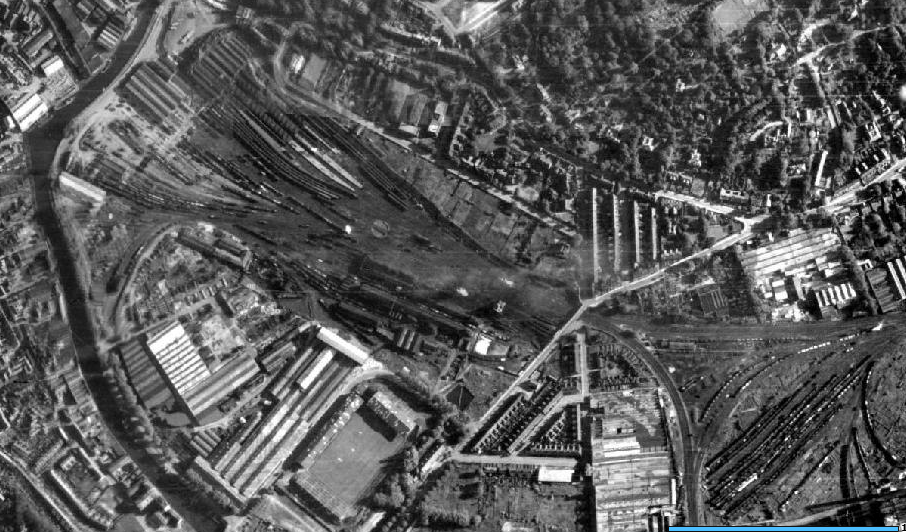
For reference – here’s a 1946 aerial photograph of Norwich railway station;
Norwich Thorpe railway station, including motive power depot, Crown Pint depot, Bolton & Paul engineering works. All very lucrative targets. The River Wensum snakes around the lefthand side of the image.
Interestingly – the 1946 aerial photographs also show the deception required. Outside of Norwich, you can just see a crude attempt at censoring the existence of what is either a fuel installation, or the present-day sewage station at Whitlingham;
Nothing to see here!!!
Surlingham was chosen to host a ‘starfish’. Local firms such as the Rockland Reed & Rush company would supply bundles of reeds to act as ‘wicks’ for the fires – whilst the pyrotechnics were handled through a series of heath robinson-esque contraptions – mixing oil & water to make dramatic explosions.
Interestingly – the knowledge & expertise behind the starfish sites is credited to expertise within the theatric industry – being able to use lights, smoke & explosions to good effect on stage can enable a mimic on a much larger scale.
It’s no exaggeration that these sites were vital. Norwich became so battered and bruised, you would see families walking out on the Drayton & Dereham roads on a nightly basis – preferring to sleep out in the open than risk another night of bombs.
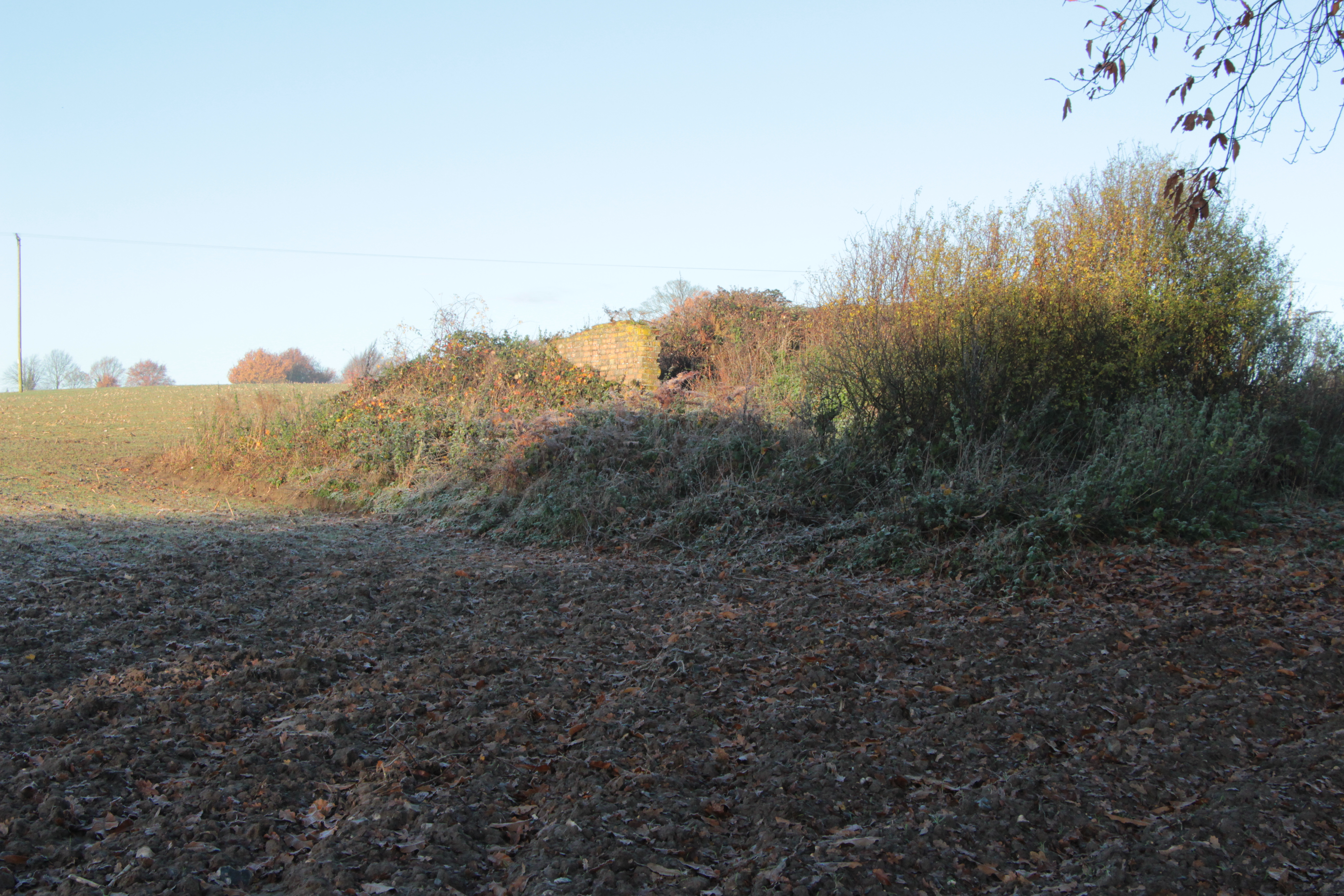
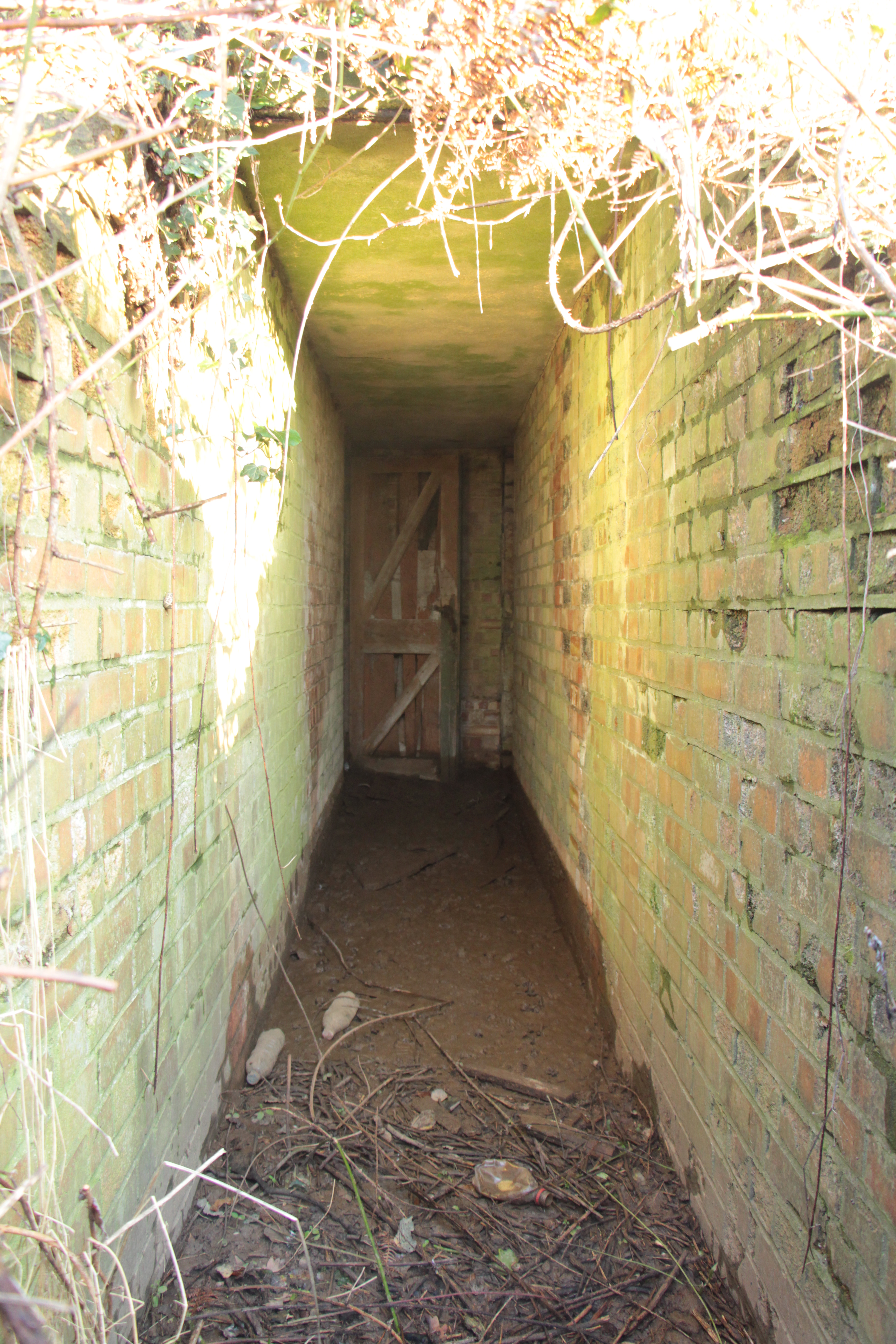
Today – the site of Surlingham’s starfish is much quieter. I stopped by, and knowing where to find the bunker – managed to capture it in its slumber;
Again – the hidden detail, and history of Norfolk’s rivers & surroundings amazes me. You can walk quite easily from Surlingham Ferry, and walk past this 100 times without knowing what it’s about.
I can’t imagine what it would have been like, orchestrating a site like this in the war – knowing it’d lure enemy bombs to drop adjacent to you instead of on an already burning city.
The link between this starfish and ‘Corsair’ is tenuous – but there. It links to Joseph Lejeune – foreman at Chumley & Hawke in the pre-war years, and the heyday of Alfred Lloyd Braithwaite’s design experiments. Lejeune’s & Braithwaite’s most extreme experiment was undoubtedly Khala Nag;
Khala Nag – sometime in the 1930’s, somewhere on the Broads near Horning.
I’m fortunate enough to own that photograph, which is to my knowledge the only extant photograph of Khala Nag – it was part of the treasure trove of ALB’s possessions which I found earlier this year, in Milford on Sea. See here for the highlights of that; https://broadssailing.blog/2019/07/18/on-the-trail-of-a-l-braithwaite/
‘KN’ was a flier. 27ft long, with only 4ft 6” (yes) beam and 3ft 6” draft she carried 2 separate rigs, one for the Broads, one for coastal waters. The extent of his commitment to balance, weight, sails & hullform is evident in this design & build.
Whilst Joseph Lejeune built the yacht, Braithwaite assisted throughout. Notably he weighed and recorded each and every component of ‘KN’. This eventually lead him not only to knowing the exact required weight of the ballast keel, but also how to trim the vessel, so that her centre of gravity could be altered to 1” in advance of the centre of buoyancy, calculated to counteract the weight of any crew. This simple calculation is often overlooked by designers, and pays dividends when sailing.
At the time of the outbreak of WW2 Joseph Lejeune was the foreman at Chumley & Hawke, and unquestionably there must have been a close working partnership between him, and Lt Cdr Braithwaite. They were close in age – and clearly shared a passion for experimenting with the limits of design at that time, to create some unique, and exciting craft.
For example, the noted cost of JL’s time during ‘KN’s’ build was £117, 4s 10d (!) The lead for KN’s keel only cost £7 9s 0d. ALB must have valued his input as a designer.
Sadly, this evidently close partnership wasn’t long lived. Whilst Lt Cdr Braithwaite went back into active service, Joseph Lejeune stayed in Horning.
I know that Alfred Lloyd Braithwaite felt very strongly about returning to active service. His age would have discriminated against him at the outbreak of war, and in fact I notice on the 1939 return there is a note which reads; ‘RNVR in Great War, but refused for present war’. ALB was not to be deterred, and was posted in 1940.
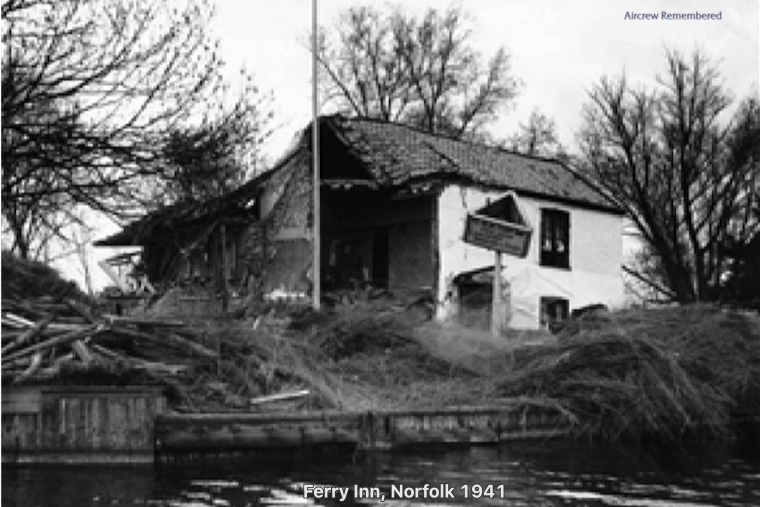
In Horning, during the evening of April 26th 1941, Horning village was subject to a stray bomb attack – which disastrous consequences.
(I actually sit, reading notes I first wrote – April 26th 2016).
It isn’t clear exactly, but it’s likely a Luftwaffe bomber was jettisoning bombs on the way back to the coast. And their attention was sufficiently drawn to drop their remaining payload of 15 bombs around Horning.
I wonder if they were aiming for the ferry itself – which may have been silhouetted. Else perhaps it was a chink of light as someone slipped into the pub?
Whatever the circumstances, the most unfortunate target was the Horning Ferry pub, and amongst the 22 fatalities that night was Joseph Lejeune, aged 50.
The devastation was instantaneous;
The link between Surlingham’s starfish and this, is that sites like that, their flashing lights and theatrical pyrotechnics were desperately trying to stop destruction and loss of life like this. Sadly it’s reckoned that Starfish sites only drew 5% of the intended bombs away from the actual targets.
This accounts for how ‘Corsair’ came to be built post-war by the apprentice at Chumley & Hawke – Tim Whelpton, directed by the then yard foreman Alfred Yaxley.
Anyway – In a roundabout way, I hope I’ve explained another bit of Norfolk’s hidden history, and some more of ‘Corsair’s’ story.
Very opposite sailing at the moment. From sailing fully reefed in a near gale to a flat calm, on a beautiful, crisp day.
Personally – I think it’s worth keeping the boat in until December, Autumn does give some beautiful days, so I resolved to make the topsail work, with a proper spar.
I sailed ‘Corsair’ for the 1st time with her topsail this year, at Cantley Autumn Regatta with the Yare Sailing Club. Here’s a gratuitous photo;
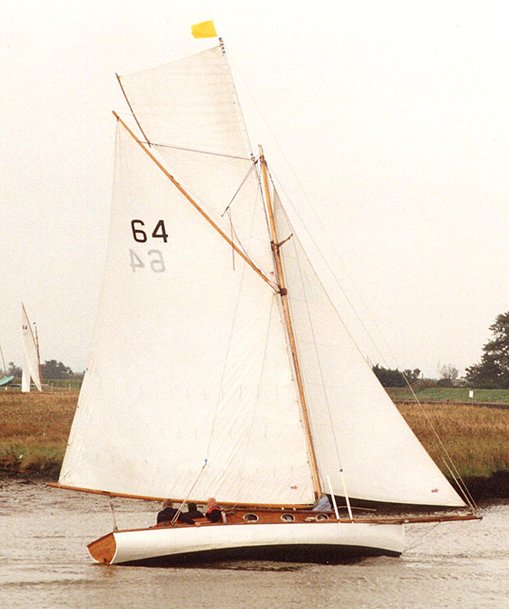
Corsair with topsail.
I’m not going to pretend that’s set well. In face, given that it’s hanging off my quant pole, which is at least a metre too short, the yard is tangled the wrong side of the gaff, and the peak isn’t high enough I’m reasonably surprised we came 3rd in that race!!
Sticking to my principles, the rig should work, and it should look right. So I resolved to make the topsail set properly. I’ve previous experience of jackyard topsails, having spent a lot of my teenage years sailing a topsail rigged halfdecker;
Grace – my halfdecker. Topsail contrived from upside down BOD jib.
Unlike his counterparts though, I am unable to send a man or two afloat to stow the topsail – neither do I have a clue when he advises us to be mindful of “passing the weather earing”.
So – first hoist of the topsail, and it was apparent that the sheeting angle was wrong – with the sheet being too low on the yard. Even worse – on port tack the yard pulled away from the mast, allowing everything to ‘twist’;
I appreciate that topsails & mainsails are two separate sails. However, for the purposes of my simple brain – one is an extension of the other. And a ruddy great gap in the middle of it doesn’t help.
So down it all came again!
Rig adjustments are subtle. The sheet was moved by 3 inches, and an addition line was added, which held the topsail spar close to the mast, and ensured it would be parallel at all points of sail. This is tied loosely to the spar – so it just pulls ‘in’ to the mast, I don’t want it to impact on the downhaul, which you can see is caught up in the topping lift.
So next attempt revealed the sheet was wrong (by 1 inch) and the second halyard (for want of a better name) was also ‘out’ by about 4 inches.
Lowered again… Avoila!
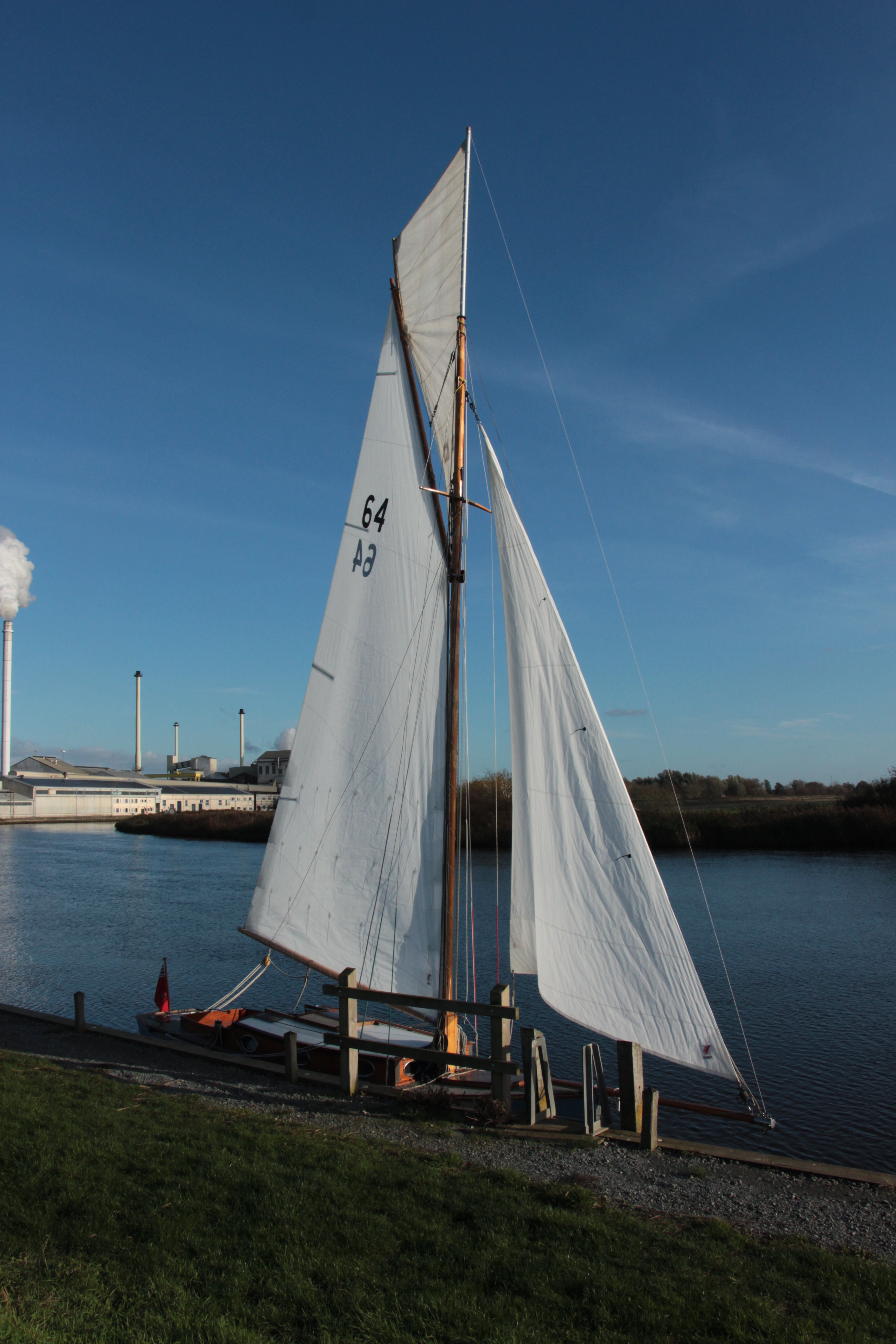
Nicely set.
So, in my book, that’s not bad. Crease diagonally up and down the main from peak to tack. Topsail yard nicely vertical. Load on the jib & the topsail forestay.
Crucially – I’ve marked everything on the spars, and given that I was knee-deep in rope on the forepeak I’ve had some thoughts about extra cleats, and some rope bags to tidy everything.
I’m pleased with this. Just got to test it all over the next few Autumnal Days.
Bliss.
My ambition to have a rig that works well on ‘Corsair’ have been a constant process if I’m honest. During 2009, I made some alterations to the jib, effectively cutting it parallel to the luff, removing approximately 12 inches of sail up its length.
At that time, I had hoped to resolve some issues with occasional lee-helm, and soon reduced the length of the bowsprit to match. From this photo in 2009, you can see that the jib doesn’t quite ‘fit’ the foretriangle;
Small jib – big gap!
To be honest, this set-up worked beautifully for me, at that time. Sailing single-handed I wanted really positive weather-helm. If it all went wrong, I needed to know the boat would luff, and come to a halt.
This was the thinking behind the original hire-boat rig, keep a small jib, so that the boat will automatically luff and stop. Also, for hire-boats any bowsprit would only be a unnecessary damage making implement!
‘Corsair’ has had 4 rigs now throughout her 68 years. She started off a stem-head sloop. First with a self-tacking jib, then a loose footed jib. In 1961 she gained a small bowsprit with the Campbell family, with a larger, high peaked mainsail. In 1989 she gained the ‘large’ topsail rig whilst in the ownership of Joe & Julia(originally cut 1978 for ‘Sabrina’ s/n 71). Joe & Julia actually kept the old sails, and the original bowsprit – enabling them to have either a ‘big’ or a ‘little’ rig.
Finally in 2019 she got her current rig – the 2nd time in her 58 career as a private yacht that she’s received brand new sails, specifically for her!
So, will I keep the rig in its current form? If history repeats itself, she will probably end up carrying this suit of sails for 40 years or so – so who can say?!
I know that for now, the extra string, extra effort and space needed for a topsail is manageable – but I can’t say how I’ll feel about it in 5, 10 years with any accuracy really.
I am glad though, the rig now can be set properly, or as near to as I can get!
Taking a break – and jumbling the chronology of things, I wanted to add a postscript to the postscript. At the end of the 2009 cruise log, I mentioned how unobservant I was with the rivers.
Recently, I was reminded about this, whilst sailing the Yare. It was an Autumnal Day, and rarely – I had the opportunity to put 3 reefs in, set a storm jib and enjoy some proper heavy weather sailing.
I’m not being fool-hardy, it’s worth sailing in heavy weather, you should understand how your boat performs when fully rigged. I know that I’ve sailed ‘Corsair’ with 3 reefs on 3 occasions in 12 years. This was the first time with the new rig.
It was comfortable, and more importantly balanced – you should always match a jib to each reef you take in. ‘Corsair’ has 3 jibs of varying sizes, and as such, the rig always gives you the right power that’s manageable. And, keep it simple and straightforward – be able to manage the rig even on a breezy day.
Also, the remains of a fascinating, hidden Broadland feature are nearby.
I’m sailing past the ghost of a railway. Between 1922 & 1937 – Claxton Manor was occupied by John Samuel Pyke, and in 1926 he built a railway here.
Built on the cheap, it utilised ex WD ‘jubilee’ track, which was effectively a 2ft gauge Hornby train-set. Rolling stock was some tipper wagons, and the cargo… Norfolk Beet!
Each year – local farms produce a tremendous volume of sugar beet, and in the 1920’s, the roads between Claxton & the sugar factory at Cantley were poor, unmetalled – and to travel to Cantley factory you were dependent on Reedham ferry. 7ton limit. A 1920’s lorry would need to make several trips, and you’d pay each way on the ferry.
Not to mention – Beet season is through the winter, so the roads could be relied upon to be muddy (!) making for a slow journey.
Or you can use a wherry – upto 30ton at a time, and can moor directly outside the factory to load & unload.
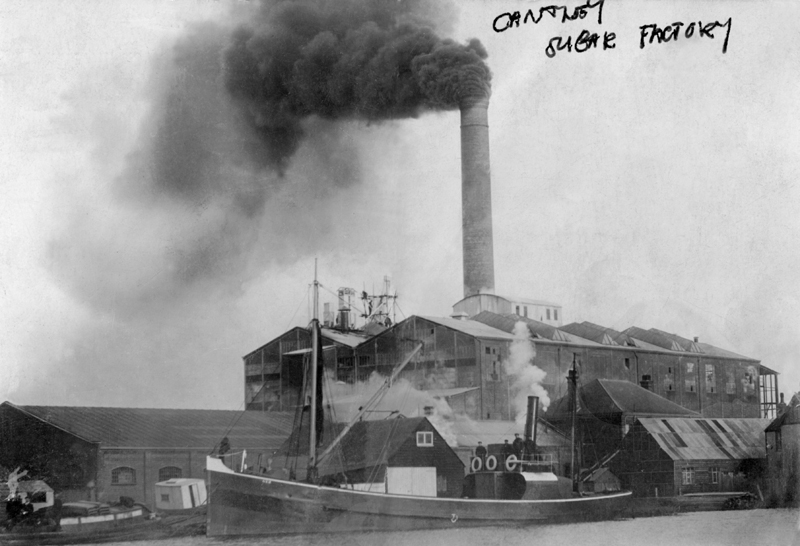
Cantley sugar-beet factory. A wherry is bottom LH corner, just ahead of the handsome steamer. (circa 1913)
In fact, all of this serves as a useful reminder that the Broads were an industrial landscape. Don’t be fooled by the picturesque windpumps, the Dutch came and drained the marshes – the rivers were the transport network.
Anyway – Farmer Pyke’s railway was also used to help construct some reservoirs at Cantley in 1926 – such was its portability, 16ft pre-fab sections can be lifted at will and rerouted.
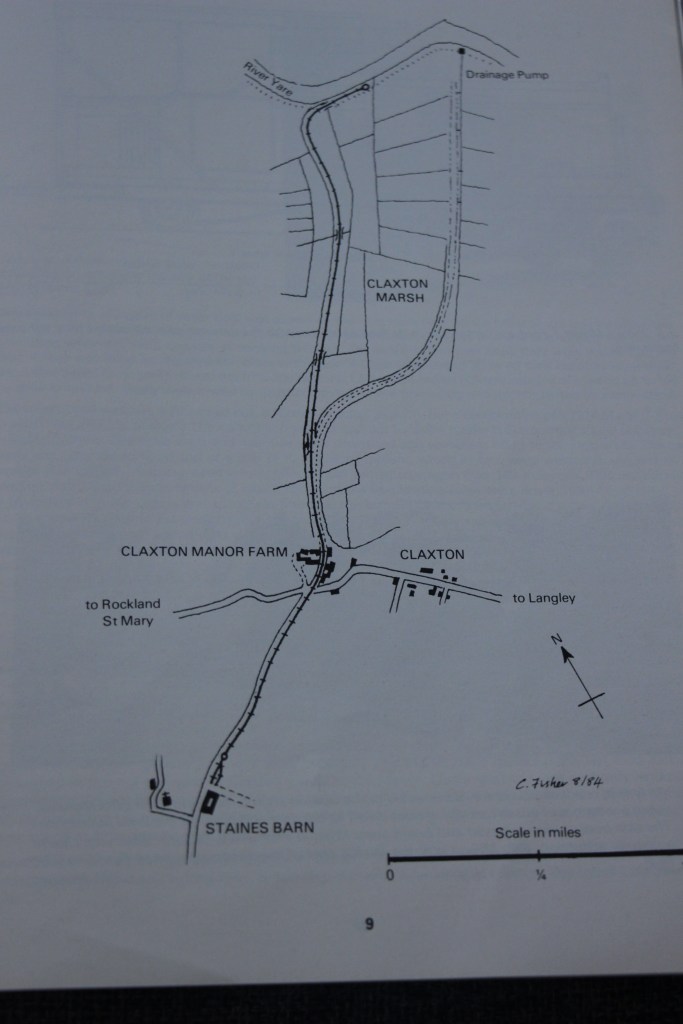
The route can be seen below, running from Staines Barn through Claxton manor farm to the river Yare.
Each train consisted of about 10 tipper wagons, each holding 1/2 ton (or so) of beet. This charming railway was the spirit of Heath Robinson himself!!
Although charming, the railway worked hard. Wherries initially carried 30tons of beet at a time, and by the late 1920’s steel lighters carrying upto 100 tons of beet at a time were used, being towed downstream by steam tug.
Loading certainly was done by hand, on the bankside of the Yare, during winter.
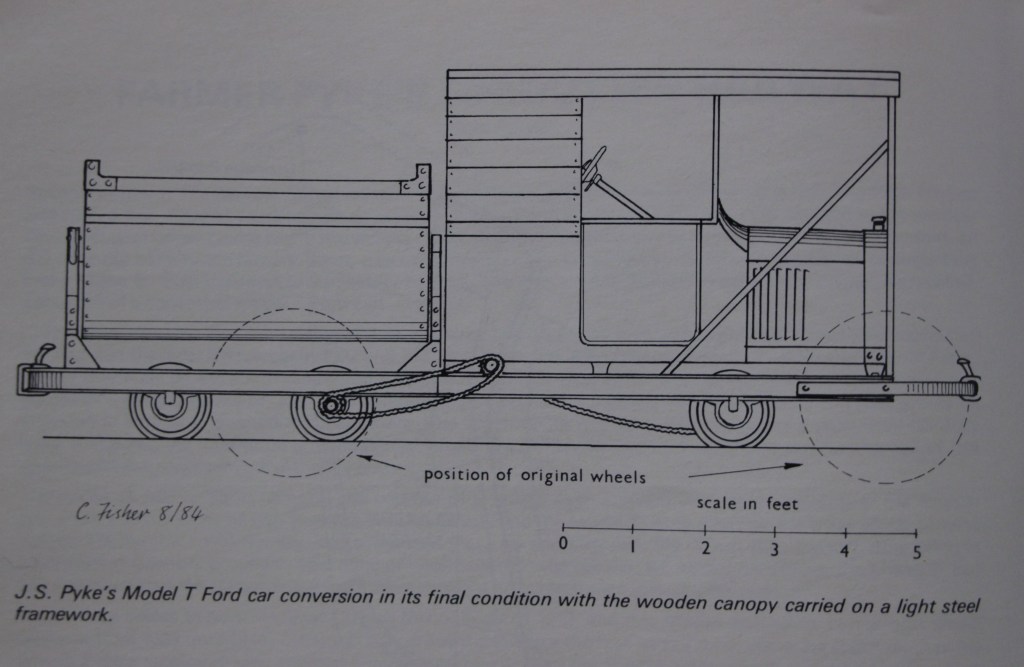
The locomotive was the star of the show. Locally made, it featured a recycled Model T Ford car (yes, really!)
The conversion was undertaken by John Keeler & Sons – agricultural engineers from nearby Thurton. To make a locomotive, you need only take one Model T, the frame of two skip wagon chassis’ & avoila!
For good measure, some sprockets and chains were robbed off a threshing machine and added to the mix.
Now – I won’t lie. I LOVE this. The ingenuity of it, the exposed chain drive to both axles, its all… well it’s excellent! Just imagine the noise!!
The loco is described as being ‘black and sort of rusty’ – with a spare engine being kept in reserve at the farm and readily swapped when overhaul was required.
Sadly – by 1936, despite an extension right upto Staines Barns, it was clear that the improved road network was causing both the wherries and the railway to sweat. Initially to cross the road, a simple solution was to bolt in the track piece across the roadway ‘as & when’…
As the local authority surfaced the road through Claxton – this makeshift crossing was frowned upon. Not to be deterred – the rails were brought VERY close to the edge of the road, and splayed slightly either side.
The entire train, loco & 10 loaded wagons then ‘lumped’ off the track, and drove across the road surface itself before re-railing itself on the opposite side!!
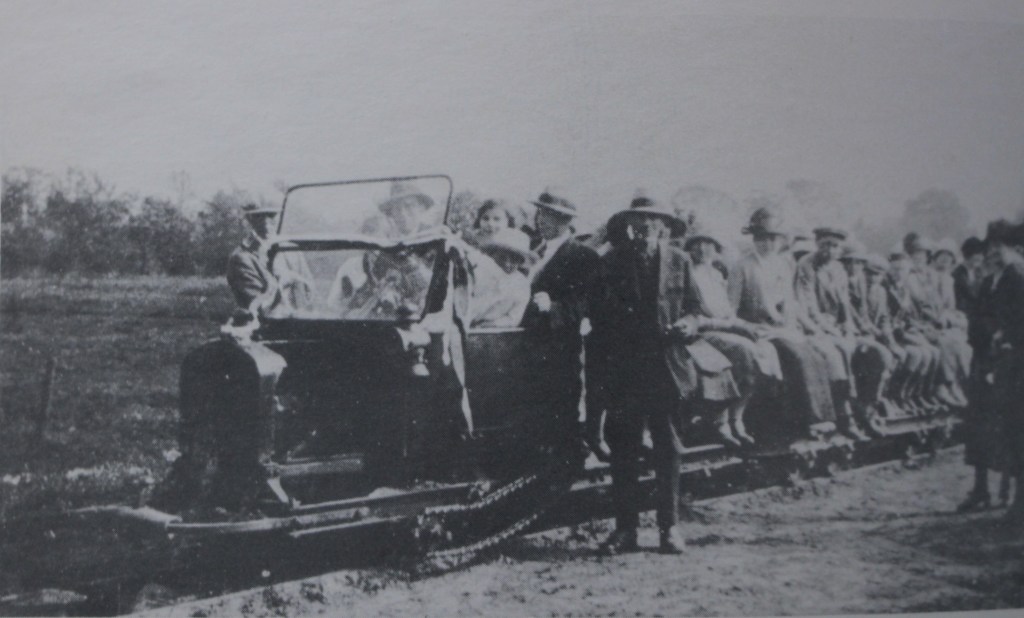
I have only one photograph of the loco working – on a Whit Monday holiday, circa 1928;
Driver Billy Mason at the wheel – circa 1928 with a unusual looking crop of Beet!!
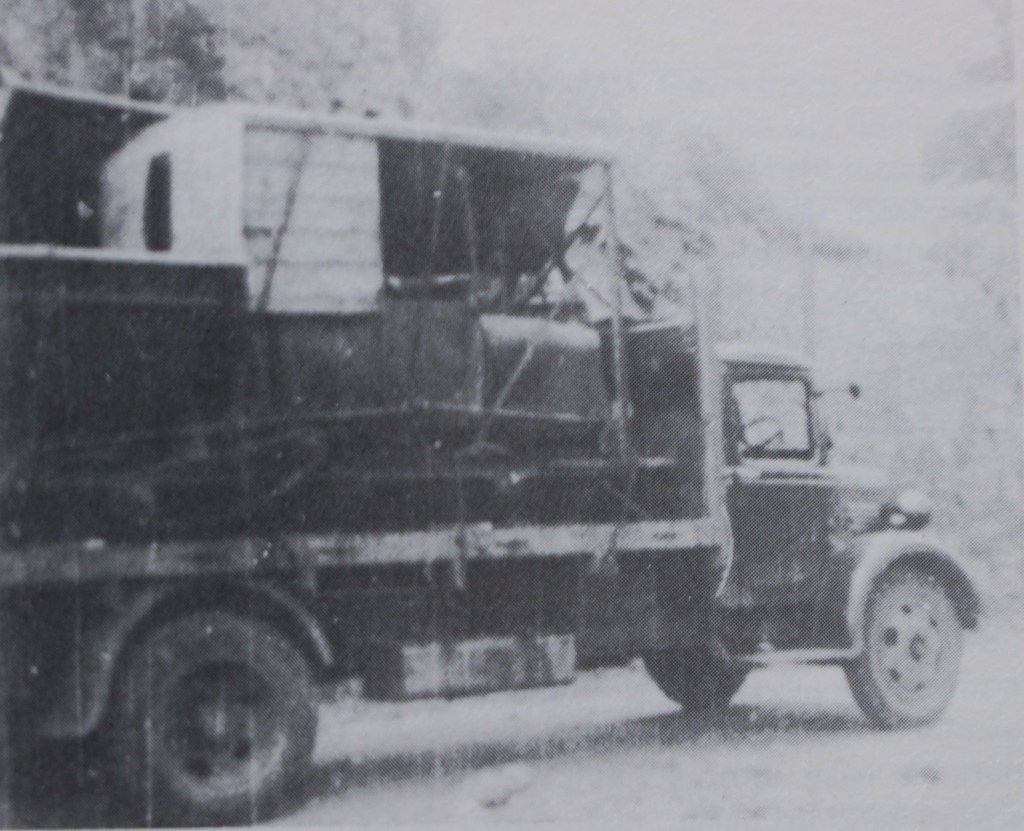
But yes – by 1936, the writing was on the wall. Sadly the railway was no longer needed. Farmer Pyke’s cunning wasn’t done yet. He managed to sell the entire railway to the Ouse Catchment Board, for use in Cambridgeshire.
Quite what they’d do with a ‘sort of black & rusty’ loco I don’t know… (cherish it I hope!)
1936 – final journey for the loco.
In 2005 – I witnessed the conversion of Staines Barns into housing, and saw several lengths of rail removed from the concrete, the last fragments of the line. Today nothing really remains, hence – the forgotten railway.
Anyway – yes. I wanted to write this, as demonstration of my statement about looking and understanding the subtleties of the Broads landscape. What’s hidden away is usually interesting.
I’m lucky enough to love where I live.
Next time, I promise I’ll write more about the boat… (!)
There’s nothing like team-spirit. Or a team in good spirits. Which is what we were, mostly. Chief Engineer Jalil stood a round (or 2), and then became miserable for the entire evening.
The object of his affections, well she didn’t work last night, day off! (We didn’t laugh, not much).
We made an early start, on a typically cold day, fully aware we had a lot of distance to cover to get ‘Corsair’ back home.
‘HB’ arrived, neatly just as we were singled up and ready to leave, and we motored downriver in company. Unusually – the skipper was overcome by a bout of cleaning & I felt the need to clean the underside of the cabin roof (!) So much to the bemusement of my crew, I set to this task with gusto.
A tidy boat is a happy boat!
Whilst moored at Reedham Street – we were engaged in a weird conversation with Vernon the burger van man. He’d learnt of Nulsec’s sinking – and wanted to know the technicalities… he laughed!
Not much can be said of our transit of the lower Yare – the ebb ran and we motored a long stretch without many notable features.
Yarmouth reached, and it proved to be itself (!) I took full advantage of the situation, and having despatched Jalil & Chris B to Asda – I kept a viligant ‘anchor watch’ waiting for slack water.
Ever alert.
Truth be told – were we all tired by this point. I’d lived aboard ‘Corsair’ for 9 days now, having attended a regatta before the cruise. We motored from Yarmouth up the lower Bure.
At Stracey – we did decide to set sail, in frankly what were gusty conditions. This was mostly a cry for help on our part. For much of the Lower Bure Theo had kept us entertained with a theory that all wind-pumps were actually Darleks… (yes, really?!)
He wore us down.
To be fair, the first 2 miles of sailing (tacking obviously!) weren’t too bad. At one stage we even thought we might catch up with the hen-party who’d passed us on a motor cruiser!
However just upriver of Stokesby – we encountered a viscious squall, which after 10 minutes showed no signs of abating… Offering careful explanation “$%&* this” – I swung ‘Corsair’ into the weather bank and we lowered sail.
It was at this point, we learnt HB had lost their dinghy – and would be several hours later coming through Yarmouth. Perhaps sailing was finished!!
We then motored back to Oby quietely, tidying ‘Corsair’ as we went. Shortly before 4pm we arrived, moored and departed. l
Joe
Postscript
The 2009 cruise is 10 years past now. It’s made me smile, writing about it in lots of ways.
We flew by the seats of our pants a fair amount, and drank far, far too much.
Our holiday started with a near-drowning, followed closely by a sinking, several collisions (both with land & other boats), featured some broken ribs, an overall age range from 78 to 20, 5 boats, three rivers, and ALOT of tacking.
There was the full range of human emotion. Rage, anger, irritation, love, infactuation(those poor barmaids) rejection, grief & sometimes even normality!
As a comparison, I look now at the rivers in a very different way, the lower Yare HAS lots of features. You’ve just got to look for them and embrace the subtleties of the Broads landscape.
For example, I know now that the lump of Brambles on the North bank, just upriver from Raven Hall isn’t just Brambles.
It’s the remains of some ancient Lime Kilns, as part of the once extensive Berney Arms settlement. You just have to look, and explore.
Also, why spend a week tacking?! Go the other way for god’s sake…






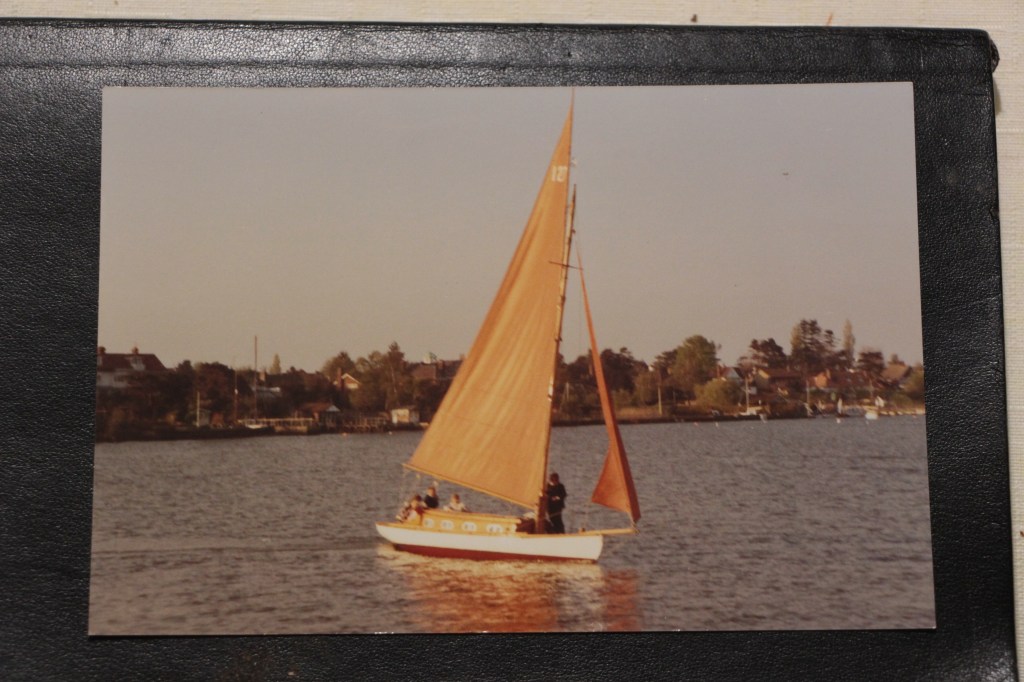
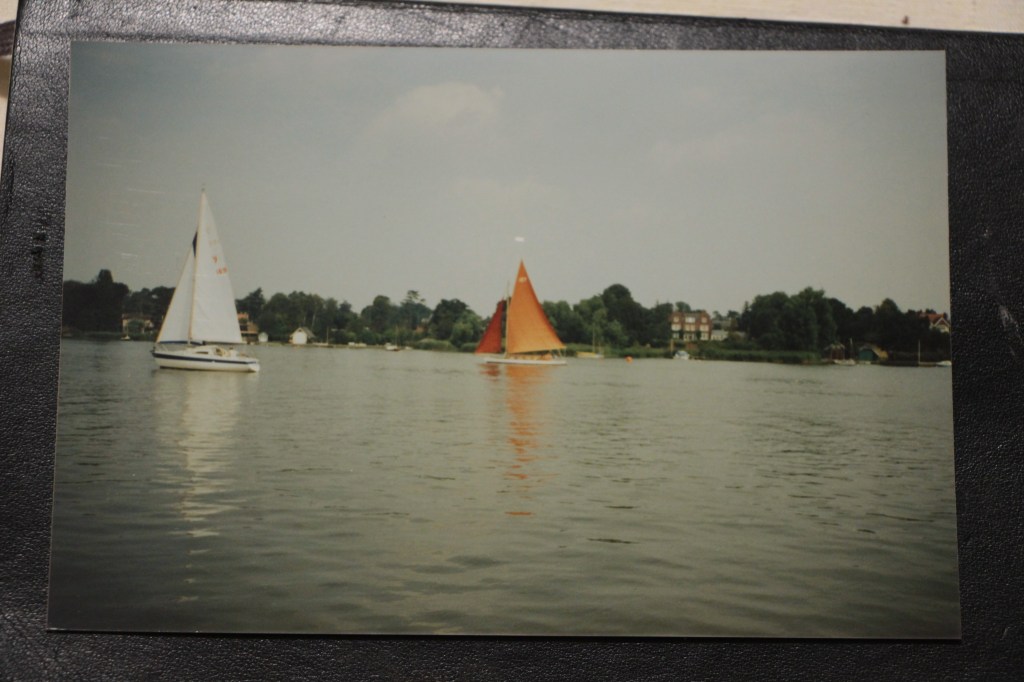
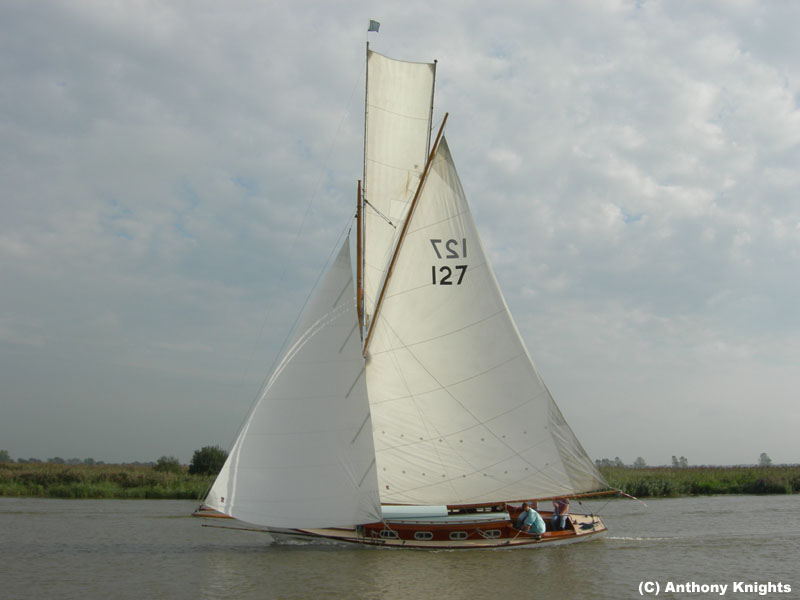
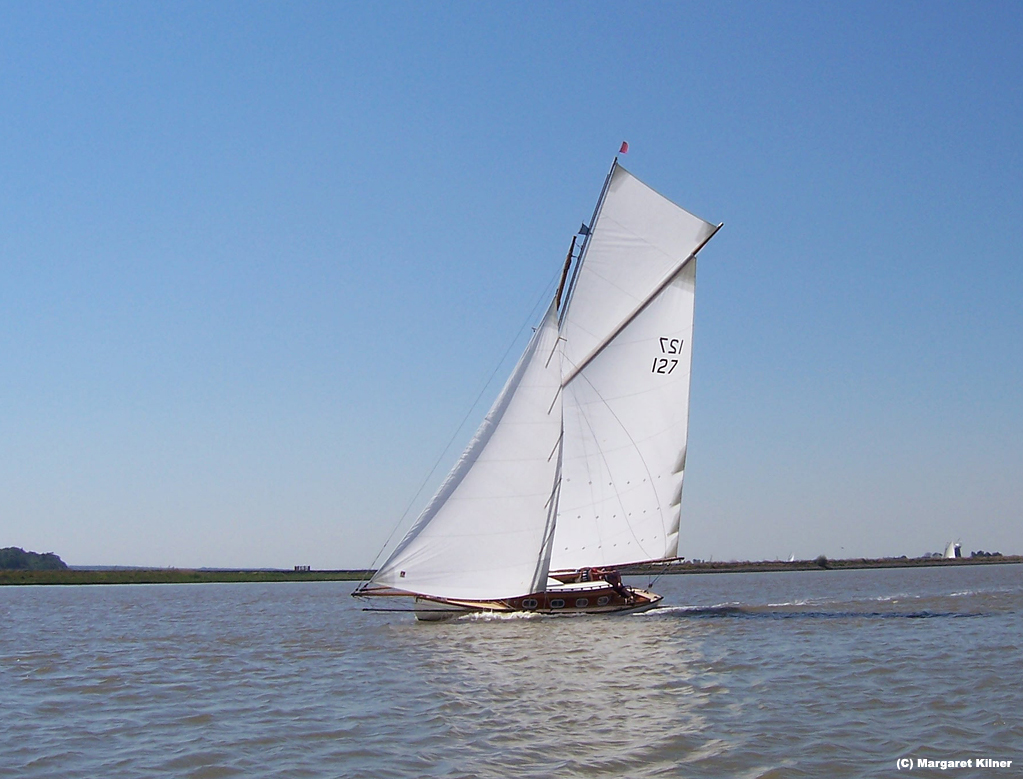

 A Broadsman
