Sorry – I haven’t written for a few days. Not least that I have made a break-through in my research. Think ‘source of the Nile’ moment… I am going to break my rule of writing chronologically – and give you an update. Then I will write fully about what I’ve found later.
But. Back to Chumley & Hawke. Their fleet differed from most hire-fleets, in so much that they were mostly designed properly. This sounds harsh, but its unrelenting honest I’m afraid. Most broads yachts were build ‘by eye’, from half models… And, AND! They were badly built!! It’s easy to look at a river cruiser today, and get misty eyed, but in the ‘heyday’ – these boats were built to do a job, and to be disposable.
Look at ‘Corsair’ – she lasted 10 years in hire, then was sold off as redundant. Now, admittedly her first private ownership was a lavish environment, with all the right elements for a wooden boat. Money, dedication, money, enthusiasm and money. Oh, and Rolls Royce chrome.
Chumley & Hawke was run pre-war by Roland Hawke, and Alfred Lloyd Braithwaite (A.I.N.A.). Braithwaite had bought into the yard in 1930, moving to Horning. His first few designs but the emphasis on sailing qualities, with accommodation coming second. Proof of this, washis ‘Clipper’ class which won the challenge cup for small yachts, Horning 1935.
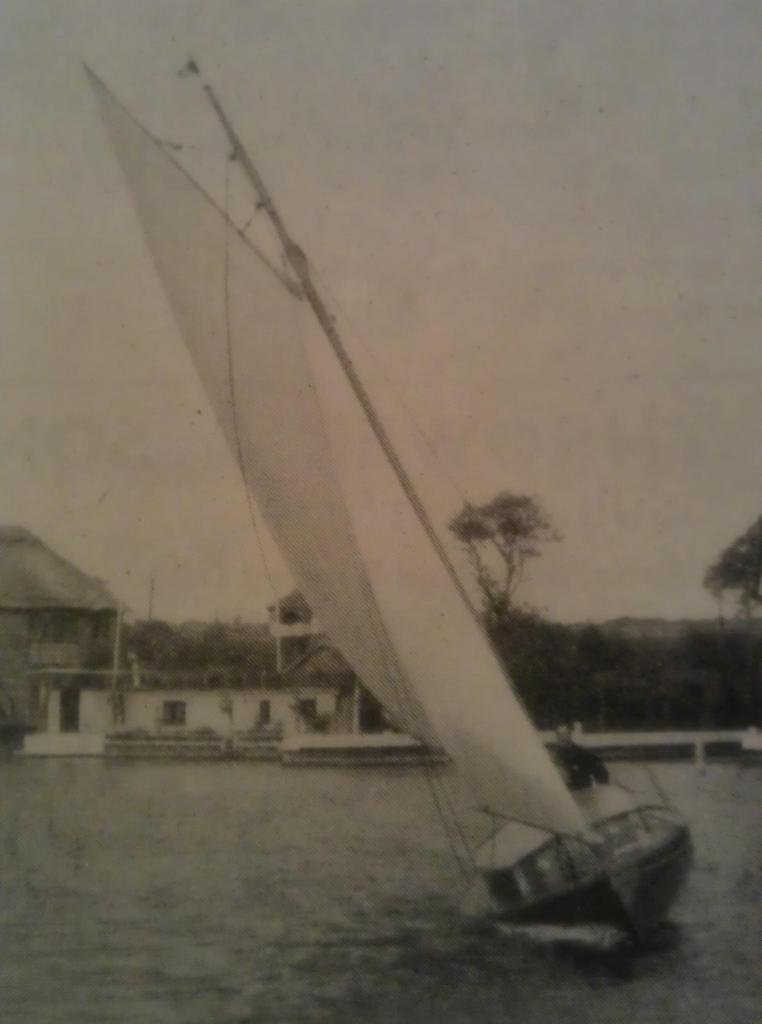
Aside from ‘Khala Nag’ – the best example I can think of this is ‘Viking’, built circa 1937. She is now a beautifully restored member of the River Cruiser class, however originally built as a 26ft halfdecker, and described as;
“Dayboat, mahogany built and designed for those who appreciate a really fine sailing boat, which compares favourably with a half-decker and has the advantage of a low cabin shelter…”
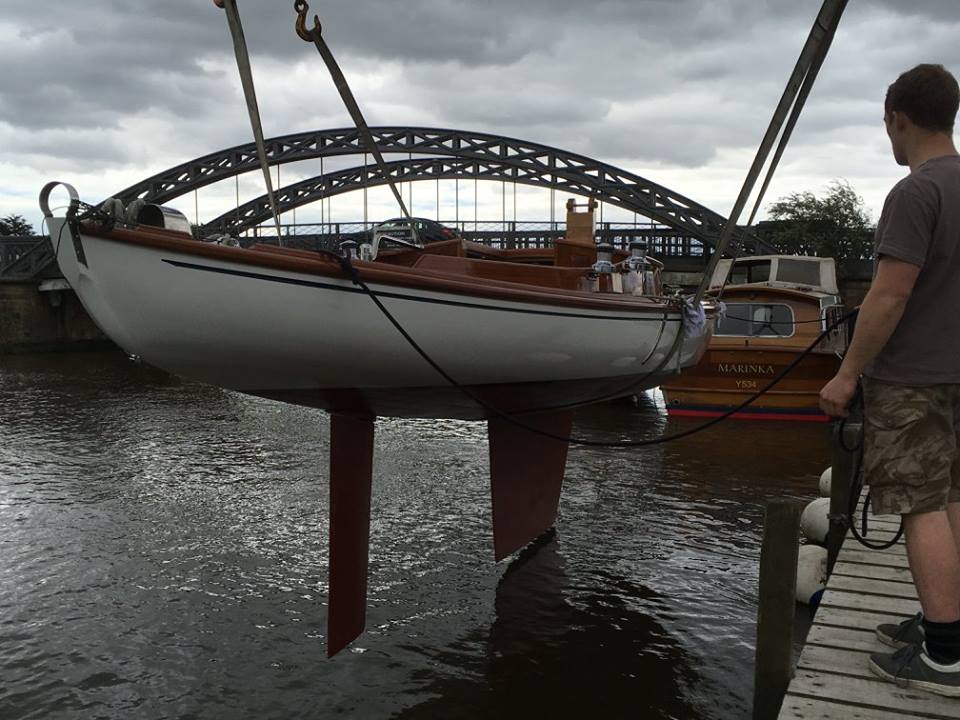
Nowadays, ‘Viking’ is a stunning vessel, having been modified to a canoe stern. Perhaps this is the biggest compliment to a devotee of metacentric hull theory – Viking was ably transformed to a canoe-stern yacht without major disfiguration. Here’s a picture of that indecently pretty hull;
Now, I can hear you ask ‘what’s metacentric hull theory’? No? Well I’ll tell you anyway. It was popular in the 1930’s. Mind you, so were airships and facism. So we’ll tread carefully.
A.L. Braithwaite was a supporter of the ‘metacentric shelf formula’, which aims to achieve good balance and handling under sail. Other notable followers include Harrison Butler.
The theory is based on the principle that as a yacht heels over under sail, the balance of the rig forces and the hydro-dynamics will be influenced by the changes in the immersed form of the hull.
Succinctly, a different shape underwater is presented as she heels and sails. The shape of the hull is defined at each ‘section’, and those different sections exert difference amounts of buoyancy. Aft sections may possibly being more buoyant than forward sections, interestingly the faster boats sit ‘bows down’ without the crew in the cockpit so are level fore/aft when sailing…
Metacentric shelf analysis plots the shifts in the varying buoyancies at each cross section of a boat, and defines a net value to windward or leeward and serves as a guide to achieving equal buoyancy in the dissimilar ends of a design. For a designer, the key is to draw and build a boat which has its greatest cross section area, within a close tolerance of the mid-point in the waterline.
The challenge then is to couple that principle with a hull drawing that decreases its cross sectional surface area in a union manner – both fore & aft of the mid-section. Further refinements can be made by accommodating the weight within a yacht into these calculations during design & build to ensure that the forces of hull buoyancy, rig power & centre of gravity all complement each other.
A.L Braithwaite designed boats which corresponded to this metacentric theory, both ‘Viking’ & ‘Privateer’ being good examples. Theoretically, their hulls change uniformly both fore & aft of the mid-section (usually within a small tolerance +/- 7-10%).
The ultimate test of course, being that a truly 100% metacentric hull should look almost identify from either direction. This has been demonstrated with ‘Viking’
Typically, the application of metacentric formula gives a sweet handling boat that is aesthetically pleasing, and has a good sailing performance without arm-breaking cases of ‘weather helm-shoulder syndrome’(™).
It should also be noted that nowadays, these calculations are done at the click of a mouse button, for Braithwaite to have applied this theory whilst it was relatively uncommon, in limited numbers whilst working in a Horning boatshed for a fleet of hire craft is quite extraordinary.
All Chumley & Hawke yachts have a distinct ‘look’ about them, with low slung cabins and sweet sheerlines. Don’t believe me? Here’s a family album;
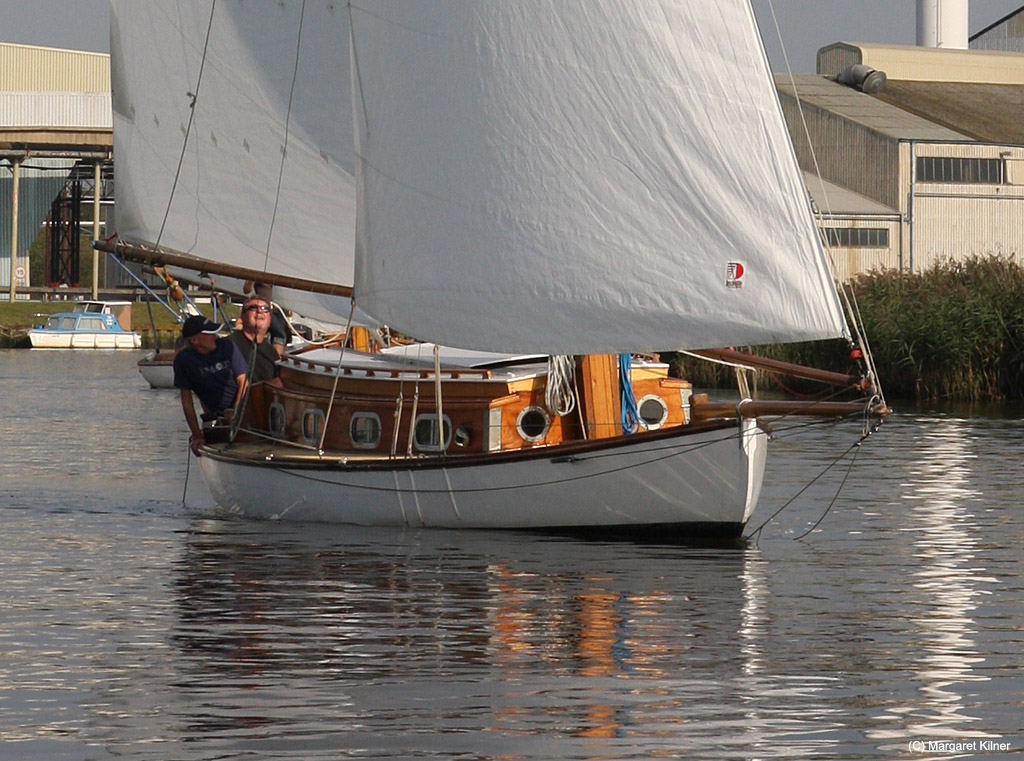
RCC Privateer – photo Margaret Kilner 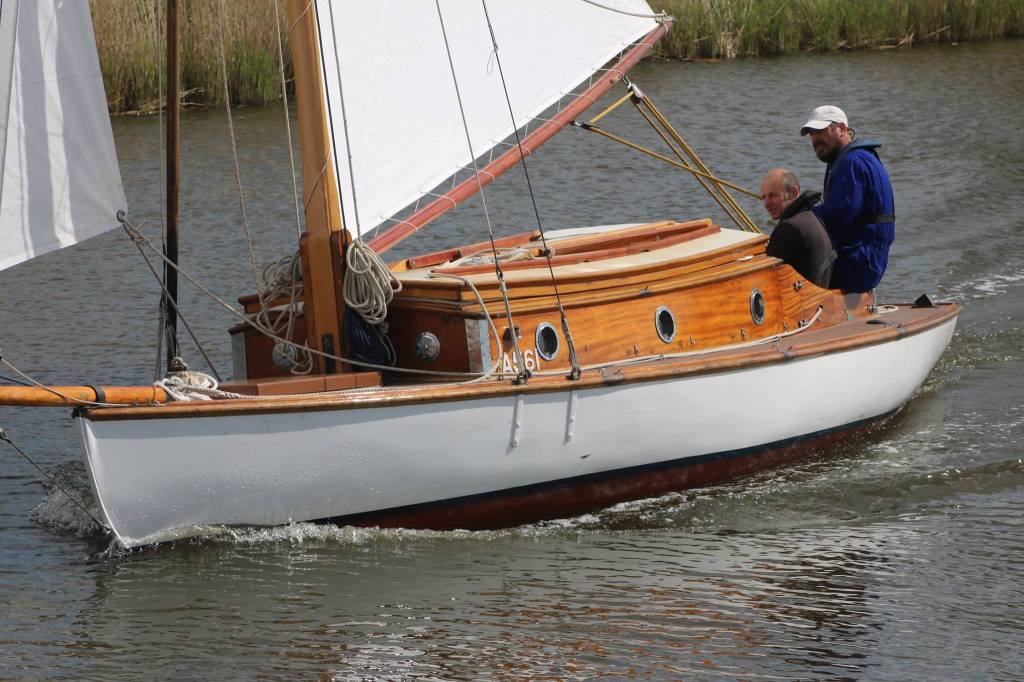
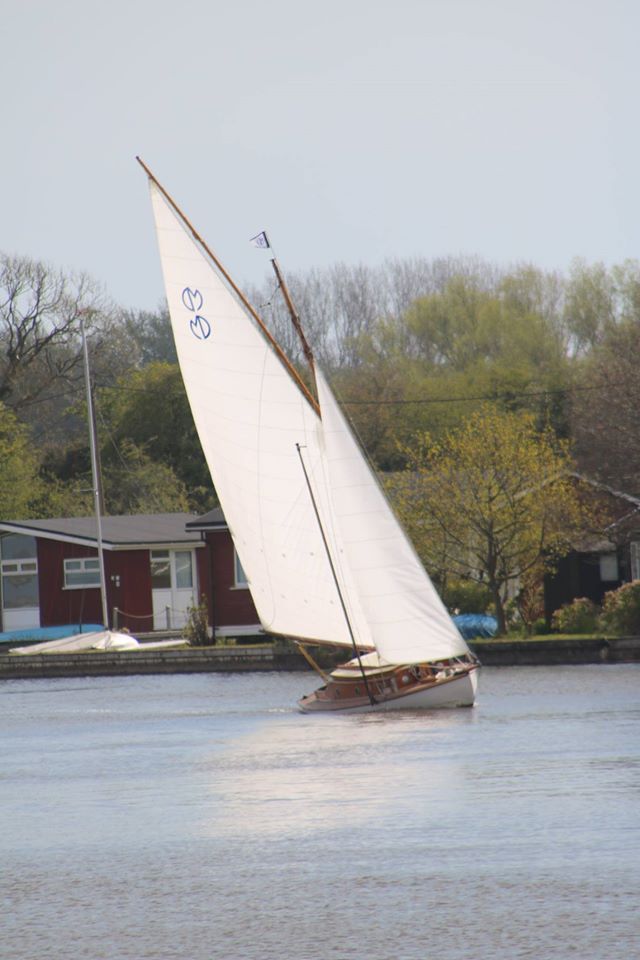
Clipper I 
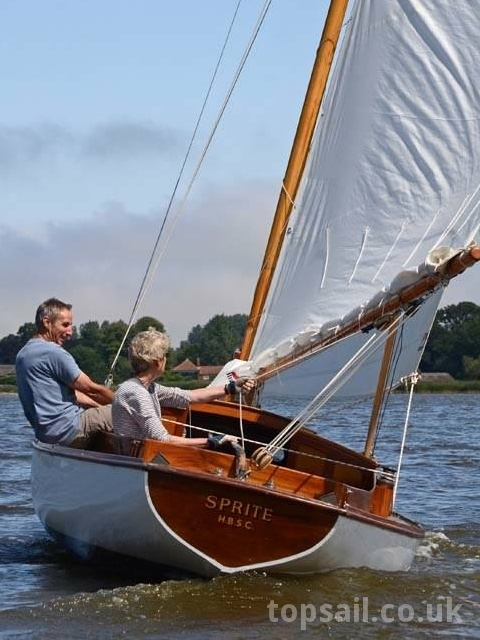
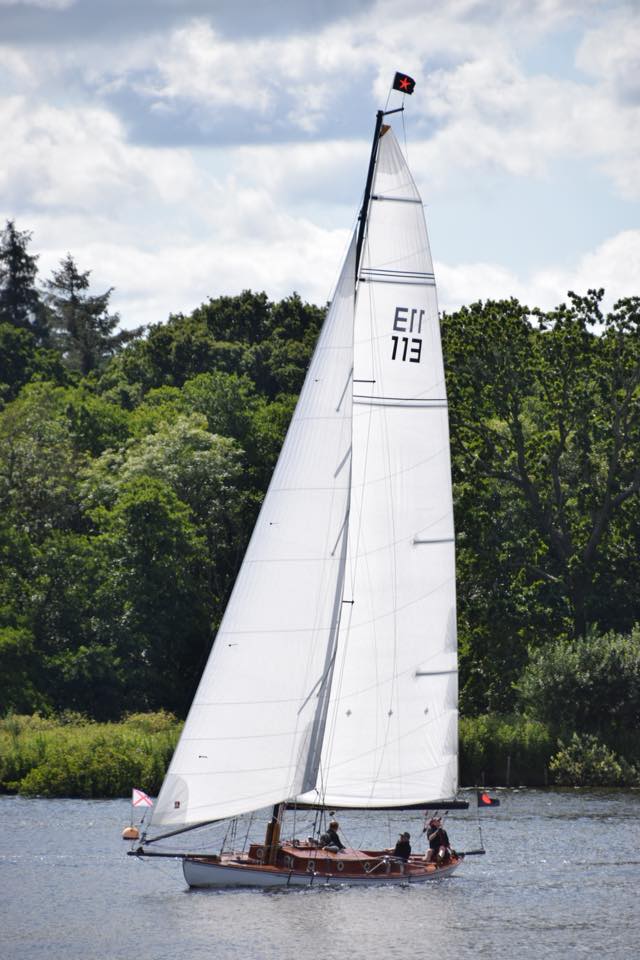
RCC Viking – photo Trish Barnes 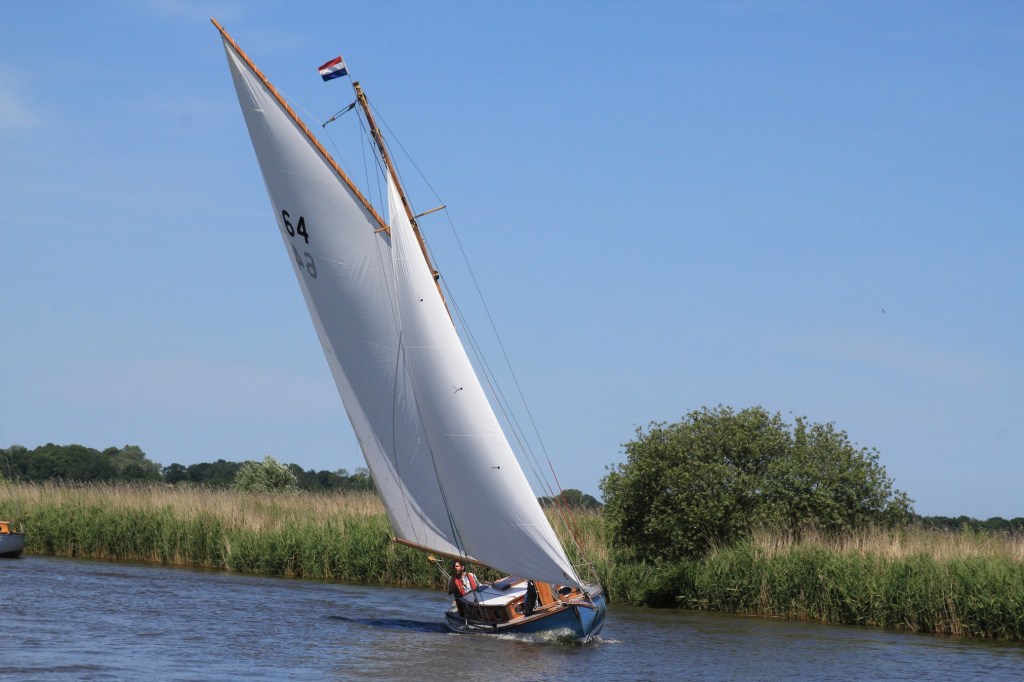
RCC ‘Corsair’ – photo Sue Hines
Finally – the stem repair I made during that first winter.
Having rough-planed the bows quite blunt, I made sure everything was square (ish) before cutting and laminating a series of oak laminates in place. These were screwed and glued, and clamped into place with large baulks of timber helping me bend them right down the hull.
I had no way of knowing if it’d work. I remember cutting the excess off each side, to preserve the ‘scallops’ where the stem is faired into the planking. Judicous use of primer and sandpaper faired it all in nicely.
12 years later, it’s still there, and it’s been not de-laminated or ‘sprung’, so I think I got it right. Evidently my nervous approach was paying off, I hadn’t done anything massively stupid (yet).
During that winter, I also donated the original 1951 short bowsprit to S/N 242 ‘Freedom, who also gained a Clipper mainsail from another. Seemingly I was surrounded by people with old wooden boats, and a perchant to recycling! Or else we were all broke. I know I was.
That winter I often had to choose to walk/cycle to work during the week. I couldn’t afford the diesel to commute AND get to the boatyard at weekends.
Next time I write, I’ll give you an update on why I’ve been so quiet. I promise it’s exciting (to me at least).
 A Broadsman
Very interesting. I own Leander 11 and believe she was built in 1934 by C&H. I have registered her with the RCC with sail number 428.
LikeLike